
How Predictive Models Boost Ad ROAS
AI predictive models find high-intent audiences, auto-adjust bids and budgets, and boost ROAS while cutting manual work.
Predictive models are transforming digital advertising by helping brands achieve higher ROAS (Return on Ad Spend). These AI-driven tools analyze user behavior, such as purchase history and engagement patterns, to predict which audiences are most likely to convert. This allows advertisers to:
Target high-intent users: Focus on audiences ready to make a purchase instead of broad, untargeted groups.
Optimize budgets in real time: Automatically shift ad spend to top-performing campaigns.
Adjust bids dynamically: Increase bids for valuable users while reducing spend on low-intent traffic.
Save time: Automate repetitive tasks like ad creation and budget management by switching from manual to AI-powered management.
Case studies highlight results like a 28% ROAS increase, 145% more purchases, and up to 33 hours of manual work saved in a single month. Tools like Meta's Advantage+ and platforms like AdAmigo.ai simplify this process, making it accessible even to advertisers without technical expertise.
Key takeaway: Predictive models help advertisers spend smarter, reduce waste, and achieve measurable growth in revenue. Use a ROAS calculator to track these improvements accurately.
Predicting LTV To Optimize ROAS With Pecan in Minutes | Pecan AI Platform Demo
How Predictive Models Improve Ad Results
Predictive models use historical data to forecast conversions, enabling real-time adjustments to targeting, budgets, and bids. These systems learn continuously, reallocating resources to strategies that yield better results. The payoff? Higher ROAS with minimal manual input. They also excel at identifying high-intent audiences by leveraging detailed user data.
Finding High-Intent Audiences with Data
Predictive models dive into user behavior - such as site visits, product page views, cart activity, engagement levels, and purchase history - to uncover patterns that indicate buying intent. Machine learning algorithms then segment these audiences, ensuring ads reach users who are actively considering a purchase rather than casting a wide net.
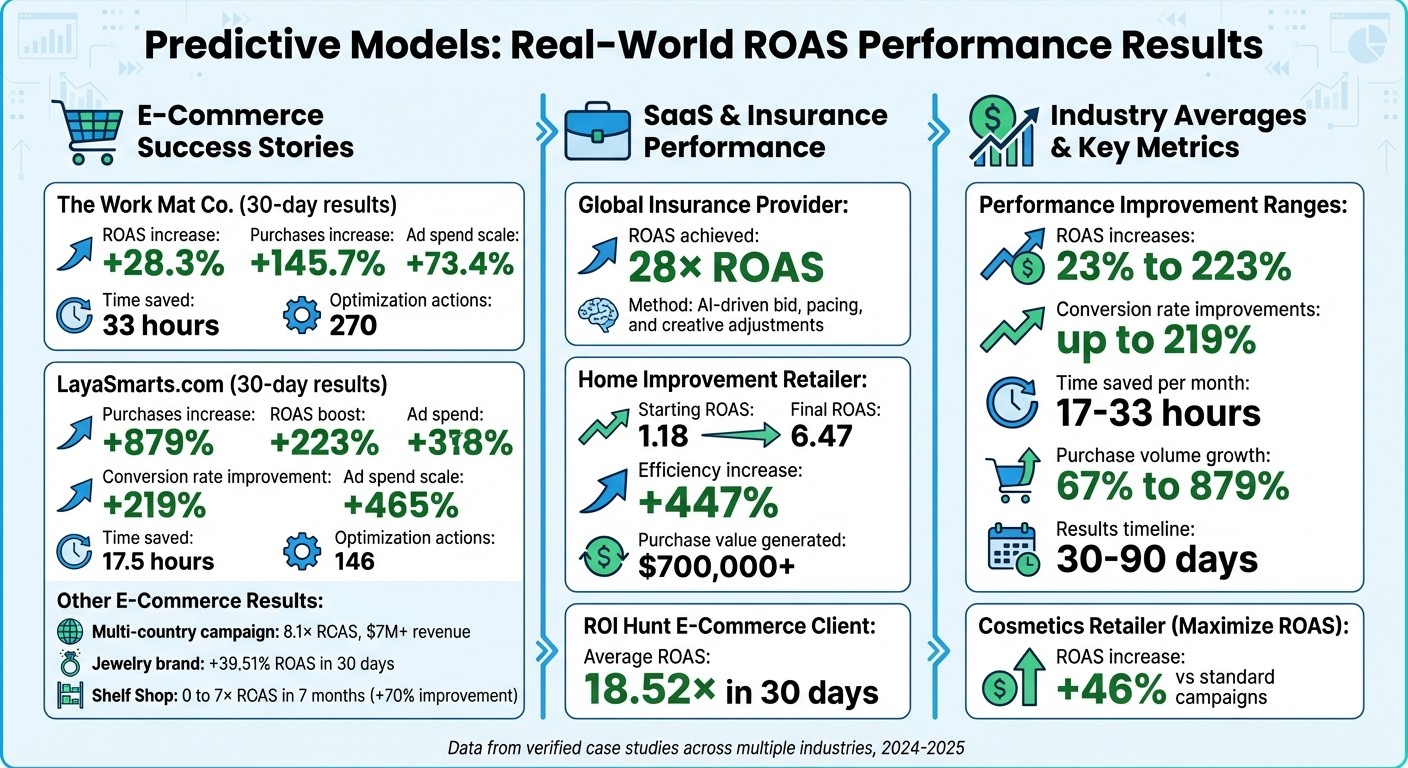
Data quality is key. For these models to perform well, they require robust behavioral signals like website interactions (e.g., page views, cart abandons), demographics, interests, and historical conversion data. Meta's Advantage+ tools, for instance, utilize pixel data and creative insights to predict intent with impressive accuracy. Consider this example: a home improvement retailer partnered with UM Marketing and boosted their Meta Ads ROAS from 1.18 to 6.47 - a 447% efficiency increase. They achieved this by retargeting website visitors and call initiators, refining geo-fencing to focus on users aged 45+, and structuring a 3-phase funnel based on seven touchpoints. This approach generated over $700,000 in purchase value.
Another success story involves ROI Hunt, whose e-commerce client achieved an 18.52× average ROAS in just 30 days. They achieved this by narrowing their targeting using customer behavior and demographic insights, followed by rigorous ad variation testing to find the most effective creatives. These examples highlight how predictive models cut down on wasted spending by focusing on users most likely to convert.
Real-Time Budget Distribution
After identifying high-intent audiences, predictive models monitor live metrics - like conversions and ROAS - to scale and adjust budgets dynamically. Instead of relying on static allocations or gut instinct, these systems use historical trends, market demand, and real-time performance to determine where funds will deliver the best results. Budgets automatically flow to top-performing campaigns.
Strike Social demonstrated this with a global insurance provider, achieving 28× ROAS through AI-driven adjustments to bids, pacing, and creatives. The system tackled audience fatigue by reallocating spend to high-performing ad sets, leading to better impression delivery and more qualified traffic. Similarly, another Meta ads campaign reached 10.94× ROAS by continuously optimizing budget allocation based on predictive insights.
This automated approach not only prevents wasted ad spend but also accelerates the success of winning campaigns. For brands juggling multiple campaigns, these models can even recommend budget splits across platforms like Meta and Google, ensuring maximum returns across all channels.
Automated Bid Adjustments
Smart bidding algorithms take predictive data - user intent, auction dynamics, and conversion probabilities - and adjust bids on the fly. They increase bids for high-value users likely to convert and scale them back for low-intent traffic, ensuring that ROAS is maximized without overspending. Meta’s Advantage+ integrates AI to respond to real-time signals like creative performance and audience behavior.
Meta’s "Maximize ROAS" optimization reframes priorities, focusing on return per dollar spent rather than just total conversion value. For example, a cosmetics retailer targeting first-time customers saw a 46% increase in ROAS by using this goal compared to standard new-customer campaigns. The system fine-tuned bids automatically, prioritizing users most likely to deliver profitable conversions.
When combined with real-time budget adjustments and precise audience targeting, automated bidding creates a seamless optimization loop. This system continuously refines itself, boosting performance and cutting CPA with AI without the need for constant manual oversight. Together, these strategies form the foundation for the exceptional results discussed in the next section.
Case Studies and Performance Data
Predictive Models Ad ROAS Performance Results Across Industries
Data from various industries shows how predictive models can lead to measurable ROAS optimization results. These models are helping e-commerce businesses grow revenue efficiently, cutting acquisition costs for SaaS companies, and delivering results that improve over time. Let’s dive into some specific examples to see these outcomes in action.
E-Commerce Results
E-commerce brands are achieving impressive ROAS growth. Take The Work Mat Co., for example. Between February 12, 2025, and March 12, 2025, this brand switched from a traditional agency to AdAmigo.ai's autonomous AI system. Despite co-founder Rochelle Dallas having no prior experience in media buying, the results were striking: a 28.3% ROAS increase, a 145.7% jump in purchases, and a 73.4% scale in ad spend. The AI system handled 270 optimization actions, saving the team about 33 hours of manual work.
"Our budgets are controlled, our spend is being smartly allocated and our ROAS is up massively. Agencies charging 7x the cost of AdAmigo have been put to shame."
– Rochelle Dallas, Founder, The Work Mat Co.
Another example is LayaSmarts.com, a fashion brand based in India. Using predictive AI, they built their Meta ad campaigns from scratch between December 14, 2024, and January 14, 2025. The results? An 879% increase in purchases, a 223% boost in ROAS, and a 219% improvement in conversion rates. Ad spend scaled by 465%, while the system executed 146 optimization actions, saving the founder 17.5 hours in the first month alone.
Other case studies back up these trends. An e-commerce campaign spanning the USA, Pakistan, Ireland, and Kuwait achieved 8.1× ROAS, generating over $7 million in revenue. A jewelry brand using catalog ads and Advantage+ saw a 39.51% ROAS boost in just 30 days. Similarly, Shelf Shop grew from zero to 7× ROAS in seven months, with a 70% improvement through pixel-based campaigns.
E-commerce isn’t the only sector seeing these benefits - SaaS companies are also leveraging predictive models to great effect.
SaaS Company Performance
SaaS businesses are using predictive models to improve lead quality and reduce acquisition costs. By analyzing behavioral data to pinpoint high-intent users, reallocating budgets dynamically, and automating bids, these models optimize ad spend with precision. For instance, a global insurance provider achieved a staggering 28× ROAS by fine-tuning bids, pacing, and creative strategies using AI. While specific SaaS metrics are less frequently documented than e-commerce, the principles driving these results remain consistent.
Average Performance Improvements by Industry
Across different industries, brands report ROAS increases ranging from 23% to 223%, with conversion rates improving by up to 219%. These systems also save anywhere from 17 to 33 hours per month on campaign management. E-commerce brands typically see these results within the first 30 to 90 days, with purchase volumes climbing between 67% and 879%. AdAmigo.ai even guarantees a 30% performance improvement within the first 30 days, showcasing the growing reliability of predictive models.
What’s more, these benefits don’t stop after the initial boost. Over time, as systems gather more data, they refine their predictions and optimizations, driving even greater efficiency and performance gains. The consistent, measurable improvements highlight the transformative potential of real-time optimizations powered by predictive models. These gains are often driven by leveraging real-time data to automate bidding and budget adjustments.
How to Use Predictive Models on Meta Ads
You don’t need to be a data scientist to incorporate predictive models into your Meta ad campaigns. Meta provides built-in tools that simplify the process, and third-party platforms can take automation to the next level. Let’s break down what you need to know about using these models effectively.
Meta's Built-In Tools: Advantage+ and Predictive Audiences
Meta’s built-in tools, such as Advantage+ Shopping Campaigns and Advantage+ Audience, use machine learning to predict which users are most likely to take action. These tools analyze data like user behavior, purchase history, and engagement signals to pinpoint high-intent prospects - saving you the hassle of manually defining audience segments.
Here’s how it works: when you create a new campaign in Ads Manager and choose the Advantage+ Shopping option, Meta’s algorithm tests various audience combinations, placements, and creative elements to find what delivers the best results. It even adjusts bids in real time, reallocating your budget to focus on users with the highest likelihood of conversion.
Lookalike Audiences are another powerful option. By uploading a customer list or using Pixel data, you can create audiences that closely resemble your best customers. For the closest match, start with a 1% lookalike audience. As you scale, you can expand to 2–5%, allowing Meta’s algorithm to identify shared traits and behaviors among potential new customers.
Data Requirements for Predictive Models
For predictive models to perform well, you need high-quality data. At a minimum, ensure you have the Meta Pixel installed on your website and the Conversions API (CAPI) set up. CAPI allows Meta to track server-side events, bypassing browser restrictions and ad blockers to provide complete conversion data.
Your Pixel should track critical events like page views, add-to-cart actions, checkouts, and purchases. Meta suggests aiming for at least 50 conversions per week per ad set to give the algorithm enough data to optimize effectively.
Another key factor is Event Match Quality (EMQ). The more accurate and detailed your input data - like email addresses, phone numbers, and zip codes - the better Meta can attribute conversions to specific users. This not only improves attribution but also enhances the training of predictive models.
You can further refine targeting by using first-party data from your CRM or email list. Uploading customer lists to create Custom Audiences and Lookalikes from high-value segments will make Meta’s predictions even more precise.
When you’ve pushed Meta’s native tools to their limits, third-party platforms can help you optimize even further.
Third-Party Platforms for Better Results
Platforms like AdAmigo.ai take Meta’s capabilities to the next level, offering fully automated optimization. These systems manage everything - from generating creatives to reallocating budgets and adjusting bids - without requiring manual input.
Case studies highlight the impact of these platforms. Users reported a 28.3% increase in ROAS, a 145.7% rise in purchases, and a 73.4% boost in ad spend, while saving about 33 hours of manual work.
Feature | Meta Advantage+ | AdAmigo.ai | Traditional Rule-Based Tools |
|---|---|---|---|
CPA Reduction | Moderate improvement | Significant (up to 30% lift) | Limited |
ROAS Improvement | Noticeable gains | Substantial (up to 83%) | Modest |
Creative Generation | Uses existing creative variations | Automatically generates new creatives | Manual only |
Automation Level | Basic | Full autonomous optimization | Rule-based adjustments |
Learning Capability | Standard machine learning | Continuous learning and adaptation | None |
What sets AdAmigo.ai apart is its ability to handle the entire optimization cycle. It audits your account, identifies opportunities, and makes improvements automatically. You can also review and approve changes before they’re implemented. Its AI Chat Agent even allows you to launch campaigns or make adjustments using simple text or voice commands.
"The fact that you can launch campaigns through text or voice commands feels like magic! It handles everything from creating lookalike audiences to adjusting budgets." – Jakob K., Verified User
Getting started is quick: connect your Meta account, set your KPIs, and define goals like “Scale spend 30% at ≥3× ROAS.” The platform provides a daily list of recommended actions - new campaigns, audience tests, budget adjustments, and fresh creatives - that you can approve, edit, or automate entirely. Unlike Meta’s tools, which operate within fixed parameters, AdAmigo.ai continuously learns and adapts based on real-world results, driving better performance over time.
What's Next for Predictive Models in Advertising
Predictive models in advertising are evolving rapidly. The focus is shifting toward autonomous systems capable of managing entire campaigns - from crafting creatives to adjusting bids - without requiring constant human involvement. These systems analyze machine learning performance metrics and adapt strategies on the fly, making them more dynamic and efficient.
AI Systems That Run Campaigns Automatically
The move from manual campaign management to fully automated AI systems is gaining momentum. Tools like AdAmigo.ai are leading the charge, handling everything from automating creative production to AI audience segmentation vs manual targeting, budget adjustments, and bid optimization - all around the clock. For instance, between February 12 and March 12, 2025, premium brand The Work Mat Co. switched from a traditional paid media agency to AdAmigo.ai's AI Recommendation Agent. The results? The system executed 270 actions in just 30 days, leading to a 145.7% increase in purchases, a 28.3% boost in ROAS, and saving 33 hours of manual labor.
What makes these systems stand out is their ability to learn continuously. Unlike older, rule-based tools that require frequent manual updates, AI-driven platforms like AdAmigo.ai analyze real-time data and refine their strategies accordingly. They can quickly identify winning creatives, optimize targeting, and operate either autonomously or with approval workflows tailored to your preferences.
These platforms not only streamline campaign optimization but also enable businesses to scale their operations effortlessly.
Managing More Campaigns Without More Work
One of the biggest challenges in advertising has always been scaling campaigns without increasing complexity. AI-driven platforms are solving this by allowing agencies to manage 4–8× more clients with the same team size. The AI takes care of daily adjustments, freeing up media buyers to focus on higher-level strategy. For example, brands like Dyut.eu have demonstrated how AI tools allow agencies to juggle multiple campaigns without adding extra overhead.
For in-house marketing teams, this means replacing the need for additional hires with an AI that works 24/7 and grows smarter over time. Companies using AI for campaign automation have reported similar successes, highlighting the efficiency and cost-effectiveness of these systems.
This ability to scale without added complexity naturally leads to better performance over time.
Performance That Improves Over Time
As predictive models process more data, their strategies become increasingly refined. Platforms like Meta already predict lifetime value and adjust bids accordingly, but tools like AdAmigo.ai take it a step further. By analyzing data across creatives, audiences, and budgets, these systems can forecast outcomes more accurately, find high-intent users faster, and personalize ads with unmatched precision.
"The AI recommendations go beyond simply suggesting actions; they provide valuable insights and justifications. This not only improves my results but also deepens my understanding of campaign optimization." – Shubham, Co-Founder, Dyut.eu
Looking ahead, trends point toward AI-powered dynamic creatives that adapt in real time to user behavior, demand forecasting driven by social trends, and cross-platform ROAS analysis that reallocates budgets automatically. The future of advertising isn't just about targeting - it’s about systems that can anticipate and react to market shifts before you even realize they’ve happened.
Conclusion
Predictive models are now at the heart of Meta ads, delivering results that manual targeting simply can't compete with. By analyzing behavioral signals like browsing habits and purchase history, these systems pinpoint high-intent audiences with incredible accuracy. The numbers speak for themselves: e-commerce brands report a 25–35% boost in ROAS, SaaS companies see 30–50% increases in trial conversions, and advertisers across industries experience 20–30% higher ROI compared to older methods. On top of that, manual vs. AI budget allocation and automated bid adjustments help cut customer acquisition costs by 15–45%. Clearly, these models are reshaping ad performance and proving their value in scalable, hands-off campaign management.
Case studies from industries like fashion and home improvement further highlight substantial improvements in ROAS and efficiency. Tools like AdAmigo.ai showcase how these systems not only optimize campaigns but also grow smarter over time as they gather more data.
"Our budgets are controlled, our spend is being smartly allocated and our ROAS is up massively." – Rochelle Dallas, Founder, The Work Mat Co.
The beauty of these systems lies in their ability to compound results. With every data point they process, they become better at refining targeting, anticipating demand shifts, and optimizing budgets, creatives, and bids as a unified system. For agencies juggling multiple clients or in-house teams managing heavy workloads, this means running 4–8× more campaigns without increasing staff. The future isn't just about targeting better - it's about leveraging systems that continuously learn and improve, freeing up time to focus on strategy. Using an AI Media Buyer allows teams to automate these complex workflows seamlessly. Manual management simply can't match the opportunities these models unlock.
FAQs
How much data do I need before predictive models work well?
Predictive models thrive on having plenty of historical data about audience behavior, ad performance, and conversions. This data helps them pinpoint high-value prospects and boost your return on ad spend (ROAS). Simply put, the better and more relevant your data, the more effectively these models can fine-tune your campaign performance.
Will automated bidding and budgeting hurt my CPA or spend control?
AI-powered tools can refine your Cost Per Acquisition (CPA) and improve budget management. These tools work by adjusting bids, budgets, and audience targeting in real time. The result? Less overspending and smarter budget allocation toward campaigns that perform well.
Studies and real-world examples back this up, showing that automated systems not only help maintain cost control but also boost Return on Ad Spend (ROAS). In short, automation streamlines processes, ensuring efficiency while keeping financial objectives on track.
What should I set up first - Meta Pixel, Conversions API, or Advantage+?
To get started, set up the Meta Pixel. This tool tracks what users do on your website, making it crucial for targeting audiences and keeping tabs on conversions. Next, integrate the Conversions API. This allows you to send data straight from your server, which helps maintain accurate tracking even with increasing privacy restrictions. With these in place, you can leverage Advantage+, which automates ad optimization for better performance.