
Common Ad Anomalies AI Detects
Learn how AI detects point, contextual, and collective ad anomalies in Meta campaigns to reduce wasted spend and improve campaign performance.
Ad performance can shift without warning, leading to expensive Facebook ads mistakes and poor results. Sudden drops in click-through rates (CTR), spikes in cost-per-click (CPC), or a decline in return on ad spend (ROAS) can indicate serious issues like invalid traffic, ad fatigue, or targeting issues. These problems often go unnoticed until they’ve already caused damage.
AI tools, like AdAmigo.ai, solve this by monitoring ad campaigns in real time. This involves tracking key metrics to catch performance shifts instantly. They detect three main types of anomalies:
Point anomalies: One-time metric spikes or drops (e.g., CTR suddenly drops 40%, often requiring you to test new creatives).
Contextual anomalies: Unusual behavior under specific conditions (e.g., high ad spend at odd hours).
Collective anomalies: Patterns across multiple data points (e.g., all retargeting ads underperforming).
Types of Ad Anomalies AI Can Detect
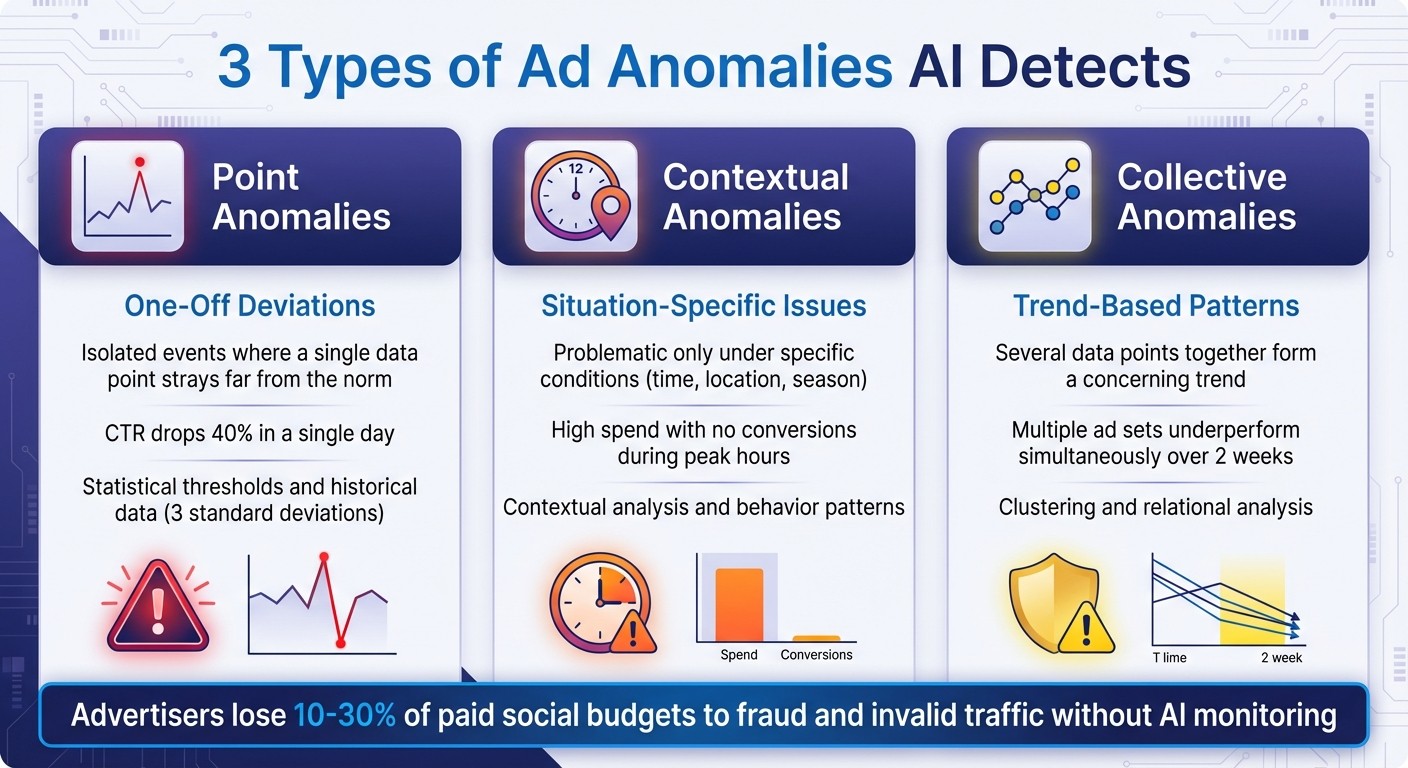
Three Types of Ad Anomalies AI Detects in Meta Campaigns
AI breaks down ad anomalies into three primary categories, each requiring a unique approach to detection. Knowing these categories can help you pinpoint issues and understand why your campaigns might not be delivering as expected. Let’s dive into the details.
Point Anomalies
Point anomalies are one-off deviations that stand out immediately. Imagine your CTR drops by 40% on a random Tuesday afternoon without any clear reason. These are isolated events where a single data point strays far from the norm.
AI detects these by comparing real-time metrics to historical patterns, flagging anything that exceeds three standard deviations. For example, if your average CPC has been $1.20 for weeks and suddenly spikes to $3.50 in a single day, AI will flag it as a point anomaly that needs attention.
Contextual Anomalies
Contextual anomalies are only problematic in specific situations - like time of day, location, or season. A $500 ad spend at 3 a.m. might make sense for a global e-commerce business but would be unusual for a small local restaurant, unless you set time-based rules to manage these fluctuations.
AI handles these by analyzing contextual factors and behavior patterns. It knows what’s normal under specific conditions. For instance, if your conversion rate usually surges during lunch hours but suddenly drops to zero on a weekday, AI will flag it as a contextual anomaly. Another example: high ad spend with no conversions during peak hours - AI’s pattern recognition tools pick up on these inconsistencies. This is especially critical when your results deviate from conversion rate benchmarks for your industry.
Collective Anomalies
Collective anomalies occur when several data points together form a concerning trend, even if individual numbers seem fine. For example, you might notice consistent underperformance across five ad sets, or a repeated fluctuation in ROAS that hints at a larger issue.
AI detects these by clustering related campaigns and analyzing their relationships across your full-funnel Meta ads setup. If all your retargeting campaigns start underperforming over two weeks while your prospecting campaigns remain steady, AI identifies this collective shift and flags it for review.
Anomaly Type | Example from Meta Ads | AI Detection Method |
|---|---|---|
Point | CTR drops 40% in a single day | Statistical thresholds and historical data |
Contextual | High spend with no conversions during peak hours | Contextual analysis and behavior patterns |
Collective | Multiple ad sets underperform simultaneously | Clustering and relational analysis |
The stakes are high: advertisers lose an estimated 10–30% of paid social budgets to fraud and invalid traffic. Without AI’s constant monitoring, campaigns are vulnerable to wasted spending, fake engagement, and distorted reporting metrics.
How AI Improves Anomaly Detection in Meta Ads

AI has turned anomaly detection into a proactive system that identifies and addresses issues through proactive threat detection before they wreak havoc on your ad budget. Instead of spotting problems days later in a spreadsheet, AI continuously monitors key metrics and adjusts campaigns in real time.
Real-Time Monitoring and Alerts
AI keeps an eye on campaigns around the clock, comparing live data to historical patterns and flagging unusual changes immediately. For example, if your CPC jumps from $1.50 to $4.20 at 2 a.m., AI can catch it and alert you right away.
This constant vigilance is crucial because Meta ad performance can shift rapidly during the learning phase. A creative that performed well yesterday might lose its edge by lunchtime today, or a competitor's campaign could drive up your CPMs during high-traffic hours. AI not only detects these changes but ensures you’re notified instantly, laying the groundwork for predictive analysis. This proactive approach is a cornerstone of Meta Ads ROI optimization.
Data-Driven Insights and Predictive Analysis
AI doesn’t just react to anomalies - it anticipates them. By learning your account’s typical behavior, including seasonal trends and daily fluctuations, AI can spot subtle changes in metrics like engagement or conversion costs before they spiral into bigger problems.
The impact of AI in anomaly detection is clear. Companies using these systems have reported up to a 50% drop in fraud losses. One global bank even achieved a 67% reduction in undetected fraudulent transactions, saving $42 million in potential losses.
Feature | Traditional/Manual Monitoring | AI-Powered Predictive Detection |
|---|---|---|
Approach | Reactive (fixes issues after they happen) | Proactive (predicts and prevents anomalies) |
Data Handling | Relies on samples or static thresholds | Analyzes entire datasets comprehensively |
Adaptability | Needs manual rule updates | Self-adjusts to market and seasonal changes |
With these insights, AI doesn’t just alert you - it enables automated adjustments to keep campaigns on track.
Automation with AdAmigo.ai
Platforms like AdAmigo.ai take things a step further by automating fixes across your campaigns. Its AI Actions feature analyzes live data and applies prioritized optimizations daily. You can choose to approve changes manually or let the system operate on autopilot.
For instance, if AdAmigo notices five ad sets underperforming or a sudden drop in conversions during peak hours, it doesn’t just send an alert. It goes further by creating new creatives, tweaking audience segmentation, and rebalancing budgets - all while adhering to your guardrails for budget pacing, geo-targeting, and placements. This ensures that automation stays under control. Agencies using AdAmigo report that a single media buyer can now manage 4–8× more clients, freeing up strategists to focus on bigger-picture growth.
Benefits of Using AI for Ad Anomaly Detection
AI brings a game-changing edge to anomaly management by combining real-time detection with predictive insights. It offers unmatched precision, instant responses, and the ability to analyze vast amounts of data - far beyond the limits of manual monitoring.
Better Accuracy and Fewer False Positives
Traditional monitoring methods often rely on rigid rules, like "alert if CPC exceeds $2.00." While straightforward, these rules don’t account for context. For instance, a viral product or an effective seasonal campaign might trigger alerts even though they represent positive outcomes. This approach can overwhelm teams with unnecessary notifications, making it harder to focus on actual problems.
AI handles this differently by creating a dynamic baseline of what "normal" looks like for your specific account. Using billions of data points, it adapts to shifting trends and analyzes complex variables - such as geography, time of day, and purchase category - to determine whether a spike is a legitimate opportunity or a potential issue. This contextual understanding slashes false alarms and reduces alert fatigue, enabling teams to concentrate on real challenges. The result? Faster, more confident decision-making.
Faster Response Times
When ad budgets are at stake, speed is everything. AI works in seconds, quickly identifying ad metric anomalies like setup errors, unusual spending patterns, or broken links the moment they happen. This rapid response prevents costly delays and keeps campaigns running smoothly - even during weekends or late-night hours when manual oversight might be limited.
Take the example of luxury brand Villeroy & Boch. Partnering with Agital, they leveraged AI to shift from brand awareness efforts to conversion-driven campaigns. By optimizing customer journey stages by adjusting Meta ads in real time, they saw a staggering 6,000% increase in new customer revenue and a 74% drop in CPA.
AI’s ability to combine real-time detection, fewer false positives, and scalability makes it a powerful tool for managing complex ad campaigns with full-funnel optimization. It handles data volumes and intricacies that would overwhelm even the most experienced human teams.
Steps to Implement AI for Ad Anomaly Detection
Bringing AI into your ad campaigns doesn't have to be complicated or time-consuming. You can break it down into three simple steps.
Define Key Metrics and Goals
Start by identifying the metrics that matter most for your campaigns - things like ROAS (Return on Ad Spend), CTR (Click-Through Rate), and CPC (Cost Per Click). Your focus might shift depending on your goals: for acquiring new customers, CPA (Cost Per Acquisition) might be key, while scaling existing products could mean prioritizing ROAS benchmarks.
Take Pura Vida Bracelets, for example. In Q4 2022, they used Meta's Advantage+ shopping campaigns with clearly defined benchmarks. The result? A 22% boost in ROAS and a 17% drop in cost per purchase. Once you’ve nailed down your goals, you’re ready to integrate an AI tool.
Integrate AI Tools Like AdAmigo.ai
Tools like AdAmigo.ai make integration easy. All it takes is linking your Meta Ads account - a process that takes just about five minutes. Once connected, you can set your KPIs (for instance, "Scale spend 30% at ≥3× ROAS"). From there, the AI starts learning your campaign’s performance patterns to track ROI effectively.
The beauty of AI lies in its ability to adapt in real time. It minimizes human errors and scales effectively across campaigns, building on the automated management capabilities we’ve talked about earlier.
Monitor and Optimize Continuously
AI is a powerful ally, but it doesn’t replace your strategic input - it complements it. Use the system's daily recommendations to refine your audience targeting, budget allocation, and creative strategies. You can decide how much control to give the system: either approve changes manually or let it run autonomously while you focus on the big picture.
For instance, Allbirds adopted a weekly ad rotation strategy in Q2 2023, using five different creatives to combat creative fatigue. This approach, supported by AI, boosted their CTR by 22% and cut CPC by 17%. AI gives you speed and actionable insights, but your ongoing tweaks create a compounding effect that drives long-term success.
And here’s the kicker: studies show that machine learning-based fraud detection can slash financial losses by up to 52% compared to traditional rule-based methods. This highlights how a well-implemented AI strategy can quickly justify its cost and deliver measurable results.
Conclusion
AI-powered anomaly detection is reshaping how advertisers approach Meta campaigns. By identifying point, contextual, and collective anomalies in real time, AI helps cut inefficiencies that waste budgets and hurt ROI. Instead of relying on manual reviews, instant alerts flag issues like CPC spikes, underperforming audiences, or creative fatigue as they happen.
The real advantage? AI takes care of the heavy lifting - analyzing thousands of data points, analyzing audience patterns, and making tactical adjustments - while leaving you free to focus on strategy and creative vision. It's not about replacing human judgment but enhancing it, often through a hybrid approach to audience creation.
Platforms like AdAmigo.ai make this technology accessible, no matter your team size. Whether you're an agency juggling multiple clients or an in-house team aiming to scale without extra hires, these tools act as an always-on AI assistant. They adapt to your budget rules, pacing needs, and placement preferences while optimizing targeting, bids, budgets, and creatives as a cohesive system. This integration shows how AI can simplify complex processes without sacrificing precision.
With a quick setup, you can start leveraging AI anomaly detection right away, freeing up your time to concentrate on bigger-picture growth strategies while the system handles the day-to-day execution.
FAQs
How does AI identify different types of ad anomalies in campaigns?
AI spots ad anomalies by digging into performance data and identifying unusual patterns. Here's how it works:
Point anomalies: These are single data points that stick out, like a sudden jump in ad costs or a sharp drop in conversions for one specific ad.
Contextual anomalies: These happen when performance shifts in a specific context - for example, an ad performing poorly during a certain time of day or in a particular region.
Collective anomalies: These involve clusters of unusual behavior, such as multiple ads or keywords underperforming at the same time.
By leveraging machine learning, AI compares real-time performance with historical data and relevant benchmarks. For instance, it might flag a point anomaly if one ad's cost suddenly spikes or catch a collective anomaly if an entire campaign starts underperforming. This early detection helps uncover issues like inefficient budgets or targeting mistakes, offering actionable suggestions to keep your campaigns running smoothly.
How does AI improve ad budget management and boost ROI?
AI takes ad budget management to the next level by enabling real-time, data-driven adjustments. It can automatically reallocate budgets toward ads that are performing well, tweak bids based on live campaign data, and refine audience targeting on the fly. This level of automation allows campaigns to adapt quickly, cutting down on wasted spend and boosting overall efficiency.
On top of that, AI-powered tools like AdAmigo.ai help identify and address costly issues, such as ad fraud, budget overspending, or unexpected drops in conversions. By automating these checks, AI keeps campaigns running smoothly without requiring constant manual oversight. The result? Advertisers often experience better ROI, faster scaling, and more reliable performance over time.
How can businesses use AI tools like AdAmigo.ai to enhance their ad campaigns?
Businesses can tap into AI tools like AdAmigo.ai to supercharge their ad campaigns by automating tedious tasks and improving performance. In just a few minutes, the AI can generate customized ad creatives, fine-tune audience targeting, and manage budgets, giving teams more time to focus on strategy and long-term growth.
With AI in the mix, companies can simplify daily tasks like setting up campaigns, adjusting bids, and tracking performance. The AI learns continuously from real-world results, helping to avoid costly errors like overspending or overwhelming the audience. When you pair AI-driven automation with human oversight, campaigns stay on track with business objectives, delivering stronger outcomes while saving both time and resources.