
2026 Meta Ads CPM Benchmarks: $2.82–$42.17 by Industry [Full Table]
Compare your Meta Ads CPM against 2026 industry benchmarks — from $2.82 (Food & Beverage) to $42.17 (IT Services). Includes full comparison table, seasonal trends, campaign objective breakdowns, and AI tactics to lower costs.
Meta Ads CPMs vary widely by industry, and knowing these benchmarks can help you plan smarter ad budgets. For example, Finance ads cost around $45.00 per 1,000 impressions, while Food & Beverage ads are as low as $2.82. In 2026, the average CPM across industries is $13.48, up 20% from 2025. Factors like competition, targeting, and engagement heavily influence these costs.
Data aggregated from Triple Whale's analysis of ~35,000 DTC brands (Jan–Dec 2025), cross-referenced with Meta platform data and industry reports.
Key Takeaways:
High CPMs: IT Services ($42.17), Finance ($29.16), Real Estate ($29.85)
Low CPMs: Food & Beverage ($2.82), Manufacturing ($2.40)
Rising Costs: Driven by competition, Meta's "Boredom Tax", and AI-driven campaigns like Advantage+.
Seasonal Spikes: CPMs peak during Q4 holidays but drop significantly post-Christmas.
If your CPM is much higher than your industry's median, it may point to issues with targeting, creative performance, or seasonality. AI tools can help manage costs by adjusting budgets, testing new ads, and improving engagement.
Meta Ads CPM Trends in 2026

Average CPM Across All Industries
In 2026, the average Meta Ads CPM has climbed to $13.48, marking a 20.03% increase from 2025 benchmarks. This rise highlights Meta's shift toward being seen as a "Premium" advertising channel. Brands with high customer lifetime value, such as direct-to-consumer companies and B2B SaaS businesses, continue to lead the platform, while smaller advertisers increasingly turn to options like TikTok, while others focus on scaling their Meta campaigns more efficiently.
Several factors are driving this cost increase. The adoption of Advantage+ campaigns has streamlined bidding processes, but it has also intensified competition for premium ad inventory. Broad targeting approaches are reducing CPM efficiency, necessitating more precise targeting to maintain performance. Ads with low engagement are being penalized with additional costs through Meta's "Boredom Tax," though strong creative and engagement strategies can mitigate this.
Let's take a closer look at which industries are seeing the biggest CPM spikes and which are managing to stay relatively stable.
Industries with the Highest CPM Growth
Some sectors are feeling the pinch of rising CPMs more than others.
IT Services & Outsourcing leads the pack, with CPMs reaching $42.17, more than double the global average. B2B SaaS is grappling with even higher rates, surpassing $55.00. Meanwhile, industries like Finance and Real Estate are also experiencing steep CPM growth due to the high value of their leads and fierce competition in auctions.
Industries with Lower and More Stable CPMs
On the other hand, certain industries are weathering these increases with more stability.
Food & Beverage and Baby Products stand out for their relatively contained CPM growth. Food & Beverage saw an increase of just 8.35%, while Baby Products grew by only 8.08%, both well below the platform-wide average. The Automotive sector posted the lowest CPM at $10.01, and Manufacturing recorded rates as low as $2.40 in some datasets. These industries benefit from larger, more general audiences, which help keep impression costs down despite the overall upward trend.
How 2026 CPMs Compare to 2025 Benchmarks
CPM costs rose across nearly every industry between 2025 and 2026. Our 2025 Meta Ads benchmarks show the overall median CPM was roughly $11.82 — meaning the jump to $13.48 represents a 20% increase in a single year. The biggest drivers: Advantage+ adoption concentrating spend in fewer, more competitive auctions, and Meta's engagement-based pricing penalizing low-quality ads. For a full picture across all metrics — CTR, CPC, CPL, and ROAS — see our 2026 cross-metric benchmarks.
CPM Benchmarks by Industry
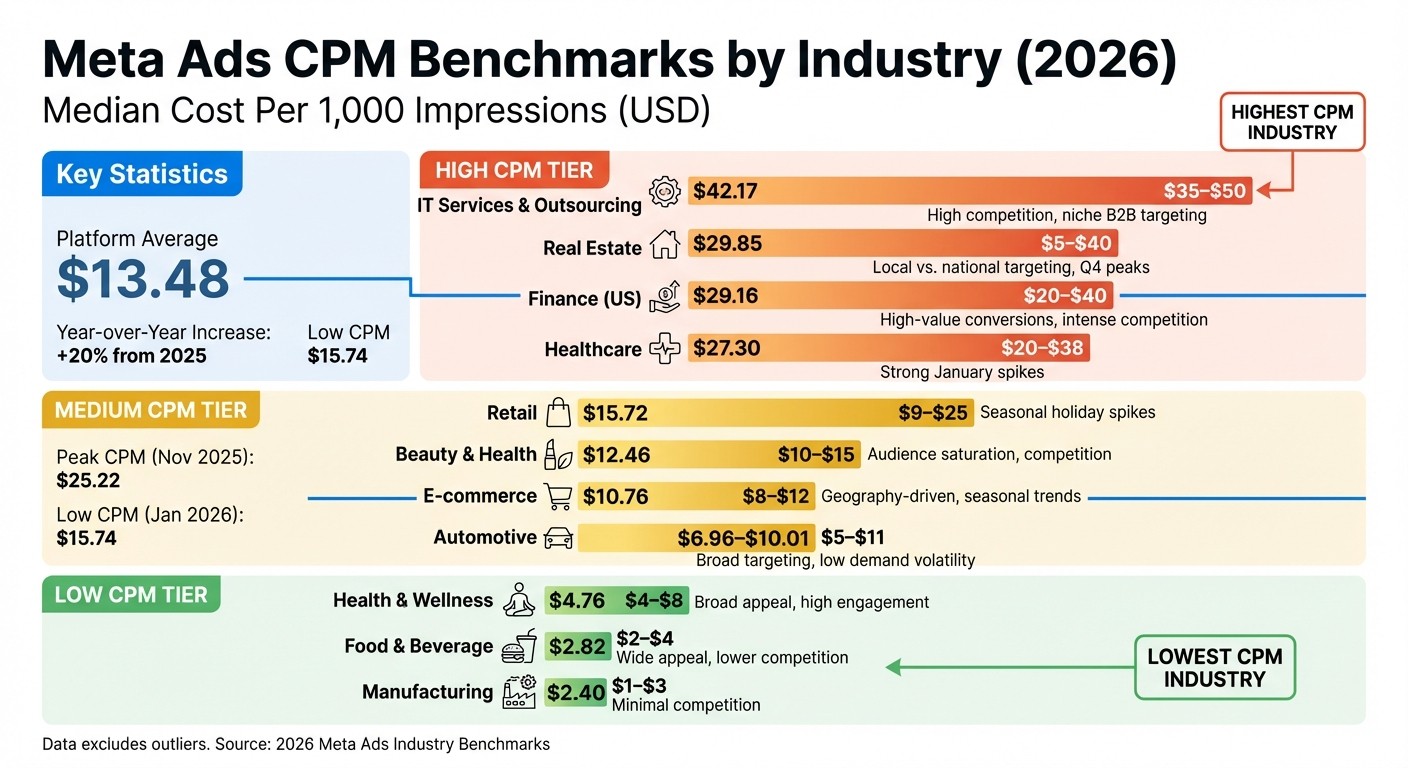
Meta Ads CPM Benchmarks by Industry 2026
Industry CPM Comparison Table
Below is a breakdown of median CPMs across key industries for 2026. The data excludes outliers to provide a clearer benchmark.
Industry | Median CPM (USD) | Range | Key Factors |
|---|---|---|---|
IT Services & Outsourcing | $42.17 | $35–$50 | High competition, niche B2B targeting |
Real Estate | $29.85 | $5–$40 | Local vs. national targeting, Q4 peaks |
Finance (US) | $29.16 | $20–$40 | High-value conversions, intense competition |
Healthcare | $27.30 | $20–$38 | Strong January spikes |
Retail | $15.72 | $9–$25 | Seasonal holiday spikes |
Beauty & Health | $12.46 | $10–$15 | Audience saturation, competition |
E-commerce | $10.76 | $8–$12 | Geography-driven, seasonal trends |
Automotive | $6.96–$10.01 | $5–$11 | Broad targeting, low demand volatility |
Health & Wellness | $4.76 | $4–$8 | Broad appeal, high engagement |
Food & Beverage | $2.82 | $2–$4 | Wide appeal, lower competition |
Manufacturing | $2.40 | $1–$3 | Minimal competition |
In November 2025, CPMs peaked at $25.22 before dropping to a 13-month low of $15.74 by January 2026.
These figures highlight the strategic value of targeted leads in industries with higher CPMs, where businesses aim to maximize returns from each impression.
CPM by Campaign Objective
Your campaign objective dramatically shifts what you'll pay. Here's how CPM ranges break down by what you're optimizing for:
Objective | Typical CPM Range | Notes |
|---|---|---|
Awareness / Reach | $10–$15 | Lowest CPM; broad audiences, no action signal |
Traffic / Engagement | $12–$18 | Mid-range; Meta optimizes for link clicks |
Lead Generation | $25–$45 | Higher; high-intent prospects in crowded B2B/B2C auctions |
Conversions / Sales | $18–$35 | Variable; depends heavily on pixel data and conversion volume |
If you're running lead gen campaigns at $25 CPM, you're in healthy territory — but the same CPM on an awareness campaign would signal trouble. Always benchmark against your objective, not just your industry. For deeper comparisons, see our CPL benchmarks by industry and CPA benchmarks.
High CPM Industries: IT Services, Real Estate, and Finance
IT Services & Outsourcing tops the list with a median CPM of $42.17. The high customer lifetime value in this sector justifies the elevated costs, as businesses are willing to pay more to secure lucrative, long-term clients.
Finance campaigns in the U.S. have CPMs about 47% higher than global averages. This reflects the potential revenue from high-value actions like mortgage applications or investment account signups. Similarly, Real Estate campaigns show a wide range: local targeting achieves a median CPM of $5.13, while national campaigns average $29.85 due to intense competition.
CPM trends in these industries can fluctuate. Advertisers routinely see CPMs climb 50–100% when creative fatigue sets in, and introducing fresh creative can bring costs back to baseline within days — sometimes as quickly as 48 hours.
Low CPM Industries: Food & Beverage and Health & Wellness
On the other end, Food & Beverage has one of the lowest median CPMs at $2.82, with some campaigns achieving rates as low as $0.25 to $0.86. These low costs stem from the universal appeal of food-related content, like recipe videos, which often generate strong engagement without advanced targeting.
Health & Wellness follows closely with a median CPM of $4.76, benefiting from content that naturally resonates with a broad audience. These industries rely on engaging material that drives results while keeping costs manageable.
The stark difference between high and low CPM industries underscores how businesses use Meta's platform to meet their goals.
"Efficient CPM beats cheap CPM every time."
A $40.00 CPM that targets decision-makers ready to invest in enterprise software can yield a better ROI than a $3.00 CPM aimed at casual viewers. Here's a quick diagnostic to apply this:
Is your CPM high but your ROAS strong? Stay the course — your targeting is likely reaching the right people. Compare against our ROAS benchmarks by industry to confirm.
Is your CPM high and ROAS weak? Check for ad fatigue, narrow targeting, or a weak creative hook — and run the numbers through a break-even ROAS calculator to see if you're even in profitable territory.
Is your CPM low but conversions absent? You may be reaching a broad but low-intent audience — tighten your targeting or review your conversion rate benchmarks to diagnose the drop-off.
What Affects CPM Rates in 2026
Competition and Auction Pressure
Meta's auction system operates on the Total Value formula: Ad Rank = Bid × Estimated Action Rate × Ad Quality. When multiple advertisers compete for the same audience, CPMs inevitably climb. Industries like Finance and IT Services often face steeper rates due to the intense competition for high-value leads.
Meta also imposes what's known as the "Boredom Tax." If users scroll past your ad without engaging, you'll pay higher CPMs as a penalty for low engagement. On the flip side, ads that spark likes, comments, and clicks tend to cost less because Meta rewards engaging content.
Another factor is targeting precision. Narrower targeting limits the available inventory, which drives CPMs higher — often to around $35. In contrast, broad targeting can bring CPMs down to about $12 by giving Meta's AI the flexibility to find cost-effective, high-intent audiences.
Targeting and Campaign Objectives
Where you target geographically has a big impact on CPMs. For instance, e-commerce campaigns in the United States average $20.48 CPM, while in India, the average plummets to just $2.70. Campaign objectives also matter — awareness campaigns typically cost between $10 and $15 CPM, while lead generation campaigns aimed at high-intent prospects can range from $25 to $45 depending on the objective.
Broad targeting is emerging as the go-to strategy for cost savings in 2026. Expanding your audience reach to over 500,000 users can slash costs by 15% to 30%. Meta's Advantage+ Shopping Campaigns, which leverage broad targeting, have been shown to reduce cost per acquisition by up to 32% compared to manual targeting — and broader reach generally means lower CPMs as the algorithm finds cheaper inventory. The trick? Letting Meta's AI work across a large pool of users instead of forcing it into crowded, pricier segments.
Seasonal Patterns and Timing
The fourth quarter is notorious for driving CPMs sky-high. As advertisers flood the platform during the holiday season, costs can jump by 30% to 80%. Black Friday and Cyber Monday are even more extreme, with CPMs often doubling or tripling, sometimes exceeding $50. Real Estate campaigns also feel the Q4 crunch, with CPMs peaking at around $40.76 during the year-end buying surge.
In contrast, the "Q5" period — from December 26 to January 15 — offers a much-needed breather. During this time, CPMs typically drop by 40% to 60% as major brands pull back their ad spend after Christmas. Many advertisers take advantage of this lull, allocating up to 30% of their annual budget for January, when competition is lower and CPMs are more affordable. Use our CPM calculator to model how seasonal shifts affect your projected costs.
How to Lower CPM Without Sacrificing Performance
High CPMs aren't a fixed cost — they're a signal. Here are the levers that actually move the needle.
Refresh Creatives Before Fatigue Sets In
Creative fatigue is the single biggest driver of rising CPMs. When users see the same ad too often, engagement drops, and Meta penalizes you with higher costs. Monitor your frequency metrics: if your average frequency climbs above 3–4 and your CPM is trending up, it's time for new creative.
AI-powered creative tools like AdAmigo's Ad Factory can accelerate this process by analyzing top-performing ads and generating fresh variations. Bulk-launching 50–300 creative and targeting combinations at once helps identify low-CPM, high-CTR winners in days rather than weeks — but the principle holds whether you use AI or manual testing: fresh creative keeps the algorithm engaged. For a baseline on what good looks like, check our CTR benchmarks by industry.
Broaden Your Targeting
Narrow targeting drives up CPM by forcing Meta into smaller, more competitive auction pools. Expanding your audience to 500,000+ users lets the algorithm find cheaper inventory. Advantage+ campaigns take this further — some advertisers report CPM drops of up to 68% versus manual interest-based targeting.
Choose the Right Campaign Objective
Optimizing for the wrong objective inflates CPM unnecessarily. If you're running a conversion campaign but have fewer than 50 tracked conversions, Meta struggles to find your buyers efficiently, and CPM climbs. Instead, optimize for an upper-funnel event like "ViewContent" or "AddToCart" until you accumulate enough data — then shift to Purchase optimization once the pixel is mature.
Use Automated Rules and Cost Caps
Set automated rules to pause ad sets when CPM exceeds a threshold, or apply cost caps to prevent Meta from bidding too aggressively. These guardrails are especially valuable during seasonal spikes when auction pressure can double costs overnight.
Tools like AdAmigo.ai's Autopilot handle this continuously — reallocating budgets from high-CPM ad sets, scaling winners, and applying cost caps automatically — but even a few well-configured manual rules in Ads Manager can prevent runaway spending.
"CPM isn't a price tag — it's an algorithm thermometer. When your CPM is high, Meta is telling you: 'Your ad doesn't deserve cheap impressions.'" — Adfynx Team
Conclusion
Understanding your CPM benchmarks is critical for making the most of your ad spend. CPM rates vary significantly by industry, ranging from $2.82 in Food & Beverage to $42.17 in IT Services. The goal isn't simply to achieve the lowest CPM but to recognize what's typical for your specific industry and region — then optimize from there.
If your CPM is 35% higher than your industry's median, it's time to take action: refresh your creative assets, broaden your targeting, and verify you're optimizing for the right objective. Compare your CPM to our ROAS benchmarks to check whether high CPM is actually hurting your bottom line — in industries like Finance, a high CPM with strong ROAS can be perfectly healthy. Use the formula (1 ÷ Profit Margin) to determine your break-even ROAS, then optimize accordingly.
In 2026, automated optimization has become essential for keeping CPMs under control. Whether through Ads Manager rules, Advantage+ placements, or AI tools that monitor campaigns around the clock, the advertisers winning on Meta are the ones who treat CPM as a diagnostic signal rather than a fixed cost.
Compare your rates to industry benchmarks. If they're above the median, start by testing new creatives, expanding your targeting, and setting cost caps to protect your margins. Staying competitive means aligning your spend with industry standards and embracing continuous optimization.
FAQs
Is my CPM too high for my industry?
Your CPM might be on the higher side if it's noticeably above the expected benchmarks for 2026. On average, CPM across industries hovers around $13.48, but there's a lot of variation depending on the sector. For instance, finance and insurance tend to see CPMs in the $15–$30 range, while food and beverage are usually much lower, around $2.82–$7. To determine if your CPM is reasonable, compare it to these benchmarks and evaluate factors like the quality of your audience, how relevant your ads are, and where they're being placed. Also check your campaign objective — a $25 CPM on a lead gen campaign is normal; on an awareness campaign, it's a red flag.
How do I lower CPM without hurting results?
Improving your CPM while maintaining ad performance boils down to a few key strategies. Start by focusing on ad relevance and creative quality — ads that resonate with viewers often come with lower costs. Craft engaging visuals and messages to grab attention and keep your audience interested.
Another smart move is to broaden your audience targeting. By expanding your reach, you tap into larger, more competitive audience pools, which can help reduce costs. Also, consider optimizing your placements — Instagram Stories and Facebook Feed often offer cost-effective options for delivering your ads.
Leverage tools like Meta's Advantage+, which can help fine-tune your targeting and improve delivery efficiency. To stay competitive, adjust your bids based on industry benchmarks — typically, CPMs range from $5 to $15, depending on your niche. Lastly, keep an eye on seasonal trends. Timing your campaigns strategically can help you manage costs while maximizing impact.
Why did my CPM spike overnight?
When you notice an overnight CPM spike, it's often tied to heightened competition in the ad auction — something that's especially common during high-demand periods like Q4. Factors like seasonal trends, shifts in targeting, ad placements (like Instagram Stories or Reels), or even changes in creative strategy can all play a role in driving up costs.
Take a closer look at any recent tweaks to your campaigns or audience settings. It's also worth considering how seasonal demand or platform updates might be contributing to the sudden increase.