
Real-Time Personalization: How AI Analyzes Audiences
AI adjusts ads and creatives in seconds using live user behavior to improve targeting, cut costs, and raise ROAS for advertisers and SMBs.
Real-time personalization is reshaping advertising by using AI to adjust ads instantly based on live user behavior, preferences, and interactions. Unlike older methods that rely on static data, this approach processes massive datasets in seconds, enabling highly relevant ad placements. For Meta ads, tools like Advantage+ Audience and GEM (Generative Ads Recommendation Model) have significantly reduced costs and improved performance, with some campaigns seeing up to 4× better results. AI also optimizes bids and recommendations, optimizes dynamic creatives, and tracks performance metrics like ROAS and CPA in real time, ensuring budgets are used efficiently. Businesses, including small and medium-sized ones, are leveraging platforms like AdAmigo.ai to streamline ad creation, audience targeting, and campaign management, leading to higher returns and less manual effort.
Key Takeaways:
How It Works: AI analyzes live data (e.g., clicks, browsing habits) to group users into behavior-driven segments.
Meta Ads Impact: AI tools reduce costs and improve conversions by focusing on high-intent users.
Performance Boost: SMBs report up to an 83% increase in ROAS using AI-powered automation.
Tools in Action: Platforms like AdAmigo.ai simplify tasks like ad creation, audience analysis, and optimization.
AI-driven personalization is the future of advertising, offering faster adjustments, better targeting, and higher ROI while adapting to privacy-first trends. This shift allows brands to scale personalization without privacy risks by focusing on behavioral signals rather than sensitive data.
Meta to use AI chats to personalize content and ads | REUTERS
How AI Analyzes Audiences in Real Time
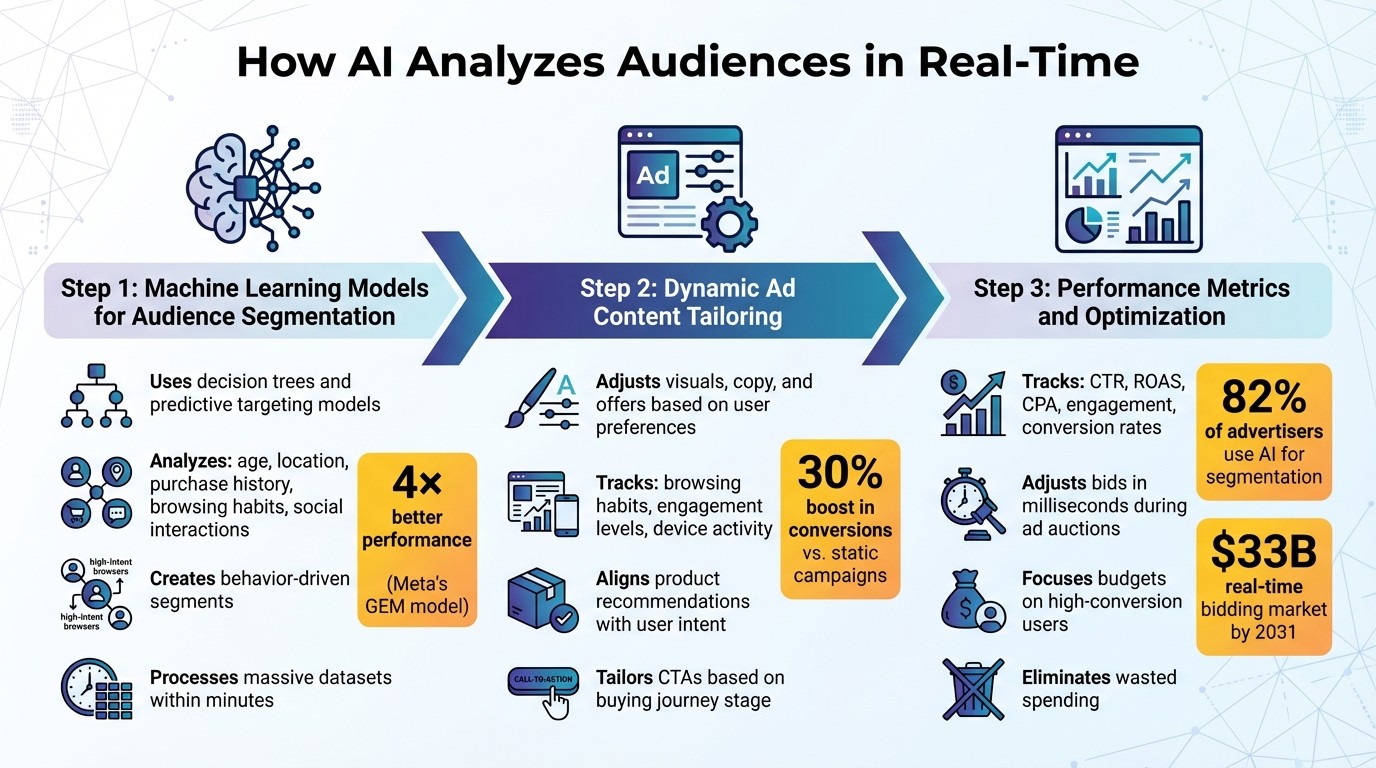
How AI Analyzes Audiences in Real-Time: 3-Step Process
AI takes real-time personalization to another level by blending systematic processes with adaptive strategies.
Machine Learning Models for Audience Segmentation
AI uses machine learning tools like decision trees and predictive targeting models to group users based on attributes such as age, location, and purchase history. But it doesn't stop at broad categories. Instead, it digs deeper, identifying smaller, behavior-driven segments like "high-intent browsers" - users who are on the verge of making a purchase.
This segmentation happens continuously. AI systems can process enormous datasets - think demographics, purchase records, browsing habits, and even social interactions - within minutes. They adapt instantly when patterns shift. A prime example is Meta's Generative Ads Recommendation Model (GEM). Built using thousands of GPUs, GEM analyzes massive behavioral data sets to fine-tune ad targeting, delivering performance that's four times stronger than earlier models.
Dynamic Ad Content Tailoring
Once audiences are segmented, AI fine-tunes every part of the ad experience. By tracking behaviors like browsing habits, engagement levels, and activity across devices, it adjusts visuals, copy, and offers to match user preferences through AI-powered creative scaling. For instance, in a Samsung campaign, AI scheduled ads for nighttime when engagement was highest, switching to daytime-specific creatives during other hours to match audience behavior.
AI takes this beyond traditional A/B testing. It aligns product recommendations with users showing high intent, tweaks messaging for those in research mode, and tailors calls-to-action depending on where someone is in their buying journey. This approach has led to a reported 30% boost in conversions compared to campaigns relying solely on past data.
Performance Metrics and Optimization
After tailoring the content, AI keeps refining campaigns by analyzing performance metrics. It tracks data like click-through rates (CTR), return on ad spend (ROAS), cost per acquisition (CPA), engagement, and conversion rates. Using this information, it spots trends and adjusts strategies in real time. During ad auctions, for example, AI recalibrates bids in milliseconds, evaluating the value of impressions based on the user's current context.
Meta's Advantage+ Audience is a great example of this optimization. It focuses budgets on users most likely to convert. Currently, 82% of advertisers rely on AI for audience segmentation and behavioral insights, with real-time bidding markets expected to hit $33 billion by 2031. Campaigns powered by these systems often generate over 3 million impressions, with peak engagement achieved by eliminating wasted spending. These quick adjustments not only improve ROI but also make scaling campaigns effortless, particularly within Meta's advertising ecosystem.
Case Studies: Real-Time Personalization in Action
Examples from various industries highlight how AI is reshaping ad performance. By allowing machine learning to handle audience analysis and ad strategies, businesses are seeing measurable improvements in ad performance.
Higher ROAS for Small and Medium Businesses
Small and medium-sized businesses (SMBs) using AI-powered automation have reported up to an 83% increase in Return on Ad Spend (ROAS). This success comes from algorithms that fine-tune AI audience segmentation vs manual targeting and optimize ad creatives. These systems analyze visual elements and use predictive models to pinpoint high-intent buyers as early as 48 hours before they convert. Tools like AdAmigo.ai make this process seamless by automating these tasks, enabling businesses to allocate their budgets to highly targeted and impactful ads. This demonstrates how AI can deliver personalized, data-driven advertising across different industries.
Dynamic Ads Transform Travel and Retail
Dynamic personalization is revolutionizing ad campaigns in the travel and retail sectors. These industries now use AI tools to adjust product recommendations, pricing, and messaging in real time based on browsing behavior and purchase signals. For instance, in retail, algorithms analyze customer interactions to showcase products that match their interests. Similarly, travel companies can tailor ads to feature offers that align with a user's recent destination searches. By replacing static campaigns with these adaptable, personalized experiences, brands are significantly improving ad performance.
Using AdAmigo.ai for Campaign Personalization
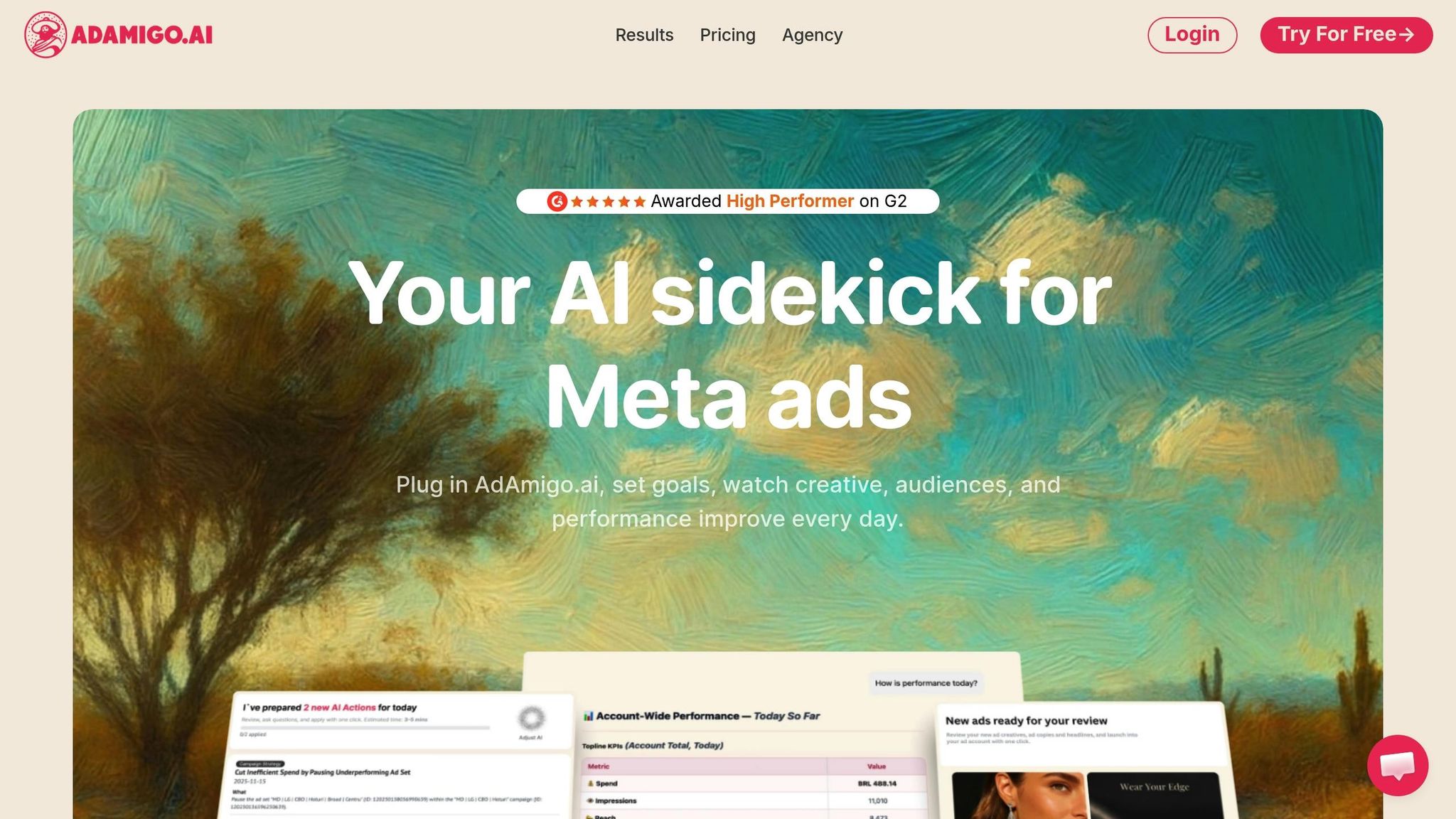
AdAmigo.ai is changing the game for personalized Meta advertising by combining real-time data with AI-driven insights. This tool takes the complexity out of [scaling ad campaigns by automating tasks like audience analysis, creative generation, and campaign optimization](https://www.adamigo.ai/blog/ai-powered-creative-scaling-for-meta-ads). Instead of relying on rigid rules, AdAmigo.ai operates as an autonomous AI agent that learns directly from the performance of your campaigns, connecting seamlessly to your Meta ad accounts.
Key Features of AdAmigo.ai
AdAmigo.ai comes packed with features designed to simplify and supercharge your advertising efforts:
AI Ads Agent: This feature analyzes your brand identity while keeping an eye on competitor and top-performing ads. It then generates fully designed and configured ad creatives that you can launch into your Meta account with just one click.
AI Actions: Forget constant dashboard monitoring. This tool delivers a daily, prioritized to-do list of impactful adjustments across creatives, audiences, budgets, and bids - ensuring your campaigns are always optimized.
Bulk Ad Launch: Scaling fast? This feature lets you launch dozens - or even hundreds - of Meta ads at once, complete with customized copy, creatives, and targeting, all directly from Google Drive.
AI Chat Agent: Need quick answers or want to launch a campaign on the fly? This on-demand assistant lets you manage campaigns and get performance insights through simple chat commands.
How AdAmigo.ai Works with Meta Systems
Getting started with AdAmigo.ai is quick and straightforward. In just five minutes, you can connect your Meta ad account, set key performance indicators (like "Increase spend by 30% while maintaining a ROAS of 3× or higher"), and share your campaign goals. From there, the system integrates with Meta's real-time data to automatically generate campaigns, refine audiences, and scale budgets without losing ROAS.
AdAmigo.ai provides a daily feed of AI-recommended changes, which you can review, edit, or approve for automatic publishing. Unlike Meta ads automation tools, this platform acts as a learning agent, continuously updating its strategies based on real-world results. It handles everything - creatives, targeting, bids, and budgets - as a unified system, identifying and scaling top-performing ads faster than manual teams ever could. This level of integration lets businesses achieve scalable growth without compromising on performance.
Why Choose AdAmigo.ai?
AdAmigo.ai is perfect for agencies looking to handle 4–8× more clients or for in-house teams aiming to cut costs without sacrificing results. Acting as a 24/7 AI media buyer, the platform grows smarter with every campaign, refining strategies to deliver better outcomes over time. Whether you want full autonomy or prefer to keep some oversight, AdAmigo.ai adapts to your needs.
The pricing is straightforward: $99/month for ad accounts spending under $5,000/month, or $299/month for unlimited AI Actions and bulk ad launches. This single tool replaces the need for multiple freelancers or top AI tools for Facebook and Instagram ads, consolidating creative generation, campaign management, and optimization into one streamlined process. The result? Improved ROAS and more time for your team to focus on big-picture strategies instead of repetitive tasks.
The Future of Real-Time Personalization in Advertising
Key Takeaways
Real-time personalization, driven by AI, has completely transformed how brands interact with their audiences. By moving beyond broad demographic targeting, advertisers can now deliver highly specific messages that adjust instantly based on individual behaviors, preferences, and intentions. And the results speak for themselves - companies excelling in advanced real-time personalization report up to 40% higher revenue compared to slower adopters.
This technology processes immense amounts of data in mere milliseconds, uncovering patterns through AI audience segmentation and predictive targeting that human analysis might miss. The outcome? Ads that feel more relevant and less invasive. This aligns with what consumers want - 71% expect personalized content, while 67% express irritation when interactions lack that personal touch. These advancements build on the data-driven strategies already enhancing platforms like Meta ads.
What's Next
The next decade holds even more refinement and sophistication in personalization. Emerging technologies, like multimodal and emotional AI, will analyze text, images, audio, and even non-verbal cues simultaneously to create campaigns that respond to moods and emotions.
With the decline of third-party cookies, privacy-first personalization is becoming the norm. AI will increasingly depend on first-party data and contextual insights to scale Meta ad growth to deliver meaningful ads without compromising user privacy. This shift is already gaining traction, as 59% of global marketers see AI-driven campaign personalization and optimization as the leading trend for 2025. The numbers back this up: the AI advertising market is expected to grow from $14.2 billion in 2022 to $70.7 billion by 2032.
Predictive analytics is another game-changer, allowing advertisers to estimate creative performance - like how likely an ad is to grab attention - before spending a single dollar. As Bill Gates aptly put it, "AI is on the verge of making our lives more productive and creative". For brands that invest in strong data systems and agile automation, the future promises rapid testing, sharper targeting, and campaigns that outpace competitors by identifying opportunities faster. These innovations will enable advertisers to craft campaigns that are not only impactful but also evolve in real time with consumer behaviors.
FAQs
What data powers real-time audience personalization?
Real-time audience personalization taps into live data such as engagement signals, website interactions, purchase history, and user behavior. With this information, AI works behind the scenes to constantly analyze and fine-tune targeting, improve campaign strategies, and adjust bids on the fly. The result? Smarter decisions and improved performance in the moment.
How does AI optimize Meta ads in milliseconds?
AI fine-tunes Meta ads in a flash by analyzing real-time data to automatically adjust budgets, bids, and audience targeting. This keeps campaigns running smoothly and efficiently, responding instantly to changes for the best possible results.
How can SMBs start using AdAmigo.ai for Meta ads?
Small businesses can kick things off by linking their Meta ad account and setting campaign goals - whether that's boosting ad spend or hitting a specific return on ad spend (ROAS). From there, they can explore AI-powered recommendations for campaigns, audience targeting, and budget allocation. These suggestions can be approved, adjusted, or even automatically published to fine-tune performance. Tools like the AI Ads Agent and bulk ad launching offered by AdAmigo.ai make scaling campaigns simpler and more efficient, helping businesses achieve better outcomes with minimal time and effort.