
How AI Detects Ad Metric Anomalies
AI detects and fixes ad metric anomalies using forecasting, machine learning, and neural nets to spot drops, overspend, and fraud and prioritize costly issues.
AI helps advertisers spot unusual changes in performance metrics like CPC, CTR, and ROAS faster than manual monitoring. These anomalies could signal technical issues, fraud, or market changes. Unlike static rules, AI uses time-series forecasting, machine learning, and neural networks to identify patterns, flag problems, and even take corrective actions automatically. Tools like AdAmigo.ai monitor data every 15 minutes, prioritize issues by financial impact, and can adjust campaigns in real-time, saving time and budget.
Key takeaways:
AI vs. Manual Monitoring: AI detects issues in minutes; manual reviews can take days.
Detection Methods: Time-series forecasting predicts trends, while machine learning finds outliers.
Common Issues Solved: AI addresses sudden performance drops, preventing overspending, and suspicious activity and fraud.
Top Tool: AdAmigo.ai automates anomaly detection and fixes, reducing manual effort by 95%.
AI transforms ad management, ensuring campaigns stay efficient and budgets are protected.
AI Techniques for Detecting Ad Metric Anomalies
Time Series Forecasting for Expected Performance
AI uses time series forecasting to predict ad metrics based on historical trends, flagging deviations that stand out. One popular tool for this is Meta's Prophet, an open-source solution that breaks ad data into three key components: trend (long-term patterns), seasonality (recurring cycles like hourly or weekly shifts), and residuals (random noise). This breakdown helps determine whether unusual activity - like a spike in cost-per-click at 3 a.m. - is genuinely unexpected or just part of regular low-traffic behavior.
Prophet stands out because it can handle missing data, automatically detect "changepoints" (where trends shift), and let users set specific confidence intervals, such as an 80% range, to visualize expected performance. For Meta ads, this means the tool can account for strong hourly cycles, reducing false alarms during predictable low-traffic periods.
"Prophet is particularly well-suited for forecasting time series data with strong seasonal effects and multiple seasons of historical data." - Matan Stern, Data Scientist
Once the forecast is in place, AI compares predicted values to actual results. As Matan Stern explains:
"Discrepancies between our predicted values and actual observations are analyzed and categorized. This binary classification - an anomaly or not - allows us to quickly identify potential issues while acknowledging the natural variations".
Visualizations comparing forecasted and actual data provide essential context, making it easier to understand how anomalies fit into broader historical trends.
Beyond forecasting, AI incorporates unsupervised learning to refine anomaly detection.
Machine Learning Methods for Anomaly Detection
After establishing trends, AI applies unsupervised learning algorithms to uncover deeper anomalies. These methods don’t require labeled data; instead, they detect outliers by identifying data points that deviate from the norm. Techniques like Isolation Forest, DBSCAN, and Local Outlier Factor (LOF) are particularly effective for analyzing Meta ad metrics, focusing on how isolated or unusual a data point is compared to the rest of your performance data.
These algorithms classify anomalies into three types:
Point anomalies: Isolated spikes, such as a sudden one-hour bidding glitch.
Contextual anomalies: Deviations that are unusual only in specific contexts (e.g., a high cost-per-click during a typically low-traffic time).
Collective anomalies: Simultaneous shifts across multiple metrics, suggesting a larger systemic issue.
Unlike rigid rules - like flagging any CPA over $50 - AI uses dynamic thresholds based on historical baselines and standard deviations (usually 2–3 sigma). For instance, a $60 CPA might be expected during Black Friday but would raise alarms on an ordinary Tuesday in March.
For even more intricate patterns, AI taps into neural networks.
Neural Networks and Autoencoders for Complex Patterns
Autoencoders, a type of neural network, are designed to compress and then reconstruct data. When they struggle to recreate the data accurately - resulting in high reconstruction error - it signals an anomaly. This method is particularly useful for identifying subtle, multi-dimensional issues in areas like creative performance or audience engagement.
For example, autoencoders can analyze hundreds of variables at once - creative formats, audience demographics, placements, time of day, device types - and detect unusual combinations. If a video ad suddenly underperforms for iOS users aged 25–34 in the evening, while other segments remain stable, the autoencoder flags this specific pattern as an anomaly.
These models excel in handling complex, high-dimensional datasets where traditional forecasting techniques fall short. They learn what "normal" looks like across all campaign variables, instantly identifying deviations that would otherwise take hours of manual analysis to detect.
Using GenAI and Traditional ML for Anomaly & Outlier Detection
How AI Detects and Responds to Ad Metric Anomalies
AI doesn't just identify unusual ad performance - it follows a structured process to gather data, train models, and alert you when something's off. Here's how it transforms raw ad metrics into actionable insights.
Data Collection and Preprocessing
AI begins by pulling key metrics like impressions, clicks, conversions, cost-per-acquisition (CPA), and return on ad spend (ROAS) from your Meta ad account every 15 to 30 minutes. This frequent collection ensures potential issues are caught quickly. The data is then organized into time series, creating a timeline that tracks performance trends by the hour or day.
Before diving into analysis, the system cleans the data. For instance, missing values caused by reporting delays are filled in using techniques like interpolation or forward-fill. Outliers, often due to tracking glitches or pixel failures, are flagged and either corrected or removed. AI also checks for incomplete UTM parameters or broken tracking pixels or incorrectly configured conversion events that could distort results. These steps ensure the data is accurate and consistent, giving the models a reliable foundation to work with.
Model Training and Anomaly Identification
Once the data is cleaned, AI trains models to establish what "normal" performance looks like. It creates dynamic baselines that account for variables like time of day, day of the week, and seasonal trends. For example, a $60 CPA might be perfectly fine during Black Friday but could signal an issue on a random Tuesday in March.
The system then compares predicted values (based on historical patterns) with actual values (current performance). If the actual numbers deviate by more than 2–3 standard deviations, the system flags it as an anomaly. Advanced AI tools also factor in promotional calendars and seasonal events, preventing false alarms during planned sales or campaigns. This added context makes AI detection far more adaptive than rigid, rule-based systems.
Alerting and Prioritizing Anomalies
After spotting deviations, AI categorizes them based on their importance. Anomalies are ranked by severity and financial impact, helping you address the most critical issues first. For example:
Critical alerts: These include situations like runaway spend exceeding 50% of your daily budget or zero conversions despite active spend. These trigger instant notifications via Slack, Teams, or email and may even pause ads automatically to prevent further losses.
High-priority issues: A sustained ROAS drop over 24 to 48 hours might not require immediate action but signals the need for a detailed review and potential budget adjustments.
Medium and low alerts: Smaller issues, such as minor CPC shifts or signs of ad fatigue, are bundled into weekly summaries to avoid overloading your team with notifications.
"AI surfaces and explains anomalies; analysts validate, prioritize, and implement changes. The result is fewer fire drills and more time on optimization." - The Pedowitz Group
AI can cut manual monitoring time by as much as 95%, shrinking an 8–12 hour process into just 30–60 minutes. By grouping related anomalies - like a CPA spike, a CTR drop, and a rise in frequency within the same ad set - into a single incident, AI keeps your dashboard clear and your focus on solving problems instead of sorting through noise.
Common Meta Ads Anomalies and AI Solutions

Let’s dive into some of the most common disruptions in Meta ad campaigns and how AI-powered tools step in to handle them. These tools are particularly effective in addressing three major anomalies: sudden performance drops, budget spikes without conversions, and fraud indicators. Each issue demands a tailored detection method and response, and that’s where AI shines.
Sudden Performance Drops
When metrics like click-through rate (CTR), cost-per-click (CPC), or return on ad spend (ROAS) take an unexpected nosedive, AI steps in with time-series analysis. By comparing current performance against historical data from the past 7–14 days and factoring in seasonal trends over 4–8 weeks, AI can separate normal fluctuations (like lower engagement on certain days) from actual problems. These problems could include creative fatigue or increased auction competition.
AI doesn’t rely on fixed thresholds. Instead, it uses dynamic thresholds that adapt to changing market conditions. If the system identifies creative fatigue, for example, it can take action by rotating in new creatives or suggesting tweaks to your audience targeting. This proactive approach keeps campaigns on track without requiring constant manual adjustments.
Budget Spikes Without Conversions
Overspending without seeing results is every advertiser’s nightmare. AI tackles this by monitoring real-time pacing to spot periods where spending outpaces conversions. By correlating spend with conversion data, AI can identify inefficiencies and shift budget to better-performing ad sets with higher ROAS.
Additionally, AI flags potential tracking issues - like pixel outages - so you can address them before more budget is wasted. For campaigns stuck in Meta’s "learning phase", AI can consolidate fragmented budgets into fewer ad sets, helping campaigns hit their optimization event targets (50 per week) more quickly.
Fraud Indicators and Invalid Traffic
AI is also a powerful ally in detecting fraudulent activity. It looks for patterns that simple rule-based tools might miss, such as a sudden spike in CTR without a corresponding rise in conversions or unusually high bounce rates. By analyzing these metrics together, AI can identify and flag suspicious activity in real time.
Once fraud is detected, AI suggests actions like excluding suspicious placements or tightening audience targeting to minimize wasted spend and reduce exposure to bots.
Anomaly Type | AI Detection Method | AI Response |
|---|---|---|
Sudden Performance Drops | Time-series analysis with historical & seasonal trends | Rotate creatives, adjust audiences, prevent unnecessary campaign pauses |
Budget Spikes | Real-time pacing and conversion correlation | Reallocate budget, consolidate ad sets, flag tracking issues |
Fraud Indicators | Multi-metric analysis (CTR, conversions, bounce rates) | Exclude placements, refine targeting, reduce exposure to invalid traffic |
AI Tools for Automated Anomaly Detection in Meta Ads
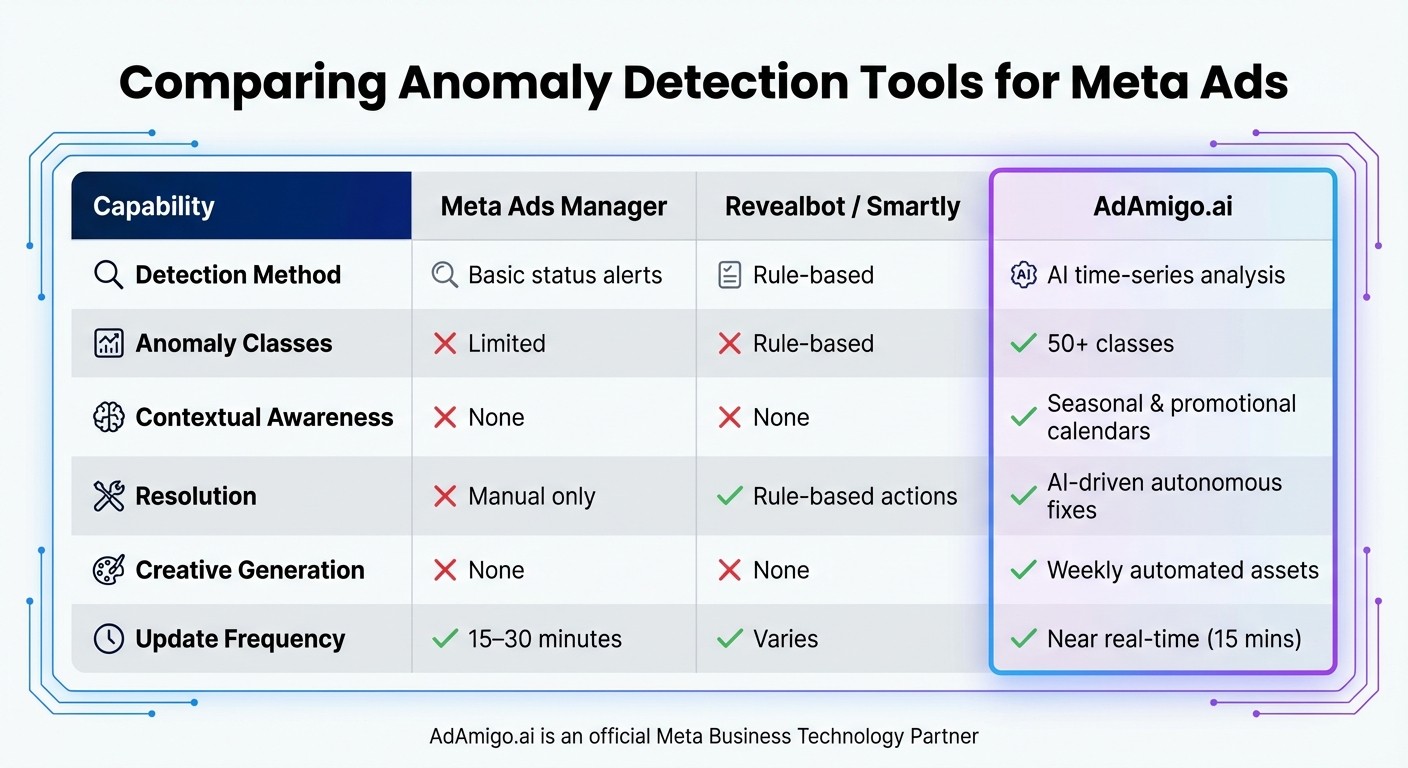
AI vs Traditional Meta Ads Anomaly Detection Methods Comparison
When it comes to ensuring success with Meta ads, having the right anomaly detection tools can make all the difference. Unlike traditional tools that rely on static rules, AI-powered solutions offer a more dynamic approach - learning, adapting, and even acting on their own.
AdAmigo.ai: Your Autonomous AI Partner for Meta Ads

AdAmigo.ai is a cutting-edge autonomous AI agent designed specifically for Meta ads. As an official Meta Business Technology Partner, it employs three specialized agents to streamline ad management:
AI Actions: Conducts 15-minute performance audits and provides daily prioritized adjustments.
AI Ads: Monitors competitors and creative performance while generating new assets weekly.
AI Chat: Delivers on-demand insights and enables bulk campaign launches.
This tool monitors over 50 types of anomalies, tackling issues like performance drops (CPA/ROAS shifts), setup inefficiencies (fragmented budgets), compliance challenges (policy violations), budget irregularities (over- or underspending), and technical glitches (pixel outages, bot traffic). Users can choose between Review Mode - to manually approve AI recommendations - or Autopilot Mode, which allows the system to take full control.
How AdAmigo.ai Enhances Anomaly Detection
AdAmigo.ai leverages AI time-series analysis to predict expected performance and identify deviations. It learns what’s "normal" for your specific account by analyzing historical data, seasonal trends, and promotional schedules. For example, a high CPA during Black Friday might be acceptable, but the same CPA on an ordinary Tuesday would trigger an alert.
What sets AdAmigo.ai apart is its ability to go beyond detection. It prioritizes anomalies based on financial impact, groups related issues to avoid overwhelming you with alerts, and takes corrective actions. These actions include consolidating fragmented budgets, pausing underperforming creatives, reallocating spend to high-ROAS ad sets, and troubleshooting Meta Ads pixel issues to prevent wasted budget. This blend of contextual understanding and autonomous problem-solving eliminates the inefficiencies of manual workflows or rigid rule-based systems.
Getting started is straightforward: connect your Meta ad account, set your KPIs and guardrails (e.g., "maintain ROAS ≥3×"), and review the AI’s daily recommendations. To maximize accuracy, integrate Meta’s Conversions API alongside the Pixel and aim for Event Match Quality (EMQ) scores between 8 and 10. High-quality data ensures better audience matching and optimization.
Comparing AI Tools for Meta Ads
Capability | AdAmigo.ai | ||
|---|---|---|---|
Detection Method | Basic status alerts | Rule-based | AI time-series analysis |
Anomaly Classes | Limited | Rule-based | 50+ classes |
Contextual Awareness | None | None | Seasonal & promotional calendars |
Resolution | Manual only | Rule-based actions | AI-driven autonomous fixes |
Creative Generation | None | None | Weekly automated assets |
Update Frequency | 15–30 minutes | Varies | Near real-time (15 mins) |
AdAmigo.ai stands out by combining advanced detection, contextual insights, and automated resolutions, making it a powerful ally for safeguarding your ad performance and budget.
Conclusion
AI-powered anomaly detection has reshaped the way businesses manage Meta ads, shifting the focus from fixing issues after they occur to actively improving performance as campaigns run. This evolution marks a departure from outdated methods like manual vs AI budget testing or rigid rules, which often fail to keep up with the fast-paced nature of modern campaigns. These older approaches tend to lack context, trigger unnecessary alerts, and often lead to wasted budgets before problems are even identified.
What sets AI tools apart is their ability to understand the normal behavior of your account. By recognizing the difference between routine changes and actual issues, AI minimizes unnecessary alerts and ensures you concentrate on problems that directly affect your results. This smarter approach not only saves time but also helps you make decisions that protect your ad spend and track ROI.
Taking it a step further, platforms like AdAmigo.ai automate the entire response process. If it detects fragmented budgets, low-performing creatives, or pixel failures, it acts quickly - reallocating budgets, pausing ineffective ads, and directing resources to high-performing campaigns. For agencies juggling multiple clients or in-house teams stretched to their limits, this level of automation allows one media buyer to manage 4–8× more accounts while maintaining or even boosting performance.
With tools like these, managing Meta ads becomes a streamlined process. Simply connect your ad account, set your KPIs and safety measures, and choose between Review or Autopilot Mode. The system then continuously audits your campaigns, prioritizes fixes based on financial impact, and provides a daily action list you can execute with just one click.
For businesses looking to scale their Meta ads without increasing overhead or wasting budget, AI-driven anomaly detection is no longer a luxury - it’s the key advantage that separates efficient growth from costly trial and error.
FAQs
What counts as an ad metrics anomaly?
An ad metrics anomaly refers to an unexpected shift in performance metrics. This could include issues like pixel malfunctions, sudden budget surges, low relevance scores, or sharp declines in engagement. Such irregularities might point to problems like setup errors, fraudulent activity, or even audience fatigue. Left unchecked, these anomalies can drain your ad budget and negatively impact your return on ad spend (ROAS).
How does AI reduce false alerts from normal seasonality?
AI reduces false alerts caused by normal seasonal changes by identifying anomalies through deviations from historical patterns rather than relying on fixed thresholds. By factoring in recurring seasonal trends, it ensures that alerts are raised only for genuinely unusual activity, cutting down on unnecessary false positives.
Should I use Review Mode or Autopilot for fixes?
When deciding between Review Mode and Autopilot, it really comes down to how much control you want over the process.
Review Mode gives you the ability to manually approve or tweak AI recommendations before they’re implemented. This option is perfect if you prefer having full oversight and want to ensure every change aligns with your goals.
Autopilot, on the other hand, takes a more hands-off approach. It automatically applies changes, making it a great choice if you’re confident in the AI’s capabilities and want to save time.
Choose Review Mode for closer supervision or Autopilot if efficiency and trust in the AI are your priorities.