
How Real-Time Data Improves Ad Targeting
How real-time data and server-side tracking improve ad targeting by reducing wasted spend, refreshing audiences, preventing ad fatigue, and boosting ROAS.
Real-time data is transforming how Meta ads perform by solving common problems like outdated audience targeting, delayed updates, and wasted ad spend. Traditional methods often rely on static lists that fail to reflect users' changing behaviors, leading to inefficiencies like showing ads to recent buyers or disengaged users. This results in higher costs and lower conversion rates.
Here’s what real-time data can do for your campaigns:
Reduce Waste: Exclude recent buyers from acquisition campaigns within minutes, cutting unnecessary spend by up to 25% as part of your strategy to reduce Facebook ad costs.
Boost Precision: Use live signals like website activity or purchase history to target high-intent users through behavioral clustering, lowering CPMs by 20–30%.
Improve Performance:Sync data instantly via tools like Meta’s Conversions API, enabling dynamic audience updates and better ROAS.
Prevent Ad Fatigue: Monitor engagement in real time to adjust frequency and refresh creatives, increasing user interaction by 10–20%.
Enhance Lookalike Audiences: Feed Meta fresh data to build more accurate audiences, improving ROAS by 2–3×.
Real-time data ensures your campaigns stay relevant and efficient by aligning ads with users' latest actions. Tools like AdAmigo.ai simplify this process by automating updates, optimizing bids, and refining targeting without manual effort. If you’re still relying on static lists, it’s time to rethink your strategy.
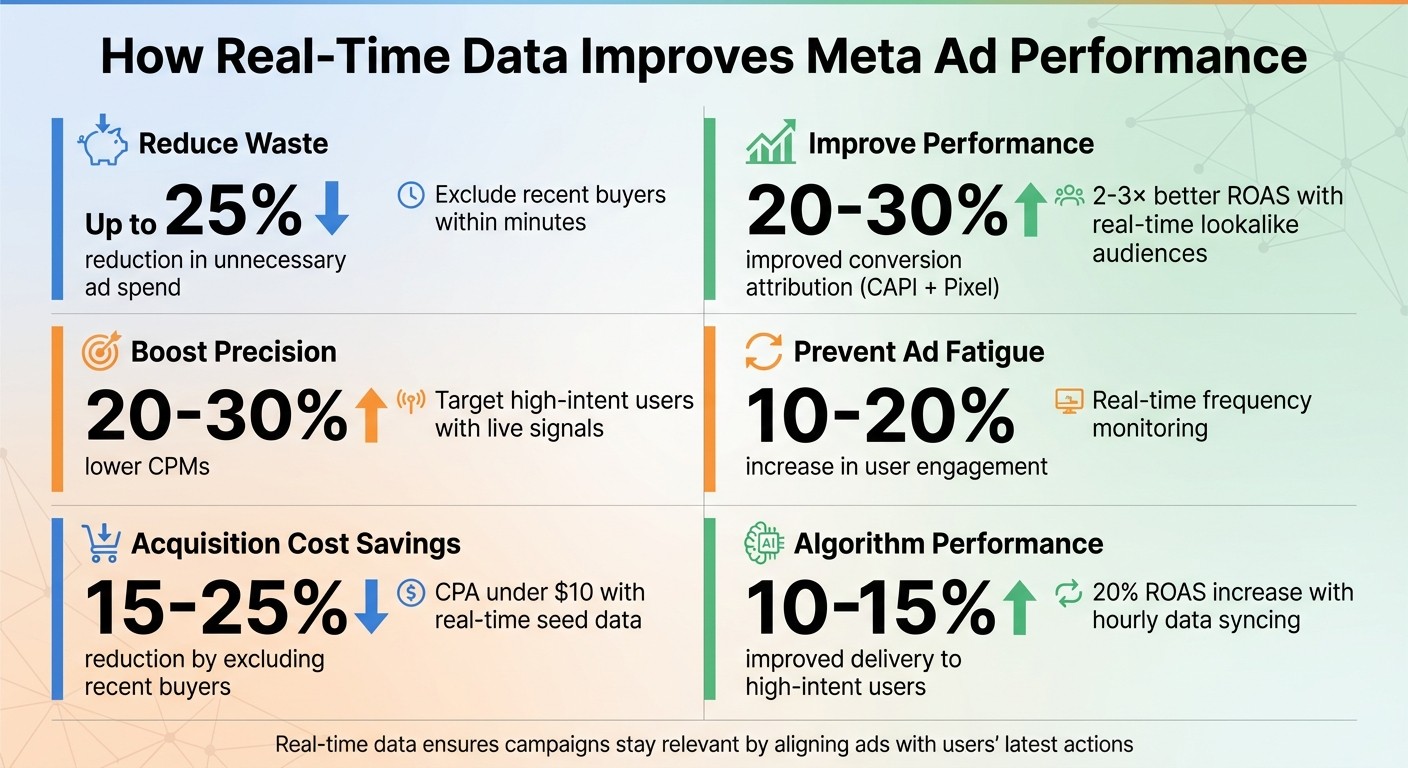
Real-Time Data Impact on Meta Ad Performance: Key Statistics
The ONLY Meta Ads Targeting Tutorial You Need in 2025
Common Targeting Problems in Meta Ads
Meta advertisers often encounter three major challenges: outdated audience lists, privacy restrictions, and delayed data. These issues not only inflate costs but also hinder campaign performance. Let’s break down how each problem impacts ad targeting and why real-time data can be a game-changer.
Why Outdated Lists Drain Your Budget
Static audience lists are a common culprit behind wasted ad spend. These lists quickly lose relevance as they fail to account for changes in user behavior. Customers who’ve already purchased or disengaged users often remain in these segments because updates happen too infrequently. The result? Money gets spent targeting people who are no longer a good fit.
You’ll notice the impact in Ads Manager: higher ad frequency, lower click-through rates (CTR), and rising cost per acquisition (CPA), even if your creative or offer hasn’t changed. Without real-time updates, Meta’s algorithm keeps serving ads to the same stale audience, leading to fatigue and missed chances to engage new, active users. And if that wasn’t enough, privacy changes add another layer of complexity.
The Impact of Privacy Changes on Targeting
Privacy updates, like Apple’s App Tracking Transparency and the decline of third-party cookies, have significantly reduced the data Meta uses to build interest-based audiences and lookalikes. This has led to smaller remarketing pools, less precise targeting, and a growing reliance on estimated data that often comes with delays.
In this new landscape, first-party data is more important than ever. Behavioral signals from your website, app, or CRM can be shared with Meta in real time using server-side integrations, helping to restore some of the lost targeting precision. Relying solely on third-party data or uploading lists sporadically leaves advertisers struggling to keep up in a fast-evolving environment. These privacy shifts make real-time data not just helpful but essential.
How Delayed Data Derails Campaigns
When conversion data doesn’t sync quickly, campaigns end up optimizing based on outdated information. This can lock your budget into underperforming ad sets while high-performing segments miss out on scaling opportunities. For example, acquisition campaigns might keep targeting recent buyers simply because their purchase hasn’t been logged yet. Similarly, retargeting efforts might waste spend on users who’ve already returned their orders due to refund data delays.
Real-time data pipelines, like Meta’s Conversions API, solve this issue by providing up-to-the-minute feedback. This enables the algorithm to exclude recent buyers, avoid low-intent users, and shift budget toward segments that are actively converting by using AI-driven resource prioritization. It’s a more dynamic approach that ensures your campaigns stay aligned with real-world behavior.
How Real-Time Data Enables Dynamic Audience Segmentation
Dynamic audience segmentation ensures your targeting lists stay updated automatically as user behavior evolves, rather than requiring manual updates. For instance, when someone adds an item to their cart, completes a purchase, or leaves your site without buying, dynamic segments adjust within minutes. Tools like Meta's Custom and Lookalike Audiences use these live signals to ensure your ads stay relevant to users' current journey stages.
This approach is a game-changer compared to manually uploading a CSV of past buyers once a month. Static lists treat every user the same until you manually update them, often leaving you targeting outdated information. Dynamic segments, however, adapt in real time to actions like page views, cart updates, purchases, and changes in customer lifetime value. This means your acquisition campaigns can automatically exclude recent buyers, while retargeting ads focus on users who haven’t converted yet.
Dynamic vs. Static Audience Segments
Static segments are essentially frozen snapshots - lists of email addresses or user IDs captured at a specific point in time. They don't change when someone makes a purchase, churns, or re-engages. On the other hand, dynamic segments automatically update based on user behavior, engagement, and identity data, following the rules you set.
This real-time adaptability is crucial because Meta's algorithm performs better when audience definitions stay current. If you feed it outdated data, it may focus on users who are no longer relevant. But with real-time inputs, the algorithm can prioritize high-intent prospects and shift resources away from less promising segments.
Real-Time Data Sources for Meta Ads
Dynamic segmentation relies on real-time data from key user interactions. The primary sources include the Meta Pixel (tracking browser events like product views and purchases), Conversions API (capturing server-side events to bypass ad blockers and iOS privacy limits), and first-party data from your CRM or CDP. For example, when a user views a product page, that event is instantly recorded by Pixel and CAPI, updating your Custom Audiences. If the user completes a purchase, Meta immediately receives the conversion signal, triggering suppression rules or moving them into a post-purchase segment.
Updates to customer lifetime value (CLV) work similarly. When your CRM recalculates a customer’s CLV after a repeat purchase, the updated profile syncs back to Meta, refining Lookalike Audiences. Instead of relying on outdated exports of "high-value customers", you’re using data from customers who became high-value this week. Real-time location data also enables segments like "visited store in the last seven days" or "currently within two miles of a location", allowing you to deliver highly targeted offers.
What You Need to Use Real-Time Data
To leverage real-time data effectively, you’ll need three key components:
Meta Pixel: Installed via a tag manager, this tracks client-side browser activity.
Conversions API (CAPI): Configured on your server or through a partner integration, CAPI ensures data reaches Meta even when users block cookies or opt out of tracking.
First-party data collection system: A CRM, CDP, or marketing automation platform to store behavioral and transactional data, syncing updates to Meta daily or in real time.
Additionally, a data integration layer is essential for connecting these components and pushing real-time updates to Meta. Platforms like AdAmigo.ai streamline this process by continuously analyzing performance data and automatically adjusting targeting, creatives, and bids based on live signals. This setup ensures your campaigns adapt seamlessly without requiring constant manual oversight. Importantly, the system must comply with privacy and consent regulations, using only data from users who have opted in.
Fixing Targeting Problems with Real-Time Data
Real-time data can tackle some of the biggest challenges in Meta ad targeting by allowing campaigns to adapt minute-by-minute. This flexibility ensures your ads stay relevant, reduces wasted spending, and improves overall performance. When combined with dynamic audience adjustments, real-time adjustments keep your campaigns aligned with the latest audience behaviors.
Stop Wasting Budget on Low-Intent Users
Static audience lists treat every visitor the same, regardless of how recently they interacted with your brand. Real-time behavior data changes the game by capturing signals like recent product views, search activity, or cart additions using AI tools for interest-based targeting. This allows Meta's algorithm to zero in on users who are actively considering a purchase.
The impact? Retailers using tools like Captify to leverage real-time search intent data have seen CPMs drop by 20–30% just by targeting in-market shoppers. This kind of precision not only makes ads more relevant but also helps lower acquisition costs and stretch ad budgets further.
Exclude Recent Buyers from Acquisition Campaigns
Few things annoy customers more than being bombarded with ads for something they just bought. This happens when exclusion lists don’t update frequently enough. Real-time purchase tracking solves this by removing buyers from acquisition campaigns within minutes. The result? Fewer wasted impressions and a smoother customer experience.
By setting an exclusion window - typically between 7 and 30 days - your system can automatically update and prevent unnecessary spending. Studies show this approach can cut acquisition costs by 15–25%.
Reduce Ad Fatigue and Frequency Problems
Ad fatigue happens when users see the same ad too many times, which can hurt engagement and overall campaign performance. Static audience segments only make this worse since they don’t adapt to changing user behavior. Real-time data, on the other hand, keeps things fresh by continuously updating audiences with new behaviors - like recent interactions, location changes, or engagement spikes.
You can also monitor bounce rates and engagement metrics in real time to identify when users are seeing your ads too often. By pausing ads for overexposed users or rotating creatives, campaigns have boosted engagement by 10–20%. Platforms like AdAmigo.ai automate this process, tracking your ads around the clock and tweaking targeting before fatigue sets in.
Improve Lookalike Campaign Results
Lookalike Audiences are only as good as the data you feed them. If your seed list is outdated, the audience Meta builds will reflect old patterns. Real-time seed audiences, updated every 15–60 minutes through pixel events, provide Meta with up-to-date signals from active converters.
The difference is striking. Campaigns that use real-time seed data have reported 2–3× better ROAS while keeping CPA under $10. The secret lies in giving Meta data from high-value customers who converted recently, not months ago.
Keep Messaging Consistent Across Channels
When your email, SMS, and Meta ads operate independently, users can end up receiving mixed messages - or worse, seeing the same offer repeatedly. Real-time audience syncing through tools like identity graphs or CDP integration for real-time targeting ensures all channels work together seamlessly.
For instance, Experian’s Digital Graph combines real-time search data with first-party insights to deliver consistent messaging across platforms. This system prevents overlaps, like showing a Meta ad to someone who just opened an SMS, and aligns messaging based on shared intent scores. With API syncing that updates multiple times a day, you can ensure your offers stay consistent across every touchpoint.
Syncing Data Across Platforms for Meta Ads
To make Meta ads truly effective, you need to connect your data sources - like your CRM, point-of-sale (POS) systems, and website analytics - so they work together seamlessly. This ensures your campaigns stay aligned with real-time audience behavior. The backbone of this process is Meta's Conversions API (CAPI), which facilitates direct system-to-system communication. For example, you can send purchase events from Shopify, lead updates from HubSpot, or in-store sales from your POS directly to Meta, often in seconds. Brands that combine CAPI with pixel tracking have reported 20–30% improved conversion attribution compared to relying solely on the pixel. This integration sets the stage for real-time optimization across all your channels.
Where Real-Time Data Comes From
The most critical data for your campaigns comes from three primary sources:
CRM systems: These hold customer profiles, purchase histories, and engagement scores.
POS systems: In-store transactions that need to sync with your online campaigns.
Website events: Actions like page views, cart additions, and purchases.
Each of these systems can send data directly to Meta using server-side integrations. For instance, when a customer completes a purchase on Shopify, a webhook can update your custom audiences to exclude that buyer - often within 30 seconds. This ensures your ads remain relevant and avoid targeting the wrong people.
Best Practices for Data Synchronization
To get the most out of your data, it’s important to sync it at the right frequency. The timing depends on the type of data and how quickly it needs to be acted upon:
Real-time syncing: This is ideal for high-priority actions like cart abandons or form submissions, enabling immediate retargeting.
Hourly syncing: Perfect for CRM updates that refresh lookalike audiences without overloading the API.
Daily syncing: Best for slower-moving data like POS summaries or compliance reports.
Tools like Segment or RudderStack can simplify this process by automating field mapping. For example, they can standardize your CRM's "email" field to match CAPI's "em" parameter using SHA256 hashing. Additionally, using unique event IDs helps avoid duplicate counts, and implementing consent checks through platforms like OneTrust is crucial. Without proper consent, unapproved events are rejected, which can lower match rates by 15–20% in privacy-conscious environments. Once your data is synced, Meta’s systems can optimize ad delivery with greater precision.
How Learning Systems Improve Performance
Meta’s Andromeda engine uses billions of signals to rank ads in real time. Feeding it fresh data - like sub-hourly updates from CAPI - allows it to make more accurate predictions, improving delivery to high-intent users by 10–15%. This rapid data flow builds on the efficiency gains mentioned earlier. Advantage+ campaigns take this a step further by leveraging machine learning to expand beyond seed audiences and automatically optimize placements. This process is enhanced by AI audience profiling, which identifies high-value segments more effectively.
However, these systems thrive only when they receive dense (high event volume), clean (accurate labels), and fresh (recently synced) data. Research shows that syncing website and CRM data hourly can increase ROAS by 20% in Advantage+ campaigns, as the algorithm learns more quickly and scales successful strategies aggressively. Platforms like AdAmigo.ai integrate directly with Meta to automate and adjust campaigns in real time, keeping them aligned with Andromeda’s learning cycles and ensuring your ads perform at their best around the clock.
Measuring the Impact of Real-Time Data on Ad Performance
When you implement real-time optimization, it’s essential to evaluate how it affects your ad performance. To do this, track metrics like ROAS (Return on Ad Spend), CPA (Cost Per Acquisition), conversion rate, CTR (Click-Through Rate) benchmarks, and frequency. These numbers reveal whether real-time targeting is delivering higher revenue and reducing costs, and increasing audience engagement. Essentially, they show how real-time data isn’t just updating segments - it’s driving meaningful results.
Key Metrics to Monitor
Effective real-time targeting should lead to higher ROAS, lower CPA, better conversion rates, and a balanced frequency that avoids ad fatigue.
Conducting Before-and-After Tests
To gauge the effectiveness of real-time data, run a simple A/B test. Create one ad set with static audiences and another using real-time audiences, ensuring all other variables remain constant. Let the test run for 7–14 days, allowing both ad sets to complete their learning phases. Use consistent attribution windows - like a 1-day or 7-day click window - to keep the comparison fair. If simultaneous testing isn’t feasible, establish a stable two-to-four-week baseline using static audiences. Then, switch to real-time segmentation for the same period and compare results. Be sure to account for external factors like seasonal shifts or major promotions to ensure an accurate evaluation.
Creating a Feedback Loop for Continuous Improvement
Real-time targeting works best when performance data feeds directly into refining your segmentation. For example, if users who added items to their cart within the past 12 hours convert three times more frequently than those from 48 hours ago, adjust your recency window accordingly. Tools like AdAmigo.ai make this process seamless by automating live performance updates. These platforms monitor campaign performance at both the ad set and audience levels, suggesting or even launching new real-time segments while reallocating budgets to top-performing groups.
AdAmigo.ai’s AI Actions can handle tasks like excluding recent buyers, refreshing lookalike audiences, and tweaking bids. Meanwhile, its AI Chat Agent provides clear insights and actionable recommendations, turning campaign optimization into an ongoing process. This constant stream of insights not only improves immediate performance but also builds a foundation for smarter campaigns over time.
Conclusion
Real-time data has become a game-changer in the world of Meta advertising. Brands and agencies leveraging live behavioral signals and continuous optimization can cut down on wasted spend, respond quickly to iOS privacy updates or platform changes, and see consistent performance improvements. On the other hand, relying on static lists and delayed reporting often leads to higher costs for less effective results.
With AI audience segmentation, audiences are updated instantly - removing recent converters or disengaged users from targeting. This dynamic approach improves key metrics like CTR, conversion rates, and ROAS by allowing timely adjustments to ads, bids, and targeting strategies. Even better, it transforms ad buying into a continuous feedback loop, refining targeting as AI learns from performance data with every impression and freeing up teams to focus on big-picture strategies instead of tedious manual tweaks.
Of course, building a real-time data pipeline can be a heavy lift, especially for smaller teams with tight budgets. That’s where tools like AdAmigo.ai come in. This autonomous solution connects to your Meta ad account in minutes and handles everything from audience updates to creative optimization. Tasks like excluding recent buyers or refreshing lookalike audiences are automated, making it easier to achieve better results without the need for constant hands-on management.
Real-time data isn’t just a nice-to-have - it’s essential for running effective Meta ad campaigns. Whether you’re part of an agency or an in-house team, integrating a real-time, learning-driven system can help you hit your KPIs - like target ROAS or cost per acquisition - faster. By connecting your Meta ad account and letting the system optimize continuously, you could see noticeable improvements in efficiency and scale within just a few weeks.
FAQs
How does real-time data help minimize wasted ad spend?
Real-time data allows you to cut down on wasted ad spend by making instant tweaks to your campaigns. It helps pinpoint ads that aren't performing well and shifts your budget toward strategies that yield better outcomes - ensuring every dollar is put to better use.
With these real-time insights, you can fine-tune your targeting, improve your ad creatives, and zero in on the audiences that drive results. This not only reduces inefficiencies but also boosts your campaign's overall performance.
How does using Meta's Conversions API benefit ad targeting?
Using Meta's Conversions API allows you to refine your ad targeting by delivering precise, real-time data straight from your servers. This method enhances event tracking, minimizes attribution errors, and ensures your campaigns are fine-tuned using dependable insights. By integrating this API, you can tackle common challenges and make smarter, data-backed choices to boost your ad performance.
How does using real-time data make lookalike audiences more accurate?
Real-time data keeps lookalike audiences sharp by continuously updating profiles with the latest behaviors and conversion patterns. This means your targeting remains in sync with what users are actually interested in right now.
With these ever-evolving insights, AI tools can refine how they match audiences, connecting you with individuals who are more likely to interact with your ads. The outcome? More accurate targeting and improved campaign results.