
Transparency in Meta Ads: Reporting Standards
2026 ad transparency: AI labels, strict business verification, CAPI tracking, attribution changes, and compliance automation.
Meta’s advertising platform in 2026 is all about transparency and compliance, driven by stricter regulations like the EU's Digital Services Act (DSA). Key changes include:
Less Personalized Ads (LPA): Ads now use 90% less data for European users, requiring advertisers to work with fewer targeting signals.
AI Content Labels: Ads created or edited with AI must display clear labels, especially for photorealistic human content or social/political topics.
Business Verification: Advertisers must meet stricter requirements, such as matching legal documents exactly and verifying domains.
Attribution Changes: Shorter attribution windows and modeled conversions replace direct tracking, with delays of up to 72 hours.
End of Lookalike Audiences: Predictive modeling now replaces traditional audience-building methods.
Conversions API (CAPI): Essential for accurate tracking, bypassing browser restrictions and improving match rates to 85–95%.
Meta also introduced AI tools in Ads Manager to assist with reporting and audience insights. However, external platforms like AdAmigo.ai offer more advanced solutions by automating compliance checks, optimizing campaigns, and providing actionable insights.
These updates aim to balance user privacy with ad performance, making compliance and automation critical for advertisers in 2026.
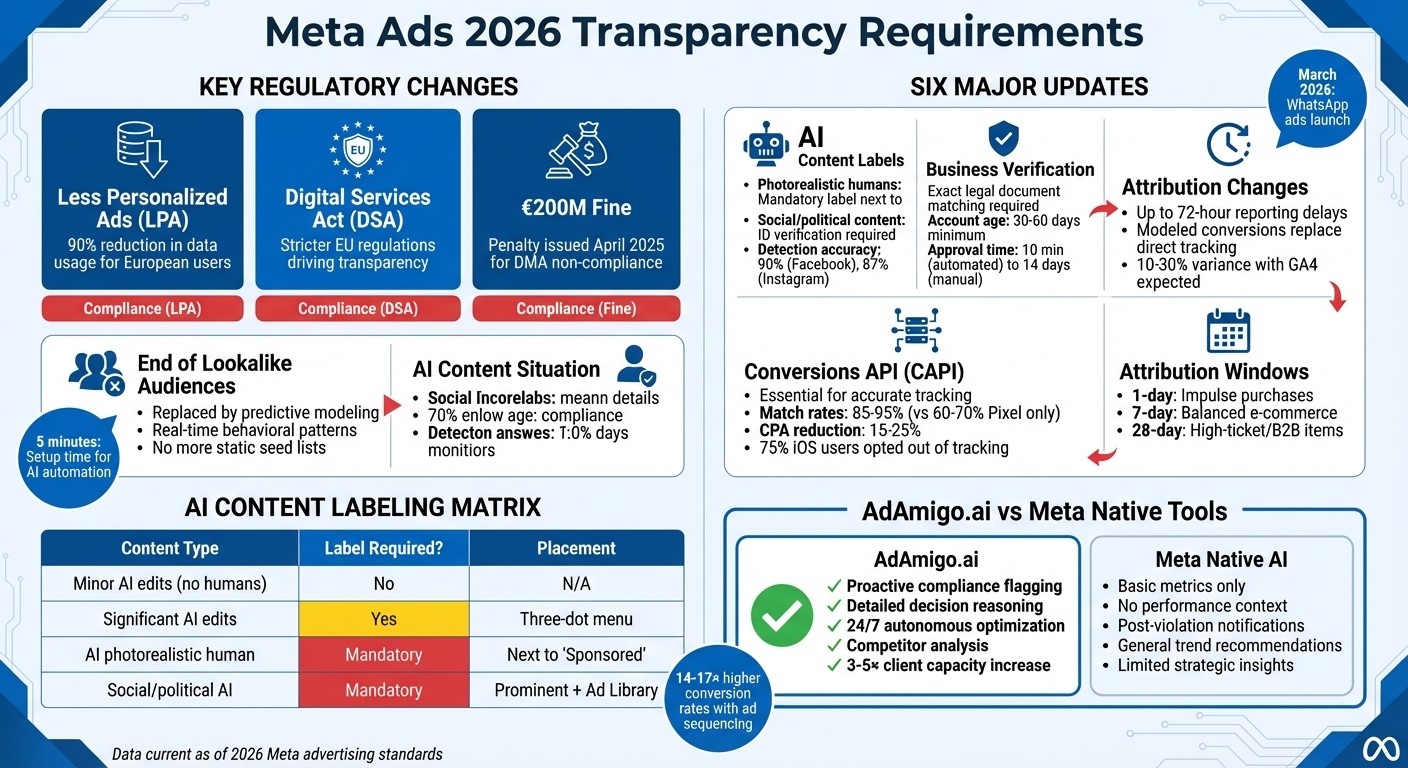
Meta Ads 2026 Transparency Requirements: Key Changes and Compliance Guide
2026 Changes to Meta's Reporting Standards

Meta has rolled out updates in 2026 to refine its data and audience management practices, continuing its focus on transparency and compliance. These updates include three key changes that reshape how advertisers handle reporting and adapt to privacy and regulatory challenges.
Required Data Source Disclosures
Advertisers now face tighter tracking restrictions, which can impact the accuracy of reporting. For example, Apple's App Tracking Transparency framework has pushed Meta to rely more on modeled conversions, causing delays in reporting performance data. It's not uncommon for Monday morning data in Ads Manager to still be adjusting due to weekend activity.
To mitigate these delays, Meta recommends using its Conversions API (CAPI) alongside the Pixel. CAPI allows conversion data to flow directly from your server to Meta, avoiding browser-level restrictions and improving data accuracy.
End of Lookalike Audiences
Meta is retiring traditional lookalike audiences and replacing them with predictive modeling. Instead of relying on uploaded customer lists to create audiences, the new system uses broader behavioral patterns and real-time campaign performance to expand audiences. This automated approach eliminates the need for static seed lists, requiring advertisers to adapt to a more dynamic and data-driven system.
Enhanced Ad Identity Verification
Business verification has become much stricter in 2026. Meta now demands that all details in your Business Manager match exactly with your legal documents. Even minor discrepancies, like omitting a comma in "ABC Marketing, Inc.", can lead to rejection.
To complete the verification process, businesses must meet several requirements:
Your Business Manager account must be at least 30–60 days old.
The primary domain must be verified under the "Brand Safety" section.
The administrator initiating verification must enable two-factor authentication.
A domain-specific email address (e.g., name@yourcompany.com) must be used instead of generic email providers, which can raise red flags during manual reviews.
Approval times vary depending on the review type. Automated reviews can be completed in as little as 10 minutes, while manual reviews may take anywhere from 48 hours to 14 business days. Agencies must also verify their own business identity before requesting access to client assets through a verified Business Manager.
AI Content Disclosure Requirements
Meta is stepping up its transparency efforts by introducing new rules for disclosing the use of AI in ad creation. These requirements, which took effect in 2026, aim to keep users informed about how artificial intelligence contributes to the content they see. Advertisers are now required to label ads that are created or heavily modified using generative AI tools, whether those tools are provided by Meta or third-party platforms.
Pedro Pavón, Meta's Director of Monetization Policy, explained the reasoning behind this initiative:
Our labels are designed to help people understand when images and videos have been created or significantly edited with our in-house generative AI tools.
How the Labeling System Works
Meta uses a tiered approach to determine when AI-generated content needs a label. Minor changes, like cropping or adjusting brightness, don’t require disclosure. But when significant edits are made, labels are mandatory. Here’s how the system is structured:
Content Type | Label Requirement | Label Placement |
|---|---|---|
Minor AI edits (no humans) | No label required | N/A |
Significant AI edits | Label required | Three-dot menu or next to "Sponsored" |
AI-generated photorealistic human | Mandatory label | Next to "Sponsored" (visible) |
Social/political AI content | Mandatory disclosure + ID verification | Prominent label + Ad Library archive |
Ads featuring photorealistic humans created with AI must display a label prominently next to the "Sponsored" tag. This applies regardless of whether the AI tools used are Meta’s or from other providers. For social or political ads, additional disclosures and ID verification are required, with these ads archived in the Ad Library.
Impact on Ad Strategies
These new rules are reshaping how advertisers approach AI-generated content. Visible AI labels could affect engagement, especially in industries where trust and authenticity are critical, such as healthcare, finance, or personal testimonials.
For example, if your ad includes AI-generated people, the label will appear next to the "Sponsored" tag. This high-visibility placement could influence how audiences perceive your brand and even impact click-through rates.
Meta’s advanced systems are designed to enforce these rules effectively. On Facebook, the accuracy rate for detecting AI-generated content is over 90%, while on Instagram, it’s 87%. These systems also help identify scams, like celebrity impersonations, using advanced Large Language Models that outperform human reviewers. Ads that fail to comply with the labeling requirements will be flagged during the review process, so staying compliant with data standards is essential. This includes understanding technical requirements like Meta Consent Mode to protect user privacy.
To ensure your ads meet these standards, conduct regular audits of your creative assets. Pay close attention to whether your content falls under the "significant edit" or "photorealistic human" categories. Users can also check if AI was involved in ad creation by clicking "Why am I seeing this ad?" - a feature that further emphasizes the importance of compliance.
Attribution and Performance Tracking Changes
Shorter Attribution Windows
By 2026, Meta's attribution system leans heavily on modeled conversions rather than direct tracking, largely due to privacy measures like Apple's App Tracking Transparency. Instead of real-time data, conversions are now estimated based on patterns, with delays of up to 72 hours for iOS users. This shift makes real-time optimization more challenging.
The choice of attribution window plays a big role in how accurate your reports are. For example:
1-day click window: Best for impulse buys or low-cost items, but it might miss conversions for products with longer decision times.
7-day click window: Offers a balanced view, making it suitable for most e-commerce campaigns.
28-day click window: Captures more conversions, which can be helpful for high-ticket items or B2B campaigns, but it risks over-attribution.
To see how different attribution windows affect your data, you can use the "Compare Attribution Settings" tool in Ads Manager. Keep in mind, though, that it's normal to see a 10–30% variance between Meta Ads Manager and Google Analytics 4 due to differences in how they attribute conversions. These adjustments highlight Meta's approach to adapting to evolving privacy standards.
iOS Privacy Changes and CAPI Requirements
Apple's App Tracking Transparency framework has reshaped how Meta tracks conversions. After iOS 14.5, around 75% of users opted out of tracking, leaving browser-based Pixel tracking to capture only 60–70% of conversions. However, combining the Meta Pixel with the Conversions API (CAPI) boosts match rates to around 85–95%. By 2026, CAPI has become essential for advertisers who want accurate performance tracking since it avoids browser limitations and ad blockers.
For better results with CAPI, use event deduplication (relying on event_id, event_name, and event_time) and prioritize key conversion events in Aggregated Event Measurement (AEM). These steps can improve data accuracy and reduce CPA by 15–25%. Additionally, providing extra customer details - like hashed emails, phone numbers, and external IDs - enhances Event Match Quality (EMQ) scores. Regularly checking diagnostics in Events Manager can help identify and fix issues before they hurt your campaign's performance.
If you're managing a more complex setup, tools like Stape or Triple Whale can simplify CAPI integration. Costs for these tools range from $50 to $500 per month, depending on the volume of events you need to process.
Tools for Compliance and Reporting Efficiency
Trying to manually manage Meta's 2026 transparency requirements can quickly become a daunting task. Thankfully, tools like Supermetrics and Funnel.io simplify the process by pulling Meta data directly into business intelligence platforms. Meta and third-party attribution tools like Triple Whale and Northbeam go a step further, offering multi-touch modeling to connect revenue across various channels. For a unified reporting experience, dashboard solutions like Databox and AgencyAnalytics bring all cross-platform data into a single, easy-to-read view.
Meta has also introduced an AI-powered reporting assistant within Ads Manager. This tool automates tasks like report creation and audience research. However, it only provides basic metrics and doesn’t delve into explaining performance shifts or flagging compliance risks. While these tools are helpful, they leave room for platforms like AdAmigo.ai to step in and offer more integrated and advanced solutions.
AdAmigo.ai: Automated Compliance and Optimization
AdAmigo.ai is more than just a reporting tool - it's an autonomous AI media buyer designed to handle both compliance and optimization seamlessly. As a certified Meta Business Technology Partner, it proactively flags potential policy violations in areas like creatives, targeting, or landing pages before an ad even goes live. This creates a clear audit trail, making internal reviews or regulatory checks far more straightforward.
But AdAmigo.ai doesn’t stop at compliance. Its suite of tools takes optimization to the next level:
The AI Ads Agent learns your brand identity, studies competitor ads, and generates new creative assets.
The AI Actions feature provides a daily list of prioritized optimizations - covering creatives, audiences, budgets, and bids - complete with detailed explanations for each recommendation.
The AI Chat Agent allows real-time interaction. You can ask questions like, "Why did ROAS drop yesterday?" or give commands such as, "Launch a new retargeting campaign", and the system executes changes directly from the chat.
For agencies, the Bulk Ad Launcher deploys hundreds of ads in one go from Google Drive, all while maintaining consistent privacy and compliance standards.
How AdAmigo.ai Helps Advertisers
AdAmigo.ai builds on automation to offer a fully autonomous solution that bridges the gap between compliance and campaign optimization.
Unlike Meta’s native tools, which provide metrics without much context, AdAmigo.ai explains the reasoning behind every decision. For instance, it clarifies why a certain audience is outperforming others or why a budget adjustment was made. This level of transparency becomes especially critical as Meta introduces modeled conversions and shorter attribution windows in 2026, which can obscure the factors driving campaign performance.
Getting started is straightforward. In just five minutes, you can set performance goals like "Increase spend by 30% while maintaining a ROAS of 3× or higher." From there, the platform continuously audits your ad account, identifies opportunities, and implements improvements 24/7. For agencies, this means a single media buyer can handle 3–5× more clients by delegating execution to the AI. In-house teams can reduce or even eliminate the need for additional hires by relying on an AI media buyer that grows more effective over time.
Feature | AdAmigo.ai | Meta's Native AI Tools |
|---|---|---|
Decision Transparency | Offers detailed reasoning for every optimization | Provides basic metrics without context |
Creative Optimization | Analyzes competitors and explains creative choices | Recommends creatives based on general trends |
Budget Management | Tracks changes with strategic explanations | Adjusts budgets with limited context |
Compliance | Flags issues proactively to prevent rejections | Notifies after violations occur |
Reporting | Delivers actionable insights | Focuses on standard metrics |
Conclusion
Meta's 2026 transparency requirements are reshaping how campaigns are managed. With the introduction of the Digital Markets Act's cross-app consent flows and a 90% reduction in data for Less Personalized Ads, advertisers must stay on their toes to remain compliant. The €200 million fine in April 2025 for failing to meet DMA standards serves as a clear reminder that regulators mean business.
Trying to keep up manually is no longer feasible. Shorter attribution windows, implementing Meta Conversions API, and adapting to new ad placements - like WhatsApp ads launching in March 2026 - make automation a necessity. Advertisers are now merging compliance efforts with optimization strategies.
AdAmigo.ai is stepping in to simplify this process. It flags policy violations before an ad even goes live, explains audience performance despite limited data, and runs optimizations 24/7 while maintaining detailed audit trails. For agencies juggling multiple clients or in-house teams handling heavy workloads, this tool allows a single media buyer to manage 3–5× more accounts.
The reporting game has also changed. While Meta's native AI tools offer basic metrics, they often fall short compared to the best Meta ads reporting dashboards when delivering the strategic insights needed to anticipate performance changes or avoid compliance issues. As ad sequencing continues to drive conversion rates 14–17× higher and new placement options become available, advertisers need tools that not only execute tasks but also provide valuable insights. With a simple setup - connecting your account, setting KPIs, and letting the AI take over in just five minutes - this approach doesn’t just streamline compliance. It also offers a deeper understanding of campaign performance.
FAQs
How do Less Personalized Ads change my targeting options?
Less personalized ads limit targeting precision because they restrict the use of detailed individual data and behavioral signals. This often leads to broader audience segments and fewer options for fine-tuned targeting, making it more challenging to connect with highly specific groups.
When do I need to add an AI label to my Meta ads?
Meta now requires an AI label on ads if they utilize in-house generative AI tools to make major edits to images or videos. This includes cases where the ad features AI-generated photorealistic humans. However, minor edits that do not involve creating photorealistic humans are exempt from this labeling requirement.
What do I need to set up the Conversions API correctly?
To correctly set up the Meta Conversions API, start by configuring your data sharing and event tracking properly. Tools like the Meta Pixel and API integration are essential for accurately tracking conversions and user interactions. Also, ensure your setup aligns with Meta's transparency and reporting guidelines to achieve the best results.