Meta's AI Disclosure Rules: What Advertisers Must Know
Meta now rejects ads without proper AI disclosure labels. Guide to what needs labeling, where labels appear, third-party tool rules, and how to avoid penalties.
Meta now requires advertisers to clearly label ads featuring AI-generated or heavily edited content. These labels aim to ensure transparency, build trust, and comply with evolving regulations. Here's what you need to know:
Where Labels Appear: Ads will display an "AI info" label either in the three-dot menu or next to the "Sponsored" tag.
What Requires Disclosure: AI-generated visuals, photorealistic humans, and significant edits must be labeled. Minor tweaks, like cropping or color adjustments, are exempt.
Political Ads: Strictest rules apply, requiring disclosure of all AI-altered content, including third-party AI usage.
Compliance Challenges: Mislabeling or omitting disclosures can lead to ad rejections, penalties, and campaign disruptions.
Third-Party Tools: Ads made with AI tools that generate ad creatives require manual disclosure, as Meta does not auto-label these.
To avoid penalties, advertisers should identify AI-generated content, enable Meta's disclosure settings, and maintain detailed records of AI usage. Tools like AdAmigo.ai can help streamline compliance by automating disclosures and tracking policy updates.
Common Compliance Problems Advertisers Face
Meta AI Disclosure Requirements by Ad Type and Content
Navigating Meta's AI disclosure rules can be tricky, especially for advertisers juggling multiple campaigns or relying on third-party creative tools. Missteps can lead to ad rejections or even financial penalties, which can quickly add up. Here’s a closer look at some of the most common compliance challenges.
Ad Rejections and Financial Penalties
One of the biggest pitfalls is failing to properly label AI-generated content, which often results in ad rejections. Meta’s systems are designed to flag ads containing "material edits" created with generative AI - like AI-generated backgrounds or images - if they lack the required disclosure. When advertisers miss these requirements, their campaigns get disrupted, and budgets are wasted on ads that never reach their intended audience.
Repeated violations can escalate the problem. Nick Clegg, Meta’s Head of Global Affairs, has emphasized the importance of compliance:
"If we determine that an advertiser doesn't disclose as required, we will reject the ad and repeated failure to disclose may result in penalties against the advertiser".
While the exact penalties vary, the real cost often comes in the form of lost campaign momentum and the resources needed to fix compliance issues. These challenges become even more pronounced when advertisers use top AI tools for Meta ads.
Third-Party AI Tools and Labeling Issues
Third-party AI platforms create a unique compliance challenge. Ads designed with these tools require manual disclosure since Meta only auto-labels content created with its own generative AI features. Many advertisers overlook this responsibility, leading to compliance gaps.
Meta does attempt to detect third-party AI content by scanning for metadata signals that are standard in the industry. However, this system isn’t foolproof. If the metadata isn’t embedded correctly - or gets stripped during the export process - ads may bypass proper labeling, leaving advertisers vulnerable to unintentional violations. Managing these risks requires compliance monitoring, especially when dealing with external tools.
Disclosing Photorealistic AI-Generated Images
Photorealistic AI-generated humans require the strictest disclosure standards. Ads featuring lifelike people who don’t actually exist must include a disclosure label placed prominently next to the "Sponsored" tag, rather than being hidden in the three-dot menu. This rule applies even if the AI-generated person is just one part of an otherwise genuine ad.
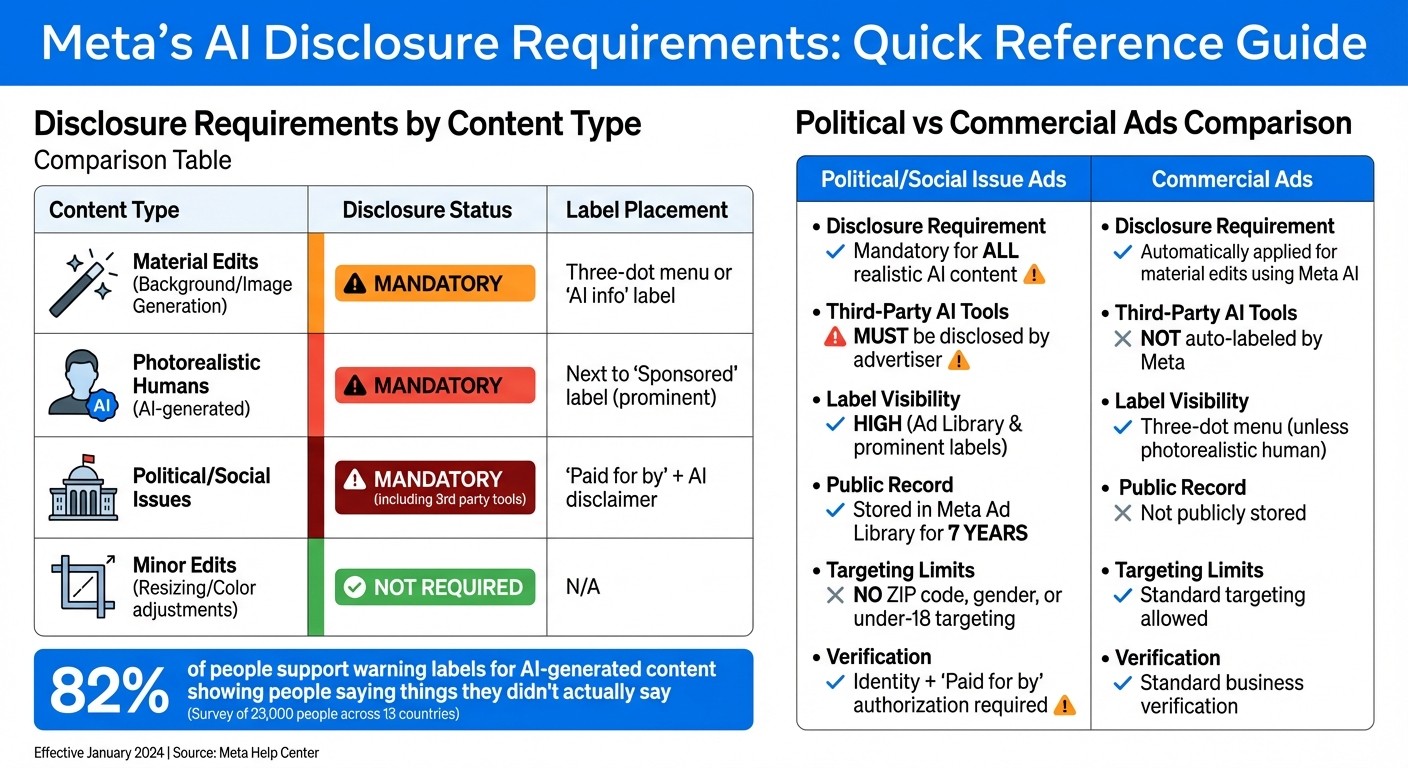
A common challenge for advertisers is determining what qualifies as a "material" edit versus a minor one. This uncertainty can lead to inconsistent labeling. A global survey of 23,000 people across 13 countries revealed that 82% support warning labels for AI-generated content showing people saying things they didn’t actually say. Meta enforces strict rules to address these concerns, but the ambiguity around classification often trips up advertisers.
AI Content Type | Disclosure Requirement | Label Placement |
|---|---|---|
Material Edits (Background/Image Gen) | Mandatory Disclosure | Three-dot menu or "AI info" label |
Photorealistic Humans | Mandatory Disclosure | Next to "Sponsored" label |
Political/Social Issues | Mandatory (including 3rd party tools) | Specific "Paid for by" / AI disclaimer |
Minor Edits (Resizing/Color) | Not Required | N/A |
These rules highlight the need for advertisers to stay informed and precise when working with AI-generated content. Even small oversights can lead to big consequences.
Disclosure Requirements by Ad Type
Meta applies distinct AI disclosure rules based on whether your campaign falls under political, social issue, or commercial categories. Knowing these differences helps you avoid ad rejections and keeps audience trust intact.
Political and Social Issue Ads
Political and social issue ads are held to the highest disclosure standards. Advertisers must reveal any digitally altered realistic content - whether it's an image, video, or audio - regardless of whether Meta's tools or third-party platforms were used. When setting up these ads, you need to select the "Social Issues, Elections or Politics" Special Ad Category to enable the required disclosure options. According to Meta's Help Center:
"For ads about social issues, elections or politics, advertisers are already required to disclose if the image, video or audio are digitally created or altered, including through the use of third-party AI tools."
Once disclosed, these ads are archived in the Meta Ad Library for 7 years. Approval for political ads can take up to seven business days, and stricter targeting rules apply. For example, targeting by ZIP code, gender, or individuals under 18 is prohibited.
Commercial Ads
Commercial ads follow a more lenient disclosure process. Meta automatically adds "AI info" labels to content created or significantly edited using its generative AI tools, such as AI-powered creative generation. Simple adjustments like resizing or color tweaks don’t trigger these labels. For most commercial ads, the "AI info" label is accessible through the three-dot menu. However, if your ad includes a photorealistic human generated by AI, the label appears prominently next to the "Sponsored" tag.
Meta does not currently auto-label commercial content produced with third-party AI tools. If you use photorealistic AI-generated content from external platforms, it’s wise to disclose this manually to maintain transparency and user trust.
Feature | Political / Social Issue Ads | Commercial Ads |
|---|---|---|
Disclosure Requirement | Mandatory for all realistic AI content | Automatically applied for material edits using Meta AI |
Third-Party AI Tools | Must be disclosed by the advertiser | Not auto-labeled by Meta |
Label Visibility | High (Ad Library & prominent labels) | Three-dot menu (unless featuring a photorealistic human) |
Public Record | Stored in Meta Ad Library for 7 years | Not publicly stored |
Targeting Limits | No ZIP code, gender, or under-18 targeting | Standard targeting allowed |
Verification | Standard business verification |
How to Comply with Meta's AI Disclosure Rules

Meta has laid out a straightforward process for ensuring compliance with its AI disclosure requirements: identify AI-generated content, adjust settings as needed, and maintain detailed records, often using AI agents to test creatives and ensure performance.
Identify AI-Generated Content in Your Ads
Start by pinpointing any ads that require disclosure. This includes labeling any image, video, or audio that is fully created or significantly modified using generative AI. For example, creating entirely new backgrounds or visual elements falls under this rule. However, minor edits like resizing, cropping, or adjusting brightness do not require disclosure.
Pay special attention to photorealistic synthetic humans. For these, the disclosure label should appear near the "Sponsored" tag. Additionally, for political, social issue, or election-related ads, you must disclose any realistic content that has been digitally created or altered, even if third-party AI tools were used.
Once you've identified the AI-generated content, the next step is enabling the appropriate disclosure settings.
Turn On Meta's Disclosure Settings
After identifying the content, Meta simplifies the process by automatically applying "AI info" labels for significant edits made with its in-house tools during campaign setup. For most commercial ads, these labels can be found in the three-dot menu at the top right corner of your ad. According to Meta:
"Our labels are designed to help people understand when images and videos have been created or significantly edited with our in-house generative AI tools".
For political, social issue, or election ads, manual disclosure may be necessary, especially if you're using third-party AI tools. Meta does not automatically label such content, so adding your own disclosure ensures transparency.
Check for Local Regulatory Requirements
Beyond Meta's rules, it's important to review and comply with any local regulations. Some jurisdictions may have specific disclosure language or requirements. Make sure to include this information directly in your ad copy if needed. For US advertisers, the FTC has separate FTC disclosure guidelines for Meta ads that complement Meta's AI labeling requirements.
Keep Records of AI Tools and Metadata
To stay compliant and prepared for audits, maintain detailed records of the AI tools and metadata associated with your ads. This includes the tool name, version, date of use, and specific prompts used for generating the content. If you're working with non-Meta AI tools, ensure that any metadata embedded in the final ad file is preserved, as Meta scans for these signals to identify synthetic content.
Record Category | Key Data Points to Log | Purpose |
|---|---|---|
AI Tool Usage | Tool name, version, date of use, specific prompt/seed | Internal audits and reproducibility |
Disclosure Status | Label type (Meta in-house vs. manual), placement, duration | Platform compliance (Meta/FTC) |
Creative Metadata | File format, embedded AI tags, watermark presence | Technical verification by Meta systems |
Compliance History | Rejection codes (e.g., "Misleading Claims"), fix date, appeal status | Identifying recurring policy triggers |
Since Meta does not clearly define what qualifies as a "significant" edit, it’s a good idea to keep both the original and edited versions of your ad copy and visuals. This can help you justify your ad's status if questions arise. Detailed record-keeping also streamlines future campaigns and helps onboard new team members effectively.
Using AdAmigo.ai to Stay Compliant
Navigating Meta's AI disclosure rules can feel overwhelming. AdAmigo.ai simplifies this process by automating compliance tasks, from creating ads to tracking policy changes. This allows you to focus on strategy instead of manually managing compliance. Here's how AdAmigo.ai's features make ad management easier while keeping you compliant.
AI Ads Agent for Compliant Creatives
The AI Ads Agent takes the hassle out of creating compliant ads. By analyzing your brand and competitors, it generates ads that meet Meta's disclosure requirements for AI-generated content. Whether it's photorealistic images, videos, or audio depicting events that never happened, the agent ensures all necessary labels and metadata are included. These elements are fully compatible with Meta's detection systems, reducing the risk of ad rejections. Once generated, the ads can be launched directly into your account with a single click, pre-configured for Meta's standards - whether you're running political, social issue, or commercial campaigns.
AI Actions for Daily Compliance Updates
While the AI Ads Agent focuses on ad creation, AI Actions keeps your campaigns aligned with Meta’s evolving policies. It provides a daily to-do list of suggested updates for your creatives, audiences, budgets, and bids. This proactive approach is essential when performing bulk ad testing with AI to ensure every variation remains compliant. If Meta introduces new disclosure requirements for high-risk AI content, AI Actions identifies affected ads and recommends fixes - saving you from constantly monitoring policy changes. You can review these updates each morning and approve them with a single tap, or let the system handle everything automatically. To further assist, the AI Chat Agent answers questions like, “Does this ad need AI disclosure?” and can analyze assets in bulk from your Google Drive before they’re uploaded to Meta.
Affordable Plans for Smaller Budgets
AdAmigo.ai offers plans designed to fit a range of budgets, making compliance accessible even for smaller advertisers. The Entry Plan, starting at $99/month (or $79/month if billed annually), is ideal for advertisers spending under $5,000/month on Meta ads. It includes up to two AI Actions daily, full access to the AI Chat Agent, and unlimited ad account audits - an affordable alternative to hiring an AI media buyer. For agencies or brands scaling quickly, the Gringo Plan at $299/month (or $179/month annually) provides unlimited AI Actions, the ability to bulk launch ads simultaneously, and onboarding support from a Meta ads expert.
Conclusion
Starting January 2024, Meta will enforce strict AI disclosure rules for political and social issue ads. Non-compliance will result in immediate ad rejections and penalties. If your ads include AI-generated content, disclosing this is non-negotiable. The stakes are high, as highlighted by Senator Amy Klobuchar:
"Deceptive AI has the potential to upend our democracy, making voters question whether videos they are seeing of candidates are real or fake".
Transparency is key to maintaining trust, and Meta has implemented several enforcement measures. These include reducing the visibility of flagged content, adding warning labels, and leveraging nearly 100 independent fact-checkers to review AI-generated material. Meta's Ad Library also records all disclosure details, ensuring accountability. Ads identified as false or manipulated face reduced reach and clear warnings.
Given these robust requirements, manual compliance can be a daunting task. Automation tools like AdAmigo.ai simplify the process. This platform helps advertisers efficiently label ads, track policy updates, and stay compliant. Key features include an AI Ads Agent that creates properly labeled creatives and metadata, and AI Actions, which monitors policy changes and suggests updates daily. Pricing starts at $99/month, with annual plans available for $79/month - a practical alternative to hiring dedicated compliance personnel.
As transparency becomes a standard in advertising, the industry is shifting toward mandatory AI disclosures. Google has already implemented similar rules in 2024, and federal legislation requiring disclaimers for AI-generated political ads is gaining traction. Advertisers who adapt now will avoid last-minute scrambles as enforcement tightens. To stay ahead, document your AI tools, activate Meta's disclosure settings, and consider AI compliance tools to navigate these evolving regulations. The cost of non-compliance is only set to grow.
FAQs
What qualifies as a “material” AI edit on Meta ads?
Meta is now labeling ads that involve “material” AI edits. This term refers to substantial changes made to ad content using generative AI tools, such as creating or significantly altering images, videos, or other creative elements. The goal is to promote transparency in how AI is used in advertising.
How do I disclose AI content made with third-party tools on Meta?
To meet Meta's transparency standards, it's important to clearly disclose when your ads involve AI-generated content. Use labels or include a note in your ad copy to let viewers know that generative AI tools were used in creating or editing the content. Meta is rolling out measures like AI labels on ads to highlight the use of AI. If you're using third-party AI tools, make sure to include a disclosure in your ad to comply with Meta's AI disclosure policies.
What happens if I forget to add an AI disclosure label?
If you don’t include an AI disclosure label, Meta might reject your ad for being misleading or not transparent enough. This is particularly important for ads that use AI-generated or modified media. To prevent rejections, make sure any AI-related content is clearly labeled in line with Meta’s policies.