
Transparency in Ads: Competitive Advantage or Risk?
Explore high, minimal, and balanced ad transparency strategies—trade-offs between trust, automation, and competitive risk, plus tools to maintain control.
Transparency in advertising is a double-edged sword. It can build trust with audiences but also exposes your strategies to competitors. In 2026, advertisers face growing pressure to balance openness with protecting their competitive edge. Key points include:
High transparency: Sharing detailed targeting data builds trust and reduces skepticism, but it risks revealing strategies to rivals.
Minimal transparency: Automation tools like Meta's Advantage+ deliver results but leave advertisers guessing about how decisions are made.
Balanced transparency: Tools like AdAmigo.ai combine automation with clear explanations, helping advertisers save time while maintaining control.
The right approach depends on your goals. High transparency fosters trust but demands more effort. Using the best AI tools for Meta ads can help streamline these workflows. Finding the right balance between AI and human oversight is often the key to managing these demands. Minimal transparency simplifies processes but sacrifices insights, often raising privacy and transparency concerns. Balanced transparency offers a middle ground, making it easier to navigate evolving privacy regulations and audience expectations.
Ad Optimizations and Meta's Lack of Transparency

1. High Transparency
Embracing full transparency means laying all your cards on the table when it comes to your advertising strategy. This includes openly sharing targeting criteria and behavioral data, explaining why users are seeing your ads, and being upfront about product details like pricing or limitations. For example, instead of vague phrases like "affordable plans", you could say something specific like "plans starting at $29/month." Similarly, a retargeting ad might include a line like, "You visited us recently - here's a reminder", to make your intentions clear.
This level of openness can bring measurable benefits. Transparent ads help shift the narrative from "Why am I being targeted?" to "This makes sense for me", reducing skepticism and boosting relevance. Platforms like Meta reward relevant ads with lower CPMs, and when customers feel well-informed, they’re more likely to stick around. This can lead to reduced churn and increased lifetime value, as customers come in with realistic expectations.
Of course, there are trade-offs. Transparency can expose your strategies to competitors, especially since tools like Meta's Ad Library make it easy to monitor active campaigns. Additionally, new regulations can complicate things. For instance, as of January 2025, health and wellness advertisers won’t be allowed to optimize for standard conversion events like "Purchase" or "Add to Cart" due to privacy concerns. Despite these challenges, companies like Homeowner Funding have proven that compliance doesn't mean sacrificing results - they saw a 500% boost in lead generation during Q3 2023 by aligning their strategy with Meta’s transparency policies.
AI tools for account analysis can help advertisers navigate these complexities. For example, Extuitive evaluates ad creatives before launch to minimize wasted spend, while AdStellar uses explainable AI to provide clarity on optimization decisions. For brands spending $10,000 or more monthly, these tools can turn compliance into an advantage. They show that even with stringent transparency requirements, strong ad performance is still achievable.
The industry is also shifting toward AI-driven "agentic" management, where AI explains its adjustments rather than acting as a mysterious black box. Over 75% of PPC professionals now use AI for campaign optimization, reflecting this trend. High transparency isn’t just about meeting requirements - it’s a way to build trust and differentiate your brand in a way that’s hard for competitors to replicate. When approached strategically, it becomes a tool for long-term success.
2. Minimal Transparency
Minimal transparency offers a glimpse at the results of complex algorithms but keeps the reasoning behind them hidden. Advertisers often depend on these platform algorithms for tasks like targeting, optimization, and delivery without getting a detailed explanation of how decisions are made. This approach is quite different from the full disclosures discussed earlier. For instance, Meta's Advantage+ tools use thousands of signals to achieve outcomes, often sparking the debate of AI audience segmentation vs manual targeting, yet the decision-making process remains locked away in what many refer to as a "black box".
On the positive side, these algorithms can pick up on subtle intent signals, resulting in more relevant ads. Meta, for example, claims that its Advantage+ Audience optimizations can reduce Cost Per Result by 33%. When algorithms perform well, they save advertisers from the hassle of constant micromanagement.
However, this lack of transparency comes with its own set of challenges. As AdStellar points out:
"The platform stays silent. You're left guessing, burning budget on theories, hoping to stumble onto that winning formula again."
This lack of visibility can leave advertisers in the dark, especially when performance dips. Issues like audience overlap - where you unintentionally bid against yourself - can go unnoticed. Meta advertising expert Jon Loomer highlights the frustration:
"Take our word for it isn't particularly convincing... Meta struggles to get advertisers to buy in due to this lack of transparency."
Another concern is the trustworthiness of data. Since the introduction of iOS 14.5, platforms have increasingly relied on modeled data instead of deterministic tracking. This means your Return on Ad Spend (ROAS) calculations might blend actual conversions with statistical estimates. For example, your dashboard might show a low Cost Per Lead, but your sales team could report that the leads are unqualified. This disconnect is hard to address when minimal transparency limits your access to the underlying data. Notably, 58% of brands report better results with "agent-assisted" AI management - where the system explains its decisions - compared to fully opaque automation.
To address these challenges, you can take steps like implementing server-side tracking through Meta's Conversions API to improve data accuracy. Following Meta API integration best practices ensures these signals remain consistent. Using detailed UTM parameters can also help capture more campaign context. Regular audits are another way to identify "visibility gaps" that force you to rely on guesswork. While minimal transparency can deliver strong results when the platform's algorithms align with your goals, it leaves you vulnerable when problems arise. This lack of clarity highlights the need for solutions that combine limited exposure with actionable AI insights. Using an AI copilot for Meta ads can help bridge this gap by providing the oversight needed to manage these opaque systems effectively.
3. Balanced Transparency with AdAmigo.ai
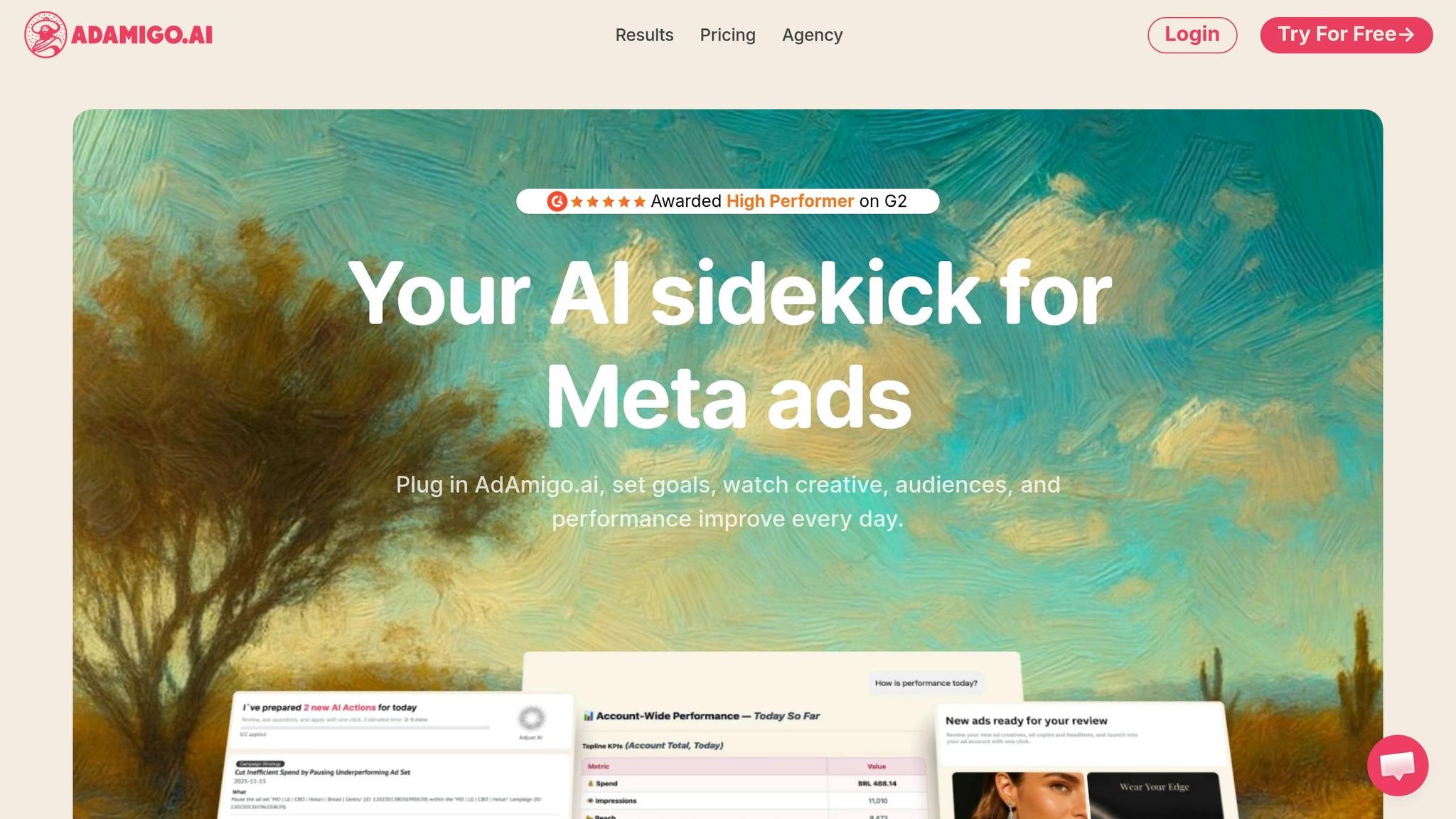
Advertisers today are looking for a solution that strikes the right balance between automation and clarity. They need tools that not only optimize performance but also explain the reasoning behind decisions. The days of "black box" systems - where AI operates without revealing its logic - are fading as marketers demand tools that protect their margins while offering transparency.
AdAmigo.ai stands out in this space by providing controlled transparency. The platform audits your Meta ad account, pinpoints high-impact opportunities, and creates a daily action plan. You can either approve these suggestions manually or let the system handle them automatically. Importantly, every decision is logged in clear, understandable language, making it easy to track and audit.
The benefits of this approach are clear. Marketers using AI automation platforms like AdAmigo report saving an average of 13 hours per week on tasks such as manual reporting and optimization. Additionally, AdAmigo's Chat Agent offers actionable insights and specific recommendations, such as adjusting budgets, pausing underperforming campaigns, or starting new tests. This level of transparency not only boosts efficiency but also minimizes strategic risks.
AdAmigo also addresses a common frustration with Meta's native tools: lack of clarity. Many advertisers feel that opaque systems erode trust. By showing exactly which changes - whether it's shifting budgets, tweaking audience settings, or updating creatives - are driving results, AdAmigo helps restore confidence. This approach empowers advertisers to maintain control over their strategy without being overwhelmed by manual tasks.
Controlled transparency is key. It allows you to review the AI's reasoning and step in when necessary. The result is a system that works alongside you, safeguarding your margins while optimizing performance. AdAmigo ensures you stay competitive without sacrificing control or efficiency.
Pros and Cons
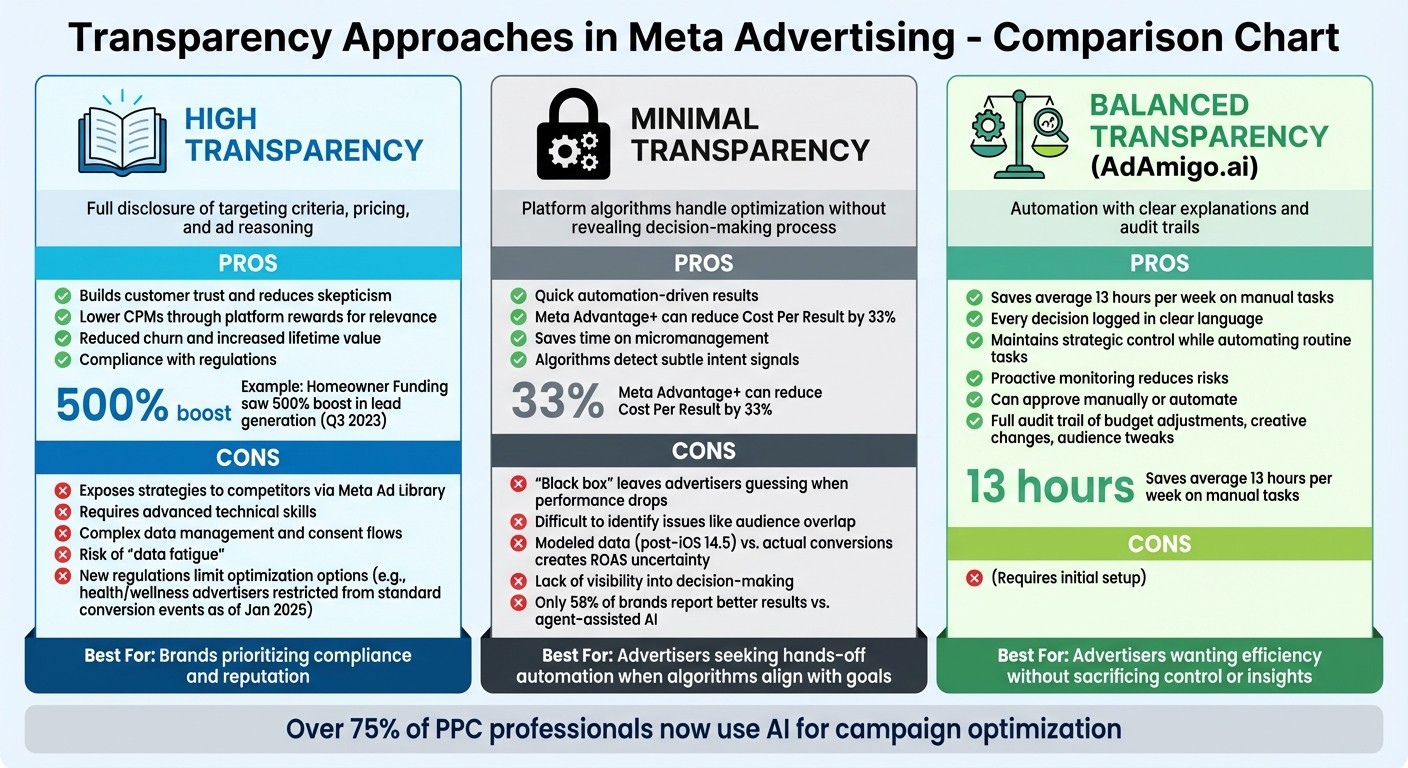
Comparison of High, Minimal, and Balanced Transparency in Meta Advertising
This breakdown highlights the central debate: Is transparency a strength or a potential drawback in advertising?
Every approach to transparency comes with its own set of trade-offs. High transparency fosters trust and lowers legal risks, but it requires advanced technical skills and meticulous data management. This option is attractive to advertisers focused on compliance and safeguarding brand reputation. However, it can also lead to "data fatigue" due to the complexities of auditing user consent and server-side tracking systems. On the other hand, minimal transparency leans heavily on automation, delivering quick results but sacrificing visibility.
With minimal transparency, tools like Meta's native automation, such as Advantage+, provide speedy outcomes. The trade-off? You lose insight into what’s happening behind the scenes. If performance dips, it becomes difficult to pinpoint the problem. This "black box" approach can obscure issues like ad fatigue or budgeting mistakes until they’ve already caused harm.
Balanced transparency, offered by platforms like AdAmigo.ai, strikes a compromise. It combines the efficiency of automation with a clear view of every decision the system makes. For example, marketers using agentic systems save an average of 13 hours per week. AdAmigo.ai logs every budget adjustment, creative change, and audience tweak in straightforward language. This allows you to audit the AI’s decisions and step in when necessary. By monitoring AI frequency control proactively, this approach reduces risks while maintaining strategic oversight. The detailed audit trail provided by balanced transparency showcases its advantage over the extremes of high or minimal transparency.
Conclusion
The ongoing debate around transparency in Meta advertising revolves around finding the right balance. On one hand, high transparency fosters trust but requires technical expertise. On the other hand, reduced transparency allows for automation-driven efficiency but risks losing key insights.
Meta's recent performance highlights this balancing act. For example, its AI infrastructure achieved an annualized revenue rate exceeding $60 billion by late 2025, and Advantage+ campaigns delivered a 14% lower cost per lead compared to traditional setups. This shift shows that success now relies more on creative quality and first-party data than on outdated targeting methods. Many advertisers are adopting Advantage+ for large-scale campaigns while keeping one or two manual conversion campaigns for high-value audiences to retain critical insights.
To stay competitive, actionable tools are becoming essential. Platforms like AdAmigo.ai provide full automation while maintaining transparency, documenting every budget adjustment, creative update, and audience tweak. This allows advertisers to focus on strategy while automating routine tasks. To meet evolving transparency demands, consider diversifying creative assets (6–10 distinct concepts), using clear targeting messages (e.g., "You visited us recently"), and including specific data points (e.g., "12,400 customers") to build trust.
Advertisers who embrace these transparency practices early will be better prepared for future regulations and will strengthen their customer relationships. Whether through detailed data sharing or controlled automation with tools like AdAmigo.ai, strategic transparency is becoming the cornerstone of success in Meta advertising.
FAQs
How do I choose the right level of ad transparency?
Striking the perfect balance in ad transparency means walking the line between building trust and meeting legal or platform requirements. Transparency isn’t just about compliance; it’s about fostering trust with your audience.
Here’s the key: be upfront about how data is collected and used. Laws like GDPR and CCPA mandate clear disclosures, so it’s essential to meet those standards. But transparency isn’t one-size-fits-all. Tailor your approach to align with your campaign’s goals. For instance, explaining your targeting methods in simple terms can help build trust. However, bombarding users with too much information might have the opposite effect.
Platforms like Meta’s Ad Library offer tools to help you maintain transparency while staying consistent with your brand’s messaging and values. By using these tools effectively, you can meet compliance requirements and maintain user trust without overcomplicating things.
What’s the downside of using Meta’s “black box” automation?
Meta’s “black box” automation tools, like Advantage+ campaigns, come with a significant downside: a lack of transparency. Marketers are often left in the dark about which creative elements, audience segments, or strategies are driving results. This makes it tough to replicate successes or fine-tune campaigns effectively.
The opacity of these tools limits control, leading to inefficiencies and, at times, eroding trust - particularly when campaigns don’t perform as expected or fail to hit key metrics. While automation can streamline processes and boost efficiency, it does so at the expense of visibility and hands-on control.
How can I stay transparent without exposing my strategy?
To maintain transparency while safeguarding your strategy, concentrate on explaining how data is collected, used, and evaluated for campaign performance without giving away specific tactics. Being open about these aspects fosters trust and ensures compliance, but it's crucial to keep proprietary methods under wraps. Tools like Meta's transparency features can help you clearly communicate your data practices and campaign outcomes. This way, your audience gains insight into your approach without exposing sensitive or competitive details.