
5 Ways Policy Changes Affect Meta Ad Performance
Meta's policy updates reduce targeting precision, prioritize creative quality, tighten attribution, force automated bidding, and require AI disclosure.
Meta's recent policy updates are reshaping how ads perform on Facebook and Instagram. Here's what you need to know:
Targeting precision has decreased. Meta's Andromeda algorithm now prioritizes AI-driven creative matching over advertiser-defined audiences, making specific targeting harder.
Creative quality is now key. Ads are evaluated based on visuals, tone, and engagement metrics, with 56% of performance tied to ad quality.
Meta ads attribution rules have changed. View attribution is limited to 1 day, and privacy updates have reduced tracking accuracy by 40–60%.
Manual bidding is gone. AI now manages bidding and optimization, requiring campaigns to generate at least 50 conversions weekly for effectiveness.
Stricter ad transparency and labeling rules are in place. Advertisers must disclose AI-generated content and comply with new transparency standards.
These changes demand a shift in strategy. Focus on creating diverse ad concepts, use server-side tracking like CAPI, and leverage AI tools to manage compliance and performance. You can also use AI tools for Meta ad account analysis to identify performance gaps caused by these policy shifts. If you're unsure where to start, follow these steps to audit your Meta ad account for hidden inefficiencies.
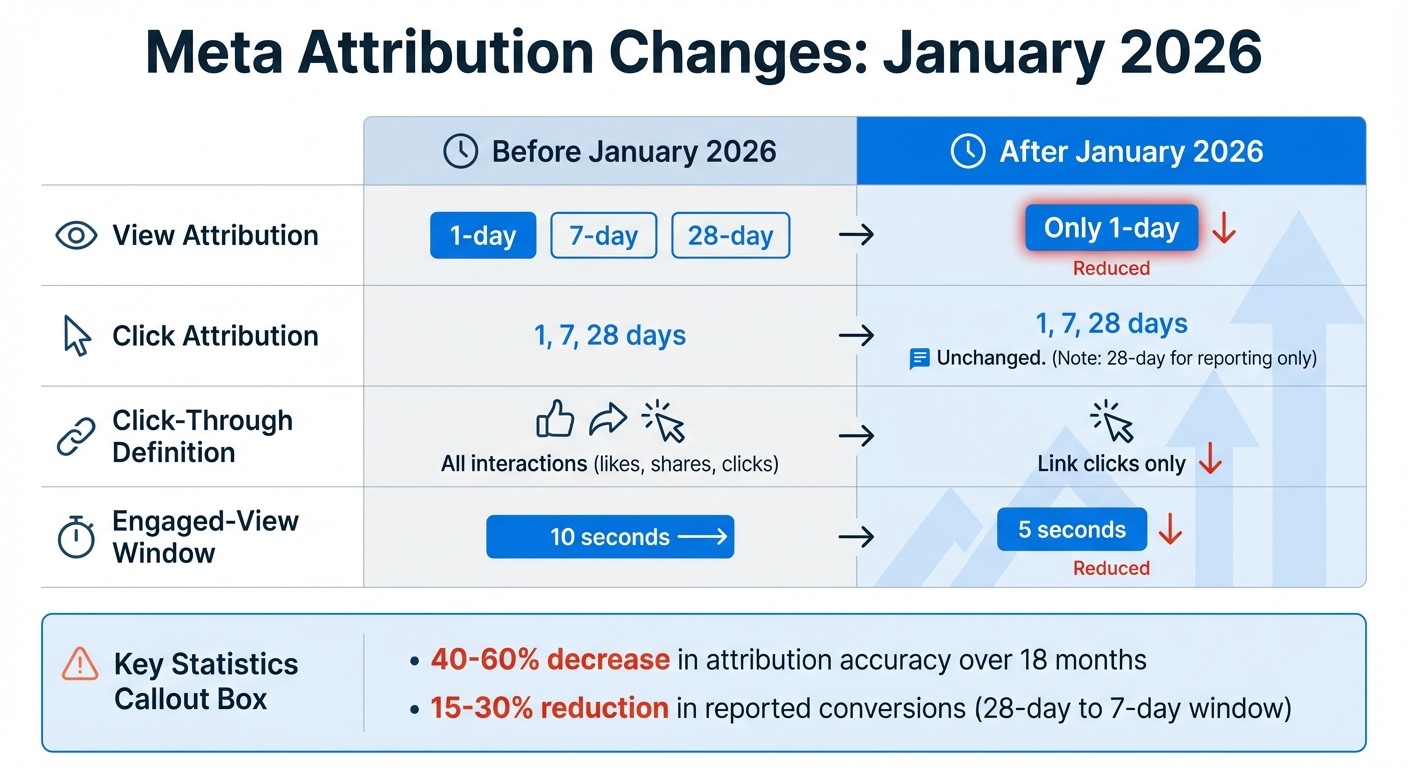
Meta Attribution Changes: Before vs After January 2026
Facebook Ads NEW Rules for 2026 (learn this ASAP)
1. Reduced Targeting Precision Limits Audience Reach
On June 23, 2025, Meta streamlined its targeting restrictions, consolidating thousands of niche categories into broader ones. This change means advertisers who previously targeted specific groups, like "vintage car enthusiasts" or "indie film fans", now work with more generalized categories such as "automotive" or "entertainment," requiring AI tools for interest-based targeting to maintain efficiency. While this simplification might seem practical, it has made reaching highly specific, high-performing audiences much more challenging, though AI can solve many targeting issues. Adding to this, algorithm updates have further altered how ads are delivered.
A significant shift came with the introduction of Andromeda, Meta's new retrieval engine, in October 2025. This system uses computer vision and semantic analysis to evaluate ad creatives and determine their eligibility for auctions. As Confect.io explains:
"The primary targeting mechanism has shifted from advertiser-defined audiences to AI-driven creative matching".
This means if an ad doesn't pass Andromeda's retrieval filter, its targeting settings won't even come into play. Additionally, tweaking ads slightly no longer creates multiple auction entries, as Andromeda groups similar creatives together. To adapt, focus on creating diverse ad content - experiment with different hooks, formats, and visuals. Your creative now serves as your primary targeting tool, so variety is key to expanding your reach in auction clusters.
2. Creative Quality Now Drives Ad Delivery
With the precision of ad targeting becoming less reliable, the focus has shifted to creative quality as the key to successful ad delivery. Meta’s algorithm now evaluates elements like visuals, text, tone, and product details to determine an ad’s quality. If an ad doesn’t meet these standards, even the most detailed targeting settings won’t make a difference.
Research underscores this shift: creative assets account for about 56% of an ad’s performance, while AI manages the rest through optimization. As one expert put it:
"56% of your ad performance comes from CREATIVE, not targeting or bidding. AI handles the rest. Yet most marketers still obsess over audience tweaks while their creatives collect dust".
Meta’s system also groups similar ads together, meaning small changes - like tweaking headlines, visuals, or button styles - won’t trigger a new auction. To tap into different audience segments, advertisers need entirely new creative concepts. Minor adjustments won’t deliver the broad reach necessary for significant results.
Meta's Advertising Standards emphasize that lower-quality ads are penalized with reduced delivery. Interestingly, ads that feel overly polished often underperform compared to those that appear more authentic and native to the platform. To demonstrate quality to Meta’s algorithm, aim for a 30-35% hold rate within the first three seconds of the ad.
To keep up with these demands, advertisers are now creating roughly 20 new creatives every month to counter ad fatigue and sustain momentum. A popular strategy is the "5x5 hack": shoot one core video, then create five different hooks and five unique calls-to-action. This approach generates between 25 and 36 variations, providing enough diversity to test effectively with AI-powered bulk testing. The goal isn’t to make minor tweaks but to produce a wide range of genuinely different creative assets using AI creative generation tools. This shift to a creative-first mindset aligns with Meta’s evolving policies and encourages advertisers to rethink their strategies.
3. Attribution Changes Reduce Reported Conversions
In January 2026, Meta introduced major updates to how it tracks and reports conversions, and the effects were felt immediately. The biggest change? View attribution windows were cut down significantly - from the previous options of 1‑day, 7‑day, and 28‑day to just 1‑day. Meanwhile, click attribution options remain at 1, 7, and 28 days, though the 28‑day window is now primarily for historical reporting purposes.
These changes, combined with privacy updates, have significantly impacted attribution accuracy. Over an 18-month period, accuracy dropped by 40–60%, and the shift from a 28‑day to a 7‑day click window reduced reported conversions by 15–30%. Luke Costley-White put it plainly:
"If you're still running Meta ads with pixel-only tracking in 2026, you're making budget decisions based on incomplete data".
Here’s a quick overview of how Meta's attribution features have changed:
Feature | Before January 2026 | After January 2026 |
|---|---|---|
View Attribution | 1‑day, 7‑day, 28‑day | Only 1‑day |
Click Attribution | 1, 7, 28 days | Unchanged (28‑day for reporting only) |
Click-Through Definition | All interactions (likes, shares, clicks) | Link clicks only |
Engaged-View Window | 10 seconds | 5 seconds |
To keep up with these changes, advertisers need to act fast. Implementing the Conversions API (CAPI) is a must. Server-side tracking helps bypass browser restrictions, ad blockers, and iOS privacy features that strip tracking parameters like fbclid. Additionally, it’s important to audit your Event Match Quality (EMQ) score in Events Manager. Aim for a score of "Good" or "Great" (70%+), which can be achieved by sending more hashed identifiers like phone numbers or IP addresses. If you’re using both Pixel and CAPI simultaneously, make sure to include a unique event_id parameter to prevent duplicate conversion counts.
Mark Byrne, Director of Paid Media at Brave Bison, highlights how the redefinition of click-through attribution:
"should reduce reconciliation debates and make Meta's reporting easier to defend in finance conversations".
For more established brands, relying solely on platform-reported data may no longer cut it. Instead, Marketing Mix Modeling (MMM) and incrementality testing offer a better way to measure true impact. As Byrne points out:
"The less reliant advertisers are on platform reported attribution, the more confidence they have in scaling investment".
These attribution updates demand fresh approaches to bidding strategies and creative development, which are explored in the next section.
4. Forced Automation Removes Manual Bidding Control
Meta's recent policy changes have redefined how advertisers manage campaigns, shifting from manual bidding to an AI-driven system. Now, instead of treating your targeting inputs as strict rules - like specific age ranges, detailed interests, or bid caps - Meta uses them as signals for its algorithm to interpret. Essentially, the control once held by advertisers has been replaced by a focus on broader strategic goals.
Rather than fine-tuning every detail, advertisers now set objectives like "Cost per result" or "ROAS goals", leaving Meta's AI to handle the optimization using automated bid rules. As Drew Madore, Founder & CEO of Synergist Digital Media, puts it:
"The algorithm is better at pattern recognition than we are. It processes millions of signals per auction... It doesn't get tired or biased or stuck in assumptions".
But there’s a catch: the algorithm needs enough data to perform effectively. Meta recommends campaigns generate at least 50 conversions per week for optimal results. Splitting budgets across too many ad sets can dilute data, making it harder for the AI to learn. The fix? Consolidate your campaigns. Combine smaller ad sets into larger ones to ensure the algorithm has enough information to work with.
For businesses with fewer conversions or longer sales cycles, focusing on earlier funnel actions like "Add to Cart" or "Initiate Checkout" can help. These micro-conversions provide the algorithm with the data it needs to improve performance. Once you launch an automated campaign, resist the urge to tweak it for at least 14 days to allow the system to stabilize and learn.
The results of embracing this automated approach can be impressive. FULLBEAUTY Brands, for instance, leveraged Meta's automated system in late 2025 by introducing AI-generated creative variations instead of their usual white catalog backgrounds. The outcome? A 45% higher ROAS, a 22% increase in conversion rate, and a 36% boost in CTR compared to their previous manual efforts.
5. New Ad Labels Change How Users See Ads
Meta has introduced new ad labeling requirements that reshape how ads are perceived on Facebook and Instagram. The most noticeable update? The familiar "Sponsored" label has been replaced with a straightforward "Ad" label. As marketer Tanmoy Dutta puts it:
"Sponsored becomes Ad: Nothing changes in targeting or performance. Meta is only changing the label users see".
This shift aligns with Meta's push for more transparency.
Another major update involves stricter disclosure rules for advertisers. If you're using AI to create or modify visual or audio elements - like product renders, background changes, or synthetic voiceovers - you now need to select the "AI-generated" box in Ads Manager. Ignoring this requirement has become a common reason for ad rejections, accounting for 14% of all rejections in 2026. The rule is straightforward: when in doubt, disclose.
Transparency efforts also extend to influencer and creator content. Any posts involving compensation - whether it's payment, gifts, or affiliate partnerships - must now use the "Partnership Ads" format. Running user-generated content without this designation is considered a "Deceptive Practice". Meta has stepped up enforcement with its Multimodal Ad Review System (MARS), which scans text, images, videos, audio, and landing pages simultaneously. This system processes ads in under 60 seconds, allowing Meta to identify violations proactively rather than waiting for user complaints.
Financial advertisers face even stricter rules. The "Financial Products and Services" category replaced the older "Credit" category in early 2025. Advertisers in this category must now include standardized risk warnings in a minimum 12pt font for static images and ensure disclaimers are visible for at least 3 seconds in videos. Cryptocurrency advertisers, in particular, must secure a "Verified Crypto Advertiser" badge to avoid automatic rejection. These measures aim to make high-risk sectors more transparent and trustworthy for users.
Staying compliant is more important than ever. Use brand suitability tools to manage sensitive campaigns, such as disabling comments or uploading block lists of profiles where your ads shouldn't appear. It's also critical to review creator scripts before launch since brands are now held accountable for claims made in Partnership Ads. Another frequent issue is landing page mismatches, which account for 11% of ad rejections. Ensuring your landing page aligns with your ad's disclosures and offers is essential. These changes highlight the growing need for AI tools to help advertisers adapt quickly and stay compliant.
Using AI Tools to Adapt to Policy Changes
Meta's 2026 policy changes have made managing ads manually a much heavier lift. With less precise targeting, a shift to creative-first delivery, and stricter compliance requirements, advertisers are navigating a more complex landscape. Thankfully, AI optimization tools are stepping in to handle tasks that used to require entire teams.
As these policy changes reshape how ads perform, automation has become a necessity. Meta now enforces compliance using proactive AI scanning. The AuditSocials Compliance Report explains:
"Meta's 2026 policy cycle marks the transition from reactive enforcement (reviewing ads after complaints) to proactive enforcement (scanning every ad through AI classifiers before the first impression is served)".
This means ads can be rejected before they even go live, making compliance a critical first step in the process.
AI tools like AdAmigo.ai are built to tackle these challenges head-on by automating the entire optimization process. These systems work around the clock, auditing accounts, spotting opportunities, and predicting performance trends. They handle everything - creative development, adjusting audience parameters, reallocating budgets, and optimizing bids - all in one seamless system. When Meta's Andromeda algorithm prioritizes creative-led targeting, AdAmigo's AI Creative Generation tool steps in. It examines your best-performing ads and competitor strategies to create new variations designed to align with Meta's updated delivery methods. This ongoing monitoring also helps streamline compliance, which is a top priority under Meta's latest rules.
The platform tracks Meta’s changing policies and flags potential issues, such as undisclosed AI-generated content or mismatched landing pages, before your ads even launch. You can choose to run campaigns in semi-autonomous mode, approving changes manually, or let the AI take full control. Either way, compliance and performance optimization remain at the core.
For agencies or smaller brands, this level of automation is a game-changer. Tasks that once required a team of media buyers can now be handled by a single person. Over time, the AI learns from your account's performance data, adapting as Meta's policies and algorithms evolve. Using AI tools ensures you stay ahead of the curve and keep your campaigns running smoothly, no matter how the rules shift.
Conclusion
Meta's policy updates for 2026 have brought significant changes to how ads perform on the platform. With reduced targeting precision, advertisers are now focusing on broader audience segments, while the Andromeda algorithm relies heavily on creative quality through its computer vision matching system to determine ad delivery effectiveness. The introduction of AI-generated content labels further influences how users engage with and perceive ads.
Meta's shift to proactive enforcement has also raised the stakes for compliance. Every ad is now scanned by AI classifiers before it goes live, and undisclosed AI-generated content accounts for 14% of ad rejections. Staying compliant isn't just recommended - it's necessary to keep campaigns running smoothly.
To adapt to these policy changes, advertisers need to stay informed. Spending just 20 minutes each month reviewing updates from Meta for Business News and the in-product Changelog can help identify important changes before they impact performance. Additionally, keeping an eye on your Account Health Score is critical - scores below 25 can drastically limit ad impressions.
Thankfully, AI-powered tools are stepping in to make life easier. Platforms like AdAmigo.ai simplify tasks such as creative generation, compliance checks, budget management, and bid optimization. For agencies, this means a single media buyer can handle 4 to 8 times more clients, while brands benefit from a continuously improving, always-available media buyer. By leveraging AI, advertisers can not only stay compliant but also enhance their campaign results and ROI.
FAQs
How do I replace interest targeting now?
To navigate the changes in interest targeting, consider switching to broader audience categories and leveraging AI-driven strategies like Advantage+ audiences, which comply with Meta's updated policies. Tools like AdAmigo.ai can take it a step further by analyzing your brand and competitors to automatically generate high-performing audience segments. This method ensures you can adjust to the reduced precision in interest targeting while still achieving strong results.
What’s the fastest way to fix worse attribution?
To tackle the challenges of declining attribution on Meta ads, it's time to rethink your measurement strategy. Meta now emphasizes metrics like 1-day view, 1/7/28-day click, and engaged view. Make sure to adjust your attribution windows to align with these updates.
For improved accuracy, lean on first-party data or leverage third-party analytics tools. Additionally, platforms like AdAmigo.ai can help by automating creative updates and refining your targeting, ensuring your campaigns stay effective despite these shifts.
What should I do if I can’t hit 50 conversions a week?
If you're struggling to hit 50 conversions a week, the goal should be stabilizing your campaign's performance while gathering enough data for Meta's algorithm to work efficiently. Here's how you can tackle this:
Combine your audiences: Reducing fragmentation can help concentrate your efforts and increase conversions.
Limit campaign adjustments: Constant edits can reset the learning phase, slowing down progress.
Refine your creatives and targeting: Better ads and sharper audience focus can drive higher conversion rates.
Leverage tools like AdAmigo.ai: Automation tools can speed up and simplify the optimization process.
By focusing on these steps, you'll create a stronger foundation for Meta's algorithm to deliver better results.