
Meta Lead Form vs Landing Page Benchmarks by Industry (2026)
Compare Meta Lead Forms and landing pages by cost, lead quality, and CPCL with industry benchmarks and hybrid strategies.
When generating leads on Meta platforms in 2026, you have two main options: Meta Lead Forms (native forms within Facebook/Instagram) or Landing Pages (directing users to your website). Here’s what you need to know:
Meta Lead Forms are fast, mobile-friendly, and cost-effective, typically delivering 30%-60% lower cost per lead (CPL). However, they often attract lower-intent leads and may suffer from outdated or inaccurate data.
Landing Pages cost more per lead but generate higher-quality prospects. They allow for more control over messaging, trust-building, and user qualification, making them ideal for industries requiring deeper engagement.
Key Insights:
Lead Forms work best for high-volume campaigns like newsletter sign-ups or local services.
Landing Pages are better for high-value, complex offerings like B2B SaaS or legal services.
Focus on Cost Per Converted Lead (CPCL), not just CPL, to measure true ROI.
Combining both methods - Lead Forms for volume and Landing Pages for intent - can optimize results. Implementing full-funnel AI optimization ensures every stage of the journey is covered.
Quick Comparison:
Criteria | Meta Lead Forms | Landing Pages |
|---|---|---|
Cost Per Lead (CPL) | Lower (30%-60% less than landing pages) | Higher |
Lead Quality | Lower | Higher |
Best Use Cases | Top-of-funnel, quick lead generation | Mid-to-bottom funnel, high-value leads |
Customization | Limited | Full control over design and content |
Conversion Rates | Higher (but often lower intent) | Lower (but higher intent) |
To maximize results, connect Meta Ads to CRM tools and integrate Meta Ads with analytics tools to track downstream performance. Tools like AdAmigo.ai can help automate and optimize campaigns for better CPCL and ROI. You can also use an AI media buyer to scale performance automatically.
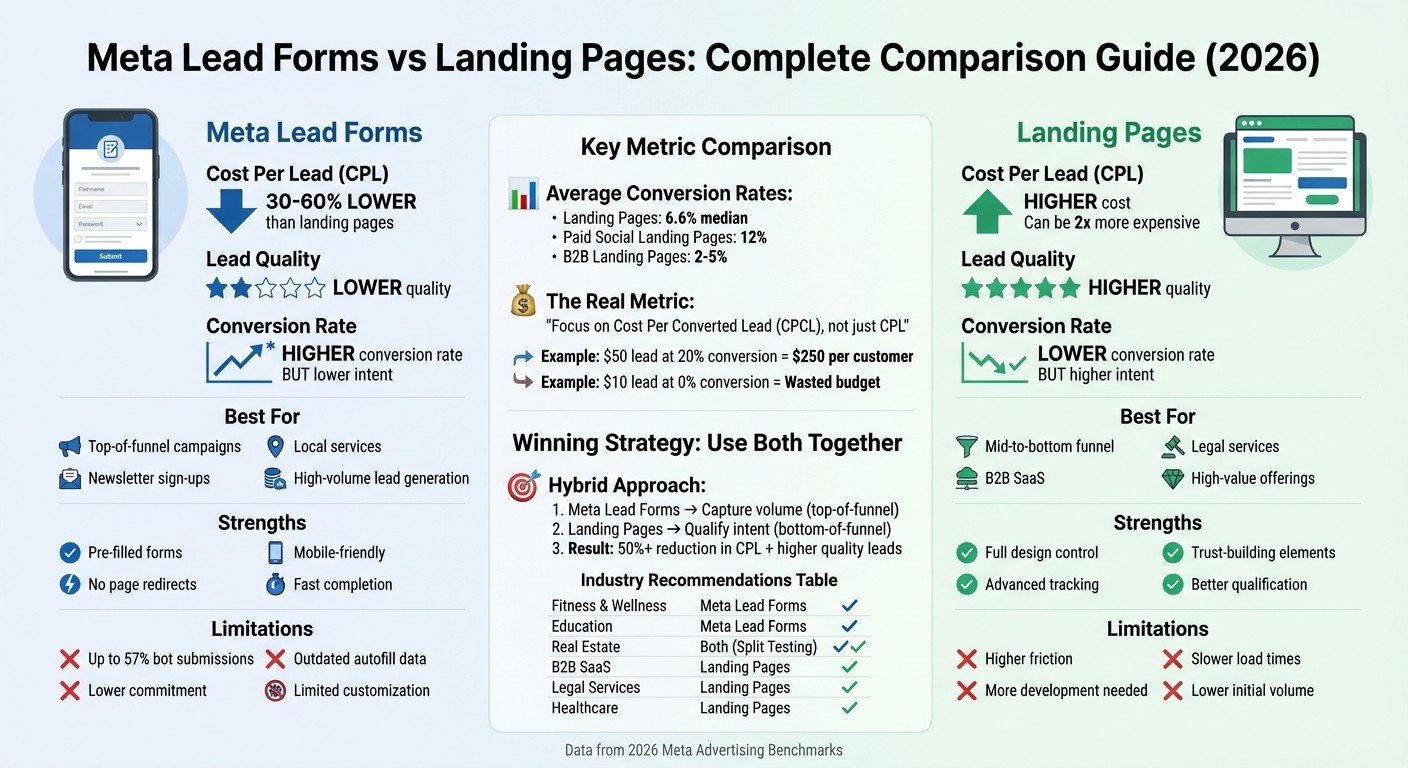
Meta Lead Forms vs Landing Pages: Cost, Quality, and Performance Comparison 2026
Landing Pages vs. Lead Forms: for High-Quality Conversions #leads @kylepursley1
Meta Lead Forms: High Volume, Low Friction

Meta Lead Forms, often called Instant Forms, allow users to submit their contact details directly within Facebook or Instagram. With pre-filled information sourced from their Meta profiles, users can complete the process with just a tap - no need to navigate away from the platform. This streamlined approach is a core part of our benchmark analysis, setting the stage for later comparisons with landing page strategies.
This mobile-friendly method emphasizes speed and simplicity, leading to significantly lower costs per lead (CPL). You can also use a Facebook Ads Cost Per Click Estimator to project initial traffic costs. By eliminating redirects and load times, campaigns using Meta Lead Forms often see CPLs that are 40% to 70% lower than those directing users to external landing pages. For instance, in late 2025, Socialware helped No Problem Flights switch from website conversions to Instant Forms, slashing their CPL by 68%. About 10% of these leads turned into actionable cases.
However, this low-friction process has its downsides. As Claire Daniels of Trio Media points out:
"The cheapest lead is rarely the most valuable. Platforms like Meta are designed to reduce friction... but lower friction also lowers commitment".
Many users complete forms while casually scrolling, sometimes without realizing they’ve submitted their details. Autofill can also pull outdated or incorrect information, resulting in disconnected phone numbers, invalid emails, or users claiming they never filled out the form. Additionally, industry estimates suggest that up to 57% of Facebook ad submissions may come from bot activity.
Meta’s AI focuses on generating as many leads as possible within budget constraints, often prioritizing quantity over quality. As Jon Loomer, a Meta ads expert, explains:
"The algorithm's primary focus is getting you as many of that action within your budget, and there's no concern for whether these people do anything else".
While lead volumes may be high, the quality and conversion rates of these leads can lag behind those generated via landing pages.
Key Metrics for Meta Lead Forms
Meta Lead Forms are great for quickly generating a large number of leads at a low cost, but the trade-off often lies in data accuracy and user intent. Key metrics include:
CPL Performance: Thanks to minimal friction, CPLs are significantly lower than campaigns relying on external landing pages.
Conversion Rates: The pre-filled, native format boosts conversion rates, though these figures don’t always reflect lead quality or downstream outcomes.
Mobile Completion: Designed for mobile users, these forms achieve high completion rates by eliminating delays and simplifying the process.
Ultimately, the critical question isn’t just about lead volume - it’s about how many of those leads are genuine, reachable, and ready to take action.
Strengths and Limitations
Strengths:
Meta Lead Forms excel when speed, simplicity, and scale are priorities. Pre-filled details reduce typing effort, especially on mobile devices, while keeping users within the app avoids delays from loading external pages. Direct CRM integrations simplify tracking. This method works especially well for top-of-funnel campaigns like newsletter sign-ups, content downloads, and webinar registrations. It’s also effective for local service businesses that depend on quick responses.
Limitations:
The ease of submission can attract users with low intent. As Alesia Sidaruk, PPC Manager at Aimers, cautions:
"Optimizing for leads alone can inflate volume but hurt quality. If your goal is sales or revenue, optimizing for deeper funnel conversions is better".
Data accuracy is another challenge - autofill can lead to outdated or incorrect information, increasing bounce rates and wasting sales efforts. tracking post-submission actions is also harder without real-time conversion tracking via the Conversions API. Finally, Meta's Advantage+ AI tends to prioritize volume over value, sometimes targeting demographics that provide cheaper leads but lower conversion potential.
Best Use Cases for Meta Lead Forms
Recognizing the strengths and challenges of Meta Lead Forms helps identify where they perform best. They are ideal for scenarios where capturing a high volume of leads quickly is more important than qualifying them deeply. Key use cases include:
Top-of-Funnel Campaigns: Perfect for building email lists or promoting lead magnets like ebooks, checklists, or webinars, where the goal is to maximize sign-ups for future nurturing.
Local Services and High-Urgency Offers: For businesses like plumbing, locksmith services, or real estate, capturing leads instantly is critical for timely follow-up.
Audience Data Collection for Pixel Optimization: Even if leads require further qualification, the data gathered can improve Meta’s algorithm for retargeting and future campaigns.
Adding Smart Friction: Advertisers can balance lead volume and quality by using Meta’s "High Intent" setting, which includes a review screen. Adding one to three custom qualifying questions can also filter out low-intent submissions. As Ahmed Ezat, Co-Founder of Pyrsonalize, observes:
"Instant Forms always win on CPL. However, Conversion Ads consistently outperform when measured by Cost Per Qualified Opportunity (CPQO)".
Landing Pages: Higher Intent, More Control
Landing pages operate differently from native lead forms, prioritizing quality over quantity. While native lead forms focus on speed and high submission rates, landing pages require users to leave Meta's ecosystem, wait for a page to load, and manually input their information. This added effort introduces a level of friction that filters out casual or automated responses, leaving behind more serious prospects.
Although landing pages tend to cost more per lead, they often deliver stronger intent and better conversion rates. Michéal Breslin, Founder of Lever Digital, explains:
"Website-based forms often produce stronger intent".
Ryan Wilson, Marketing Lead at Distl, adds:
"Meta often generates more form fills, but a chunk are low-intent thanks to auto-filled Lead Ads and duplicates. Meta lead forms are brilliant don't get me wrong, but don't evaluate on raw numbers".
Landing pages give advertisers complete control over the user experience. This includes customizing messaging, adding testimonials, showcasing trust signals, and creating tailored funnels for complex or high-value offerings. With full ownership of the data, marketers can map events to conversion goals, conduct A/B testing on CTAs, and integrate seamlessly with analytics platforms or track custom conversions via CRM systems. For industries like B2B services or enterprise software, where education and trust-building are crucial, this level of control is indispensable. The metrics and examples below highlight how landing pages perform in various scenarios.
Key Metrics for Landing Pages
Across industries, the median conversion rate for landing pages is 6.6%. While this figure is lower than the double-digit rates often seen with Meta Lead Forms, the conversions represent higher-intent actions. When it comes to paid social traffic, landing pages achieve an average conversion rate of 12%, outperforming paid search traffic, which converts at 10.9%. Desktop users convert 8% better than mobile users, even though mobile generates nearly five times more traffic. Additionally, landing pages written at a 5th to 7th-grade reading level convert at 11.1%, compared to just 5.3% for content written at a professional level. For high-value B2B campaigns on Meta, conversion rates between 2% and 5% are considered typical.
These numbers underscore the unique strengths and challenges of using landing pages for lead generation.
Strengths and Limitations
Strengths:
Landing pages shine when lead quality outweighs the need for sheer volume. The manual data entry process filters out low-commitment users, leaving behind more serious prospects. They also allow for complete creative freedom, enabling businesses to showcase custom branding, detailed product descriptions, video content, and client testimonials. Additionally, owning the data opens the door to advanced tracking, behavioral analysis, and A/B testing.
Limitations:
The higher friction of landing pages often results in fewer top-of-funnel conversions. For instance, using a landing page with a longer form can double the cost per lead - from around $15 for a native form to approximately $30 for a landing page. Slow page load times, especially on mobile, can lead to drop-offs before users even see the offer. Moreover, developing landing pages requires more investment in design, copywriting, and technical setup compared to the simplicity of Meta Lead Forms.
Weighing these strengths and limitations helps determine when landing pages are the right choice.
Best Use Cases for Landing Pages
Landing pages are ideal for mid- to bottom-of-funnel campaigns where prospects are actively exploring solutions. They work particularly well for high-consideration purchases, such as enterprise software demos, professional service consultations, or real estate inquiries - situations where the higher lead cost is justified by the potential deal value. They're also well-suited for complex products or services that require detailed explanations or trust-building before purchase. Landing pages are especially effective when qualifying leads through structured questions about budget, timeline, or decision-making authority. Additionally, they’re invaluable when maintaining consistent branding and capturing detailed behavioral data throughout the customer journey is a priority.
Tools like AdAmigo.ai make it easier for advertisers to integrate landing page performance data with CRM events, allowing for optimizations based on cost per converted lead and ROI rather than just cost per lead (CPL). This capability ensures that landing pages remain a powerful option for driving meaningful results.
Cost per Converted Lead: Prioritizing ROI Over CPL
When it comes to evaluating lead capture strategies, shifting the focus from cost per lead (CPL) to cost per converted lead (CPCL) is essential for achieving meaningful business results. This approach ensures you're not just chasing numbers but driving actual revenue.
The CPL vs. CPCL Trade-Off
CPL measures how much you spend to get a form submission, while CPCL - also known as cost per acquisition (CPA) - calculates the cost of turning a lead into a paying customer. This distinction is key for assessing whether your lead generation efforts are truly delivering value.
For example, Meta Lead Forms often produce CPLs that are 25% to 35% lower than landing pages. But lower CPLs can sometimes be deceptive. As Cedric Yarish from AdManage.ai explains:
A $50 qualified lead that converts at 20% is infinitely better than a $10 garbage lead that converts at 0%.
To put that into perspective: a $50 lead with a 20% conversion rate costs $250 per customer. In contrast, a cheaper lead that doesn’t convert wastes your budget entirely.
To figure out the maximum CPL you can afford while staying profitable, use this formula:
Max CPL ≈ Gross Profit Per Customer × Lead-to-Customer Rate.
For instance, if your average customer generates $1,000 in gross profit and 10% of your leads convert, you can spend up to $100 per lead without losing money. This calculation shifts the focus from simply generating more leads to ensuring those leads contribute to your bottom line. You can also use an ad performance benchmark tool to see how your current metrics stack up against industry standards. It also highlights the importance of tracking what happens after the initial lead capture.
Why Downstream Data Matters
Optimizing for CPCL means you can’t stop at tracking form submissions - you need to integrate downstream data. Feeding offline conversion data from your CRM into Meta using the Conversions API (CAPI) (and debugging your conversion tracking to ensure data accuracy) allows the algorithm to learn which leads actually result in sales, not just clicks or form fills. As Michéal Breslin, Founder of Lever Digital, puts it:
CRM data must feed back into ad optimisation. Offline conversion imports improve accuracy. Meta must sit inside a broader framework alongside Search, CRM reporting and lifecycle marketing.
Once you’re generating about 50 conversion events per week, you can adjust your campaign objective from "Maximize number of leads" to "Maximize conversion leads" to focus on higher-value actions. This is particularly important for industries like B2B SaaS, where the cost of a standard lead might hover around $63.40, but a more qualified lead (like an MQL or SQL) can range from $150 to $250. While these leads cost more upfront, their higher conversion rates make them worth the investment.
Platforms like AdAmigo.ai simplify this process by integrating directly with your CRM. They track downstream events and automatically optimize campaigns for CPCL and ROI, rather than just chasing raw lead numbers. By feeding real sales data back into Meta’s algorithm, tools like AdAmigo ensure your ad spend targets prospects who are more likely to generate revenue.
Industry-Specific Recommendations
Selecting the right lead generation method depends heavily on the nuances of your industry and the value of each lead. The comparison below helps guide decisions to improve cost per converted lead and maximize overall ROI.
Comparison Table by Industry
This table highlights the recommended methods and key success factors for different industries:
Industry | Recommended Method | Key Success Factor |
|---|---|---|
Fitness & Wellness | Meta Lead Forms | High-volume lead capture |
Education & Training | Meta Lead Forms | Rapid enrollment and gated content access |
Real Estate | Both (Split Testing) | Balancing initial capture with qualification |
B2B SaaS | Landing Pages | Detailed qualification and contextual information |
Legal Services | Landing Pages | Thorough information exchange |
E-commerce | Landing Pages | Providing detailed product context |
Healthcare | Landing Pages | Ensuring lead quality and compliance |
Tailored Strategies for Key Industries
These recommendations provide a roadmap for crafting strategies that align with specific industry needs.
For B2C industries like fitness, education, and event promotion, Meta Lead Forms are ideal for capturing a high volume of leads quickly. However, the ease of form submission can mean lower commitment levels, making post-capture qualification essential to identify serious prospects. Integrating offline conversion insights can help bridge the gap between digital leads and final sales.
In contrast, B2B and high-value services such as SaaS, legal services, and healthcare benefit more from landing pages. These pages allow businesses to deliver detailed information, build trust, and thoroughly qualify leads before they enter the sales funnel. As Michéal Breslin, Founder of Lever Digital, puts it:
In B2B, Meta ads aren't usually the hero of last-click conversions. It's the assist. The amplifier.
For industries like real estate and e-commerce, a hybrid approach works best. Start with Meta Lead Forms for initial lead capture, then use landing pages to qualify and nurture leads further. This combination ensures a balance between generating volume and targeting intent.
Ultimately, the choice of method should align with the customer journey and the value of each deal. For industries with longer sales cycles or high-value transactions, the added friction of landing pages helps filter for quality. Meanwhile, for lower-priced offerings with simpler onboarding, Meta Lead Forms can be more effective. Tools like AdAmigo.ai can help integrate these strategies with CRM systems, boosting the efficiency of your media buying efforts. Using AI tools for account analysis can further refine these cross-channel strategies.
Using Both Methods Together
Building on the benchmarks and tailored strategies discussed earlier, combining both approaches can take your funnel performance to the next level. The best lead generation strategies don’t force you to choose one method over the other. Instead, they integrate Meta Lead Forms and landing pages to balance lead volume and quality across a full-funnel Meta ads setup.
When to Use Meta Lead Forms
Meta Lead Forms shine in top-of-funnel scenarios, where the goal is to quickly build a list with minimal friction. They’re perfect for newsletter signups, downloadable resources, or offers that only require capturing initial interest. Thanks to pre-filled data and a seamless in-app experience, users can complete forms without leaving the platform. This ease of use often leads to at least a 50% reduction in cost per lead compared to driving traffic to a separate landing page.
The autofill feature is especially helpful on mobile, eliminating the hassle of typing on small screens - a common conversion killer. For campaigns focused on generating awareness or building email lists for future nurturing, Meta Lead Forms offer a cost-effective way to gather a high volume of leads.
When to Use Landing Pages
Landing pages are more effective for bottom-of-funnel conversions, where prospects need extra details before making a decision. These are ideal for promoting complex B2B services or high-value products that require trust-building and a deeper understanding. While landing pages introduce more friction, this serves to filter out casual users and attract those who are genuinely interested.
using landing page fixes allows you to deliver tailored messaging, highlight product features, and guide potential customers through multi-step decisions. Although the cost per lead (CPL) tends to be higher - often $45.80 or more - the higher-quality leads and better downstream conversion rates make the investment worthwhile. Keep in mind that page speed is critical; even a one-second delay can increase CPL by up to 20%. Combining the high intent of landing pages with the volume of Meta Lead Forms creates a well-rounded strategy that addresses both awareness and conversion.
Combining Both Methods
Using Meta Lead Forms and landing pages together allows you to efficiently capture leads while boosting the quality of downstream conversions. This dual approach can significantly improve ROI, especially when paired with tools like AdAmigo.ai. Implementing a strategy for Meta ads ROI optimization ensures every dollar spent on both forms and pages contributes to your bottom line. One way to integrate both methods is by using the "Thank You" screen of Meta Lead Forms as a gateway to your landing page. After someone submits a Lead Form, direct them to a specific product page, property listing, or booking tool. This strategy captures initial interest with minimal friction and provides a natural next step for those ready to engage further.
Another effective tactic is retargeting. Target users who interacted with your Lead Form but didn’t submit, as well as those who did submit, with ads that link to your landing page. This two-step approach combines the high-volume benefits of Lead Forms with the qualification and engagement power of landing pages, helping you optimize for cost per converted lead, rather than just raw CPL.
Optimizing Lead Capture with AdAmigo.ai
Managing Meta Lead Forms and landing pages manually can be a constant juggling act of budget tweaks and performance reviews against industry benchmarks. AdAmigo.ai simplifies this process by acting as an autonomous AI media buyer, optimizing both methods at the same time. The result? You capture leads at the best possible cost and quality, combining high-volume lead generation with efficient downstream performance.
AI-Driven Testing and Optimization
AdAmigo's AI Autopilot takes the guesswork out of testing and optimization. Instead of manually tweaking one variable at a time, the platform launches bulk creative tests with over 120 ad variations. These include different hooks and formats, helping you identify high-performing ads - often referred to as "monster" winners - much faster. When it’s time to scale those winning ads, AdAmigo retains Post IDs, ensuring that existing likes, comments, and shares stay intact. This approach helps maintain strong conversion rates, even as you increase your ad spend.
CRM Integration for Better Results
One of AdAmigo's standout features is its seamless CRM integration. By syncing CRM data like bookings, phone calls, and sales directly through Meta's Conversions API, the platform shifts its focus from basic Cost Per Lead (CPL) metrics to more impactful ones, like Cost Per Qualified Lead (CPQL) and Customer Acquisition Cost (CAC). This creates a feedback loop that allows the AI to prioritize lead capture methods and creative combinations that generate actual customers. Plus, it ensures your sales team can reach prospects within the critical 5-minute window - a key factor in improving conversion rates. On top of that, CRM-driven Lookalike Audiences consistently outperform interest-based targeting by 25–40%, giving you a big advantage in acquiring high-quality leads.
Feature | AdAmigo.ai (AI-Driven) | Manual Management |
|---|---|---|
Optimization | Real-time, 24/7 adjustments | Weekly/bi-weekly reviews |
Tracking | Automated CAPI/CRM sync | Manual UTM/Naming conventions |
Downstream Focus | Focuses on CPQL and ROI | Often limited to CPL/CPC |
Response Time | Instant sync (<5 min) | Manual CSV downloads (often >24h) |
Automation for Continuous Improvement
AdAmigo's AI doesn’t just optimize - it evolves. The platform continuously monitors both Meta Lead Forms and landing pages, applying proven strategies like the "High Intent" setting to improve qualification rates by 15%. It also enforces CAPI implementation to avoid browser-side data loss. Over time, as the AI gathers more performance data, it fine-tunes its strategies to your specific account. This creates a compounding effect where your ad performance keeps improving without you having to lift a finger.
Conclusion
Deciding between Meta Lead Forms and landing pages comes down to a balance between lead volume and quality. Meta Lead Forms often deliver lower costs per lead (CPL), making them a great choice for high-volume campaigns. However, as the Pyrsonalize Blog notes:
CPL is a vanity metric. Instant Forms always win on CPL. However, Conversion Ads consistently outperform when measured by Cost Per Qualified Opportunity (CPQO).
This highlights an important trade-off: shifting focus from pure volume to capturing higher-quality leads. The real breakthrough occurs when you move beyond optimizing for CPL and start prioritizing cost per converted lead. By integrating CRM data through Meta's Conversions API, you can transition from chasing inexpensive leads to identifying those that are more likely to turn into paying customers. This is where the "Conversion Leads" performance goal becomes critical, enabling Meta to optimize for leads with the highest downstream potential.
While industry benchmarks and ROAS targets provide useful context, your campaign's specific goals should guide your strategy. For example, in legal services, where the average CPL reached $741.00 in 2026, the key question is whether those leads convert at a rate that justifies the cost. On the other hand, e-commerce businesses, with an average CPL of $109.00, may focus more on volume while incorporating smart friction to filter for quality.
Platforms like AdAmigo.ai simplify this process by automating the testing of both Meta Lead Forms and landing pages. This allows you to A/B test landing pages alongside native forms to see which drives higher quality. With built-in CRM integration, AdAmigo.ai ensures you're not just generating leads but capturing ones that convert. Meanwhile, its AI continuously tests and scales the strategies that yield the best results.
To succeed, align your lead capture efforts with both industry benchmarks and your business objectives. Measure success based on cost per converted lead, not just CPL. By tracking downstream performance, integrating CRM data, and embracing automation, you can shift your focus from acquiring cheap leads to securing loyal customers, freeing up your time to refine your overall strategy.
FAQs
How do I calculate CPCL from my Meta leads?
To figure out your CPCL (Cost Per Qualified Lead), use this formula:
CPCL = Total Spend ÷ Number of Qualified Leads
It's important to clearly define what counts as a "qualified lead" for your campaign. This could mean leads that meet certain criteria or have successfully passed specific qualification steps. Your definition will directly influence how you calculate and assess this metric.
When should I switch from CPL to Conversion Leads optimization?
Switching to Conversion Leads optimization makes sense when your focus shifts from simply reducing lead costs to prioritizing lead quality and achieving a higher return on investment (ROI). This approach is particularly useful if you're noticing that your leads, while inexpensive, are of poor quality or if your conversion rate data indicates that targeting downstream actions could yield better outcomes.
For instance, tools like Meta’s Conversions API can help you track and optimize for meaningful actions, such as actual sales or qualified leads. By doing so, you can improve the efficiency of your campaigns and ensure you're investing in leads that truly drive results.
What’s the best way to improve lead quality in Meta Lead Forms?
If you're looking to boost the quality of leads from Meta Lead Forms, focus on attracting prospects with genuine interest and qualifying them effectively. Here’s how you can do it:
Use Click-to-Chat Ads: These ads are perfect for industries like education, healthcare, and automotive, where direct engagement is critical. They allow you to connect with potential leads in real-time, addressing their questions and gauging their intent.
Leverage AI Tools: AI can be a game-changer for qualifying leads. It helps you quickly identify serious prospects while filtering out spam, saving time and resources.
Send Conversion Events via the Conversions API: This step allows Meta to optimize your ad delivery, prioritizing lead quality over sheer volume. By focusing on meaningful conversions, you'll see better overall performance from your campaigns.
By combining these strategies, you can create a more efficient process that delivers leads with higher potential, ultimately improving your results.