
CBO vs. Manual Budgeting for Meta Ads
Compare Meta's CBO vs manual (ABO) budgeting—when to test with fixed ad set budgets and when to switch to CBO to scale winners.
When running Meta ads, your first decision is choosing between Campaign Budget Optimization (CBO) or manual budgeting (ABO). Here's the key difference:
CBO automatically allocates your budget across ad sets based on performance, ideal for scaling successful campaigns.
Manual budgeting gives you full control over spend per ad set, making it better for testing audiences and creatives.
Quick takeaway: Start with manual budgeting to test and identify top-performing ads. Then, switch to CBO to scale those winners efficiently. However, scaling Meta ads often requires troubleshooting budget spikes and creative fatigue.
Quick Comparison
Feature | CBO (Campaign Budget Optimization) | Manual Budgeting (ABO) |
|---|---|---|
Budget Level | Campaign | Ad Set |
Control | Automated by Meta's algorithm | Full manual control |
Best For | Scaling proven ads | Testing new audiences/creatives |
Effort Required | Low | High (requires daily monitoring) |
CBO simplifies scaling but can neglect smaller audiences, whereas AI-driven resource prioritization ensures budgets are reallocated to the highest-performing segments. Manual budgeting requires more effort but ensures balanced testing and control. Use them together for the best results.
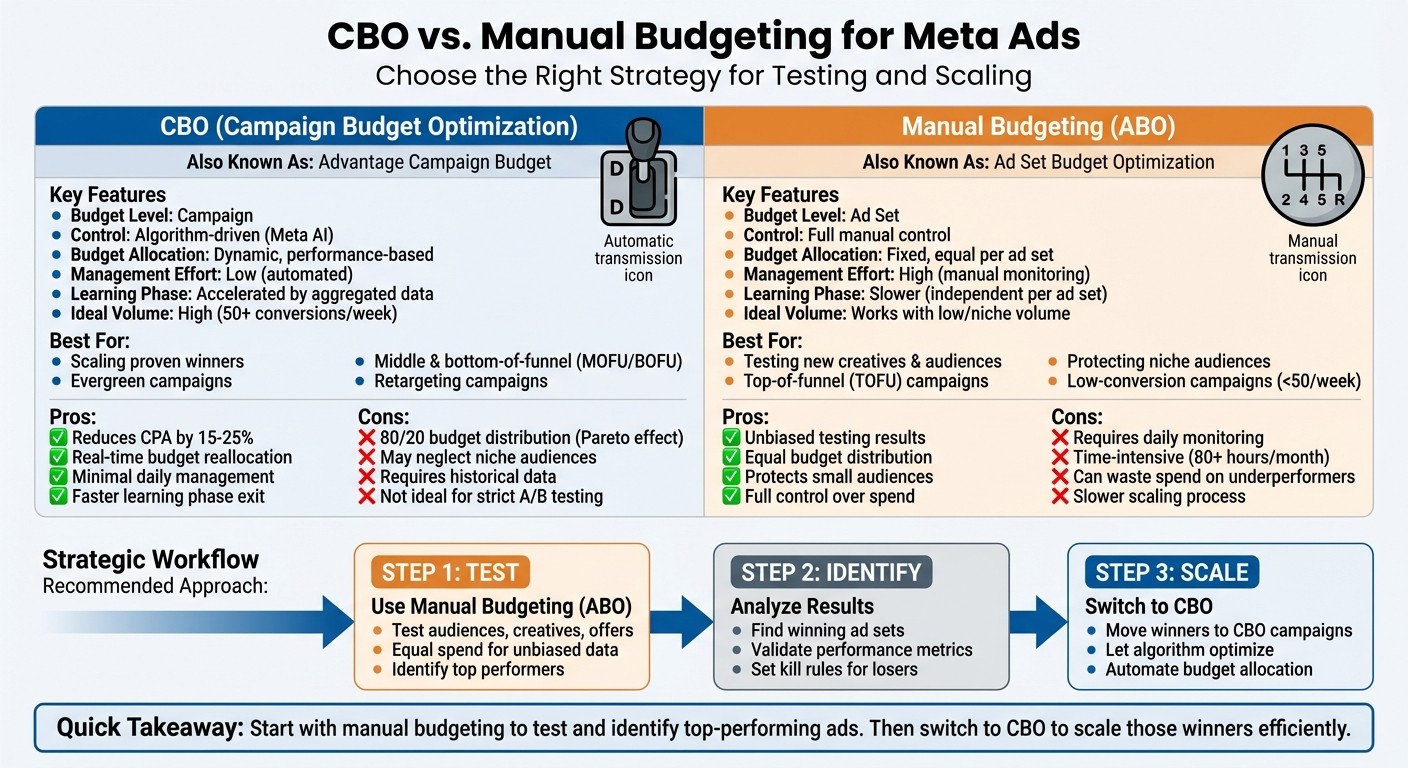
CBO vs Manual Budgeting for Meta Ads: Complete Comparison Guide
Facebook Ads ABO vs CBO - Which Should You Use in 2026?
What is Campaign Budget Optimization (CBO)?
Campaign Budget Optimization (CBO) is a system where you set a single budget for an entire campaign, and Meta's algorithm takes care of distributing that budget across your ad sets.
Think of it like an automatic transmission for your ad spend. The algorithm constantly evaluates performance metrics - like conversions, CPA, and ROAS benchmarks across different industries. Based on those signals, it shifts funds away from underperforming ad sets and directs them toward ones with better potential, almost in real-time.
How CBO Works
When you run a CBO campaign, Meta pools performance data from all your ad sets instead of analyzing them individually. This allows the algorithm to pinpoint "efficient segments" - specific audiences or creatives delivering results at a lower cost - and allocate more budget to them.
One key advantage is that it helps ad sets exit the learning phase faster. With a centralized budget, high-performing ad sets can reach the critical 50 conversions per week threshold much quicker than they would under manual vs. automated budgeting. Plus, the system adapts in real-time. If an ad starts to go viral or an audience becomes saturated, CBO automatically adjusts the budget to maximize results without requiring manual intervention. This adaptability ensures your campaign budget is used effectively and keeps performance on track.
Benefits of CBO
CBO simplifies scaling with minimal effort. Once you identify ad sets that perform well, you can plug them into a CBO campaign and let the algorithm take over. This automation reduces the need to micromanage individual budgets, freeing up your time to focus on creative ideas and overall strategy. You can even use AI agents to test creatives automatically to find those winners faster.
It’s especially useful for evergreen campaigns, where proven ads need to run consistently without constant fine-tuning. By dynamically reallocating funds, CBO minimizes wasted spending by pulling resources from underperforming ad sets and prioritizing the ones that deliver results.
What is Manual Budgeting?
Manual budgeting, often referred to as Ad Set Budget Optimization (ABO), is a strategy where you assign a specific budget to each ad set instead of relying on automated distribution. This gives you complete control over how much is spent on each audience, creative, or offer. Unlike Campaign Budget Optimization (CBO), which automatically reallocates funds based on performance, ABO keeps spending fixed unless you decide to adjust it.
How Manual Budgeting Works
With manual budgeting, you create separate ad sets within a campaign and assign each one its own daily or lifetime budget. For instance, if you're testing three audiences and want equal spending, you might allocate $100 per day to each ad set. Meta will then spend exactly that amount on each ad set, regardless of how well or poorly they perform.
Unlike CBO, which reallocates funds dynamically, ABO keeps spending consistent until you step in. If an ad set isn’t performing well, it will still use up its budget unless you manually pause it. To mitigate losses, advertisers using ABO often rely on strict automation rules for scaling, such as automated campaign pausing for any ad set that spends twice the target cost per acquisition after reaching $100 in spend.
Benefits of Manual Budgeting
Manual budgeting offers specific advantages, especially when testing. It ensures unbiased results by forcing equal spending across all ad sets, making it easier to determine which creative or audience works best using a Meta ad testing framework. This prevents the algorithm from prematurely favoring one ad set over another, which can skew results.
"I prefer to do that with manual budgets... The reason I like to control the budget is to get an even read on everything. I'm consciously choosing to perform a little worse [overall] but to have a better understanding of what is working." - Barry Hott, Facebook Ads Strategist
Another key advantage is protecting niche audiences. In CBO campaigns, the algorithm often prioritizes larger audiences, potentially neglecting smaller, high-intent groups like retargeting pools. For example, CBO might allocate 80% of the budget to a cold audience, leaving your retargeting ad set underfunded. With ABO, you can ensure that smaller, valuable audiences receive the budget they need to make an impact.
CBO vs. Manual Budgeting: Main Differences
CBO, now called "Advantage Campaign Budget", relies on Meta's algorithm to manage spending, while manual budgeting requires you to assign specific budgets to each ad set. This hands-on approach ensures that niche audiences, which might get overlooked by an algorithm, still receive adequate attention.
With CBO, the entire campaign budget is pooled and dynamically allocated by the algorithm. In contrast, manual budgeting locks spending at the ad set level. What does this mean? CBO often concentrates most of the budget on one or two early-performing ad sets, while manual budgeting ensures all ad sets get an equal share - even if some don’t perform as well.
CBO is a set-it-and-forget-it automation system, requiring minimal daily management. On the other hand, manual budgeting demands regular oversight to pause underperforming ad sets and reallocate funds effectively. This distinction highlights the trade-off: manual budgeting gives you more control, making it easier to protect niche audiences (like retargeting pools that might get overlooked in a CBO setup by using custom audiences). Meanwhile, CBO is better suited for scaling successful ad sets quickly without constant adjustments. In short, CBO shines when scaling Meta ads via budget or audience expansion, while manual budgeting is perfect for testing new audiences and creatives.
Here’s a quick breakdown of the differences:
Comparison Table
Feature | CBO (Advantage Campaign Budget) | Manual Budgeting (ABO) |
|---|---|---|
Budget Level | Campaign | Ad Set |
Control | Algorithm-driven (Meta AI) | Full manual control |
Budget Allocation | Dynamic, performance-based | Fixed, equal per ad set |
Best For | Scaling winners & evergreen ads | Testing creatives & audiences |
Management Effort | Low (automated) | High (manual monitoring) |
Learning Phase | Accelerated by aggregated data | Slower (independent per ad set) |
Ideal Volume | High (50+ conversions/week) | Works with low/niche volume |
Pros and Cons of CBO
Advantages of CBO
CBO (Campaign Budget Optimization) shines when it comes to scaling successful ad sets. By reallocating budgets in real time to favor high-performing ads, it can reduce costs per acquisition by 15–25%. Instead of manually tweaking budgets across multiple ad sets every day, you set a single campaign-level budget and let Meta's AI handle the rest. To maintain control, you can set budget guardrails to prevent overspending on specific segments.
This approach works especially well for evergreen campaigns with multiple creatives targeting similar audiences. For instance, if you're running a direct-to-consumer brand with various product images and video ads aimed at the same broad demographic, CBO will shift more of your budget to the ads that perform best. This means you get better results without needing to constantly micromanage your campaigns.
But while CBO offers efficiency, it does come with some notable challenges.
Disadvantages of CBO
CBO prioritizes efficiency over balance. As Friday Marketing Agency explains:
"The platform is not trying to be fair - it is trying to be efficient. If Meta predicts that an ad set will not find additional customers on a given day, it may limit or completely stop spending on that ad set, even if its return on ad spend looks good".
This focus on efficiency can result in a Pareto effect - where 20% of your ad sets consume 80% of the budget. Promising ad sets may get sidelined too soon, as the algorithm often favors early performance indicators like click-through rates or engagement. This can lead to an "early leader" hogging the budget before other ad sets have had time to prove their value.
CBO also complicates strict A/B testing. If you’re trying to equally compare two creatives or audiences, CBO’s dynamic budget allocation can skew the results. Combining different funnel stages in the same campaign - such as prospecting and retargeting - can also backfire. Retargeting, with its typically lower cost per acquisition, may dominate the budget, leaving prospecting efforts underfunded. This imbalance can disrupt your funnel's flow and limit its effectiveness.
Lastly, CBO relies heavily on historical data to perform well. Campaigns with small budgets or limited conversions may face greater volatility and inconsistent outcomes, making it harder to achieve stable results.
Pros and Cons of Manual Budgeting
Advantages of Manual Budgeting
Manual budgeting, also known as Ad Set Budget Optimization (ABO), gives you full control over where every dollar goes. You can decide precisely how much budget each ad set gets, which is especially useful for protecting smaller audiences that Campaign Budget Optimization (CBO) might overlook. For example, when running both retargeting and prospecting campaigns, manual budgeting ensures that retargeting audiences receive their fair share, even if Meta's algorithm might prioritize larger, cold audiences instead.
This method is also ideal for testing creatives and audiences. If you're comparing two ad variations, ABO ensures an equal spend, producing unbiased results. This prevents the algorithm from prematurely favoring one option based on early clicks or engagement. As Friday Marketing Agency explains:
"ABO works best when you need controlled testing and equal budget distribution - but only if you actively monitor performance". You can also use an ad performance analyzer to identify which sets are underperforming.
Another scenario where manual budgeting shines is in low-conversion campaigns. When you're generating fewer than 50 conversions per week - common in niche markets or B2B campaigns - the algorithm often lacks enough data to optimize effectively. In these cases, fixed budgets per ad set provide a more predictable approach.
That said, this level of control comes with its own set of challenges.
Disadvantages of Manual Budgeting
The biggest downside of manual budgeting is the time it requires. It demands daily attention to monitor performance and optimize Meta Ads ROI, which can overwhelm small teams unless they use AI automation platforms. Unlike CBO, which automatically shifts money away from underperforming ad sets, manual budgeting sticks to its original allocation until you step in. This can lead to wasted spend on ads that aren't delivering results.
Cedric Yarish from AdManage puts it perfectly:
"ABO is manual transmission, CBO is automatic".
While manual budgeting gives you more control - similar to driving a stick shift - it requires constant oversight. Scaling campaigns is also more tedious since increasing budgets by more than 10–20% every 48–72 hours can reset Meta's learning phase. To avoid wasting money, it's essential to set clear time-based rules in Meta Ads in advance. For instance, pause any ad set where the cost per acquisition exceeds twice your target after spending $100.
When to Use CBO vs. Manual Budgeting
Use CBO for Scaling
Once you’ve identified your winning ads, CBO (Campaign Budget Optimization) becomes your go-to for scaling. This method works best for campaigns with proven performers, as it’s designed to maximize results across multiple ad sets. To make the most of CBO, aim for campaigns that can generate at least 50 conversions per week at the campaign level.
CBO shines in middle-of-funnel (MOFU) and bottom-of-funnel (BOFU) campaigns, like retargeting efforts. Its algorithm automatically allocates your budget to the ad sets delivering the most cost-efficient results. For instance, if you’re retargeting website visitors across multiple ad sets, the algorithm will prioritize spend on the audience converting most efficiently on any given day.
That said, keep your prospecting and retargeting campaigns separate when using CBO. Combining different funnel stages in one campaign can cause the algorithm to favor either the larger prospecting audience or the more efficient retargeting group. This imbalance could leave one stage underfunded, reducing overall performance.
Use Manual Budgeting for Testing
Manual budgeting takes the lead during the testing phase, ensuring equal spend across ad sets for unbiased comparisons. This approach is essential for top-of-funnel (TOFU) campaigns, where you’re testing different cold audiences, creatives, or offers. By allocating budgets manually, you can accurately gauge the performance of each variable.
Manual budgeting also works well when audience segments have differing strategic values. For example, if leads from one demographic are three times more valuable than another, manual control ensures these higher-value segments aren’t underfunded, even if their initial cost per acquisition is higher.
Combine Both Approaches
The best strategy often blends both methods. Start with manual budgeting to test and identify your top-performing audiences, creatives, or offers. Once you’ve found your winners, transition them into CBO campaigns to scale Meta ads horizontally.
Keep your account structure organized for optimal results. Using AI tools for Meta ad account analysis can help identify structural inefficiencies before you scale. Consolidate campaigns into fewer groups with multiple ad sets - this setup gives CBO the flexibility to reallocate spend effectively. Avoid scattering your budget across too many single-ad-set campaigns, as it limits CBO’s ability to optimize.
Tools for Budget Optimization
Managing Meta ads can be time-intensive, but budget optimization tools simplify the process by automating adjustments, allowing you to focus on strategy. A great example is AdAmigo.ai, a platform that streamlines both Campaign Budget Optimization (CBO) and manual budgeting.
How AdAmigo.ai Enhances CBO
AdAmigo.ai acts as an AI-powered media buyer, taking care of your CBO campaigns by continuously analyzing performance and making real-time optimizations. Instead of manually monitoring metrics, the tool reallocates budgets across ad sets, scales top-performing creatives, and pauses ads that aren't delivering results - all while staying within the budget and KPIs you define.
The platform offers two operational modes:
Manual Mode: This mode provides more control. The AI suggests up to two optimizations daily, but you get the final say before any changes are implemented.
Autopilot Mode: Perfect for hands-off management, this mode makes continuous adjustments and automatically increases budgets by 10–20% every 48 hours if the data supports it. It’s particularly effective for scaling campaigns, as it handles the heavy lifting while you monitor the overall performance.
How AdAmigo.ai Supports Manual Budgeting
For campaigns that rely heavily on testing, AdAmigo.ai simplifies manual budgeting by uncovering actionable insights. Its AI Chat Agent allows you to ask direct questions like, “Which ad set should I increase budgets on?” or “What caused yesterday’s spike in cost per acquisition?” You’ll get instant, data-driven responses to guide your decisions.
During the testing phase, AdAmigo.ai can also save you hours with its Bulk Ad Launch feature. Simply upload your creatives to Google Drive, provide a brief, and the AI takes care of the rest - it generates ad copy, structures campaigns, and publishes the ads directly to your Meta account. This speeds up the process of identifying successful creatives, which you can later transition into CBO campaigns for scaling.
Conclusion
Deciding between CBO and manual budgeting isn't about declaring one better than the other - it’s about knowing when to use each approach. As Levi Steede explains:
"Most advertisers treat ABO vs CBO like picking a favorite sports team. It's not about which one is 'better.' It's about using the right tool for the right situation".
Manual budgeting gives you precise control, making it ideal for unbiased testing. On the other hand, CBO is perfect for scaling ads that are already performing well, as it automates the process to find the most cost-effective conversions.
Often, the best results come from combining both methods. Start with manual vs AI budget testing during the testing phase to gather reliable data. Once you’ve identified high-performing ads, shift them to CBO campaigns to let Meta’s algorithm handle scaling. This approach balances control during testing with automation for growth.
Managing campaigns manually can take over 80 hours a month, but tools like AdAmigo.ai simplify the process. These tools can automate budget adjustments, scaling, and testing, freeing up your time for strategic decisions. Understanding what AI tools can actually do helps in selecting the right platform for your workflow. Whether you prefer hands-on control or letting AI handle the details, these platforms can adapt to your needs.
As your campaigns develop, your strategy should evolve too. Use manual budgeting to test new ideas, rely on CBO for scaling proven winners, and explore automation tools to reduce the workload. The goal isn’t to get everything perfect immediately - it’s to build a system that improves over time while letting you focus on growing your business.
FAQs
How much budget is needed for CBO to work well?
To make Campaign Budget Optimization (CBO) work well, aim to allocate at least 50 times your target CPA (Cost Per Acquisition) each week. Start by creating 3–5 ad sets, each targeting a different audience. This approach helps the algorithm distribute your budget more effectively, focusing on the ad sets that deliver the best results.
How do I keep retargeting from being underfunded in CBO?
To make sure retargeting campaigns don’t get overlooked in Campaign Budget Optimization (CBO), start by assigning a larger initial budget to retargeting ad sets or sticking with fixed budgets during the learning phase. Keep a close eye on performance metrics and make adjustments as necessary - like combining ad sets that are delivering strong results. Additionally, platforms like AdAmigo.ai can help by automating budget adjustments, ensuring your retargeting audiences get the funding they need while optimizing spend based on performance data.
When should I move winners from ABO to CBO?
When you’ve pinpointed high-performing creatives and audiences that consistently deliver strong results, transition from Ad Set Budget Optimization (ABO) to Campaign Budget Optimization (CBO). Start by testing with ABO to gather precise data on what works best. Once you identify the ad sets driving the highest ROAS or conversions, shift to CBO. This allows Meta's algorithm to take over, distributing the budget efficiently to boost performance and scale your growth.