
How Cookie Banners Impact Ad Performance
Cookie banners and banner ghosting strip tracking, inflate CPA, and weaken ad optimization — consent mode and AI can restore performance.
Cookie banners, required by privacy laws like GDPR, which require a strict compliance checklist, are causing major challenges for advertisers. Here's the core issue: when users reject or ignore these banners (a behavior known as "banner ghosting"), critical tracking data from tools like the Meta Pixel is lost. This disrupts ad targeting, conversion tracking, and algorithm optimization, leading to higher costs and reduced campaign performance.
Key takeaways:
40–60% of users ignore cookie banners, and only 8–12% consent in regions like Germany.
Data loss reaches up to 90% in some countries, skewing audience profiles and inflating costs.
Missing conversion data leads to inaccurate metrics, higher CPA, and lower ROAS.
Meta's algorithms struggle with incomplete data, raising ad costs and reducing efficiency.
Solutions include improving banner design to increase opt-ins, using Google Consent Mode to recover lost data, and leveraging AI tools like AdAmigo.ai for real-time optimizations. By combining these strategies, businesses can mitigate the impact of cookie banners while complying with privacy and consent rules.
How Cookie Banners Reduce Ad Targeting and Data Collection
Loss of Tracking Data
The real challenge with cookie banners isn’t outright rejection - it’s the number of visitors who simply ignore them. This phenomenon, known as "banner ghosting", impacts 40–60% of website visitors. When users ghost your banner, tracking tools like the Meta Pixel can’t set cookies. That means every action they take - whether it’s viewing a page, clicking a button, or completing a purchase - becomes invisible to your ad account.
"The biggest threat to your analytics isn't cookie rejection - it's cookie banner ghosting." - Sealmetrics
The numbers are striking. In Germany, only 8–12% of users accept cookies, leading to a 90% total data loss. France experiences an 80% loss, while the UK loses 70% of tracking data. In the United States, data loss is currently lower, at around 20–30%, but it’s steadily increasing as more state-level privacy laws take effect.
Installing a compliant cookie banner can immediately cause a 30–50% drop in reported users and sessions within Meta Ads Manager. This doesn’t mean your traffic has disappeared - it’s just that Meta can no longer track a significant portion of your audience.
This loss of tracking data doesn’t just affect visibility; it also creates a distorted audience profile, making precise targeting much harder.
Weaker Audience Segmentation
The small percentage of users who do accept cookies - typically 10–20% - don’t represent your entire audience. This creates a systematic bias in your data. Studies show that cookie accepters are often younger or older (less privacy-conscious), more trusting of brands, or simply dismissing the banner in haste. Meanwhile, privacy-focused users - often middle-aged professionals and tech-savvy individuals - are more likely to ghost or reject cookies.
This skewed data has real consequences. Meta’s algorithms, which rely on audience data to build Lookalike Audiences or optimize Advantage+ campaigns, are learning from an incomplete and biased sample. For example, high-intent customers who visit multiple times might appear as one-off visitors because their session data is missing. On platforms like LinkedIn, where privacy-conscious B2B professionals dominate, data loss can reach 70–80%, further distorting metrics.
The outcome? Meta has to rely on weaker signals and modeled data to fill in the gaps. This degrades targeting accuracy and increases your cost per acquisition.
🍪 Cookie Consent Banners (Tools Like “Cookie Bot”) Are Destroying Your AD Performance - Here's Why 📉
How Cookie Banners Affect Conversion Tracking and ROAS
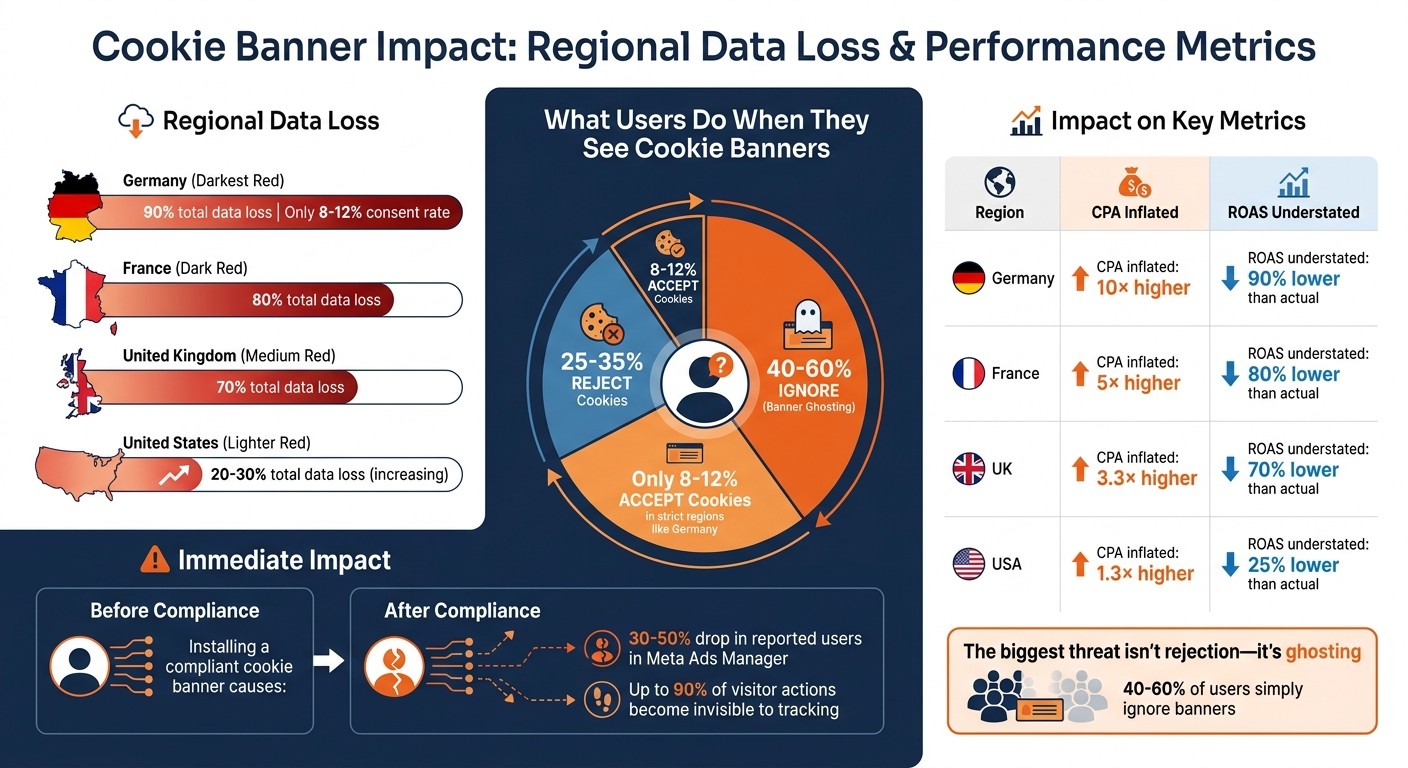
Cookie Banner Impact on Ad Performance: Data Loss and Cost Inflation by Region
Missing Conversion Data
Cookie banners don't just impact tracking - they also disrupt how conversions are measured and attributed. When a user rejects or ignores a cookie banner, the Facebook Pixel can't track their actions. Imagine someone browsing your site, adding items to their cart, and even completing a purchase. If they didn’t accept cookies, Meta won't register that conversion. This creates what's known as attribution breakdown, where the connection between the ad click and the final sale is lost.
For e-commerce brands running campaigns that span multiple sessions, the problem is even worse. A customer might click your ad one day and return later to make a purchase. But if the initial session wasn’t tracked, Meta can’t link the sale back to your ad. This incomplete picture hides the real value of your campaigns, making it essential to fix conversion tracking, making it harder to evaluate performance and driving up acquisition costs unnecessarily, making it harder to scale Meta ads effectively.
Higher CPA and Lower ROAS
When conversions aren’t tracked, your performance metrics can become wildly inaccurate. Take a SaaS campaign, for example: out of 100 actual sign-ups, only 10 might be recorded due to cookie restrictions. This could make your cost-per-acquisition (CPA) appear to be $500, even though the real CPA is closer to $50. Similarly, an e-commerce site generating $150,000 in revenue might only report $30,000 if just 20% of users accept cookies - an 80% undercount.
This incomplete data doesn’t just skew your metrics - it can lead to bad decisions. A campaign that’s actually profitable might look like a failure, causing you to pause it. Or worse, you might pour resources into campaigns that seem to perform well but are actually underperforming. And because Meta’s algorithms rely on this data to optimize targeting, the problem snowballs, making it even harder to reach the right audience.
Region | Total Data Loss | Impact on Metrics |
|---|---|---|
Germany | 90% | CPA inflated 10×, ROAS understated by 90% |
France | 80% | CPA inflated 5×, ROAS understated by 80% |
United Kingdom | 70% | CPA inflated 3.3×, ROAS understated by 70% |
United States | 20–30% | CPA inflated 1.3×, ROAS understated by 25% |
The financial impact is undeniable. Without accurate conversion data, you could end up slashing budgets on campaigns that are actually working - or doubling down on ones that aren’t. This noisy data makes it harder to trust your metrics, leaving you guessing about what’s truly driving results.
How Cookie Banners Hurt Smart Bidding and Algorithm Performance
Meta's smart bidding algorithms - like those behind Advantage+ campaigns - rely on high-quality conversion signals to function effectively. These signals come from tracking user actions like clicks, site behavior, and purchases. But when cookie banners block the Meta Pixel, the algorithm loses visibility into the customer journey. Instead of making precise, data-driven decisions, it’s forced to rely on estimates. This loss of critical data compounds earlier tracking challenges, further weakening smart bidding performance.
This issue creates what's known as a learning tax - the extra costs advertisers face when Meta's AI struggles to optimize with incomplete data. With fewer conversions to analyze, the algorithm shifts to broader targeting, often showing ads to less relevant audiences. This not only increases costs but also hurts overall performance. For example, Meta reported a 14% rise in costs with only a 6% increase in impressions in 2025, and the average cost per lead on Facebook jumped 21% year-over-year. Much of this cost inflation stems from algorithms operating with incomplete signals.
The problem gets worse when Meta's AI relies solely on the small percentage of users who accept cookies. This group, often just 10–20% of site visitors, doesn’t represent the broader audience. It excludes the 40–60% of users who ignore cookie banners altogether - a significant portion of traffic that remains untracked. In regions with particularly low consent rates, such as parts of Europe, the algorithm is left working with an even smaller, skewed dataset.
"If ad targeting is less effective, costs will increase for advertisers." - AdExchanger
The ripple effects of poor tracking don’t stop there. When the algorithm misses key actions, it assumes no conversion occurred and adjusts bids downward. This creates a vicious cycle where profitable campaigns are mischaracterized, leading to budget cuts and further misaligned targeting. For instance, Instagram’s average CPM reached $9.46 in Q2 2025, surpassing Facebook’s CPM, as advertisers vied for fewer trackable placements. The bottom line? Advertisers end up paying more for campaigns that deliver weaker results - all because the algorithm is operating with incomplete visibility.
How to Reduce Cookie Banner Impact on Ad Performance
Cookie banners can disrupt tracking and ad performance, but with the right strategies, their impact can be minimized. The trick lies in finding a balance: complying with privacy laws and auditing requirements while optimizing for user consent and supplementing lost data with privacy-friendly tracking. This is a critical step in any conversion optimization checklist. Two key approaches to consider are refining banner design to encourage more opt-ins and leveraging Consent Mode to recover insights from users who decline or ignore the banner.
Better Cookie Banner Design
Small design adjustments can make a big difference in opt-in rates. Research shows that users tend to favor straightforward options, like a simple "Accept All/Reject All" choice, over complex menus. In fact, granular options can lower consent rates by 8–20% compared to binary choices. Additionally, 97–98% of users bypass granular settings when a clear reject option is available.
To improve opt-in rates, try these tips:
Use a distinct color (e.g., blue) for the "Accept" button and a neutral color (e.g., gray) for the "Decline" button.
Position the banner in the bottom-right corner of the screen, a placement that can achieve opt-in rates of approximately 34% on desktop.
Ensure your Consent Management Platform (CMP) is lightweight, ideally under 20KB, to avoid slowing down your website. Heavy banners can increase your Largest Contentful Paint (LCP) from 1.43 seconds to 3.61 seconds.
Avoid full-screen overlays, which can pressure users into making rushed decisions and might lead to negative reactions.
Using Consent Mode
Even with an optimized banner, some users will still decline or ignore it. That’s where Consent Mode can help. In its Advanced Mode, Google tags load immediately in a denied state, sending anonymous, cookieless signals. These signals don’t rely on personal identifiers or cross-site tracking, but they allow machine-learning models to estimate user behavior.
Consent Mode can recover 70–85% of the data lost from non-consenting users. This modeled data enables ad bidding algorithms to perform effectively, even with limited direct tracking. This is where AI predicts performance trends to fill the gaps.
Here’s a quick comparison of Basic vs. Advanced Consent Mode:
Feature | Basic Consent Mode | Advanced Consent Mode |
|---|---|---|
Tag Loading | Blocked until consent is granted | Loads immediately in a denied state |
Data Collection | No data until "Accept" is clicked | Sends anonymous, cookieless pings |
Modeling | No behavioral or conversion modeling | Enables machine-learning models |
Data Recovery | 0% of non-consented traffic | 70–85% of missing data recovered |
To ensure everything is working correctly, use tools like Google Tag Assistant or browser DevTools. Check that tags are sending the appropriate signals: gcs=G100 for denied states and gcs=G111 for granted states. Importantly, don’t attempt to hide the reject button or preselect checkboxes - these practices are illegal under GDPR and are considered "dark patterns".
How AdAmigo.ai Helps Manage Privacy Challenges
AdAmigo.ai steps in to tackle the privacy challenges that come with data loss and shrinking ad performance. With cookie banners blocking up to 90% of visitor data, ad campaigns often struggle - visibility drops, attribution becomes unreliable, and CPA (cost per acquisition) skyrockets. AdAmigo.ai addresses these issues head-on with AI-driven, real-time optimizations, shifting the workload from manual analysis to automated systems designed to handle fragmented data.
AI Autopilot for Limited Data
AdAmigo.ai’s AI Autopilot keeps a close eye on performance metrics and dynamically reallocates budgets as needed. Even when 40–60% of your audience data is missing, the system identifies live performance trends and redirects ad spend toward campaigns that are still delivering results. This real-time adjustment ensures campaigns stay effective, even in the face of incomplete tracking data.
AI-Powered Creative Testing at Scale
When detailed targeting becomes unreliable due to reduced data, AdAmigo.ai compensates by generating and testing over 50 ad variations at once. This approach helps pinpoint the creatives that resonate with broad audiences, eliminating the need for AI audience segmentation vs manual targeting. By testing at scale, the platform uncovers messaging that drives conversions, even when granular targeting is off the table.
Real-Time Adjustments with AI Chat Agent
If attribution accuracy breaks down and your CPA appears to spike - despite actual costs remaining steady - you need quick insights. The AI Chat Agent steps in to explain these performance shifts and make immediate adjustments. Whether you want to approve changes manually or let the system handle optimizations autonomously, the tool adapts to privacy challenges in real time, ensuring your campaigns stay on track despite data gaps caused by cookie rejections. This proactive approach is one of several ways to use audience data for growth even in a privacy-first landscape.
Conclusion
Cookie banners are now blocking a staggering 80–90% of website visitor data, making ad targeting and conversion tracking much less reliable. With 40–60% of users ignoring these banners and 25–35% actively rejecting them, platforms like Meta are left optimizing with incomplete data. This drives up CPA and throws off ROAS calculations.
To tackle the challenges of incomplete tracking, advertisers need to embrace privacy-focused tools. For instance, Google Consent Mode v2 and GA4 tracking uses behavioral modeling to recover 70–85% of the lost measurement gap. Pairing this with server-side tracking solutions, like Meta’s Conversions API, and effective banner design can improve consent rates and data accuracy - all without compromising user trust.
Advanced AI tools are also stepping in to bridge these data gaps. Platforms like AdAmigo.ai are becoming indispensable. These AI-driven tools can reallocate budgets on the fly, scale creative testing, and extract performance insights from limited data. By testing dozens of creative variations simultaneously and optimizing campaigns around the clock, they handle tasks that would be impossible to manage manually at the required speed.
The advertising world of 2026 will reward those who adapt. Brands that combine privacy-conscious tracking, streamlined consent management platforms (CMPs), and AI-powered optimization will thrive, maintaining performance while respecting user privacy. On the other hand, businesses sticking to outdated, cookie-dependent methods will face rising CPAs and incomplete conversion data as the gap in tracking continues to grow.
Balancing privacy and performance isn’t just possible - it’s essential. But getting there will require smarter tools and infrastructure designed for a cookieless future.
FAQs
How can I tell if cookie banners are making my Meta results look worse?
If tracking scripts are running before users provide consent, your cookie banner isn’t doing its job of blocking tracking effectively. This can lead to incomplete or inaccurate data in analytics and advertising platforms. As a result, your Meta performance metrics might look worse than they actually are.
What’s the fastest way to recover conversion data without breaking privacy laws?
To recover conversion data quickly while remaining compliant, consider using cookieless analytics platforms like Sealmetrics. These platforms don't depend on cookies or consent banners, which means they avoid issues like "banner ghosting" and ensure you capture 100% of visitor data under GDPR's legitimate interest. While properly configuring consent banners can help, cookieless solutions offer the most dependable way to regain accurate data.
Should I prioritize better consent rates or switch to modeled/server-side tracking?
Improving consent rates often has a bigger impact on ad performance than just leaning on modeled or server-side tracking. When consent rates are higher, tracking and targeting become more precise, which translates to better ROI. While modeled or server-side tracking can help minimize data loss, they can't completely substitute for user consent. The key? Work on refining your cookie banner design to boost consent rates, and treat modeled or server-side tracking as a backup strategy to support your efforts.