
Fashion eCommerce Meta Ads ROAS Benchmarks (2026)
2026 benchmarks for Meta Ads ROAS in fashion: median 2.18x, top 10% 6x, plus seasonality, AOV, margins, and scaling tips.
If you're running Meta ads for a fashion eCommerce brand, understanding ROAS (Return on Ad Spend) is critical for profitability. (Use a ROAS calculator to monitor your specific performance.) In 2026, the median ROAS for fashion brands is 2.18x, with top performers reaching 6.0x. Rising ad costs and varying profit margins make it essential to tailor strategies based on your brand's unique metrics. Here's what you need to know:
Benchmarks: Average ROAS ranges from 2.18x to 2.96x, while the top 10% achieve 6.0x.
Key Factors: Profit margins, AOV (Average Order Value), and ad creative testing heavily influence ROAS.
Seasonality: Costs spike in Q4 but offer high returns, while January provides cost-efficient acquisition opportunities.
Platform Comparison: Meta excels at discovery (ROAS 2.18x–2.90x), Google leads in high-intent search (ROAS 3.40x–4.48x), and TikTok builds awareness (ROAS 1.69x–2.80x).
Scaling Ads: Gradual budget increases (no more than 20%) and testing 21+ creatives monthly are key for sustained performance.
To stay competitive, focus on optimizing AOV, leveraging AI automation platforms like AdAmigo.ai, and diversifying across platforms. These strategies can help you scale campaigns effectively while maintaining profitability.
The NEW WAY to Scale Meta Ads for Clothing Brands (After Andromeda)

2026 Meta Ads ROAS Benchmarks for Fashion eCommerce
2026 Fashion eCommerce Meta Ads ROAS Benchmarks and Performance Tiers
Understanding these benchmarks is crucial for fashion brands aiming to fine-tune their ad spend based on factors like profit margins, average order value (AOV), seasonal trends, and the volume of creative assets.
Typical ROAS Ranges for Fashion Brands
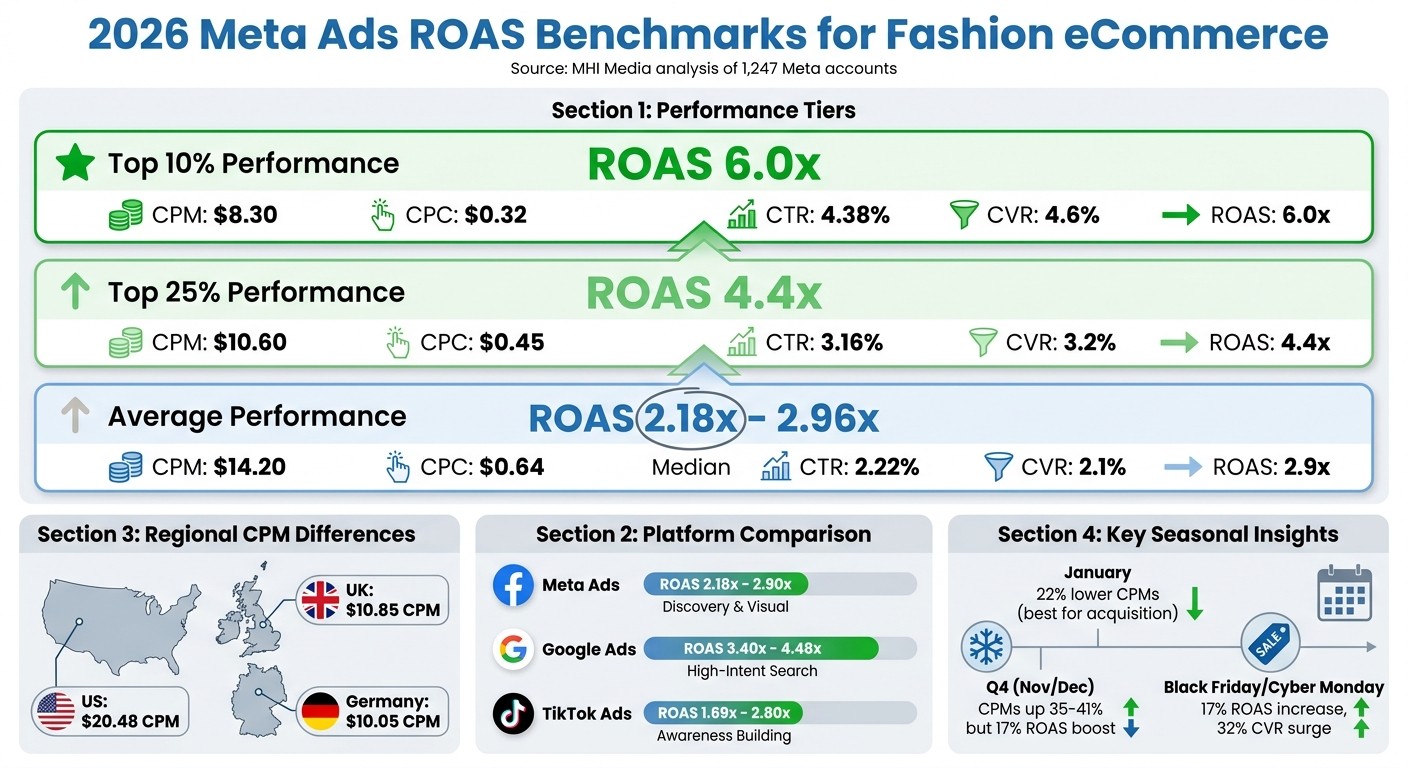
In 2026, the median Meta Ads ROAS for fashion and apparel brands sits at 2.18x. Average-performing brands fall between 2.18x and 2.96x, while the top 25% reach 4.4x, and the elite top 10% achieve an impressive 6.0x ROAS.
These disparities often stem from differences in creative testing, campaign optimization, AI-powered creative scaling, and leveraging Meta's advanced automation tools. For example, Advantage+ Shopping Campaigns now make up 62% of eCommerce conversion spending on Meta, highlighting their growing importance.
Performance Tier | CPM | CPC | CTR | CVR | ROAS |
|---|---|---|---|---|---|
Average | $14.20 | $0.64 | 2.22% | 2.1% | 2.9x |
Top 25% | $10.60 | $0.45 | 3.16% | 3.2% | 4.4x |
Top 10% | $8.30 | $0.32 | 4.38% | 4.6% | 6.0x |
Source: MHI Media analysis of 1,247 Meta accounts
These benchmarks provide a foundation for analyzing how regional and seasonal factors influence ad performance across industries.
Year-Over-Year Trends and Regional Differences
ROAS performance is also shaped by geography and seasonal shifts. For instance, US CPMs average $20.48, nearly double those in the UK ($10.85) and Germany ($10.05). This means brands must tailor their ROAS goals to reflect the advertising costs in each market.
Seasonality is another key factor. Take Black Friday/Cyber Monday 2024, when fashion brands saw a 17% boost in ROAS compared to their yearly average. On the flip side, January offers a cost-efficient opportunity for customer acquisition, with CPMs averaging 22% lower than the annual rate. Many brands strategically allocate 35% to 40% of their annual acquisition budgets to Q1 to capitalize on these reduced costs.
Meta vs. Google Ads vs. TikTok: ROAS Comparison

Each platform plays a unique role in a well-rounded marketing strategy. Google Ads leads in direct ROAS for fashion, delivering returns between 3.40x and 4.48x by targeting shoppers actively searching for products. Meanwhile, Meta Ads offers a balance, with ROAS ranging from 2.18x to 2.90x, excelling in scaling reach and driving visual discovery. TikTok Ads, while lower in direct ROAS (from 1.69x to 2.80x), shines at building top-of-funnel awareness that often converts later through other channels.
It's important to note the distinct strengths of Meta and Google. Meta is ideal for customer discovery, while Google is better suited for capturing high-intent demand. Leading fashion brands are now combining Meta's expansive reach with Google's ability to target shoppers ready to buy.
What Affects ROAS for Fashion Brands
ROAS (Return on Ad Spend) isn't an isolated metric. It's influenced by several interconnected factors that fashion brands need to understand to set realistic goals and improve performance. Whether your brand achieves a 2.0× or 6.0× return depends on how well you manage these variables.
How AOV and Pricing Affect ROAS
Average order value (AOV) has a direct impact on your potential ROAS. For example, increasing AOV from $45 to $65 can boost ROAS by 44% without changing the conversion rate. Similarly, raising AOV from $50 to $75 results in a 50% ROAS increase with the same ad spend.
This becomes even more important when you consider rising ad costs. Meta CPMs (cost per thousand impressions) increased by about 19.2% year-over-year in 2025. A higher AOV helps offset these costs while maintaining profitability. For instance, a luxury brand with a $250 AOV and 50% margins can stay profitable at 2.0× ROAS. On the other hand, a fast-fashion brand with an AOV of $40 and 35% margins needs at least a 2.9× ROAS just to break even.
To raise AOV without increasing ad spend, tactics like product bundling or adjusting free-shipping thresholds can make a big difference. In 2025, the median eCommerce AOV was $71.69, reflecting a 2.7% year-over-year increase.
Understanding these pricing strategies lays the groundwork for tackling another key variable: seasonal trends.
Seasonal Patterns in Fashion ROAS
Fashion brands experience predictable seasonal shifts in ROAS, and successful brands plan accordingly. January is the most cost-efficient month for acquiring new customers, with CPMs 22% lower than the annual average.
In contrast, Q4 sees a sharp rise in ad costs, with CPMs jumping 41% in November and 35% in December. However, this period is critical - it often accounts for 42% of annual eCommerce revenue. During Black Friday and Cyber Monday in 2024, Meta ROAS increased by 17%, and conversion rates surged by 32%. While costs are higher, focusing on volume rather than strict efficiency can pay off during this time.
Seasonal spikes aren't limited to the holidays. Spring fashion trends in April push CPMs up by 5%, and back-to-school campaigns in August increase CPMs by 12%. To stay ahead, brands should test creatives 6–8 weeks before these high-cost periods to identify top-performing assets.
Creative Volume and Testing Frequency
Creative strategy is another major driver of ROAS. Creative quality and variety account for over 50% of Meta Ads performance in 2026. Brands that test 21 or more new creatives each month see significantly better ROAS compared to those testing fewer than 10.
During high-spend times like December, weekly creative updates may be necessary to maintain performance. For brands with daily ad spends of $5,000 or more, refreshing 25–30% of creative assets every two weeks helps prevent ad fatigue, which can hurt ROAS. Interestingly, user-generated content tends to outperform professional studio ads, delivering 24% higher ROAS and 48% higher click-through rates on average.
Meta's algorithm also favors accounts with diverse creative assets. In 2026, brands using 15 or more active creatives perform better, while those spending $5,000+ daily may need 50–100 active creatives to stay competitive.
Margins and Break-Even ROAS
Margins are the ultimate factor that determines the lowest ROAS (Return on Ad Spend) you need to stay profitable. While AOV, seasonality, and creative volume influence ROAS, margins set the baseline. Implementing a Meta ad testing framework can help identify which creatives drive the highest efficiency relative to these margins.
How Margins Determine Minimum ROAS
Your profit margin defines your break-even ROAS. The math is simple: use a break-even ROAS calculator or divide 1 by your gross profit margin percentage. For instance, a fashion brand with a 50% margin needs a 2.0× ROAS to break even. On the other hand, a brand with a 35% margin would need a 2.86× ROAS to avoid losses.
Fashion and apparel brands generally operate with profit margins between 35% and 50%. However, calculating net margins involves more than just subtracting the cost of goods sold (COGS). You also need to account for:
Fulfillment costs (typically 8–15% of revenue)
Payment processing fees (around 2.9–3.5%)
Platform fees
High return rates can be a major drain on margins. Returns, often exceeding 30%, can cost as much as 66% of the product's price, making them a critical factor to monitor.
"Understanding your break-even ROAS is the difference between profitable growth and cash flow destruction. Most ecommerce businesses that fail do so because they prioritized growth over profitability."
– Oliver, Digital Ads Calculator
The examples below illustrate how margins directly affect ROAS targets.
Break-Even ROAS Examples
The same ROAS can mean drastically different outcomes depending on your margins. For example, a luxury brand with a 60% margin can turn a profit at a 2.0× ROAS, but a retailer with a 25% margin would incur losses at that same level.
Gross Profit Margin | Break-Even ROAS | Target ROAS (+20% buffer) |
|---|---|---|
60% | 1.67× | 2.00× |
50% | 2.00× | 2.40× |
40% | 2.50× | 3.00× |
35% | 2.86× | 3.43× |
25% | 4.00× | 4.80× |
To achieve true profitability, aim for a target ROAS that is 20–30% higher than your break-even point. For example, a direct-to-consumer brand with margins between 50% and 60% can scale profitably with a 2.0–3.0× ROAS. In contrast, a dropshipping business with a 25% margin would need a 4.0–5.0× ROAS just to stay afloat.
How Returns Change Your Real Break-Even ROAS
The break-even table above assumes every sale sticks. In fashion eCommerce, that's rarely the case. Apparel return rates run between 20% and 30% on average, and some segments — like formal dresses — hit 50%. According to the National Retail Federation, 19.3% of all online sales were returned in 2025.
The page already references the Coresight Research (via Optoro) finding that processing a return costs roughly 66% of the product's price. Let's turn that stat into a concrete calculation — using the exact numbers fashion brands are searching for.
Worked example: 40% gross margin, 15% return rate
Here's how to calculate your return-adjusted break-even ROAS, step by step — so you can swap in your own numbers.
Step 1: Find your nominal break-even. With 40% gross margin, 1 ÷ 0.40 = 2.50×. At this ROAS, every dollar of ad spend returns $2.50 in revenue and $1.00 in gross profit — just enough to cover the ad cost on paper.
Step 2: Calculate what a return actually costs you. Take a $100 average order. If the customer keeps it, you earn $40 in gross profit. If they return it, you lose the sale entirely and pay roughly $66 in return processing — shipping, inspection, repackaging, and restocking. Your net outcome on that order: −$66.
Step 3: Blend the return probability into your per-order profit. Out of every 100 orders at $100 each:
85 orders are kept: 85 × $40 profit = $3,400
15 orders are returned: 15 × (−$66) = −$990
Total profit across all 100 orders: $2,410
Your effective margin: $2,410 ÷ $10,000 = 24.1% — not the 40% you started with.
Step 4: Recalculate your break-even. 1 ÷ 0.241 = 4.15×. That's 66% higher than the 2.50× nominal break-even the standard table shows.
To make this actionable across different scenarios, here's how return rates shift the effective break-even for a brand with 40% gross margin:
Return Rate | Effective Margin | Effective Break-Even ROAS |
|---|---|---|
5% | 34.7% | 2.88× |
10% | 29.4% | 3.40× |
15% | 24.1% | 4.15× |
20% | 18.8% | 5.32× |
25% | 13.5% | 7.41× |
The gap between platform ROAS and real ROAS. Meta reports ROAS based on the purchase event — which fires when the order is placed, not when it's kept. If your dashboard shows 3.0× and you mentally compare it to the 2.50× break-even from the table, you'd think you're profitable. But with a 15% return rate, your real break-even is 4.15× — and that 3.0× campaign is quietly losing money.
This is why the top-performing fashion brands track return-adjusted ROAS separately from platform-reported ROAS. The difference between the two is where margin lives or dies. If you're not already factoring returns into your ROAS targets, start with your own return rate from the last 90 days and run it through the four steps above — you might be surprised by the result.
How to Scale While Maintaining ROAS
Scaling your Meta ad spend while keeping your ROAS intact requires a smart mix of budget tweaks, creative updates, and audience expansion. Factors like margins, average order value (AOV), and seasonal trends all play a role in shaping ROAS, but with the right strategies, fashion brands can grow without losing profitability.
Budget Adjustments Without Disrupting the Algorithm
To avoid throwing Meta's algorithm off balance and causing CPA spikes, increase ad budgets gradually - no more than 20% at a time. This measured approach keeps performance steady as you scale.
But scaling isn’t just about spending more; it’s about scaling your creative assets. As one agency explains:
"Scaling isn't about increasing budget. It's about increasing the number of proven creative winners that can absorb more spend without CPA rising." – 27Five
For example, a campaign spending $1,000 per day might need 8–12 strong-performing creatives to maintain efficiency. As your budget grows, expand your creative library proportionally to handle the additional spend without seeing performance drop.
Focus on tracking new customer acquisition cost (nCAC) rather than blended ROAS. Blended ROAS can be misleading because it includes repeat purchases, which might hide the true cost of acquiring new customers.
Reaching New Audiences and Expanding Geographically
Broad targeting often delivers better results than narrow interest segments. Meta’s AI has become highly effective at identifying likely buyers based on behavior rather than specific interests. Brands using broad targeting - defined by age, gender, and location - often achieve 29–37% better ROAS compared to interest-based targeting strategies.
Advantage+ Shopping Campaigns (ASC) should be your go-to tool for scaling. Consolidating campaigns allows Meta’s algorithm to process data more effectively, optimizing performance. You can also use AI tools for account analysis to identify which campaigns are ready for this transition.
When your prospecting campaigns hit a frequency higher than 3.0, it’s time to expand geographically. If your local market starts to feel saturated, look to nearby regions with similar demographics. This approach introduces fresh audiences and reduces competition within your existing market.
Top-performing brands allocate their budgets strategically: 80% to prospecting, 15% to retargeting, often utilizing AI-powered retargeting to optimize bids, and 5% to retention. This setup prioritizes acquiring new customers over chasing repeat sales that might have happened anyway.
By combining audience expansion with a strong creative library, you’ll be ready to scale even further with a multi-platform strategy.
Integrating Multiple Platforms for Better Results
To scale effectively while maintaining ROAS, diversify across platforms. Each platform brings unique strengths to the table. For example:
Meta excels in discovery and broad reach, with a median ROAS of 1.86×.
Google Ads captures high-intent search traffic, boasting a median ROAS of 3.52×.
TikTok drives top-of-funnel awareness with a median ROAS of 1.41×.
Using these platforms together creates a ripple effect. TikTok can feed Meta’s retargeting audience and even drive branded searches on Google. Brands using this layered approach often see a 20–30% boost in overall marketing efficiency compared to sticking with Meta alone.
Test a variety of creative formats - user-generated content, lifestyle visuals, and founder stories - to connect with different segments of your audience. Brands that test over 20 new creatives each month report a 65% higher ROAS than those testing fewer than 10.
How AdAmigo.ai Improves ROAS for Fashion Brands
Fashion brands face the constant challenge of testing new ad creatives to avoid fatigue while scaling budgets without disrupting Meta's algorithm. AdAmigo.ai steps in as an AI-powered media buyer, automating creative testing and budget adjustments around the clock.
Automated Creative Testing
In the fashion world, ad creatives often lose their effectiveness within 5–7 days, making frequent testing a must. AdAmigo.ai’s Ad Factory takes this burden off your plate by continuously analyzing top-performing ads and competitor campaigns, then generating fresh variations automatically. Instead of manually launching new ads, the platform handles bulk ad testing with AI on its own.
Take The Work Mat Co. as an example. Between February 12 and March 12, 2025, they transitioned from a paid media agency to AdAmigo.ai. During that month, AdAmigo.ai executed 270 optimizations, including creating 158 new ads - far beyond what a human team could achieve. The results? A 145.7% increase in purchases and a 28.3% lift in ROAS. Co-founder Rochelle Dallas shared her experience:
"Our budgets are controlled, our spend is being smartly allocated and our ROAS is up massively. Agencies charging 7 times the cost of AdAmigo have been put to shame quite frankly!"
This level of efficiency is crucial for fashion brands. The top 10% of performers often achieve a 6.0× ROAS compared to the 2.9× average, largely by testing over 20 new creatives every month. Automated creative testing like this sets the stage for smarter budget management.
AI-Powered Budget Management
Scaling ad budgets without disrupting Meta's algorithm takes precision. AdAmigo.ai’s AI Autopilot applies gradual scaling rules, adjusts budgets in real-time based on performance using AI budget testing, and reallocates spend to high-performing ads. The system also fine-tunes audience targeting, all without manual intervention.
For instance, Dyut.eu, a premium skincare brand, switched to "Full Autopilot Mode" from September 25 to October 25, 2024. During this period, AdAmigo.ai completed 163 optimizations, including 41 budget adjustments and 26 audience refinements. The outcome? A 23% boost in ROAS, a 67.8% increase in purchases, and 18.3 hours saved on manual work. Co-founder Shubham highlighted the added value:
"The AI recommendations go beyond simply suggesting actions; they provide valuable insights and justifications. This not only improves my results but also deepens my understanding of campaign optimization."
By automating these processes, AdAmigo.ai ensures budgets are optimized while keeping campaigns flexible and responsive.
Real-Time Performance Monitoring
AdAmigo.ai takes campaign management further with real-time performance insights. Its AI Chat Agent allows you to get instant diagnostics through text or voice commands. Instead of combing through Ads Manager, you can ask questions like “Why did ROAS drop yesterday?” or “Launch a new retargeting campaign,” and the AI will analyze the data and take action immediately.
Additionally, the AI Recommendation Agent provides daily insights, prioritizing key metrics and explaining shifts in performance. This helps brands spot issues like ad fatigue early and rotate creatives before results dip. For The Work Mat Co., these real-time insights saved about 33 hours of manual work in a single month - equivalent to over four full working days.
These tools are indispensable for maintaining the ROAS benchmarks that fashion brands strive for. To see more success stories, check out case studies like Stilnovo launched Meta ads from scratch and Layasmarts scaled purchases by 879% using AdAmigo.ai’s automation.
Summary
As of 2026, the median Return on Ad Spend (ROAS) for fashion brands stands at 2.18×, with top performers achieving 6.0×. Here's the key insight: profitability hinges on margins. For instance, a brand with a 70% margin breaks even at 1.43× ROAS, while a brand with just 25% margins needs a 4.0× ROAS to stay profitable.
To improve ROAS, creative testing plays a major role. Brands testing 21 or more creatives per month often see significant ROAS improvements. In the fashion industry, regularly updating creatives is critical to avoiding ad fatigue. Additionally, scaling ad budgets effectively requires a gradual approach - budget increases should stay within 20% every 3–5 days to avoid disrupting Meta's algorithm. Shifting focus from platform ROAS to metrics like new Customer Acquisition Cost (nCAC) can also provide a clearer picture of success.
Tools like AdAmigo.ai streamline the entire optimization process - handling creative testing, budget adjustments, and audience targeting automatically. This allows for hundreds of optimizations each month, far beyond what manual management can achieve. For example, Layasmarts saw an 879% increase in purchases using AI-driven campaigns, while Stilnovo successfully launched and scaled Meta ads from scratch with AI tools for Meta Ads. These strategies and benchmarks offer a clear path for fashion brands aiming to achieve consistent success with Meta Ads.
FAQs
What ROAS should my fashion brand aim for based on our margins?
Your fashion brand should target a ROAS (Return on Ad Spend) that goes beyond your break-even point, which is based on your gross margin. For instance, if your margin is 50%, you'll need a ROAS of at least 2.0x to break even. That said, industry standards recommend setting your sights higher - 4x to 6x is often seen as a strong performance range. Keep in mind, though, that variables like seasonality, the amount of creative content you produce, and your average order value (AOV) can play a big role in shaping your results.
How do I calculate my break-even ROAS with returns and shipping costs?
To figure out your break-even ROAS while factoring in returns and shipping costs, follow this formula: 1 ÷ Profit Margin. Here's how to adjust your profit margin for accuracy:
Start with net revenue: Subtract the returns and shipping costs from your total revenue. This gives you the actual revenue you’re working with.
Calculate your profit margin: Take that net revenue and subtract product costs, fees, and overhead.
By doing this, you ensure your ROAS accounts for all expenses - both variable and fixed - like returns and shipping.
How many new ad creatives do we need each month to improve ROAS?
To boost your ROAS, it’s essential to consistently produce and test several new ad creatives every month. While the exact number can differ, industry standards emphasize the value of frequent testing - often requiring dozens of creative variations. This steady experimentation helps uncover what connects best with your audience and drives improved performance.