
Real-Time Data in Meta Analytics Tools
Compare four Meta analytics tools—native, AI-powered, reporting-focused, and retail-sync—to see differences in real-time latency, automation, and best use cases.
Managing Meta ads effectively requires real-time data. Why? Delayed updates can waste budget on underperforming campaigns. Real-time tools refresh metrics every 15–30 minutes, enabling faster decisions, like pausing failing ads or scaling successful ones immediately. However, these systems often require advanced setups and integrations and real-time API updates. Here's how four tools compare:
Native Meta Ads Manager: Offers free, near-instant updates (15–20 minutes) but relies on manual adjustments.
AdAmigo.ai: Automates optimizations using AI, handling creatives, targeting, and budgets for $99/month.
Improvado: Focuses on cross-channel reporting with 30-minute updates but requires manual campaign changes.
Flywheel MCP: Tailored for retail campaigns with minute-level updates, syncing inventory and ad performance.
Quick Comparison
Tool | Data Latency | Key Feature | Best For |
|---|---|---|---|
Meta Ads Manager | 15–20 minutes | Manual adjustments | Small budgets or beginners |
AdAmigo.ai | 15 minutes | Automated AI optimizations | Agencies & scaling campaigns |
Improvado | 30 minutes | Cross-platform reporting | Enterprise reporting |
Flywheel MCP | Minute-level | Retail-specific automations | E-commerce advertisers |
Each tool addresses specific needs, from free baseline management to AI-driven scalability and retail-focused automation. Choose based on your goals. For a deeper dive into performance, see our guide to Meta Ads ROI optimization.
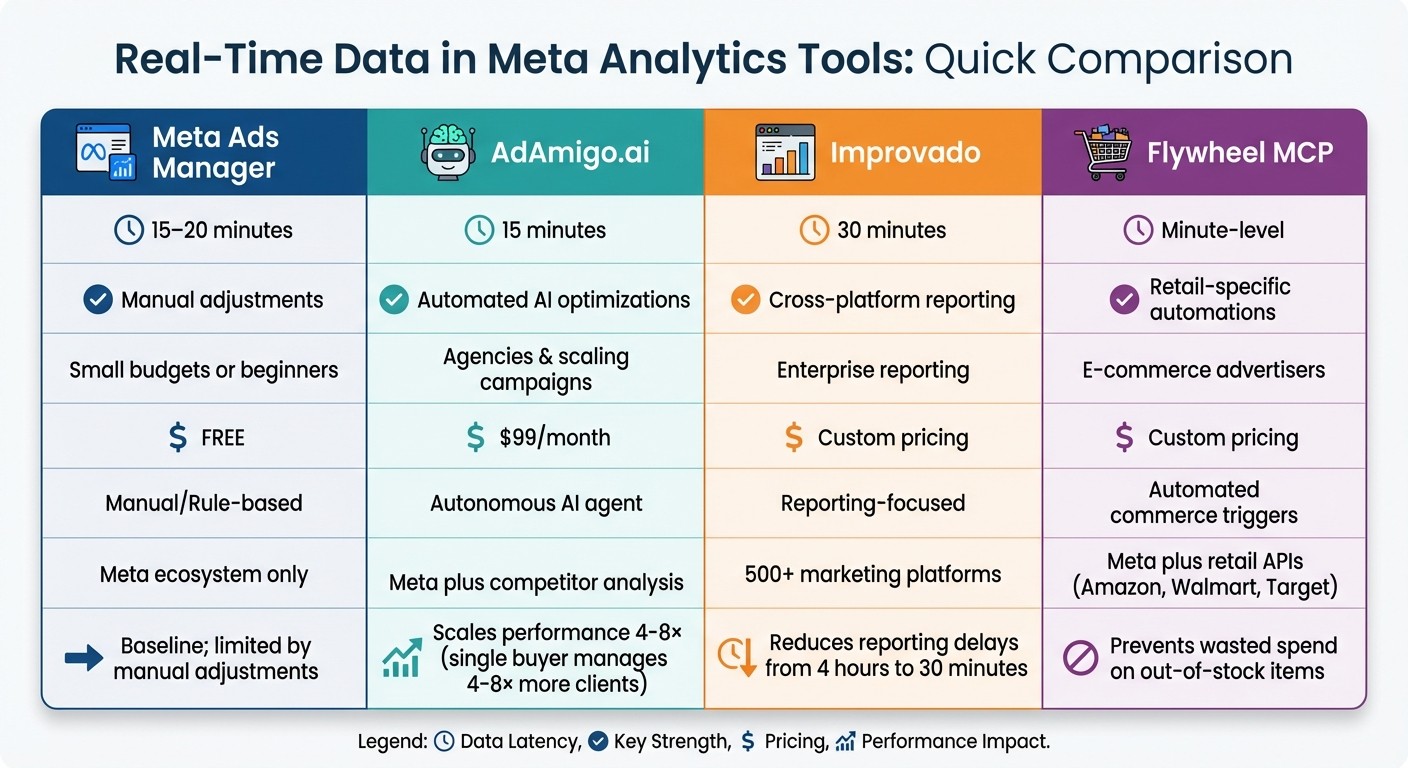
Meta Analytics Tools Comparison: Features, Latency, and Best Use Cases
1. Native Meta Ads Manager
Data Latency
Meta Ads Manager refreshes key metrics like impressions, clicks, conversions, CTR, CPA, and ROAS every 15–20 minutes. This near-real-time update cycle helps advertisers stay on top of their campaigns, a notable step up from older systems that might only sync data once or twice a day. However, even this short delay can feel lengthy when you're trying to catch and address issues like overspending or underperforming creatives as they happen.
Data Sources
The platform pulls data from several sources to improve tracking and measurement accuracy. Meta Pixel tracks browser-based user actions on your site, while the Conversions API sends server-side signals within an hour, bypassing ad blockers for better conversion data. The Ads Reporting API provides detailed metrics in 15–30 minutes, and webhooks deliver instant updates on ad approvals or budget thresholds. For offline activity, you can upload CRM or in-store purchase data daily. Together, these feeds power over 700 metrics available through Meta's API, giving advertisers a comprehensive view of campaign performance.
Optimization Approach
Meta Ads Manager uses these data streams to drive automation. Advantage+ automation simplifies campaign management by automatically selecting placements, rotating creatives, and expanding audiences for conversion campaigns. Advertisers can also run A/B tests and analyze performance by audience segment, device, or location in real time. This helps pinpoint underperforming ad sets so budgets can be adjusted on the fly. While automation minimizes manual effort, advertisers still need to actively monitor dashboards and make strategic decisions to refine campaigns.
Performance Impact
The ability to access instant metrics helps advertisers cut down on wasted ad spend. Although the update frequency doesn't allow for constant adjustments, integrating external tools like GA4 to enhance cross-channel data quality can make a big difference. For instance, some advertisers have reported a 22% boost in conversions within two weeks by combining Meta's native data with external insights - showing how enriched data streams can drive better results.
2. AdAmigo.ai
Data Latency
AdAmigo.ai takes raw data from native streams and turns it into automated, real-time optimizations. By connecting directly to your Meta ad account through the Marketing API, it pulls performance data on a 15-minute refresh cycle - just like Meta's own tools. But here's where it stands apart: instead of just displaying static dashboards, its autonomous AI agent dives into the data, analyzes performance trends, and makes optimization decisions instantly. This means underperforming ad sets get addressed quickly, while high-potential creatives are maximized without delay.
Data Sources
The platform taps into Meta's entire data ecosystem, including Pixel, Conversions API, and Ads Reporting API, for seamless tracking. Setup is quick - just five minutes. All you need to do is connect your account, set your KPIs (like "Increase spend by 30% with a minimum 3× ROAS"), and let the AI take over. Unlike traditional dashboards, AdAmigo.ai continuously learns from your brand's identity, monitors competitor ads, and tracks top-performing creatives. These data feeds allow the AI to fine-tune strategies on the fly.
Optimization Approach
AdAmigo.ai doesn’t just tweak one element - it optimizes creatives, targeting, bids, and budgets as a unified system. Its AI Actions feature generates a daily task list with high-priority adjustments, such as testing new ad variations, updating audience segments, or reallocating budgets. You can approve these changes with one click or let the system handle them automatically. The AI Chat Agent adds another layer of functionality, letting you ask questions about performance changes or launch campaigns in bulk using conversational commands. While the platform adapts and learns from real-world results, it always respects your budget limits, geographic restrictions, and placement rules.
Performance Impact
This streamlined approach boosts efficiency and drives better ROI. With AdAmigo.ai, a single media buyer can manage 4–8× more clients by automating day-to-day campaign tasks, freeing up time for strategic planning. Agencies benefit from this efficiency without sacrificing performance. The AI's ability to generate fresh, brand-aligned creatives and adjust campaigns around the clock creates a snowball effect. Over time, as the AI learns from each campaign, it becomes better at predicting which creative, audience, or budget strategy will deliver the best results. This continuous improvement keeps performance climbing while reducing manual effort.
3. Improvado
Data Latency
Improvado focuses on delivering a consolidated view for cross-channel reporting rather than providing near-real-time updates like Native Meta Ads Manager or AdAmigo.ai. It operates as a marketing data aggregator, pulling information from platforms such as Meta Ads Manager and others, and consolidating it into centralized dashboards or data warehouses. Because of this, updates are less frequent compared to the near-instant data offered by native Meta tools or autonomous platforms. However, for teams prioritizing reporting and attribution analysis over immediate bid adjustments, this trade-off is often acceptable. The slightly delayed updates are balanced by the platform’s ability to integrate a wide range of data inputs.
Data Sources
Improvado can connect Meta Ads to third-party tools and an extensive array of other marketing and sales data sources, including Meta Ads Manager, Google Ads, TikTok, LinkedIn, Salesforce, and various analytics platforms. Using API connections, it gathers campaign metrics such as ad spend, impressions, conversions, and audience data. Once collected, this data can be visualized through tools like Tableau, Looker Studio, or Power BI, or stored directly in a data warehouse. This broad integration capability makes it particularly useful for teams managing cross-channel reporting and comparing Meta and Google Ads performance alongside other paid media efforts.
Optimization Approach
Unlike platforms designed for campaign optimization, Improvado focuses on organizing and visualizing data. It centralizes reporting, but any campaign adjustments must be made manually within tools like Meta Ads Manager. Essentially, Improvado acts as a command center for identifying trends across multiple channels, leveraging historical data benchmarking to contextualize performance, while the actual execution of changes remains in the hands of the user. This setup is especially beneficial for agencies looking to simplify reporting workflows and improve client presentations.
Performance Impact
By automating data aggregation tasks, such as exporting and merging CSV files across platforms, Improvado reduces the time spent on manual processes. This allows teams to focus more on strategic initiatives. However, the overall impact on performance depends on how efficiently teams can act on the insights the platform provides.
4. Flywheel MCP
Data Latency
Flywheel MCP takes a commerce-first approach, focusing on retail insights rather than ad performance metrics. It syncs key retail data - like inventory levels, buy box status, and digital shelf information - with Meta's Marketing API. While it doesn’t provide the lightning-fast updates of Meta Ads Manager, its minute-scale latency is well-suited for retail campaigns. This timing ensures advertisers can pause or adjust spending based on product availability, making it a practical choice for commerce-driven strategies.
Data Sources
Flywheel MCP integrates APIs from major retailers like Amazon, Walmart, and Target to create a closed-loop view of retail conversions by comparing Meta's data with third-party insights. By combining first-party e-commerce data with Meta’s audience targeting, it refines AI audience segmentation vs manual targeting. These unified data streams also enable automated campaign adjustments, ensuring ads stay aligned with real-time retail conditions.
Optimization Approach
The platform steps in automatically when issues arise. This proactive approach is similar to how specialized tools monitor your ad accounts for performance drops. For instance, if a product loses the buy box or inventory falls below a set threshold, ad spend is reduced or campaigns are paused. This automation prevents wasted budget on products that can’t be sold, directly linking e-commerce operations to paid social strategies.
Performance Impact
By syncing retail data with Meta advertising, Flywheel MCP removes the need for manual coordination between e-commerce and ad teams. Campaign adjustments happen automatically, particularly during periods of high demand, ensuring efficiency and minimizing lost opportunities.
The Numbers That Matter - Facebook Ads Analytics Tutorial
Pros and Cons
real-time data integration brings unique advantages to each tool, impacting speed, automation, and the ability to gain insights across platforms. Here's a closer look at the pros and cons of each tool based on their features:
Native Meta Ads Manager provides free, built-in real-time data for managing campaigns. However, its reliance on manual adjustments and rule-based optimizations can slow response times. Additionally, its interface lacks efficiency, limiting its ability to deliver insights across multiple platforms.
AdAmigo.ai uses an autonomous AI system to simplify multi-campaign optimization by handling creatives, targeting, bids, and budgets. This unified approach enables scalable automation at a budget-friendly cost of $99/month, making it a strong option for those seeking cost-effective performance enhancements.
Improvado specializes in automating data pipelines, cutting reporting delays from four hours to just 30 minutes. It’s a great choice for enterprise teams that need unified dashboards across hundreds of platforms. This often involves moving Meta Ads data to BigQuery for long-term storage and SQL-based analysis. This level of detail is essential for teams looking to analyze Meta ad metrics alongside other channel data. However, its custom pricing and steeper learning curve may not suit advertisers focused solely on Meta ads.
Flywheel MCP caters specifically to commerce advertisers on platforms like Amazon, Walmart, and Target. With minute-level data updates and features like automatic campaign pausing for low inventory, it minimizes wasted ad spend. That said, its narrow focus on the retail sector may limit its appeal for advertisers outside this niche.
Tool | Data Latency | Optimization Approach | Data Sources | Performance Impact |
|---|---|---|---|---|
Native Meta Ads Manager | Real-time (native) | Manual / rule-based | Meta ecosystem only | Baseline; limited by manual adjustments |
AdAmigo.ai | Near real-time | Autonomous AI agent | Meta plus competitor analysis | Scales performance effectively |
Improvado | 30 minutes (automated) | Reporting-focused | 500+ marketing platforms | Significantly reduces reporting delays |
Flywheel MCP | Minute-scale | Automated commerce triggers | Meta plus retail APIs (Amazon, Walmart, Target) | Prevents wasted spend on out-of-stock items |
This breakdown highlights how each tool’s capabilities and limitations align with specific real-time performance monitoring and optimization goals.
Conclusion
Real-time data has become a cornerstone of Meta advertising, and the right tool largely depends on your team's structure and goals. Native Meta Ads Manager is a solid starting point, offering baseline performance for free. It's a great option for those with smaller budgets or beginners who don't mind manual adjustments. However, its rule-based automation and lack of cross-platform insights can limit its potential for scaling.
For agencies juggling multiple clients, speed and efficiency are critical. AdAmigo.ai allows a single media buyer to manage 4–8× more accounts through autonomous AI optimization. It combines creative generation, targeting, and bid management into a unified system that learns and adapts based on real-world results. In-house teams can also benefit, using it to replace or complement traditional hires with an AI-driven media buyer that works around the clock, optimizing creatives, targeting, budgets, and bids seamlessly. This approach is essential for scaling Meta ads with multi-format creatives to prevent fatigue.
Larger operations or enterprises might lean toward tools offering broader reporting capabilities. Improvado delivers detailed dashboards across multiple platforms, though its custom pricing and steeper learning curve may not appeal to advertisers focused solely on Meta. For example, Rekom Group, which manages Facebook marketing for over 200 venues across four countries, uses real-time data syncing to track performance metrics at both global and local levels. Similarly, Flywheel MCP supports retail advertisers by integrating minute-level inventory data, automatically pausing campaigns when stock runs low to avoid wasted spending.
Ultimately, the choice comes down to your specific needs. Opt for Native Meta Ads Manager for basic campaign management, AdAmigo.ai for scalable AI-driven optimization at $99/month, or enterprise-level solutions like Improvado for extensive multi-platform reporting.
FAQs
Is 15–30 minute latency considered 'real-time' for Meta ads?
For Meta ads, a latency of 15–30 minutes is generally regarded as "real-time." This timeframe is sufficient for AI tools to make timely updates to bids, budgets, and targeting, ensuring campaigns are optimized efficiently.
Do I need the Meta Pixel and Conversions API for real-time tracking?
Yes, combining Meta Pixel with the Conversions API helps ensure accurate, real-time attribution and quicker campaign adjustments. This duo works around browser limitations by enabling server-to-server data sharing, leading to more reliable data and better performance insights.
Which tool fits my team: manual, AI automation, reporting, or retail sync?
AI automation tools like AdAmigo.ai bring a smarter approach to managing your campaigns. With features like real-time data integration, automated adjustments, creative generation, and audience optimization, it goes far beyond traditional manual methods or basic reporting tools.
AdAmigo.ai doesn’t just execute tasks - it learns and evolves. By automating complex processes like bid management and budget allocation, it lightens your team’s workload while efficiently scaling campaigns. The result? Improved ROAS and smoother operations, making it an excellent choice for teams looking to maximize performance without the extra hassle.