
5 Tips for Optimizing Event Rules in Meta Ads
Improve Meta Ads ROAS by prioritizing high‑intent events, adjusting bids by location and placement, testing rule sets, and automating with AI.
Want better results from your Meta Ads? Start optimizing event rules.
Event rules help refine bidding, budgets, and targeting, improving Return on Ad Spend (ROAS) without increasing your budget. Managing these rules manually can be time-consuming and prone to errors, but tools like AI-powered platforms simplify the process and deliver better outcomes.
Here’s a quick summary of the 5 tips to improve your Meta Ads campaigns:
Set Rule Priorities Using Performance Data: Focus on high-intent actions like purchases or subscriptions to improve ROAS and hit scaling benchmarks.
Adjust Bids by Location: Use Value Rules to allocate budgets where conversions are highest.
Optimize Placements: Increase bids for high-performing placements like Instagram Reels and reduce them for weaker ones.
Test Multiple Rule Sets: Use different rules for scaling, budget protection, and performance monitoring to maximize efficiency.
Automate with AdAmigo.ai: Leverage AI for continuous, data-driven adjustments to bids, budgets, and creatives.
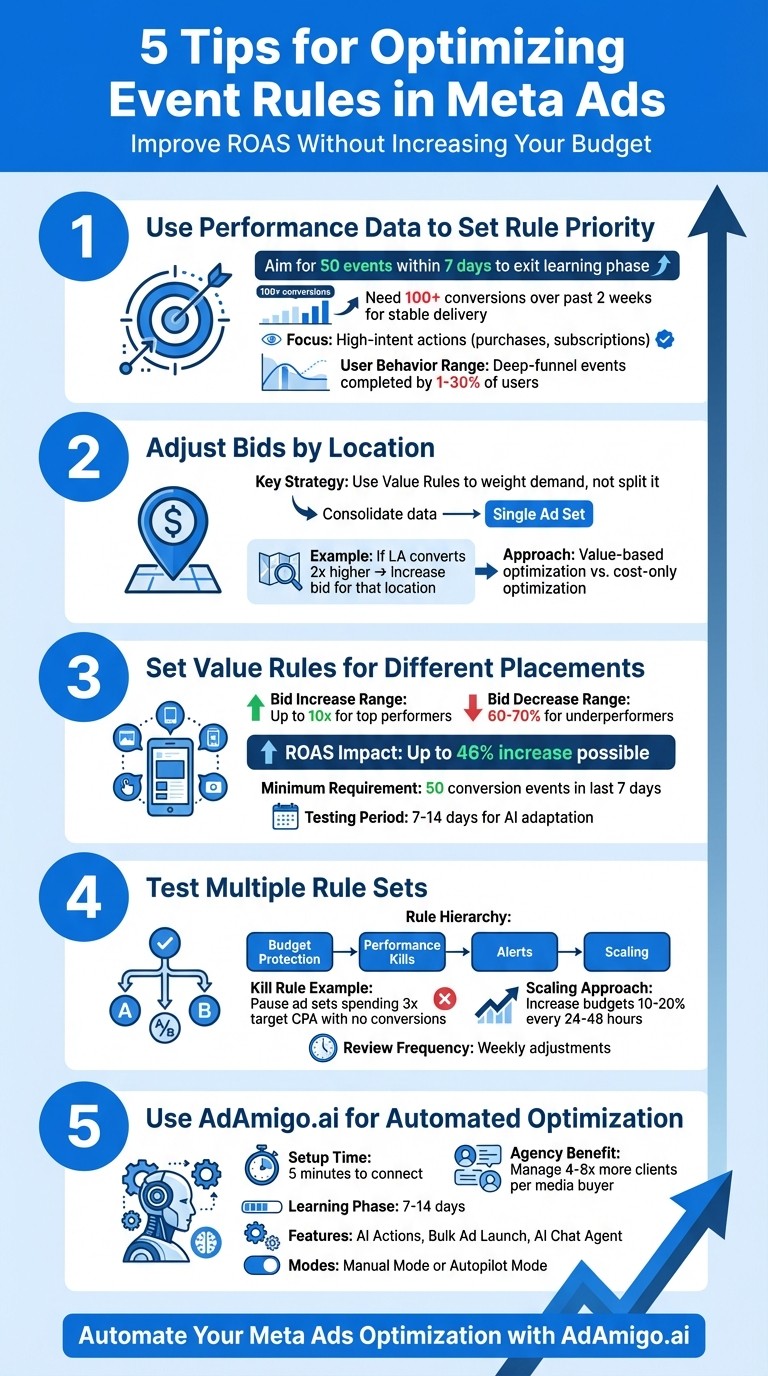
5 Tips for Optimizing Meta Ads Event Rules to Improve ROAS
Meta Ads Value Rules Explained (Find Higher‑Value Customers & Improve ROAS)
1. Use Performance Data to Set Rule Priority
When setting up your campaigns on Meta, it’s crucial to align your performance goals with your business objectives. Meta’s algorithm takes your instructions literally. As Jon Loomer from Jon Loomer Digital explains:
"The algorithm is literal. Your campaign objective means very little. It's your performance goal that defines how your ads will be delivered."
To get the most out of your campaigns, focus on high-intent behaviors. For instance, a user viewing your pricing page or completing a tutorial demonstrates a stronger intent to purchase than someone who simply clicks on an ad. These deeper actions help Meta identify more qualified users faster. To ensure stable delivery, aim for events that have at least 100 conversions over the past two weeks. This approach ensures your rules are targeting meaningful actions that drive real results.
Deep-funnel events, such as subscriptions or first-time purchases, tend to outperform broader, top-of-funnel metrics. These actions, typically completed by 1% to 30% of users, provide better optimization opportunities. For example, optimizing for purchases allows Meta to zero in on actual buyers. To move through the learning phase efficiently, aim for 50 events within a 7-day period. If you have overlapping rules, consolidate them into one high-priority rule to hit that 50-event target within the same timeframe.
Impact on ROAS (Return on Ad Spend)
Your prioritization strategy doesn’t just improve conversions - it also shapes your ROAS. Rules that focus on volume might drive more conversions but can lead to fluctuating ROAS. On the other hand, cost cap vs bid cap strategies or ROAS-targeted rules limit spending to auctions that are more likely to meet your profitability goals, often resulting in higher ROAS.
For instance, you could set automated rules to pause ad sets when the cost per acquisition exceeds $80 over three days and the ROAS drops below 1.5. Just remember to account for attribution lag and windows to avoid pausing ads prematurely.
2. Adjust Bids by Location
Fine-tuning your ad spend based on location can make a big difference in campaign performance. By leveraging performance data, you can adjust bids to align with local market trends, ensuring your budget is used where it will have the most impact.
Campaign performance isn't equal across all locations. Some cities or regions consistently deliver higher order values and conversion rates, while others may fall short. Instead of creating separate ad sets for each location - which can fragment your data and slow down learning (a common mistake when structuring Meta ad campaigns) - Meta's Value Rules allow you to adjust bids for specific geographies within a single ad set.
How It Boosts Campaign Performance
Value Rules help Meta's auction system prioritize impressions that are more valuable based on your actual business results. For instance, if your sales data reveals that customers in Los Angeles convert at twice the rate of those in other regions, you can increase your bid for that location. This method keeps your data consolidated and focuses on high-performing areas.
Shalini Vijayakumar from CustomerLabs explains:
"Value Rules were introduced to support a more scalable approach: weighting demand instead of splitting it. This change reflects a broader shift from cost-only optimization to value-based optimization."
By shifting to this strategy, you can streamline your efforts and see measurable improvements in ROI.
How to Set It Up in Meta Ads Manager
To implement location-based bid adjustments, use Meta Ads Manager to create a set of combined rules based on your preferred location criteria and AI-driven bid modifiers. Keep in mind that if multiple rules overlap, only the first matching rule will apply, so it's important to prioritize them accordingly.
Effect on ROAS (Return on Ad Spend)
While increasing bids in high-value locations might lead to higher CPMs, the goal is to achieve better ROAS. By focusing your spend on regions that historically generate more revenue or higher-quality leads, you're targeting users with a greater likelihood of converting. Use the "Value Rules breakdown" report in Ads Manager to monitor whether the increased costs in premium locations result in stronger ROAS.
Scaling Across Campaigns and Objectives
Value Rules make it easier to scale your campaigns without breaking them into multiple segments. This approach works across different objectives - whether you're focusing on purchases, lead generation, or app installs. By consolidating your data, Meta's system can learn faster and optimize more effectively over time.
3. Set Value Rules for Different Placements
Learning how to optimize Meta ad placements and fine-tuning bids takes your campaign optimization to the next level. Placements like Instagram Reels can drive high engagement, while others, such as Audience Network, might not deliver the same value. Instead of creating multiple ad sets for each placement - which can scatter your data and disrupt Meta's learning process - Value Rules allow you to adjust bids for specific placements within a single ad set.
Effectiveness in Improving Campaign Performance
Value Rules let you adjust bids dynamically, boosting them for top-performing placements and reducing them for less effective ones. For instance, you can increase bids by up to 10x for placements that work well and cut bids by 60% to 70% for underperforming ones. Imagine Instagram Reels consistently delivering 20% to 40% higher engagement than other placements for your ecommerce brand. In this case, you might increase your bid by 30% to 50% for Reels. On the flip side, if Audience Network shows a conversion rate of 0.8% compared to Instagram Feed’s 3.5%, lowering your bid for Audience Network by 60% to 70% makes sense. This way, Meta's AI reallocates your budget naturally, avoiding unnecessary cost increases across your campaign.
Ease of Implementation Within Meta Ads Manager
Setting up Value Rules for placements in Ads Manager is straightforward. The key is to organize your rules properly by mapping events to conversion goals - place the most specific ones at the top. For example, "Instagram Reels + iOS" should precede broader rules like "All Instagram Placements". Use the Breakdown tool to review past performance data using AI tools for Meta ad account analysis and identify placements with at least a 20% variance in ROAS. This helps you pinpoint where bid adjustments will make the biggest difference. Keep in mind, your campaign needs at least 50 conversion events in the last 7 days to activate Value Rules.
Impact on ROAS (Return on Ad Spend)
When used effectively, Value Rules can increase your ROAS by up to 46%. By focusing your budget on placements that consistently deliver better results, you can maximize returns. While high-performing placements might come with higher CPMs, the overall impact on ROAS is often worth the trade-off. Start with modest bid adjustments - around 20% to 30% - and give Meta's AI 7 to 14 days to adapt. If a rule doesn’t improve performance within 21 days, remove it and try a different approach. Ads Manager also includes a "Value Rules" breakdown, so you can track how these adjustments affect delivery and costs.
Scalability Across Different Campaigns and Objectives
Value Rules are currently available for Sales and App Promotion campaigns, although they don’t apply to Advantage+ Catalog Ads or Special Ad Categories. They are especially effective when combined with broad targeting or Advantage+ Audience, giving Meta’s algorithm enough data to optimize while you retain control over budget allocation.
This placement-focused strategy works seamlessly with location-based adjustments, ensuring your bids align with real-time performance data. By fine-tuning placements, you ensure every dollar in your campaign budget delivers maximum impact.
4. Test Multiple Rule Sets in Your Account
If you're already using detailed event rules, testing multiple rule sets can take your campaign performance to the next level. By applying different logic to various stages of your campaign, you can fine-tune your approach. For example, a testing rule set can help you identify underperforming ads, while a scaling rule set can increase budgets for those that are performing well. This strategy avoids the pitfalls of a one-size-fits-all approach, which can lead to wasted ad spend on underperforming campaigns.
Effectiveness in Improving Campaign Performance
To make this work, you need a clear hierarchy for your rules and defined timeframes. Start by setting effective guardrails for budget protection, then focus on performance kills, alerts, and scaling. Without this structure, rule conflicts can arise - like one rule trying to scale an ad set while another pauses it due to temporary performance dips. Proper alignment ensures that short-term fluctuations don't override your long-term performance goals.
Ease of Implementation Within Meta Ads Manager
A good starting point is a "kill rule" that pauses any ad set spending more than three times your target CPA without generating conversions. This simple step protects your budget while you experiment with additional rules. When you're ready to scale, increase budgets by just 10% to 20% every 24 to 48 hours. This measured approach avoids disrupting Meta's algorithm or triggering prolonged learning phases. To stay on track, review your rule sets weekly and adjust thresholds as market conditions change.
Impact on ROAS (Return on Ad Spend)
Tailoring your rule logic to your specific campaign objectives is crucial. For example, if you're focused on e-commerce, your rules should reflect ROAS targets, while lead generation campaigns might prioritize CPA thresholds and analysis. A generic setup won't deliver the same results. Customizing your rules ensures you're optimizing for the best possible ROAS outcomes.
Scalability Across Different Campaigns and Objectives
Automated rules act as a kind of "always-on" media buyer, allowing you to manage dozens of ad sets while continuously scaling winners and pausing underperformers. As AdBid.me puts it:
"The difference between profitable and unprofitable accounts often comes down to one thing: how fast you kill losers and scale winners."
While automation handles the repetitive tasks, balancing AI and human oversight is still essential for creative strategy and major decisions. By combining automated rule sets with thoughtful management, you create a scalable system that can adapt to changing market dynamics. This structured, data-driven approach not only optimizes your campaigns but also complements your broader advertising strategy. For even more seamless optimization, consider tools like AdAmigo.ai to automate and refine your efforts further.
5. Use AdAmigo.ai for Automated Optimization
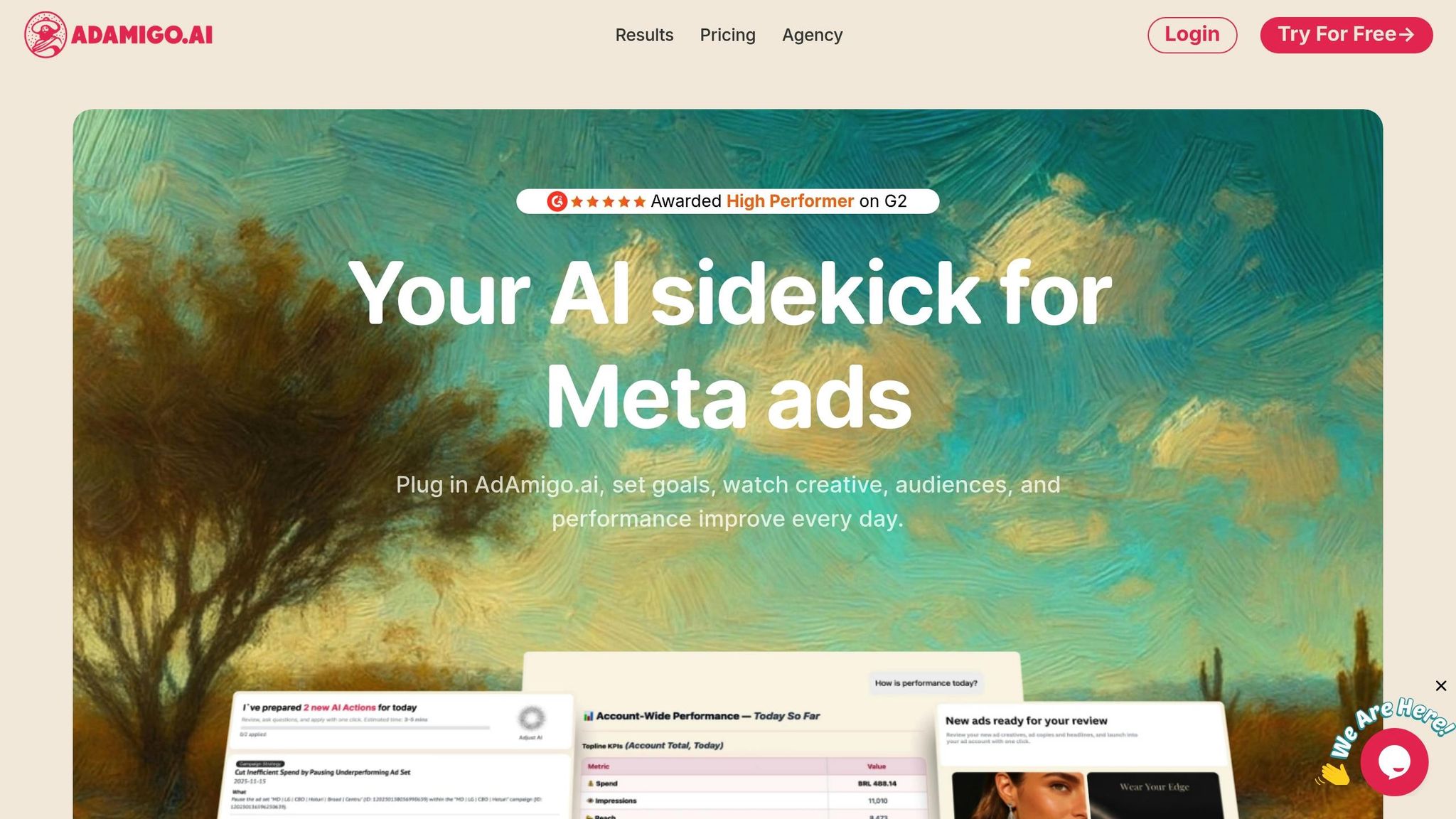
AdAmigo.ai steps in as a solution to the challenges of manual rule management and the need for dynamic adjustments in Meta Ads Manager campaigns. This platform offers an automated approach that adapts to real-time campaign data, taking the hassle out of constant manual updates.
Instead of requiring you to tweak event-based rules every few weeks, AdAmigo.ai uses AI that learns from your campaign performance. It automatically updates strategies as market conditions evolve, ensuring your campaigns stay optimized without extra effort.
Boosting Campaign Performance
AdAmigo.ai integrates directly with your Meta ad account and provides a daily prioritized to-do list through its AI Actions feature. These tasks are ranked based on performance signals, and you can choose between two modes: Manual Mode, where you approve changes, or Autopilot Mode, which executes adjustments automatically within your predefined limits. Need quick insights? The AI Media Buyer delivers data-backed answers to your questions in plain language via a chat interface.
This integration streamlines campaign management, letting you focus on results instead of tedious manual adjustments.
Simple Setup with Meta Ads Manager
Getting started with AdAmigo.ai is quick and painless. In about five minutes, you can connect your Meta ad account, define your KPIs using a Meta ads conversion optimization checklist (like "Increase spend by 30% at ≥3× ROAS"), and let the AI dive into your campaigns. Its Bulk Ad Launch tool simplifies the process further by creating hundreds of ads at once, all aligned with your goals and event parameters.
The platform requires a 7–14 day learning phase to understand your audience's behavior before scaling aggressively. This brief period allows the AI to fine-tune its strategies, making it an excellent complement to manual campaign management.
Scaling Across Campaigns and Objectives
AdAmigo.ai optimizes all aspects of your campaigns through full-funnel AI optimization - creatives, targeting, bids, and budgets - as a unified system. Whether you're focused on lead generation or managing intricate eCommerce setups, the platform adapts to your objectives. For agencies, this scalability is a game-changer, enabling a single media buyer to handle 4–8× more clients. While the platform takes care of execution, senior strategists can dedicate their time to big-picture planning.
Conclusion
The five tips outlined earlier provide a solid foundation to improve your Meta Ads performance. The key takeaway? Let your performance data guide your event rule optimizations. By focusing on actual results - such as higher conversion rates from specific age groups or locations - you align your efforts with the algorithm, rather than relying on guesswork. Success comes from adjusting bids, placements, and rule sets based on insights from your Ads Manager breakdowns.
However, manually analyzing performance data, reordering rules, and fine-tuning bids across multiple campaigns can become a time drain. That’s where automation tools like AdAmigo.ai come into play. These platforms simplify processes such as bid adjustments, manual vs AI budget testing, and creative testing, consolidating them into a single, efficient system.
Automation isn’t just about saving time - it’s about scaling smarter. Agencies using AI-driven tools report managing significantly more clients without expanding their teams, while in-house marketers avoid the need for additional hires. With data-backed event rules and automated workflows, you can focus on strategy while the day-to-day execution takes care of itself.
FAQs
Which event should I optimize for?
When creating a campaign, it's crucial to optimize for the event that aligns with your specific goal - whether that's driving purchases, securing sign-ups, or something else. Make sure to set up and properly map custom or standard events in Meta Ads. This ensures your campaign objectives and tracking are perfectly in sync, giving you the best chance to achieve the results you're aiming for.
How many conversions are required for Value Rules?
The articles don't mention a specific minimum number of conversions required to use Value Rules in Meta Ads.
When should I automate with AdAmigo.ai?
When you're looking to save time and fine-tune your Meta ad campaigns, AdAmigo.ai is a go-to solution. It's perfect for handling multiple campaigns, boosting performance, and applying smart, rule-based adjustments - like increasing budgets for high-performing ads or pausing those that aren't delivering results.
What sets AdAmigo.ai apart is its ability to provide round-the-clock monitoring, time-based scheduling, and real-time optimization. This means you can scale your campaigns effortlessly while shifting your focus to strategy instead of getting bogged down in manual tasks.