
Why Centralized Dashboards Improve Ad Performance
Unify ad data across platforms for real-time decisions, accurate cross-channel attribution, and AI-driven optimizations that boost ROAS and reduce manual work.
Centralized dashboards simplify ad management by consolidating performance data from multiple platforms into one real-time view. This eliminates the hassle of juggling multi-account management and spreadsheets, reduces human error, and enables faster, data-driven decisions. These systems often leverage historical data to predict future performance trends. Key benefits include:
Real-Time Updates: spot and fix issues like high CPA or low CTR immediately with an ad performance analyzer.
Cross-Channel Attribution: Identify which platforms drive the best ROI with unified data.
Time Savings: Automate repetitive tasks and focus on strategy.
For example, companies like Schroders and The Work Mat Co. saved significant time and improved metrics like ROAS and CPA by using centralized dashboards paired with AI tools for Meta ads. These systems not only streamline reporting but also optimize campaigns with actionable insights, helping businesses achieve better results without the manual workload.
Centralize All Your Ecommerce Analytics and Boost SEO | Boardroom
How Centralized Dashboards Improve Ad Performance
Centralized dashboards tackle the challenges of data silos and delayed reporting, offering three major advantages for ad campaigns: real-time decision-making, accurate cross-channel attribution, and reduced manual workloads. Let’s break down how these benefits transform ad performance.
Faster Decisions with Real-Time Data
Implementing full-funnel AI optimization allows these dashboards to act on data automatically across every stage of the customer journey.
Centralized dashboards update every few minutes, making it possible to spot issues before they dent your ROI. This is a game-changer when you consider that 46% of marketers review reports weekly, while 25% only check monthly. As Linda Grönlund from Supermetrics explains:
"Real-time ad analytics displays live campaign data. With timely data, you can adjust bids, shift budgets, and improve creative in hours rather than waiting for the next reporting cycle".
Dashboards also come equipped with automated alerts. Instead of manually monitoring CPA spikes or CTR drops, which often leads to common mistakes in bulk Meta ad testing, these tools send instant notifications via SMS or email when key metrics hit critical thresholds. This proactive approach can improve agency efficiency by up to 30% and save marketing teams 20–30% of their time on repetitive tasks.
Better Cross-Channel Attribution and Reporting
Unlike single-platform tools like Meta Ads Manager, centralized dashboards integrate data from platforms like Meta, Google, and TikTok. This unified view highlights which channels truly drive conversions, moving beyond outdated single-touch attribution models.
Take LayaSmarts.com, for example. Between December 14, 2024, and January 14, 2025, this India-based fashion brand used AdAmigo.ai to craft its Meta ad strategy. By executing 146 AI-driven actions through a centralized dashboard, founder Shubham achieved an 879% increase in purchases, a 223% boost in ROAS, and saved over 17 hours of manual work. This all-in-one view made it easy to identify successful creative strategies using AI tools for Meta ad account analysis and optimize Meta Ads for ROI more effectively than manual methods.
Less Time Spent on Analysis
Centralized dashboards streamline data collection by pulling information through APIs and standardizing metrics across platforms. For instance, Dyut.eu, a premium skincare brand, used AdAmigo.ai's dashboard between September 25 and October 25, 2024, to execute 163 optimization actions. The results? A 23% improvement in ROAS, a 67.8% rise in purchases, and 18.3 hours saved on manual work.
This time savings allows teams to focus on strategy rather than getting bogged down in data compilation. As Dyut.eu’s co-founder Shubham puts it:
"It's incredibly refreshing to be able to launch a campaign through AI prompts. The AI recommendations go beyond simply suggesting actions - they provide valuable insights and justifications. This not only improves my results but also deepens my understanding of campaign optimization".
What Metrics to Track in Centralized Dashboards
Tracking the right metrics is the backbone of an effective centralized dashboard. It’s not just about collecting data - it’s about identifying the KPIs that reveal how your campaigns are performing, where they’re thriving, and where costs might be spiraling out of control. With the right metrics in play, you can make informed decisions faster and with greater confidence.
ROAS, CTR, CPC, and CPA
Return on Ad Spend (ROAS) is a cornerstone metric for understanding profitability. It’s calculated as Revenue ÷ Ad Spend. For instance, if you spend $1,000 on ads and generate $3,000 in revenue, your ROAS is 3.0. This figure helps you gauge whether your campaigns are delivering real value.
Click-Through Rate (CTR) evaluates how engaging your ad is. The formula is simple: (Clicks ÷ Impressions) × 100. On Google Ads, the average CTR stands at 6.66%, while on Meta, a rate above 1% is often acceptable. Anything below 1% might point to weak creative or poor targeting.
Cost Per Click (CPC) measures how much you’re paying for each click, with Google Ads averaging $5.26. Meanwhile, Cost Per Acquisition (CPA) shows how much it costs to acquire a customer or lead. If your CPA is significantly higher than your target - say, three times the goal - it’s a red flag to reassess your landing page or ad creative.
Here’s a key insight: if you see high CTRs but low conversions, it could mean your ads are grabbing attention but aren’t driving meaningful actions. This mismatch often hints at deeper issues in the sales funnel.
Budget Pacing and Ad Frequency
Budget pacing is all about ensuring your monthly ad spend is distributed evenly. Centralized dashboards monitor this in real time, helping you avoid overspending or running out of budget prematurely. With Meta Ads CPM globally averaging $6.59 and projected to hit $23.00 in the U.S. by 2026, keeping a close eye on daily spend with an ad budget calculator is vital for staying on track.
Ad frequency - calculated as Total Impressions ÷ Unique Reach - reveals how often individuals see your ads. If this number exceeds 3.0, it’s often a sign of creative fatigue. Automated alerts can flag when this happens, giving you time to rotate in new creatives or expand your audience to maintain engagement and control costs.
Identifying Your Best-Performing Creatives
Centralized dashboards simplify the process of pinpointing which creatives are driving results - and which aren’t. While CTR shows which ads grab attention, metrics like ROAS and CPA tie that engagement back to revenue. For example, an ad with a high CTR but weak conversions might be attracting expensive traffic that doesn’t convert.
In 2026, Meta’s Andromeda ad-retrieval system began prioritizing creative diversity over relying on a single “top performer”. This approach allows for better audience matching by utilizing a variety of ad formats. If the frequency of your best-performing creative exceeds 3.0, it’s a good idea to rotate in fresh assets or target a broader audience to keep costs in check.
Take this real-world example: in May 2025, a national lawn care franchise partnered with Strategus to launch a data-driven Connected TV campaign paired with retargeted display ads. By using advanced tracking in a centralized dashboard, they achieved $2.1 million in attributed sales in just one month - an impressive 3,000% ROI. That level of insight and performance is only possible when all creative and conversion data is unified in one place.
Case Studies: How Centralized Dashboards Improved Results
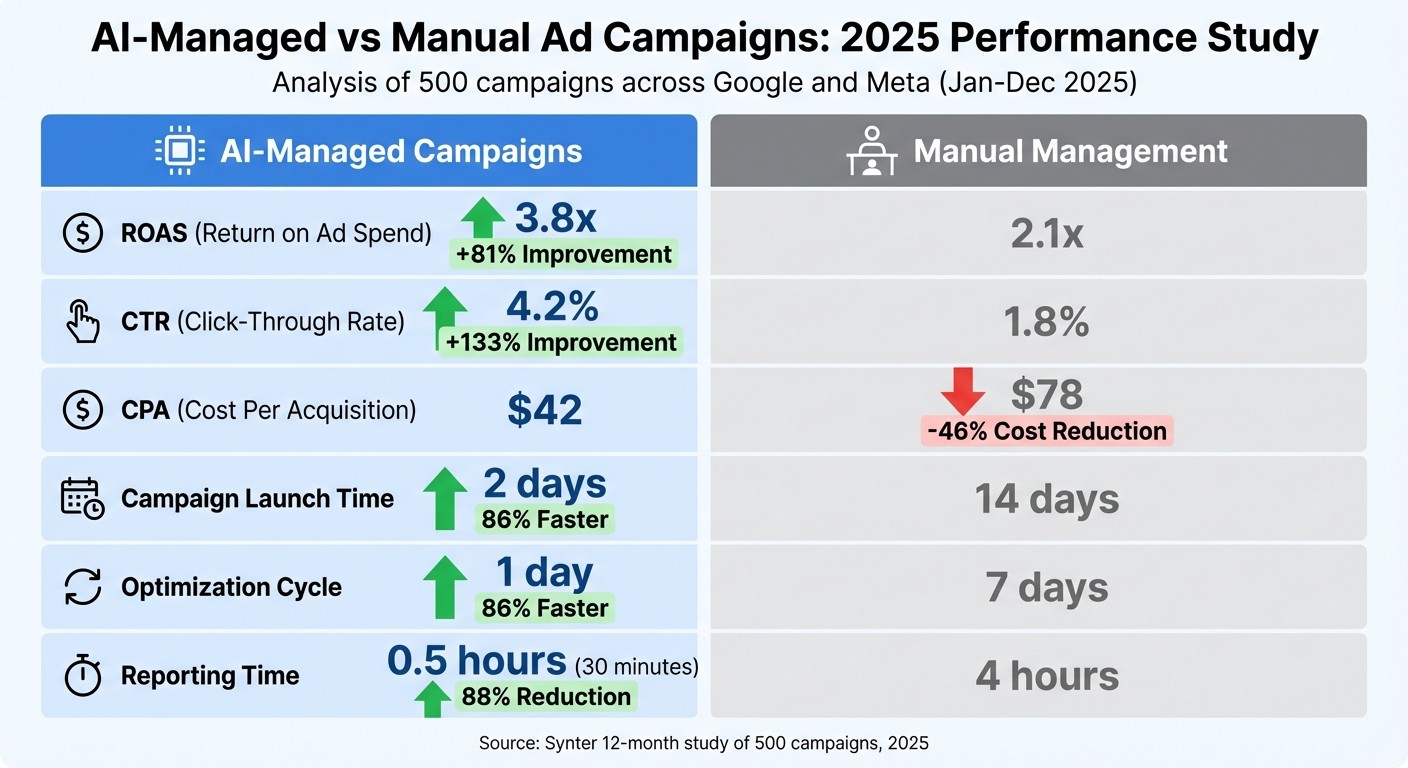
AI-Managed vs Manual Ad Campaigns: Performance Comparison 2025
Results from real-world campaigns highlight the effectiveness of centralized dashboards. These outcomes showcase how brands can achieve better performance and efficiency by leveraging these systems. Below are examples of how centralized dashboards have transformed campaign management.
Cross-Platform Analysis Increased ROAS
A study by Synter analyzed 500 campaigns across Google and Meta from January to December 2025. The findings were striking: AI-managed campaigns achieved a 3.8x ROAS, compared to just 2.1x for manually managed campaigns - an 81% improvement. Additionally, CTR surged by 133% (rising from 1.8% to 4.2%), while CPA dropped by 46% (from $78 to $42).
The study also revealed how centralized dashboards streamlined processes. Campaign launch times were slashed by 86%, dropping from 14 days to just 2 days. Optimization cycles saw similar improvements, shrinking from 7 days to just 1 day. These time savings allow brands to act on trends and seasonal opportunities faster than competitors. Beyond efficiency, centralized dashboards also provide a significant edge in budget planning and forecasting.
Budget Forecasting with Historical Data
Centralized dashboards empower brands to allocate budgets dynamically by using real-time performance data. This ensures every dollar is directed to where it will have the most impact. Such precision in budget adjustments is challenging, if not impossible, to achieve with manual, disconnected systems.
In addition to financial benefits, these dashboards also enhance creative strategies by speeding up the time it takes to test and optimize ad content using dynamic creative optimization vs. manual ad testing.
Creative Optimization Boosted CTR
The Synter study also underscored how centralized dashboards improve creative performance. AI-managed campaigns achieved a 4.2% CTR, more than doubling the 1.8% CTR of manually managed campaigns. This wasn't just about launching more ads - it was about quickly identifying the creatives that resonated most with audiences and scaling them faster than human teams could manage.
Metric | AI-Managed | Manual Management | Improvement |
|---|---|---|---|
ROAS | 3.8x | 2.1x | +81% |
CTR | 4.2% | 1.8% | +133% |
CPA | $42 | $78 | -46% |
Launch Time | 2 days | 14 days | 86% faster |
Source: Synter 12-month study of 500 campaigns, 2025
Centralized Dashboards vs. Siloed Platforms
Using individual platform interfaces for campaign management creates a disjointed view of your advertising efforts. Each platform only provides a slice of the data, making it difficult to aggregate multi-channel conversion data, leaving media buyers guessing about the bigger picture. This fragmented approach forces constant manual vs AI-powered management adjustments and frequent switching between tools like Business Managers and isolated account views, making it harder to effectively manage multiple Meta campaigns.
As campaigns become more complex, siloed platforms struggle to keep up. Centralized AI systems, on the other hand, streamline operations by treating each advertising platform as a simple API endpoint. Synter Media explains it well:
"AI agents treat each platform as another API endpoint - adding Microsoft Ads or Reddit doesn't meaningfully increase operational complexity".
The benefits of centralized dashboards are clear: they slash reporting time by 88%, reducing it from four hours to just 30 minutes. They also shrink optimization cycles from seven days to just one day - an 86% improvement. This faster response time allows brands to act on trends before competitors even notice, creating a compounding advantage, especially for those managing multiple clients or product lines. Here's a side-by-side comparison of the operational differences:
Performance Comparison Table
Feature | Centralized Dashboards | Siloed Platforms |
|---|---|---|
Decision Speed | High (real-time adjustments) | Low (periodic manual checks) |
ROI Visibility | Complete (cross-channel view) | Limited (platform-specific) |
Reporting Time | ~0.5 hours | ~4 hours |
Optimization Cycle | 1 day | 7 days |
Budget Management | Dynamic reallocation | Static/manual allocation |
Error Reduction | High (automated budget rules) | Low (manual execution risks) |
Beyond speed and efficiency, centralized dashboards solve another major issue: audience cannibalization. When campaigns run in silos, they can unknowingly compete for the same users, driving up costs unnecessarily. A unified dashboard eliminates this problem by identifying audience overlaps and optimizing budget efficiency for better ROI. The result? A smarter, faster, and more cost-effective approach to campaign management.
Adding AI to Dashboards: How AdAmigo.ai Helps
Centralized dashboards are great for organizing data, but when you add AI automation into the mix, they become tools for action. Instead of just viewing insights, you can act on them using the best AI tools for Meta ads automatically - whether it’s adjusting bids, reallocating budgets, or launching new creatives. AdAmigo.ai takes this concept further. Acting as an autonomous AI media buyer, it connects directly to your Meta ad account, performing 24/7 optimizations. Here’s a closer look at how its AI-powered features enhance Meta ad campaigns.
AI-Powered Optimization for Meta Ads
AdAmigo.ai’s AI Ads Agent goes beyond basic automation. It continuously analyzes your brand identity, studies competitor ads, and identifies top-performing campaigns to create new, optimized creatives. Unlike traditional rule-based engines, this agent learns and adapts over time, refining its strategies based on actual campaign results. It respects all your settings - budget limits, AI-enhanced geo-targeting, placement preferences - and can operate autonomously or with your approval for every change.
The impact is clear. Take The Work Mat Co., for example. After switching from a paid agency to AdAmigo.ai between February 12 and March 12, 2025, the company saw purchases increase by 145.7% and ROAS (Return on Ad Spend) improve by 28.3%. Over that month, the AI executed 270 optimization actions, saving co-founder Rochelle Dallas about 33 hours of manual work.
"Our budgets are controlled, our spend is being smartly allocated, and our ROAS is up massively. Agencies charging 7x the cost of AdAmigo have been put to shame".
Daily AI Actions for Continuous Improvement
AdAmigo.ai doesn’t just optimize in real time - it also provides daily recommendations to fine-tune your campaigns. The AI Actions feature generates a prioritized list of tweaks for creatives, audiences, budgets, and bids. You can review and approve these suggestions, edit them, or let the system handle everything automatically. By detecting issues like sudden drops in CTR or spikes in CPC, it ensures your campaigns stay efficient. These daily adjustments have led to a 28% ROAS increase and a 22% reduction in CAC (Customer Acquisition Cost).
For instance, Dyut.eu, a premium skincare brand, switched to full autopilot mode between September 25 and October 25, 2024. During that time, the AI executed 163 actions, including 41 budget adjustments and 63 new ad creations. The result? A 23% boost in ROAS, a 67.8% jump in purchases, and 18.3 hours of saved effort. Co-founder Shubham shared:
"The AI recommendations go beyond simply suggesting actions - they provide valuable insights and justifications. This not only improves my results but also deepens my understanding of campaign optimization".
Bulk Ad Launch and Real-Time Monitoring
With the Bulk Ad Launch feature, AdAmigo.ai makes it easy to deploy dozens - or even hundreds - of Meta ads at once using assets from Google Drive. From there, the system automatically scales high-performing ads while pausing underperformers. Real-time monitoring ensures only the best ads keep running. For agencies managing multiple clients, this means a single media buyer can handle 4–8× more accounts, focusing on strategy while the AI takes care of execution.
Conclusion
Centralized dashboards tackle one of the most frustrating aspects of digital advertising: scattered data. By bringing metrics from various platforms into a single, unified view, they eliminate the hassle of switching between tabs or manually updating spreadsheets. This streamlined approach doesn’t just save time - it also enables quicker decisions, better cross-channel attribution, and more room to focus on strategy.
But here’s the thing: while centralized dashboards simplify data management, their true potential shines when combined with AI tools for optimizing performance. Data visibility alone isn’t enough - what you do with it matters. AI-managed campaigns take the reins by adjusting bids, reallocating budgets, and refreshing creatives in real time. This automation is particularly effective for managing the learning phase and reducing performance volatility. The results? Campaigns run with AI have shown a 133% boost in CTR, a 46% drop in CPA, and an 81% jump in ROAS compared to traditional, manual methods.
For Meta advertisers, platforms like AdAmigo.ai act as an autonomous media buyer, handling everything from optimizing creatives to managing budgets and bids 24/7. Whether you’re overseeing a single brand or juggling multiple client accounts, pairing centralized dashboards with AI automation saves time, cuts costs, and drives performance at a pace manual management simply can’t match. This combination doesn’t just improve results - it transforms how ad management is done by blending AI efficiency with human strategy.
In today’s fast-moving digital landscape, adopting these tools isn’t just a smart choice - it’s essential for achieving scalable, impactful outcomes.
FAQs
What should I connect to a centralized ad dashboard first?
The first step is linking your Meta ad account to the centralized dashboard. Doing this lets the system gather key data from your campaigns, creatives, and audiences, bringing everything together in one place. This unified view makes it easier to analyze performance and fine-tune your strategies for better results.
How does cross-channel attribution work without double-counting conversions?
Cross-channel attribution assigns credit to multiple marketing touchpoints that contribute to a conversion, ensuring no double-counting occurs through de-duplication methods. This approach guarantees that each conversion is recorded only once, even if multiple platforms claim it. To achieve this, marketers rely on strategies like eliminating overlaps caused by duplicate tracking pixels, maintaining consistent tracking identifiers (such as UTM parameters), and choosing the right attribution model - whether it's first click, last click, or multi-touch. These steps help ensure accurate data, leading to better insights and smarter budget allocation.
When should I add AI automation on top of my dashboard?
When you're looking to manage ad campaigns more efficiently and respond to changes in real-time, adding AI automation can make a big difference. It's especially helpful if you're juggling multiple campaigns, need to scale testing, or want to adjust budgets and targeting based on performance insights. AI takes care of the repetitive tasks, like shifting budgets toward high-performing ads or managing triggers such as CPA or CTR. This frees you up to focus on strategy while improving your ROAS and keeping costs in check.