
How AI Simplifies Meta Ad Account Structures
How AI consolidates Meta ad accounts, automates budgets and creatives, improves targeting, and speeds scaling for better performance.
Managing Meta ad accounts manually can be overwhelming, with fragmented campaigns, audience overlap, and constant budget adjustments. These inefficiencies often lead to poor performance and wasted time. AI solves these problems by simplifying account structures for multi-objective campaigns, solving common targeting issues, and automating daily tasks. Here's how AI transforms Meta ad management:
Simplified Campaigns: AI consolidates campaigns, enabling faster learning and better algorithm performance.
Improved Targeting: AI uses machine learning to identify high-intent audiences, reducing overlap and boosting efficiency.
Automated Optimization: AI adjusts budgets, bids, and creatives in real-time, delivering consistent results with minimal effort.
Faster Scaling: AI-powered setups allow for quicker scaling and better use of ad spend.
For example, AI-driven campaigns have shown 41% more conversions and significantly lower costs per purchase. Tools like AdAmigo.ai take this further by automating everything from creative generation to budget management, letting advertisers focus on strategy while AI handles execution.
AI isn't just a tool; it's a smarter way to manage Meta ads. Whether you're running global campaigns or testing new creatives, AI saves time, reduces errors, and improves performance.
How to Use Meta's New AI Features for Facebook Ads (Without Ruining Your Results!) 🚀
Manual vs AI-Powered Meta Ad Account Structures
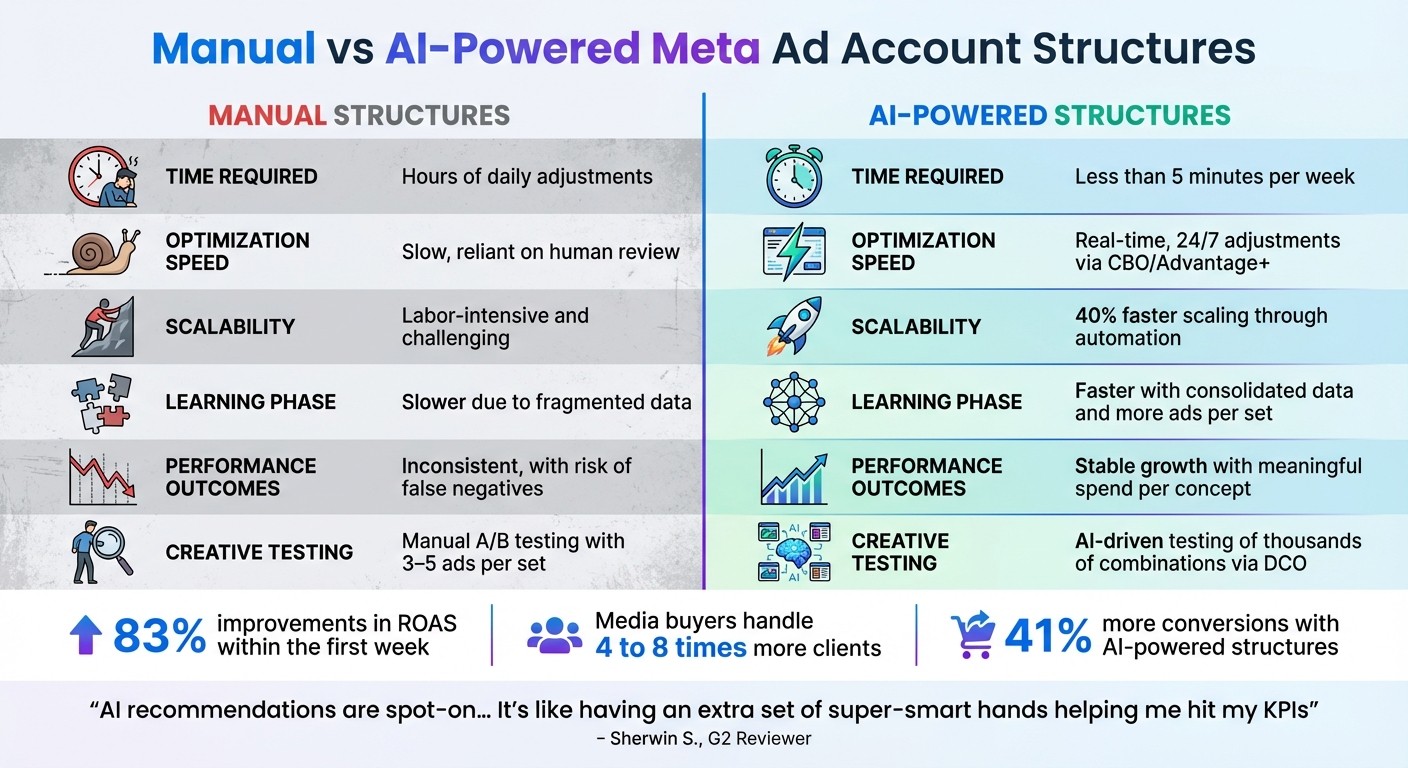
Manual vs AI-Powered Meta Ad Account Structures Comparison
Manual Structures: Common Problems
Managing Meta ads manually can be a major time sink. Advertisers often create 3–5 ad sets per campaign, carefully keeping audience overlap under 20% to avoid internal competition. While this approach works in theory, it becomes a logistical headache at scale. Each ad set requires at least 2,000 impressions before you can gather enough data to make informed decisions. This means slower optimization cycles and wasted budget.
Scaling only makes things harder. When campaigns are split across regions or funnel stages, Meta's algorithm struggles to learn effectively. Budget allocation becomes a guessing game between CBO vs ABO for broader reach and more granular control. Creative testing is another challenge - it typically involves 3–5 ads per ad set, with small manual tweaks like changing a headline or call-to-action. This is where bulk ad testing with AI can significantly improve efficiency. This process often results in lower-quality data due to limited impressions. Running ads across multiple markets adds another layer of complexity, requiring manual adjustments for each region, from "Demandez votre devis" in France to "Cotiza ahora" in Mexico.
AI-powered solutions streamline these processes, eliminating many of these inefficiencies.
AI-Powered Structures: Faster and More Efficient
AI takes a completely different approach, simplifying and accelerating ad management. Modern AI-powered structures consolidate campaigns, enabling faster learning through stronger machine learning signals. For example, Meta's Advantage+ Shopping Campaigns encourage advertisers to include more ads per ad set, as this consolidated data improves the algorithm's performance. The current best practice revolves around a streamlined 2-campaign structure: one for creative testing and another for scaling successful ads.
This structure leverages AI to handle tasks that overwhelm human teams, like real-time optimization across thousands of variables. Ad sets with $1,000 per day in stable performance automatically move from testing to scaling campaigns. This avoids "false negatives", where promising ads fail due to insufficient budget. With updates like Meta's Andromeda, predictive algorithms are now even better suited for simplified campaign hierarchies.
Comparison Table: Manual vs AI-Powered Structures
AI-powered systems transform time-consuming manual processes into efficient, automated workflows.
Metric | Manual Structures | AI-Powered Structures |
|---|---|---|
Time Required | Hours of daily adjustments | Less than 5 minutes per week with automation |
Optimization Speed | Slow, reliant on human review | Real-time, 24/7 adjustments via CBO/Advantage+ |
Scalability | Labor-intensive and challenging | 40% faster scaling through automation and AI frequency control |
Learning Phase | Slower due to fragmented data | Faster with consolidated data and more ads per set |
Performance Outcomes | Inconsistent, with risk of false negatives | Stable growth with meaningful spend per concept |
Creative Testing | Manual A/B testing with 3–5 ads per set | AI-driven testing of thousands of combinations via DCO |
The results speak for themselves. Users of AI-powered platforms like AdAmigo.ai have reported 83% improvements in ROAS within the first week. Media buyers are now able to handle 4 to 8 times more clients by letting AI manage execution. As G2 reviewer Sherwin S. noted:
"AI recommendations are spot-on (...) It's like having an extra set of super-smart hands helping me hit my KPIs".
How to Simplify Meta Ad Account Structures with AI
Step 1: Use AI for Campaign Budget and Objective Setup
AI takes the guesswork out of budget management by analyzing performance metrics and reallocating funds to your top-performing ad sets in real-time. With CBO best practices, you can skip the hassle of manual budget adjustments. Studies show that simplified campaign structures using CBO can deliver 41% more conversions compared to traditional methods. To make the most of this, create one campaign per primary objective - whether it's sales, lead generation, or brand awareness. Mixing objectives within a single campaign can confuse Meta's algorithm and hinder optimization.
For global campaigns focused on brand awareness, CBO is ideal as it automatically directs spending to high-performing ad sets across regions. On the other hand, if you're running local conversion campaigns where precise control over market-level budgets is critical, Ad Set Budget Optimization (ABO) is a better choice. AI tools also simplify adjustments. For example, you can use chat commands like, “Scale spend 30% at ≥3× ROAS” to fine-tune campaigns effortlessly.
One pool cleaning technology brand demonstrated the power of AI by reallocating 15% more budget to an automated Advantage+ shopping campaign. The result? A 57% lower cost per purchase, proving how AI can identify and scale high-performing campaigns.
Next, let's explore how AI takes the reins on audience targeting for even better results.
Step 2: Let AI Handle Targeting and Audience Selection
When it comes to targeting, AI outshines manual methods by leveraging machine learning to identify and engage the right audience. Meta's algorithms consolidate lookalike audiences into single ad sets, reducing duplication and optimizing ad spend. To get started, install the Meta Pixel, enable server-side tracking with the Conversion API, and prioritize up to 8 key conversion events. This creates a feedback loop between your CRM and Meta, allowing AI to refine audience targeting and improve campaign performance.
For example, an e-commerce brand using AI-optimized placements saw a 39% drop in customer acquisition costs and a 26% increase in reach. To avoid audience overlap (which can lead to competition between similar groups), keep it under 20%. Activating Advantage+ Audience enables Meta's algorithm to detect patterns and expand your reach to users most likely to engage.
AI thrives with broader audience pools, as it can pinpoint high-intent users more effectively than manual segmentation. However, patience is key - allow a 7–14 day learning phase for the AI to gather sufficient data before making any manual tweaks.
With budgets and audiences in place, the final step is streamlining ad creative production using AI.
Step 3: Generate Ad Creatives with AI
AI can handle the heavy lifting of ad creative production by analyzing your brand's identity, studying competitors' successful campaigns, and generating ready-to-launch creatives. With Dynamic Creative Optimization, Meta tests variations of your ads across different languages, visuals, headlines, and calls-to-action. Each ad focuses on testing one variable at a time, ensuring a data-driven approach to optimization.
Using Advantage+ Creative, Meta's AI automatically tailors visuals and copy to align with audience preferences. It's also essential to refresh your creatives regularly to avoid ad fatigue with AI. While the refresh rate depends on factors like audience size and campaign performance, aim to gather at least 2,000 impressions per ad set before evaluating results.
The first 72 hours of a campaign are especially critical. During this period, AI uses performance data to shape the campaign’s direction, so early adjustments can significantly influence outcomes.
With AI managing budgets, targeting, and creative production, your campaigns are set up for success with less manual effort and more precision.
How AdAmigo.ai Simplifies Meta Ad Account Management
Meta's built-in AI tools are great for optimizing campaigns, but AdAmigo.ai takes things a step further. Acting as an autonomous media buyer, it doesn’t just tweak campaigns - it manages your entire account structure, from generating creative assets to adjusting budgets. Unlike traditional rules-based systems that rely on fixed formulas, AdAmigo.ai uses a learning agent that evolves based on real-world performance data. This dynamic approach lays the foundation for the best practices we’ll explore later.
AdAmigo.ai is designed for teams that want to scale without increasing their headcount. Agencies can handle 4–8× more clients by letting the platform take over daily tasks, allowing senior strategists to focus on big-picture planning. For in-house teams, it can replace expensive hires with an AI that continuously improves its expertise. Setup is quick - just five minutes. Connect your Meta account, set your KPIs (e.g., "Increase spend by 30% while maintaining at least a 3× ROAS"), and the agent starts delivering recommendations that you can either approve or let auto-publish. These features naturally lead into a streamlined workflow, which we’ll dive into next.
AI Ads Agent: Launch Campaigns with One Click
The AI Ads Agent simplifies the entire campaign launch process. It analyzes your brand identity and top-performing competitor ads to generate campaigns complete with on-brand creatives, compelling copy, audience targeting, and budget allocations - all ready to go with a single click. This eliminates hours of manual work. As G2 reviewer Jakob K. put it:
"The fact that you can launch campaigns through text or voice commands feels like magic! It handles everything from scaling with lookalike audiences to adjusting budgets."
The agent takes care of AI vs manual audience creation, budgets, bids, and placements while respecting your rules, such as geo restrictions, pacing limits, or budget caps. It integrates seamlessly with Meta’s Campaign Budget Optimization (CBO), creating efficient campaign structures with 3–5 ad sets to minimize audience overlap (keeping it under 20%). For agencies managing multiple clients, the agent can even auto-generate ad sets for different market segments - like U.S. lookalikes versus retargeting audiences - organizing them into one campaign per objective to avoid redundancy.
AI Actions: Daily Recommendations for Budgets and Bids
Every morning, AI Actions provides a prioritized to-do list, highlighting the most impactful changes for your account. These recommendations might include reallocating budgets to high-performing ad sets, adjusting bids to lower your cost-per-acquisition, refining audience segments to reduce overlap, or replacing underperforming creatives.
You control how much authority the AI has. In Manual Review mode, you can approve each recommendation with a single click. In Autopilot mode, the agent makes changes automatically but stays within the constraints you’ve set. One verified user shared:
"These AI actions go beyond simply suggesting actions; they provide valuable insights and justifications."
This level of transparency ensures you not only know what’s being changed but also why it matters, turning routine optimizations into valuable learning moments.
Bulk Ad Launch: Scale Campaigns Quickly
Scaling campaigns can be time-consuming, but Bulk Ad Launch makes it simple. By connecting to your Google Drive, it pulls in your assets and uses templates to create and launch dozens - or even hundreds - of ads at once. This feature is especially handy when testing multiple creative ideas across different audience segments. It ensures brand consistency while adhering to your targeting and budget rules, making it easy to scale without the headache of manual duplication.
Best Practices for AI-Optimized Account Structures
Define Clear Goals and KPIs Before Starting
AI tools thrive when they have a clear sense of direction. Before connecting your Meta account, set specific and measurable goals - like achieving a 3× ROAS or increasing spend by 30% while keeping profitability intact. Without clear targets, AI might spread your budget too thin, trying to juggle different objectives like awareness campaigns and conversion-focused efforts, which require separate optimization strategies.
Stick to one primary goal per campaign. When you give AI precise instructions - such as "Increase spend by 30% while maintaining a ROAS of 3× or higher" - it can create campaigns, audiences, and budgets that align with your priorities. It will also respect any rules and guardrails you set, like geographic restrictions or pacing limits. With these objectives in place, consistently monitor the AI’s performance to ensure it’s delivering on your expectations.
Review AI Recommendations Regularly
Even the smartest AI benefits from a little human oversight. When starting out, check AI-generated suggestions daily or every 24–48 hours. Pay close attention to budgets, automated bid rules, targeting tweaks, and creative updates. This hands-on approach ensures the recommendations stay aligned with your goals. For example, confirm that audience overlap is below 20% and that budget reallocations make sense given your market conditions.
Regular reviews help you avoid pitfalls like the AI over-prioritizing short-term wins - such as lowering cost-per-acquisition - at the expense of long-term customer value. They also prevent the AI from accidentally breaking custom rules, like exceeding geo-specific budget caps. Plus, these reviews can teach you a lot about refining your overall strategy. Once you’ve established a steady review process, you can shift to semi-autonomous execution for better efficiency.
Use Semi-Autonomous Mode for Better Control
Start by manually approving every AI recommendation rather than jumping straight into full autopilot. In semi-autonomous mode, the AI suggests changes for creatives, audiences, budgets, and bids, but you have the final say before anything goes live. This step-by-step approach builds your confidence, helping you understand the reasoning behind each adjustment and ensuring all changes align with your restrictions on placements, pacing, and budgets.
After observing performance for a week or two and confirming that results align with your KPIs, you can activate auto-publish for smaller, high-confidence changes while keeping manual approval for major strategic decisions. Agencies managing multiple clients often find this approach helps them scale operations 4–8× faster. As G2 reviewer Sherwin S. put it:
"The AI actions are spot-on, enabling quick adjustments and immediate results. It's like having an extra set of super-smart hands helping me hit my KPIs."
Conclusion
Running Meta ad accounts doesn’t have to feel like an endless grind of manual tweaks and adjustments. Thanks to AI, tasks like audience targeting, budget management, and creative testing are now handled by automated, real-time systems that adapt seamlessly to market changes. Instead of spending hours fine-tuning bids or launching campaigns one by one, you can shift your focus to strategic planning while AI takes care of the heavy lifting.
The numbers speak for themselves: AI-powered campaign structures deliver 41% more conversions, and fully embracing AI optimization leads to 40% faster scaling compared to partial adoption. Tools like AdAmigo.ai make this a reality - allowing one media buyer to manage 4 to 8 times more clients by automating execution, creative generation, and around-the-clock performance monitoring. You can even use an ad performance benchmark tool to see how your results stack up against industry standards. These results highlight the game-changing impact of AI-driven ad management.
Getting started is quick and straightforward. In just five minutes, you can connect your Meta ad account, set your KPIs, and let AI provide daily recommendations for campaigns, audiences, and budgets. You can choose to approve changes manually or let the system run on autopilot when you’re ready. As G2 reviewer Rochelle D. shared:
"Our budgets are controlled, our spend is being smartly allocated and our ROAS is up massively. Agencies charging 7 times the cost of AdAmigo have been put to shame!"
FAQs
How does AI enhance targeting in Meta ad campaigns?
AI takes Meta ad campaigns to the next level by analyzing vast amounts of real-time user data - like demographics, interests, behaviors, and past conversions - to pinpoint the most relevant audience segments. Unlike traditional targeting methods that remain static, AI continuously fine-tunes these segments based on new performance data. This dynamic approach keeps campaigns relevant and minimizes wasted ad spend.
Tools like Meta’s Advantage+ and platforms such as AdAmigo.ai make this process even smoother. For instance, AdAmigo.ai’s AI Ads Agent dives deep into your brand identity, competitor insights, and past performance to identify high-value audience signals. It then uses this information to launch fully optimized campaigns. Meanwhile, its AI Actions feature provides daily recommendations for tweaking audiences, budgets, and bids, ensuring your targeting strategy stays in sync with actual performance data.
How does AI help optimize ad budgets effectively?
AI simplifies budget management by dynamically adjusting ad spend in real time to deliver better results. By leveraging predictive analytics and intelligent bidding strategies, it helps boost both ROI and ROAS while ensuring your budget is distributed effectively across campaigns.
With around-the-clock monitoring and ongoing performance tweaks, AI eliminates the uncertainty of budget adjustments. This not only saves time and cuts costs but also frees you up to concentrate on bigger strategic priorities.
How does AI make scaling Meta ad campaigns easier?
AI makes scaling Meta ad campaigns easier by automating essential tasks. It handles creating ad visuals, pinpointing target audiences, and fine-tuning budgets and bids in real time. Plus, it can launch multiple ads simultaneously, saving time and ensuring accuracy.
Tools like AdAmigo.ai take it up a notch by analyzing performance data, optimizing campaigns on their own, and providing useful insights. This frees up marketers to concentrate on strategy while maintaining steady growth and smoother operations.