
5 Tips to Prevent Interest-Based Audience Overlap
Cut wasted ad spend by preventing audience overlap: use exclusions, narrow interests, separate ad sets, tailored creatives, and frequency tracking.
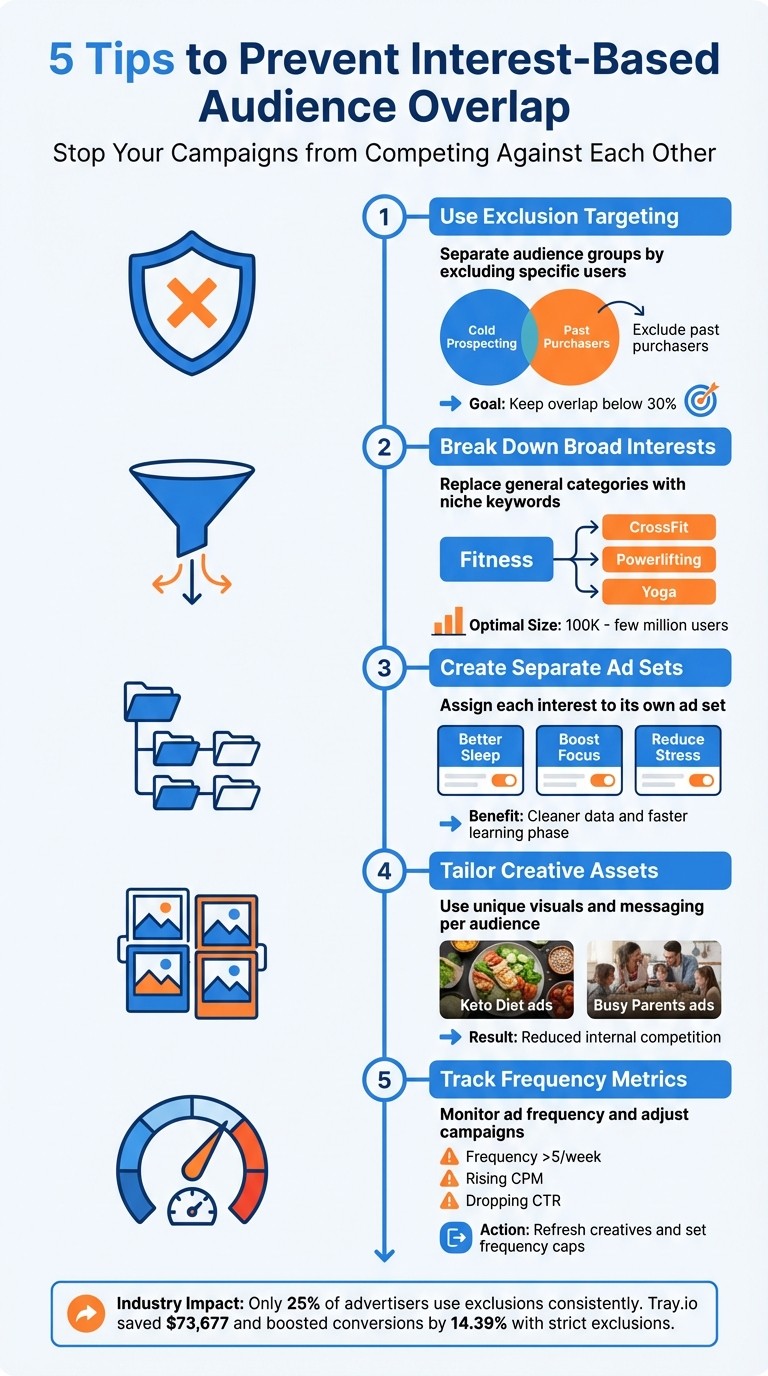
Audience overlap can waste your ad budget by making your campaigns compete against each other for the same users. This drives up costs, confuses algorithms, and leads to ad fatigue. To avoid this, here are five practical strategies:
Use Exclusion Targeting: Separate audience groups by excluding specific users from seeing ads meant for other segments to avoid audience overlap.
Break Down Broad Interests: Replace general categories with niche keywords to target more specific groups.
Create Separate Ad Sets: Assign each interest or angle to its own ad set for cleaner data and better performance tracking.
Tailor Creative Assets: Use unique visuals and messaging for each audience to reduce internal competition.
Track Frequency Metrics: Monitor how often users see your ads and adjust campaigns when frequency is too high.
These tactics help reduce overlap, cut costs, and improve Meta ads ROI by ensuring your campaigns reach the right people without competing against each other.
5 Strategies to Prevent Ad Audience Overlap and Reduce Wasted Spend
HOW TO PREVENT AUDIENCE OVERLAP: 3 Strategies for Better Facebook Ads Performance (HIGHER ROAS 📈)
1. Use Exclusion Targeting to Separate Interest Segments
Exclusion targeting allows you to keep your audience groups distinct by ensuring that specific users don't see ads meant for a different segment. For instance, if you're running a cold prospecting campaign, excluding "Past Purchasers" ensures they aren't targeted, creating clear audience boundaries. This approach prevents your ad sets from competing against each other in auctions. Similarly, excluding "Website Visitors" from cold interest campaigns keeps them in your retargeting funnel, while removing 1% Lookalikes from 3% Lookalike ad sets isolates the closest matches and reduces redundant impressions.
To apply exclusion targeting effectively in Meta Ads Manager, follow these steps:
Steps to Set Up Exclusions in Meta Ads Manager:
Go to the Ad Set level of your campaign and scroll to the Audience section.
Under Custom Audiences, click the Exclude button and select the audience to exclude, such as "Purchasers – Last 30 Days" or "Email Subscribers." If you need help identifying which segments to target first, use a target audience finder to build your initial profiles.
If you're using Advantage+ Audience, switch to the original audience options by clicking "Switch to original audience options" to ensure strict exclusions.
"The 'expand' or 'recommended audience' option can override your exclusions by treating your inputs as hints rather than hard rules. If your intent is strict exclusion, disable expansion or use the original audience setup." - Máté Hunyor, Wupscale Marketing
Before launching your campaign, double-check your setup with the Show Audience Overlap tool. In Meta Business Manager, navigate to Audiences, select up to five audiences, click Actions, and choose Show Audience Overlap. Review the Venn diagram to confirm that your segments have less than 30% overlap. For best results, audit this weekly or before major campaign launches to avoid frequency spikes.
2. Break Down Broad Interests into Specific Segments
Broad categories like "Fitness and wellness" or "Marketing tools" are simply too vague. They attract a massive range of users with wildly different goals, making it harder for Meta's algorithm to figure out who your ideal audience is. For example, targeting "Fitness" might land your ads in front of everyone from weekend joggers to competitive bodybuilders - two groups that require completely different approaches.
The solution? Swap those umbrella terms for more focused, niche keywords. Instead of "Fitness", go for terms like "CrossFit", "powerlifting", or "yoga teacher training." Similarly, replace "Marketing tools" with more specific options like "SEO tools", "email marketing platforms", or "social media schedulers." This level of detail helps you cut through the noise and connect with people who are actually interested in what you’re offering.
Being specific also avoids unnecessary internal competition. Let’s say you run separate ad sets for "Marketing tools" and "SEO tools." Since both might attract SEO professionals, your ads could end up bidding against each other, driving up costs without expanding your reach. Keeping your segments distinct avoids this overlap, gives Meta clearer signals, and helps optimize your ad delivery.
When it comes to audience size, aim for a sweet spot: between 100,000 and a few million users. Audiences larger than 10 million lack focus, while those under 100,000 are too limited to scale effectively. To hit that ideal range, try using interest layering best practices. For instance, combine "Fitness" with "Women aged 25–35" and "Recently engaged" to create a micro-segment that's both targeted and scalable.
For even sharper targeting, skip the default suggestions in Meta Ads Manager's "Browse" tool - they tend to be too generic. Instead, manually research specific industry terms, niche hobbies, or even the names of competitors and influencers your audience already follows. This approach uncovers hidden interest categories that others might overlook, giving you access to high-intent audiences that are ready to engage. You can also use AI to find new audience interests that manual research might miss.
3. Create Separate Ad Sets for Different Interest Angles
Once you've narrowed down your target interests, assign each one to its own ad set using audience segmentation. This approach not only simplifies performance tracking but also helps manage targeted exclusions effectively.
For example, if you're promoting a wellness app, you could create separate ad sets focusing on specific angles like "Better Sleep," "Boost Focus," and "Reduce Stress." This setup allows you to see which message resonates most with your audience while giving Meta's algorithm cleaner data to work with. As a result, the auction system can deliver ads that are more relevant to individual users. This structured approach also lays the groundwork for more refined creative and exclusion strategies later on.
"When your ad sets overlap, those signals get messy. It can take a lot longer (and cost more) for your campaigns to exit the learning phase." – Bestever
separating ad sets also simplifies exclusion strategies. For instance, if you're running a campaign for a fitness brand, you might have one ad set targeting "CrossFit" and "Powerlifting" (high-intensity themes) and another targeting "Yoga" and "Pilates" (wellness and flexibility themes). By keeping these themes in distinct ad sets, you can exclude users who have already engaged with one theme from seeing ads for the other using audience data. This reduces wasted impressions and ensures your budget is spent more effectively. Use clear and descriptive naming conventions, like "Fitness_Women_25-35_Yoga," to track performance and identify any audience overlap.
When testing new angles, it's important to use manual budget testing to allocate equal budgets to each ad set. This ensures a fair comparison of results. If you notice audience overlap exceeding 30%, consider merging the audiences or tightening exclusion criteria to improve efficiency.
4. Use Different Creative Assets for Each Interest Campaign
To make your ad campaigns more effective, use AI to match creatives to audiences for each interest group. Reusing the same visuals and copy across campaigns can lead to internal competition, higher costs, and audience fatigue. It’s important to avoid this overlap by tailoring your approach for each segment.
Let’s say you’re promoting a meal kit service. For an audience interested in the Keto Diet, your ad might highlight low-carb ingredients and nutritional benefits. Meanwhile, an ad targeting Busy Parents could focus on time-saving features and show family-friendly dinner scenes. This strategy not only provides clearer signals to AI-driven behavioral targeting on Meta but also helps your campaigns move out of the learning phase faster. Tools like AdAmigo.ai (https://adamigo.ai) simplify this process by generating brand-aligned, conversion-driven creatives specific to each audience. By varying your hooks and angles, you can set clear expectations and engage each segment more effectively.
"If your message is clear and your creative hooks attention, the algorithm can place it in front of the right people at the right time." – Wupscale Marketing
The opening moments of your ad are critical. Tailor your hooks and opening lines to grab attention and address specific audience needs right away. For example, a fitness app targeting "Marathon Training" could start with, "Struggling to hit your weekly mileage?" On the other hand, an ad for "Weight Loss" might lead with, "Ready to drop 15 pounds by summer?" This level of specificity ensures your message resonates with the intended audience.
Also, match your creative style to the preferences of different demographics. Younger audiences, like Millennials and Gen Z, often connect best with authentic, user-generated content that feels relatable. Older audiences may lean toward more polished and professional visuals. By aligning your creative assets with both the interest group and its demographic profile, you reduce overlap between campaigns and avoid competing with yourself.
5. Track Frequency Metrics and Adjust Campaigns
Frequency metrics help identify when your ads are being shown to the same users too often. If you notice frequency climbing while new user acquisition remains stagnant, it’s a clear sign your campaigns are over-targeting the same audience.
"If your frequency is climbing but new user acquisition is flat, your campaigns may be over-serving ads to the same people." – Angad Singh, Segwise
Keep an eye on three major warning signs: frequency exceeding 5 per week, sharp increases in CPM, and a steady drop in click-through rates. These indicators point to audience saturation and ad fatigue, where your audience begins to ignore repetitive ads, and multiple ad sets may even start competing against each other for the same users. Acting on these signals quickly can help you maintain campaign performance and avoid wasting ad spend.
To address high frequency, set frequency caps at the account level. This encourages Meta to target new users instead of repeatedly cycling through the same audience. If you’re running similar campaigns (e.g., targeting "Yoga" and "Meditation" audiences), combine them under a shared budget to minimize internal competition. Make it a habit to review your frequency metrics weekly, especially after launching new campaigns.
When frequency increases, it’s time to refresh your ad creatives. Introduce new visuals and messaging to re-engage your audience. Also, exclude custom audiences like past purchasers or email subscribers from prospecting campaigns. This keeps your frequency metrics in check while expanding your reach to untapped users.
To simplify the process, consider leveraging automation tools. Platforms like AdAmigo.ai (https://adamigo.ai) can monitor frequency metrics for you, generate fresh creatives that align with your brand, and handle adjustments to budgets and audience targeting - all in real time. These tools can save time and ensure your campaigns remain efficient and effective.
Conclusion
Avoiding interest-based audience overlap is essential for protecting your budget and making every dollar count. To achieve this, focus on strategies like exclusion targeting, narrowing broad interests, creating separate ad sets, differentiating creatives, and keeping an eye on top metrics in historical data like frequency. These steps help prevent internal competition, which can drive up CPMs unnecessarily, and ensure Meta’s algorithm targets fresh, unique prospects instead of repeatedly engaging the same users.
The benefits are clear. Industry standards recommend keeping audience overlap below 30% to maintain strong performance. Yet, according to the Wasted Ad Spend Report 2024, only about 25% of advertisers consistently use audience exclusions in every campaign, and 6.4% skip them entirely. This gap presents a major opportunity. For example, Tray.io implemented strict audience exclusions over nine months in 2023, saving $73,677 in wasted ad spend and boosting their conversion rate by 14.39%, even as their click volume dropped by nearly half.
"Spend some time thinking about who shouldn't see your ads, because it's really easy to add exclusion audiences, and it could save you quite a bit in the way of ad spend." – Kasim Aslam, Founder, Solutions 8
These results highlight the power of precise audience management. Start by auditing your campaigns using Meta’s Audience Overlap tool. If overlap exceeds 30%, consider prioritizing your ad sets by consolidating or pausing underperformers. Reassess your exclusions and AI audience profiling and segmentation strategies regularly. You can also improve precision by scaling with behavioral clustering to target actions rather than just interests. Conducting weekly reviews can prevent overlap from eating into your budget. You can also use an ad performance analyzer to identify which campaigns need immediate attention.
As campaigns grow more complex, automation can simplify your workload. Platforms like AdAmigo.ai can track frequency metrics, generate fresh creatives aligned with your brand, and adjust budgets and targeting in real time. This allows you to focus on strategy while performance scales. Staying proactive is key - clean audience signals not only reduce costs but also speed up learning and drive better campaign results.
FAQs
How can I use exclusion targeting to improve my ad campaigns?
Exclusion targeting is a smart strategy to fine-tune your audience and avoid overlap, helping your campaigns reach distinct groups without wasting resources. The first step is to identify where overlaps might occur - common examples include lookalike audiences or overlapping interest groups. Most ad platforms offer tools to exclude specific segments, like users already targeted in other campaigns or those who’ve already converted. This ensures you're not sending redundant messages.
Keep an eye on metrics like frequency and reach to detect any signs of audience overlap. Another helpful tactic is excluding website visitors who’ve already completed key actions, like making a purchase, from your retargeting campaigns. By doing this, you can allocate your budget more effectively, boost campaign performance, and minimize audience fatigue - all while making sure your ads remain impactful and efficient.
What are the advantages of narrowing broad interests into smaller, niche segments for ad targeting?
Focusing on niche segments instead of broad interests offers some clear benefits when it comes to ad targeting. First, it helps eliminate audience overlap. When multiple ad sets target the same group of users, you end up with internal competition that drives up costs and wastes ad spend. By breaking your audience into distinct interest groups, you ensure each campaign speaks to a unique crowd, cutting down on redundancy and boosting efficiency.
On top of that, niche segmentation makes your ads more relevant and engaging. When ads are tailored to specific interests, they’re more likely to connect with users, which can lead to higher click-through rates (CTR) and a better return on ad spend (ROAS). It also simplifies testing and optimization - smaller, more focused groups tend to respond more predictably, helping you allocate your budget to the audiences that deliver the best results. In short, precise audience segmentation means smarter spending and stronger campaign outcomes.
How can I manage ad frequency to avoid audience fatigue?
To keep your audience engaged and prevent fatigue, keep a close eye on key metrics like click-through rates (CTR), engagement levels, and conversion rates. If you notice a drop in CTR or a rise in cost per acquisition (CPA), it could mean your audience is getting tired of seeing the same ads too often.
One way to address this is by setting frequency caps, which limit how many times a single user sees your ads. Another effective approach is to refresh your ad creatives regularly. Switching up formats and fine-tuning your audience segments based on performance data can also help minimize overexposure and keep your campaigns fresh.
For an easier way to manage this process, consider using automation tools like AdAmigo.ai. These tools can handle tasks like optimizing targeting, updating creatives, and maintaining campaign effectiveness - all while ensuring your audience doesn’t feel overwhelmed.