
Why Meta Ads Need Third-Party Privacy Auditors
Meta ad accounts need independent privacy audits to prevent regulatory fines, stop data leaks, and improve campaign performance.
Meta's ad platform is a privacy minefield. With billions in fines tied to GDPR, CCPA, and HIPAA violations, advertisers face serious risks from misconfigured pixels, consent issues, and improper targeting. Internal teams often lack the expertise or tools to manage these complexities effectively.
Third-party privacy auditors can help. They provide independent oversight, ensuring compliance with privacy laws while maintaining ad performance. From mapping data flows to monitoring consent practices and data hygiene and creative compliance, auditors catch issues internal teams miss. Their continuous monitoring reduces errors, protects ad accounts, and optimizes regulatory adherence.
Key takeaways:
Meta ads rely heavily on data, but improper setups can breach regulations.
Internal audits often fail to identify compliance gaps.
Third-party auditors offer 24/7 monitoring, detailed data mapping, and real-time alerts.
Tools like AdAmigo.ai enhance oversight with automated anomaly detection.
Bottom line: Third-party audits reduce risks and improve ad outcomes by ensuring regulatory compliance and data accuracy.
Privacy Risks in Meta Ads
How Meta Ads Use Data
Meta's advertising platform thrives on behavioral data gathered from every interaction - clicks, page views, purchases, and even form submissions. Tools like the Meta Pixel and Conversions API (CAPI) play a key role in collecting this data, which is then used to refine targeting and improve campaign effectiveness. However, if event tracking is set up incorrectly, it can lead to mishandling of user data. For instance, an event match quality score below 6.0 is considered a medium risk, signaling potential issues in how user identity is being handled.
The "Andromeda" update rolled out in late 2025 added another layer of complexity by introducing creative-led targeting. With this update, the content of the ad itself increasingly acts as a targeting signal. This shift means that AI-generated ad creatives might inadvertently include sensitive data, raising concerns about privacy and regulatory compliance. These evolving practices are drawing closer scrutiny from regulators.
Regulatory Pressures Affecting Meta Ads
The intricate ways Meta handles data are under increasing pressure from regulatory frameworks. Laws like GDPR, CCPA, and industry-specific rules such as HIPAA set stringent guidelines for data collection and usage. For advertisers using Meta, even standard practices - like passing customer email addresses or phone numbers through CAPI for audience matching - can breach regulations if proper consent isn’t obtained.
Industries like healthcare and finance face the toughest restrictions. For example, under HIPAA, even indirect identifiers cannot be transmitted without violating compliance. The FTC has already taken action against companies that misuse Meta’s tracking tools in ways that breach these regulations.
Common Privacy Gaps in Meta Ad Accounts
Many privacy risks in Meta ad campaigns stem from the fast-paced nature of campaign launches. Often, tracking setups are established at the start and rarely revisited, while updates to website consent flows may not account for ad tracking adjustments. This disconnect can lead to significant privacy gaps.
Here are some of the most common issues:
Privacy Gap | Risk Level | Practical Impact |
|---|---|---|
Pixel event match quality < 6.0 | Medium | Leads to inaccurate data mapping and potential non-compliance. |
Duplicate event detection | Medium | Causes over-reporting, inflates ROAS, and sends inaccurate data to Meta. |
Broken links or disabled ads | High | Results in wasted ad spend and data from faulty user journeys. |
Hacker intrusion attempts | Critical | Could lead to account takeovers and unauthorized data access. |
Consent misalignment | High | Exposes advertisers to GDPR/CCPA violations. |
Without ongoing oversight, these problems can linger for weeks or even months. For instance, a misconfigured Pixel might not raise any red flags but could quietly collect and transmit data in ways that violate compliance standards - all while ad budgets continue to be spent. These risks highlight the importance of implementing robust, third-party monitoring to ensure privacy and compliance.
Why Internal Compliance Teams Fall Short
When it comes to managing privacy risks in Meta ads, internal compliance teams often face structural challenges that limit their effectiveness. The issue isn't a lack of effort but rather the way these teams are organized and the scope of their responsibilities.
Siloed Ownership of Privacy Processes
Meta ads compliance spans multiple departments, which often operate in isolation. Legal teams draft the policies, marketing teams handle campaigns, and IT oversees tracking infrastructure. Unfortunately, these groups rarely coordinate effectively. For example:
Legal might approve a data-sharing practice without understanding how the Meta Pixel is configured.
Marketing could launch a campaign without consulting the privacy team.
IT might update server-side tracking without notifying other departments.
This fragmented approach leads to blind spots, where issues can go unnoticed until they become significant problems.
The Complexity of Meta's Data Ecosystem
Meta's data ecosystem is intricate, requiring much more than a simple review of ad copy. Compliance involves monitoring data across multiple platforms, such as websites, CRMs, server-side APIs, and the Meta Pixel. Each layer introduces potential risks. For instance:
A server-side event firing outside the consent window could breach compliance.
Misconfigured conversion tags might cause violations independently.
Internal teams often lack the tools to monitor these data layers in real time. Studies show that without automated systems, ad accounts typically experience 5–6 critical mistakes per month. By contrast, automated solutions can evaluate over 30 dimensions of an account nightly, covering areas like pixel status, event match quality scores, and audience health. This level of analysis far surpasses what periodic internal reviews can achieve.
Limits of Internal Audits
Internal audits often focus on broad control frameworks rather than the detailed, end-to-end analysis that Meta ads compliance demands. These audits check for the existence of policies but may overlook whether the technical implementation aligns with those policies. Compounding the issue, privacy risks don't adhere to a 9-to-5 schedule. Problems like hacker attempts or broken tracking links can emerge at any time, beyond the reach of teams working standard hours.
Even Meta acknowledges the limitations of its systems: "Our review process may not detect all policy violations, and ads remain subject to review and re-review and may be rejected for violating our policies at any time". Despite employing over 3,000 privacy-focused staff and investing $8 billion in its privacy program since 2019, Meta's own efforts can't catch everything. This underscores how challenging it is for internal advertiser audits to meet the same standard, highlighting the need for independent third-party privacy auditors.
What Third-Party Privacy Auditors Do
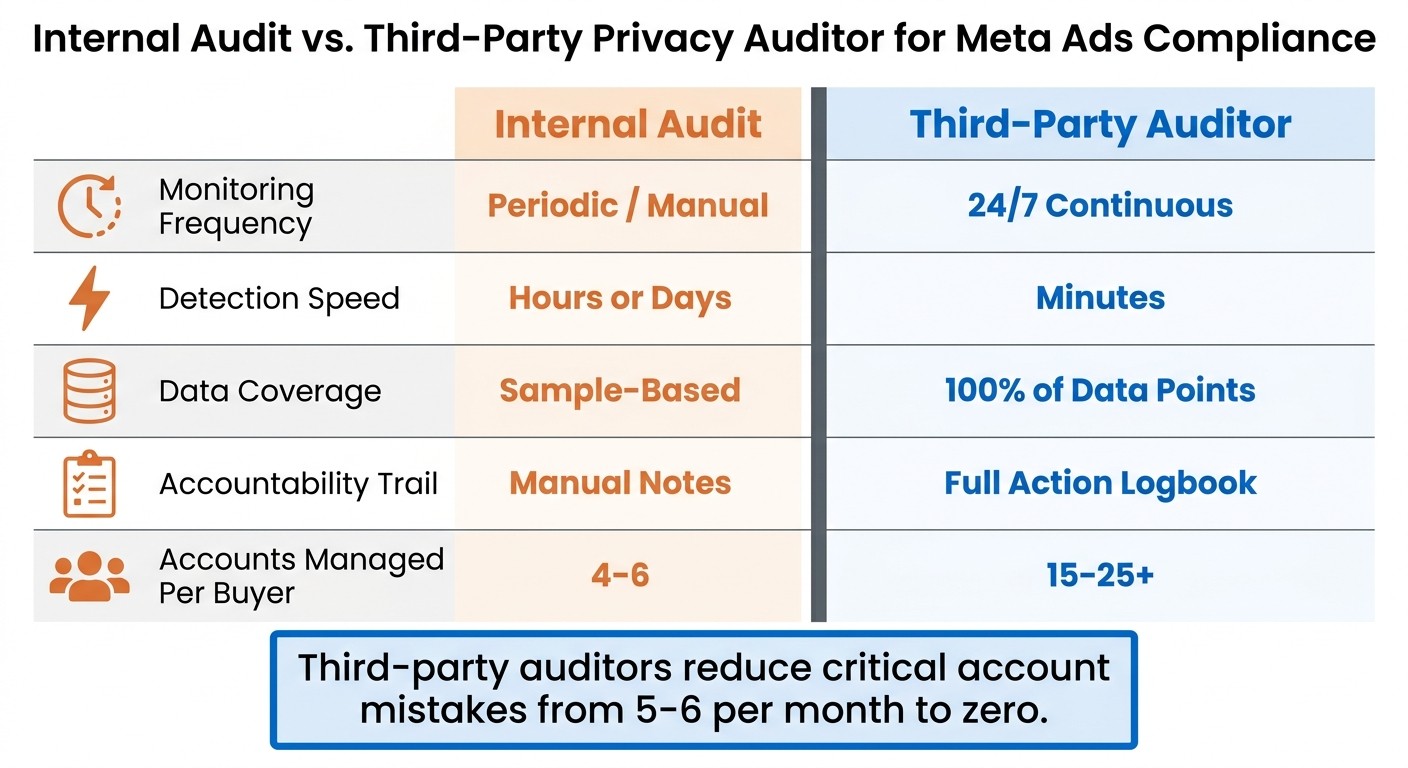
Internal Audit vs. Third-Party Privacy Auditor: Meta Ads Compliance
Third-party privacy auditors step in to address compliance gaps by offering an independent, technical review of your Meta ad account. This includes everything from pixel setups to ensuring ad creatives meet compliance standards.
Mapping Data Flows End to End
Internal teams often struggle to track every detail of data transfers. That’s where third-party auditors come in. They map out exactly where your data goes, tracing signals sent from your website, CRM, or server-side API to Meta. Their goal? Ensuring every transfer aligns with privacy regulations.
The process starts with a 90-day historical scan to uncover patterns, anomalies, and structural issues. For example, they might identify conversion events firing outside a consent window, duplicate pixel events skewing data, or improperly anonymized customer data being shared with Meta. These missteps can lead to regulatory penalties or even account suspensions. By creating a detailed map of data flows, auditors establish a foundation for verifying compliance and proper consent practices.
Validating Consent and Policy Alignment
Auditors don’t just check if you have a consent banner - they dig deeper. They ensure your tracking practices align with privacy policies and regulations like GDPR and CCPA. This includes reviewing your Meta Pixel and Conversions API setup, and event match quality. For instance, maintaining an event match quality score above 6.0 ensures the data you send to Meta is both accurate and properly attributed.
They also address disconnects between legal approvals and actual marketing implementations. Often, these gaps arise from internal silos, and auditors help bridge those divides to keep your campaigns compliant.
Reviewing Targeting and Ad Creative Compliance
Compliance isn’t just about data - it extends to how you build audiences and create ads. Auditors check that audience data, lookalike sources, and creative content meet both regulatory and Meta-specific requirements.
The importance of this review has grown since Meta’s Andromeda update in late 2025. As Chris R. Pechau, Founder of AdAmigo.ai, explained:
"Andromeda isn't about a checklist. It's about your campaigns, your audiences, your signals, your budget distribution, your account history."
With creative assets now playing a key role in targeting, a noncompliant ad can directly impact who sees your campaigns.
Continuous Monitoring and Alerts
Privacy risks don’t wait - they can crop up anytime. That’s why one-time audits aren’t enough. Third-party auditors offer continuous, automated monitoring, running 24/7 to catch setup errors, unauthorized account changes, broken tracking links, and unusual spending patterns as soon as they happen.
Real-time alerts via Slack or WhatsApp ensure immediate action. This system also keeps a transparent record of every change with a full action logbook. Such monitoring has been shown to reduce critical account mistakes from an average of 5–6 per month to zero.
Capability | Internal Audit | Third-Party Auditor |
|---|---|---|
Monitoring frequency | Periodic/manual | 24/7 continuous |
Detection speed | Hours or days | Minutes |
Data coverage | Sample-based | 100% of data points |
Accountability trail | Manual notes | Full action logbook |
Accounts managed per buyer | 4–6 | 15–25+ |
This constant monitoring fills the gaps left by internal audits, ensuring your ad accounts remain compliant and protected.
How to Add Third-Party Audits to Your Meta Ads Workflow
How to Choose a Privacy Auditor
Selecting the right privacy auditor is a pivotal step in ensuring effective oversight of your Meta ad campaigns. To protect your ad data and minimize risks during platform updates, look for auditors with Meta Business Partner status. This credential demonstrates familiarity with Meta's ecosystem and its frequent changes, such as those introduced by the Andromeda update.
Beyond credentials, prioritize two key qualities: real-time anomaly detection and clear communication. An auditor who can identify issues as they arise - rather than during periodic reviews - helps you act faster. And if they can't explain their findings in plain English, it’ll leave your legal and marketing teams struggling to respond effectively.
Working With Internal Teams and Automation Tools
To maximize the value of third-party audits, ensure alignment across your marketing, legal, and IT teams. Auditors play a crucial role in maintaining a detailed log of all changes to your ad accounts. This single source of truth benefits everyone:
Legal teams can verify compliance histories.
IT teams can track updates to configurations.
Marketing teams can review optimizations and understand their impact.
Automation tools, like AdAmigo.ai's Protect feature, add another layer of efficiency. These tools send real-time alerts through platforms like Slack or WhatsApp, enabling teams to act quickly. When implementing automation, it’s critical to set guardrails for metrics like CPA (Cost Per Acquisition) and ROAS (Return on Ad Spend). This ensures that automated actions stay within budget and performance limits. As one G2 reviewer, Rochelle D., shared:
"We are getting INSANE RESULTS! Our budgets are controlled, our spend is being smartly allocated and our ROAS is up massively." - Rochelle D., G2 Review
This combination of internal collaboration, automation, and continuous monitoring creates a flexible and effective compliance strategy.
Setting a Regular Audit Schedule
Start with a 90-day historical scan to establish a baseline for compliance, and then move to quarterly reviews. While these scheduled audits provide structure, automation tools like AdAmigo.ai ensure your records remain updated between reviews.
Keep your documentation up to date. Every time Meta updates its policies or your team adjusts a pixel configuration, your compliance records need to reflect those changes. Automated logbooks can handle this passively, but it’s still important for someone on your team to review the logs quarterly. This ensures no critical updates are overlooked. Treat these audits like financial reviews: schedule them, document them, and sign off on them to maintain accountability.
Conclusion: The Case for Third-Party Privacy Auditors in Meta Ads
Staying on top of privacy compliance in Meta ads demands constant attention. Third-party auditors provide independent, ongoing oversight, often catching problems internal teams might miss. Their work minimizes regulatory risks, ensures consent frameworks are sound, and creates accountability systems that can stand up to scrutiny from both regulators and clients.
But compliance isn't just about avoiding fines - it also boosts ad performance. When your ad account is set up with clear goals, properly configured pixels, and compliant creatives, Meta's algorithm gets better data to work with. This means better delivery, lower costs, and more effective campaigns. In short, compliance directly enhances ad results.
Automation tools help bridge the gaps between audits. For example, AdAmigo.ai's Protect feature offers round-the-clock anomaly detection. It keeps an eye on spend anomalies, broken links, and unauthorized access, catching issues before they become costly problems. With this kind of continuous monitoring, your account stays protected and ready for audits at any time.
Advertisers who can show a well-documented, audited compliance process are better equipped to handle stricter regulations or tough client questions about data practices. As AdAmigo.ai explains:
"Anomaly detection is no longer optional in enterprise ad operations. It is the new standard for governance, quality control, and budget protection."
FAQs
What data does the Meta Pixel and Conversions API send to Meta?
The Meta Pixel and Conversions API work together to send event data to Meta. This includes details like user actions, conversions, and interactions on your website. Meta uses this information to help track and improve the performance of your ads.
When do Meta ads require explicit user consent under GDPR or CCPA?
Meta ads must obtain explicit user consent under GDPR and CCPA when they involve the collection, processing, or sharing of personal data for activities such as targeted advertising or behavioral profiling. This step is essential for staying in line with privacy laws and regulations.
What should I look for when hiring a third-party privacy auditor for Meta ads?
When choosing a third-party privacy auditor for Meta ads, focus on their knowledge of Meta’s platform policies, API permissions, and data management practices. This ensures they can help you stay compliant and avoid potential violations. They should also be capable of detecting anomalies, leveraging automation tools for real-time monitoring, and adhering to strict security protocols like data encryption and regulations such as GDPR or CCPA. These steps are essential for safeguarding your account and ensuring privacy.