
Reels Ads vs. Feed Ads: Performance Comparison
Reels deliver cheaper, higher-engagement reach while Feed drives stronger clicks and conversions.
Choosing between Reels and Feed ads can significantly impact your campaign results. Here’s a quick breakdown to help you decide:
Reels Ads: Best for awareness and prospecting. Lower CPMs ($6.50–$8.20) and CPAs (12–15% cheaper than Feed) make them cost-effective for reaching new audiences. They excel in engagement, with over 60% of viewers watching with sound on and longer average view times (8–15 seconds). However, they have lower CTRs (0.45–0.65%) and conversion rates (1.8–2.0%).
Feed Ads: Ideal for conversions and retargeting. Higher CPMs ($11.50–$13.20) reflect their ability to deliver better CTRs (1.05–1.20%) and conversion rates (2.8%). Feed users are more intent-driven, making this placement more effective for closing sales and driving actions.
Quick Comparison Table:
Metric | Facebook Feed | Instagram Feed | Facebook Reels | Instagram Reels |
|---|---|---|---|---|
Average CPM | $11.50 | $13.20 | $6.50 | $8.20 |
Average CTR | 1.20% | 1.05% | 0.45% | 0.65% |
Conversion Rate | 2.8% | 2.4% | 1.8% | 2.0% |
Relative CPA | 100 (Baseline) | 108 | 88 | 90 |
Sound-On Rate | 15–30% | 15–30% | 60%+ | 60%+ |
Avg. View Time | 3–6 seconds | 3–6 seconds | 8–15 seconds | 8–15 seconds |
Key Takeaway: Use Reels for cost-efficient awareness campaigns and Feed for higher-intent conversions. Testing both placements with creative testing strategies and dynamic tools like AdAmigo.ai can help optimize your budget and maximize ROI. Understanding ROAS benchmarks is also essential when scaling these different placements. You can also use an Ad Performance Analyzer to evaluate your current metrics.
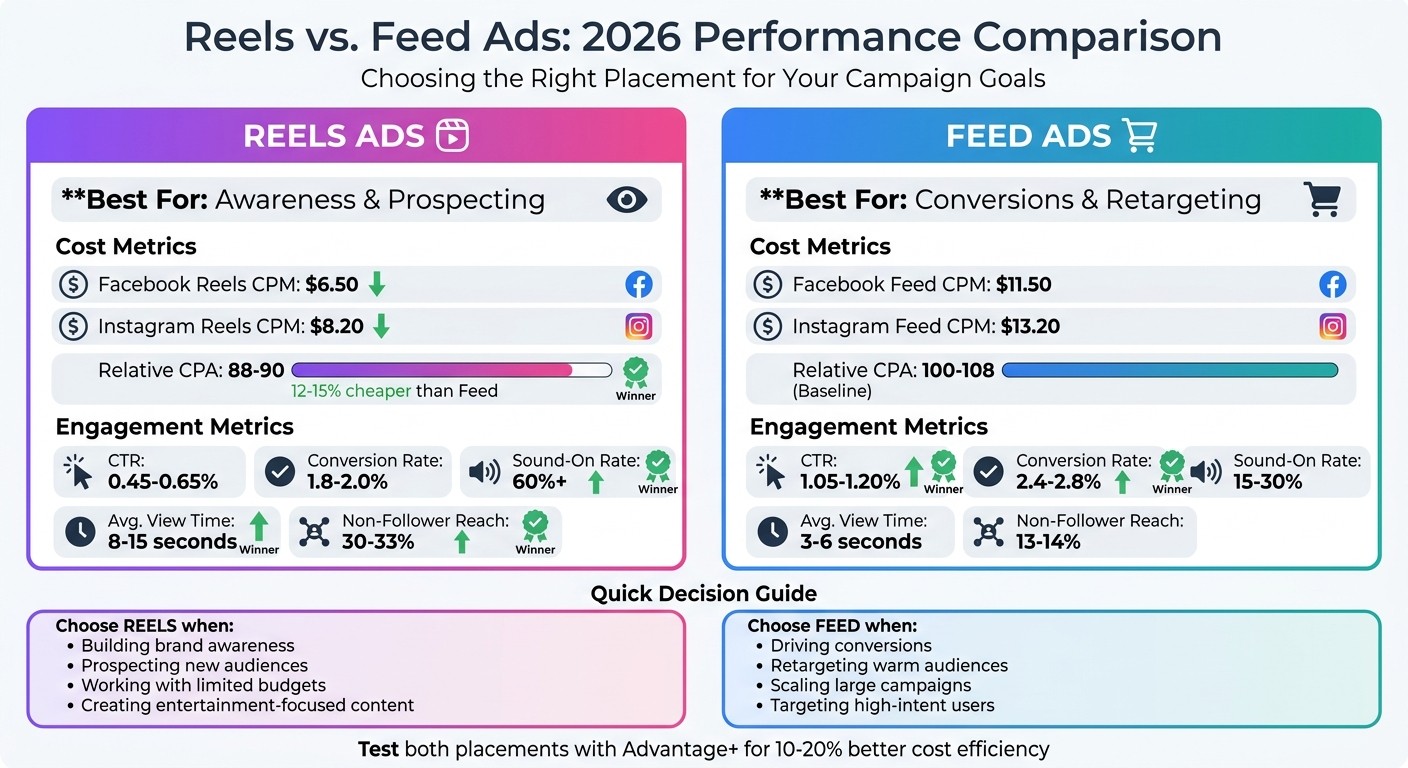
Reels vs Feed Ads Performance Metrics Comparison 2026
Meta Ads Performance Battle: Feed vs Stories/Reels!
Performance Metrics: Reels vs. Feed
The differences in performance between Reels and Feed ads are striking, and understanding these can help make smarter decisions about where to allocate your ad budget. For starters, Facebook Feed ads achieve an average conversion rate of 2.8%, while Facebook Reels trails behind at 1.8%. But conversion rates are just one part of the story - cost and engagement metrics further highlight how these placements perform differently.
Reels ads are more cost-efficient for prospecting. The relative CPA index for Reels falls between 85–88, compared to Feed's baseline of 100. This translates to 12–15% lower prospecting costs. A key factor here is the lower CPMs: Facebook Reels averages $6.50, while Facebook Feed comes in at $11.50. Instagram shows a similar trend, with Reels CPMs at $8.20 versus $13.20 for Feed.
However, Feed ads have the edge in click-through rates (CTR). Users scrolling through the Feed tend to be in a "browse-and-click" mindset, actively exploring content and shopping. This is reflected in their higher CTRs. On the other hand, Reels users are more focused on entertainment, spending more time watching videos (8–15 seconds on average versus 3–6 seconds for Feed) but clicking less often.
Where Reels truly shines is in deeper engagement. Over 60% of Reels viewers watch with the sound on, compared to just 15–30% for Feed. When ads are tailored for sound-on viewing, Reels ads see a 35% boost in engagement metrics. This makes Reels a strong choice for campaigns aimed at building brand awareness, where metrics like watch time and engagement matter more than immediate clicks.
Side-by-Side Metrics Comparison
Here’s a breakdown of these metrics for a clearer comparison:
Metric | Facebook Feed | Instagram Feed | Facebook Reels | Instagram Reels |
|---|---|---|---|---|
Average CPM | $11.50 | $13.20 | $6.50 | $8.20 |
Average CTR | 1.20% | 1.05% | 0.45% | 0.65% |
Conversion Rate | 2.8% | 2.4% | 1.8% | 2.0% |
Relative CPA | 100 (Baseline) | 108 | 88 | 90 |
Sound-On Rate | 15–30% | 15–30% | 60%+ | 60%+ |
Avg. View Time | 3–6 seconds | 3–6 seconds | 8–15 seconds | 8–15 seconds |
These metrics highlight the importance of aligning your ad placements with your campaign goals. Whether you’re looking for cost-effective prospecting, higher click-through rates, or deeper engagement, the choice between Reels and Feed should depend on what you’re aiming to achieve.
How Users Interact with Reels vs. Feed Ads
User behavior differs significantly between Reels and Feed ads. Reels cater to entertainment-focused viewing, while Feed ads align with users actively browsing and engaging. Recognizing these distinctions can help you tailor your ad strategy to meet specific goals.
Reels: Longer Views and Sound-On Engagement
Reels users are in an entertainment-driven mindset, prioritizing content that captures their attention. They’re not scrolling to shop or click; instead, they want engaging, enjoyable videos. This creates a unique space for brands that align their messaging with this behavior.
Reels ads typically hold attention for 8–15 seconds on average. The vertical, full-screen format and algorithmic delivery encourage users to stay engaged longer compared to Feed ads. This immersive experience is a hallmark of Reels, making it a powerful tool for storytelling and brand awareness. However, high engagement can lead to ad fatigue if creative isn't refreshed.
Sound is a game-changer for Reels. Over 60% of viewers watch with sound on, making audio a crucial creative element. In contrast, 70–85% of Feed users browse with sound off. Incorporating music, voiceovers, or trending audio can increase engagement by as much as 35%.
"Reels users are in a lean-forward, entertainment-first mindset. They swipe past anything that looks like an ad within the first 3 seconds." - Digital Applied
Reels also offer broader reach. They connect with 30–33% non-followers, compared to Feed’s 13–14%. This makes Reels particularly effective for reaching new audiences. However, lower click rates reflect its focus on engagement over direct conversions, making it ideal for brand awareness or consideration campaigns.
Feed: Click-Focused Browsing Behavior
Feed users are in a different headspace - they’re actively browsing and exploring content. This higher intent translates to more clicks and conversions.
Users tend to scroll through their feeds at a moderate pace, pausing for 1–3 seconds to evaluate posts. This behavior contributes to higher click-through rates (CTR). For example, Facebook Feed averages a 1.20% CTR, while Instagram Reels achieve about 0.65%.
Because most Feed users browse with sound off 70–85% of the time, visuals and text overlays are essential. Captions and bold imagery ensure your message lands without relying on audio. Strong visual storytelling and clear messaging are key to grabbing attention quickly.
Feed ads also benefit from algorithmic nuances. In 2026, the algorithm prioritizes "caption dwell time", rewarding posts that keep users reading longer. Comments longer than five words are flagged as "high social relevance", boosting organic reach. Crafting educational or thought-provoking captions can amplify your ad’s performance.
Additionally, Feed supports a variety of formats - single images, carousels, videos, and collections - giving advertisers flexibility in how they present their message. This versatility, combined with higher intent, makes Feed ads a strong choice for direct-response campaigns focused on conversions and retargeting.
Cost and Scaling Differences
Reels and Feed placements come with distinct cost structures and scaling capabilities, making them critical considerations for effective budget planning.
Reels: Lower Costs and Added Organic Reach
Reels are a cost-efficient option, offering 15–25% lower CPMs compared to Feed placements. On average, CPMs for Reels hover around $6.50 on Facebook and $8.20 on Instagram, making them a smart choice for prospecting campaigns. This translates into 12–15% lower CPAs, which can stretch your budget further.
"Reels offers 15-25% lower CPMs than Feed with strong prospecting efficiency, but requires entertainment-first creative with native aesthetics." - Benly.ai
Meta's incentives through 2026 contribute to these lower costs.
Another advantage of Reels is their potential for organic reach. Unlike Feed ads, which depend entirely on paid distribution, Reels that resonate with audiences can gain traction organically. Users often share engaging Reels to Stories or through direct messages, amplifying their reach. Meta's discovery algorithm also plays a role, exposing Reels to 30–33% non-followers, creating additional visibility beyond your paid impressions.
However, there’s a catch: Reels have limited inventory. For campaigns with larger budgets, this means you might max out on efficient Reels spend and need to pivot to Feed placements to scale Meta ad budgets.
Feed: High Inventory for Large-Scale Campaigns
While Reels shine in cost efficiency, Feed placements provide the volume and scalability needed for advertisers with significant budgets.
Feed placements dominate in reach, with Facebook Feed engaging over 2.1 billion daily active users and Instagram Feed reaching 1.4 billion. In comparison, Instagram Reels and Facebook Reels attract 700 million and 400 million users, respectively. This vast inventory makes Feed indispensable for campaigns spending tens of thousands of dollars daily.
For large-scale campaigns, advertisers often allocate 60–70% of their budget to Feed placements, with only 20–30% going to Reels. While Feed CPMs are higher, the added cost reflects its ability to deliver greater conversion volume and tap into well-established user behaviors. Feed users are typically more intent-driven, with commerce-focused browsing habits that make it a go-to choice for direct-response campaigns.
Feed also benefits from cross-device attribution flexibility. Around 15% of Feed impressions come from desktop users, a stark contrast to Reels, where desktop usage is under 5%. This desktop reach offers scalability that mobile-only Reels can’t match. When your Reels budget hits its limit, Feed’s extensive inventory ensures you can scale further without compromising performance.
Creative Requirements and Optimization Tips
Reels and Feed ads call for different creative strategies due to their distinct formats and audience behaviors. Adapting your content to these specific needs not only boosts engagement but also helps achieve your campaign goals.
Reels: Vertical Video Best Practices
Reels thrive on an entertainment-first approach. Ads that feel organic - like those using handheld visuals, natural lighting, and simple editing - outperform polished studio productions. Stick to the 9:16 vertical aspect ratio and aim for a video length of 15–30 seconds to keep viewers engaged.
"Ads that look like organic Reels - handheld camera, natural lighting, lo-fi editing - consistently achieve lower CPMs and higher completion rates than studio-produced spots." - Instagram Reels Ads 2026: Creative Strategy Guide
The first 3 seconds are crucial. Failing to refresh your creative can lead to ad fatigue on Meta, causing performance to dip as users tune out repetitive content. A strong hook rate (above 25%) ensures the algorithm doesn’t deprioritize your ad. Use tactics like bold statements, surprising visuals, or results-first messaging to grab attention.
Audio plays a huge role in Reels' success. Ads with sound-on creative can see a 35% increase in performance compared to silent versions. To avoid important elements being obscured by UI components, keep text, logos, and faces within the center 72% of the frame.
While Reels focus on engaging, vertical storytelling, Feed ads offer a broader range of creative possibilities.
Feed: Multiple Format Options
Feed ads provide flexibility with formats like single images, carousels, videos, and collections. For mobile, 1:1 (square) or 4:5 (vertical) formats are ideal for maximizing screen space.
Since most Feed content is viewed without sound, strong captions and clear visuals are essential. Your opening frame should work as a static thumbnail for users with autoplay off. Feed users tend to scroll quickly, with an average view duration of 3–6 seconds. This means your value proposition needs to be immediate and visually clear. Keep your primary text under 125 characters to avoid truncation on mobile.
These differences highlight the importance of tools that can refine your strategy for each placement.
Using AdAmigo.ai for Placement Testing
Optimizing ad placements requires constant testing and adjustments, which can be time-consuming. AdAmigo.ai simplifies this process with its AI Autopilot feature, continuously monitoring your campaigns to identify the best-performing placements for your KPIs.
The platform’s AI Creative Generation tool analyzes your top-performing ads and creates custom variations. It can generate 9:16 vertical assets for Reels and 4:5 or 1:1 formats for Feed, ensuring your creatives are optimized for each placement. AdAmigo.ai also automates testing, budget reallocation, and creative updates, allowing you to focus on strategy while the platform handles the details. You can choose to let it run autonomously or approve changes before they’re implemented, keeping your campaigns optimized around the clock without manual intervention.
Which Placement to Use for Your Campaign Goals
Choosing the right placement is all about aligning your strategy with your campaign goals. Every placement plays a specific role in the customer journey, and knowing how to leverage them can make a huge difference in your results.
Use Reels for prospecting and awareness
Reels are all about discovery. Thanks to its algorithm, Reels content reaches people beyond your followers, achieving 2.4 times more discovery reach compared to feed placements that target only followers. That makes Reels perfect for top-of-funnel campaigns, especially when you're introducing your brand to new audiences.
Reels also stand out cost-wise, offering a highly efficient way to build awareness and tap into an audience of roughly 726 million users.
"Reels deliver the most efficient prospecting CPAs, making it ideal for top-of-funnel awareness and consideration campaigns." - Benly.ai
The trick is to understand the mindset of Reels users. They’re in entertainment mode, scrolling for captivating content - not necessarily looking to shop. That means your ads need to grab attention fast, ideally within the first three seconds, instead of going for a hard sell. If your goal is brand awareness or showcasing a new product, Reels should be your go-to placement.
Use Feed for Conversions and Retargeting
When it comes to driving conversions, Feed is where you want to focus. With a conversion rate of 2.8%, Feed excels at retargeting and engaging audiences who are already familiar with your brand. These users are more likely to take action, whether it’s making a purchase or signing up.
Feed placements typically account for 60-70% of ad spend in conversion-focused campaigns because they cater to intent-driven behaviors. While Reels can be less effective for retargeting (with a relative CPA of 105-110 compared to Feed’s baseline of 100), Feed consistently delivers when it comes to closing sales and re-engaging warm leads.
The difference lies in how users behave. People scrolling through the Feed are often searching for information and ready to act, while Reels users are immersed in video content and less likely to leave the app. If your goal is to drive purchases, sign-ups, or reconnect with past customers, Feed should be your priority.
Test Both Placements to Find What Works
The smartest approach? Test both placements to see what resonates with your audience. Start with Advantage+ vs. Manual Placements, which let Meta’s AI dynamically allocate your budget across Feed, Stories, and Reels based on performance. This strategy can improve cost-per-result efficiency by 10–20%.
For even better results, consider tools like AdAmigo.ai, which automates split-testing and adjusts budgets dynamically. It analyzes your campaigns, pinpoints the most effective placements for your goals, and reallocates spending - either automatically or with your approval. Instead of manually checking Ads Manager every week, AdAmigo optimizes your campaigns 24/7, ensuring every dollar works hard to deliver the best ROI.
Conclusion
Reels and Feed ads each bring distinct advantages depending on your campaign goals. Reels are perfect for building brand awareness and attracting new audiences, offering lower CPMs and reaching 30–33% of users, including those who don’t already follow your account. With its entertainment-focused atmosphere, Reels fosters engagement, making it a strong choice for introducing your brand to fresh audiences at a 12–15% lower relative CPA compared to Feed.
On the other hand, Feed ads excel in driving conversions and retargeting efforts. They deliver better results when it comes to closing sales, reconnecting with warm leads, or scaling campaigns with larger budgets. This is why many advertisers allocate 60–70% of their efficient spending to Feed placements.
The most effective approach? Test both placements and let the results guide your budget decisions. Start with Advantage+ Placements to dynamically adjust spending in real time, improving cost efficiency by 10–20%. Tools like AdAmigo.ai simplify placement testing, analyze creative performance across Reels and Feed, and optimize budgets around the clock to maximize ROI. By detecting underperforming ads and scaling successful ones automatically, the AI ensures your campaigns stay on track. This automation helps teams track creative trends and prevent fatigue before performance dips.
Key takeaway: Optimized placement strategies can deliver over 40% better cost per acquisition by 2026. Whether you’re running a small-scale test or managing extensive campaigns, understanding how Reels and Feed work together - and using tools like AdAmigo.ai to fine-tune them - can significantly improve your advertising results.
FAQs
How should I split budget between Reels and Feed?
To make the most of your budget, consider this breakdown: dedicate 60-70% to Feed ads, as they tend to deliver higher conversions and a wide audience reach. Allocate 20-30% to Reels, which are great for engagement and discovery thanks to their lower CPMs. Finally, reserve 10-20% for Stories, which work well for retargeting efforts. While using Advantage+ placements can help with automatic optimization, keep an eye on performance data and make manual adjustments as needed to fine-tune your results.
What creative changes matter most for Reels vs. Feed?
Reels thrive on entertainment-first content that feels natural and immersive. They’re designed for short, vertical videos that immediately catch the eye, often paired with sound-on experiences to enhance engagement. This makes them perfect for quick, attention-grabbing moments.
Feed ads, however, call for a different approach. They work best with polished visuals, clear messaging, and versatile formats. These ads are typically geared toward longer viewing times and often include strong calls-to-action to drive specific outcomes.
In essence, Reels shine with dynamic, engaging storytelling, while Feed ads are better suited for more traditional campaigns that align with intent-driven user behavior. Each format serves a distinct purpose, tailored to how users interact with the platform.
When should I stop scaling Reels and shift spend to Feed?
When your Reels campaigns start showing reduced efficiency or ROI, or if your focus shifts toward driving conversions, it might be time to move some of that budget over to Feed. Reels are excellent for prospecting, often offering lower CPMs, but Feed typically delivers stronger results in terms of ROAS and conversions. Consider reallocating your spend if you notice rising CPAs, stagnant engagement, or performance metrics that clearly favor Feed placements.