
Meta Ads Benchmarks by Creative Format (2026): Image vs Video vs Carousel vs Collection vs Lead Form vs DPA
Benchmarks for Meta ad formats—CTR, CPC, CVR and ROAS for image, video, carousel, collection, lead form and DPA to guide format choice.
Want better Meta ad performance? Your ad format and placement matter more than ever in 2026. Here's what you need to know:
Image Ads: Affordable and quick to produce, delivering a 1.74% CTR and 3.3x ROAS. Great for retargeting and testing.
Video Ads: Top performer with up to 3.8x ROAS. Short videos (15 seconds) engage users best, especially in sound-off environments.
Carousel Ads: Versatile for showcasing multiple products, offering a 3.7x ROAS with strong engagement.
Collection Ads: Ideal for mobile shopping, achieving the highest ROAS (4.2x) with immersive experiences.
Lead Form Ads: Best for capturing leads, boasting a 7.72% conversion rate but higher CPC at $1.92.
Dynamic Product Ads (DPA): Retargeting powerhouse with up to 4.7x ROAS, perfect for large product catalogs.
Key Takeaway: A mix of formats - 40% user-generated content, 30% images, 20% videos, 10% carousels - keeps audiences engaged and avoids ad fatigue. Tools like AdAmigo.ai simplify testing and scaling — including a creative format converter for Meta ads that adapts assets for every placement — helping brands launch 5–12 new creatives weekly for consistent results.
Quick Comparison:
Format | Avg CTR | Avg CPC | Avg ROAS | Best For |
|---|---|---|---|---|
Single Image | 1.74% | $0.87 | 3.3x | Retargeting, fast testing |
Video (15-30s) | 2.31% | $1.02-$1.15 | 3.6x-3.8x | Engagement, awareness |
Carousel | 2.08% | $0.91 | 3.7x | Multi-product campaigns |
Collection | 2.47% | $1.08 | 4.2x | Mobile shopping |
Lead Form | 2.59% | $1.92 | N/A | Capturing leads |
DPA (Catalog) | 2.31% | $0.70-$0.87 | 4.7x | Retargeting large catalogs |
Bottom Line: Choose formats based on your campaign goals. Pairing the right format with automation tools like AdAmigo.ai can maximize performance while saving time. You can also use an ad performance benchmark tool to see how your current metrics stack up.
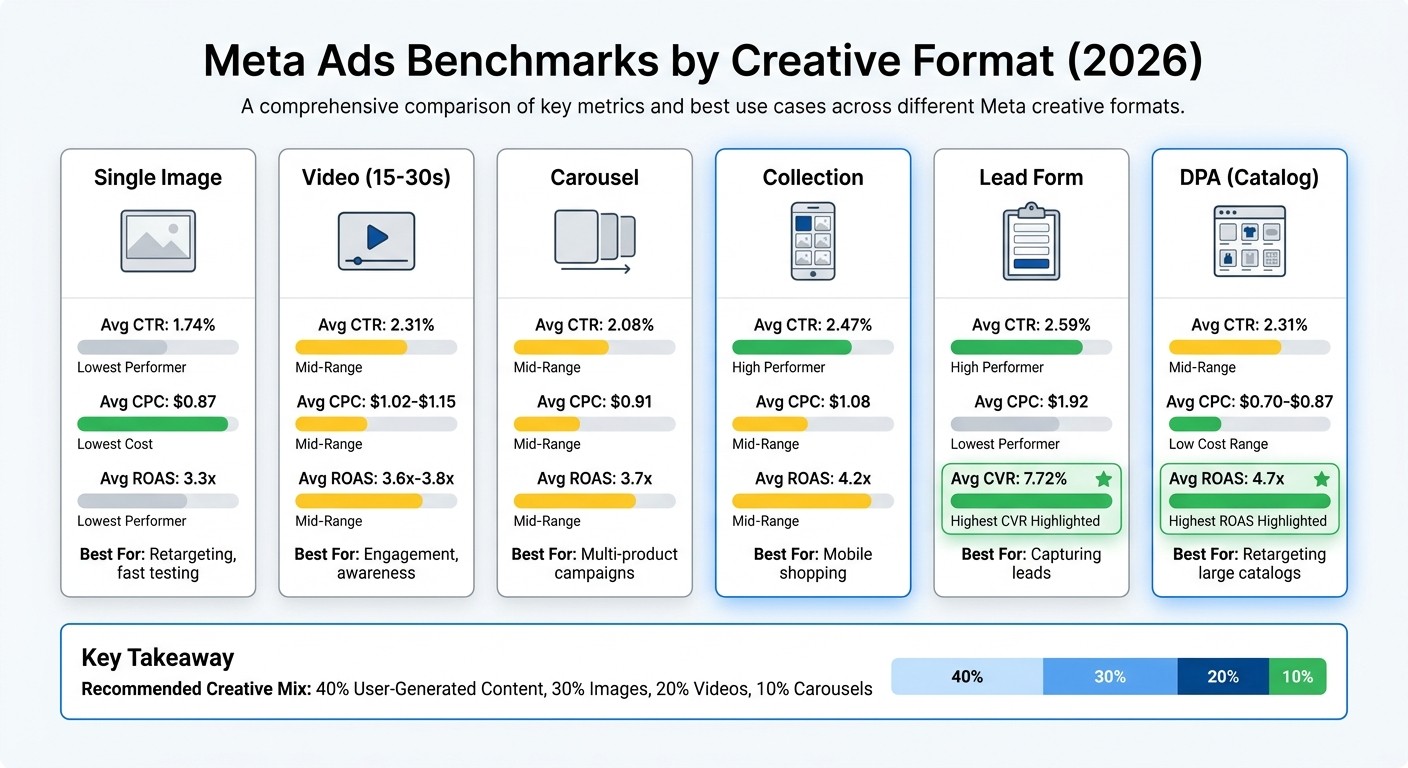
Meta Ads Performance Benchmarks by Format 2026: CTR, CPC, ROAS Comparison
The BEST Facebook Ads Format (Based On Data)
Performance by Creative Format
Here’s a closer look at how different ad formats stack up based on key performance metrics.
Image Ads: Consistent Results at a Lower Cost
Static image ads are reliable performers that don’t require the production time or expense of video. According to MHI Media’s analysis of 1,247 accounts, these ads average a 1.74% CTR, 2.8% conversion rate, and 3.3x ROAS, with a $15.80 CPM. This makes them a budget-friendly option for testing new messaging quickly using creative testing benchmarks. Brands can further lower creative testing costs by focusing on high-impact concepts first. Static images are gaining traction again in direct response campaigns because they deliver value instantly. They’re versatile across placements like Feed and Stories but tend to generate less engagement than video or carousel formats. Image ads shine in retargeting, sale promotions, and scenarios where fast, large-scale testing is needed without the delays of video production. These insights are crucial when using AdAmigo.ai to scale campaigns effectively.
Video Ads: Engagement Powerhouse
Video ads dominate among Meta’s top-performing campaigns, accounting for 78% of successful ecommerce ads. Short videos (around 15 seconds) deliver a 2.31% CTR and 3.6x ROAS, while longer videos (30–60 seconds) achieve a 1.89% CTR with a higher 3.8x ROAS. Videos also boast 2.1x higher engagement rates and 34% lower cost-per-acquisition compared to static images. To maximize impact, test various hooks within the first three seconds. Keep in mind that 85% of Feed videos are watched without sound, whereas Reels and Stories have a 60% sound-on rate. This makes optimizing videos for silent viewing essential before adding sound. These metrics are invaluable for refining creative strategies with AdAmigo.ai.
Carousel Ads: Versatility for Multi-Product Campaigns
Carousel ads are ideal for showcasing multiple products or breaking down features step-by-step. They achieve a 2.08% CTR, 3.1% conversion rate, and 3.7x ROAS, with a $16.40 CPM. This format sits between static images and videos in terms of engagement and cost. Using three to five cards strikes the right balance for storytelling and interaction. Carousels are particularly effective for ecommerce brands that need to highlight product variations, provide feature breakdowns, or create tutorial sequences. They’re resurging in popularity for multi-product browsing and educational content. These metrics can help guide format choices when scaling with AdAmigo.ai.
Collection Ads: Optimized for Mobile Shopping
Collection ads stand out for mobile shopping experiences, delivering a 2.47% CTR, 3.6% conversion rate, and 4.2x ROAS, with a $19.30 CPM. They integrate with Instant Experience to create immersive, mobile-first shopping journeys, making them perfect for catalog discovery and high-AOV products. As of March 2026, Collection ads are no longer a standalone format in Ads Manager - they’re now found under "Format display options" in the Ad Creative section. Despite this change, they remain a top choice for mobile shopping campaigns. These benchmarks are key when testing formats with AdAmigo.ai.
Lead Form Ads: Efficient for Generating Leads
Lead Form ads simplify conversions by keeping users on Meta’s platform, eliminating the need for external landing pages. This reduces friction and improves completion rates, particularly for bottom-funnel goals like newsletter signups, quote requests, or demo bookings. While they tend to have lower top-funnel CTRs compared to video or carousel ads, they make up for it with a lower cost per lead. Lead Forms work best when your focus is on lead volume rather than immediate sales and when you have a strong follow-up system in place. They’re a go-to for high-conversion, bottom-funnel scenarios.
Dynamic Product Ads (DPA): Retargeting Made Easy
Dynamic Product Ads (DPA) use your product catalog to automatically show relevant products to the right audience. They deliver an impressive 4.7x ROAS for retargeting, compared to 3.1x for prospecting campaigns. This automation makes them the most efficient format for scaling campaigns across extensive product catalogs. DPA excels at AI-powered retargeting for users who have viewed products, abandoned carts, or made previous purchases (ideal for cross-sells and upsells). While initial catalog setup is required, the format automates ad creation for each product variation, making it a powerful tool for retargeting strategies with AdAmigo.ai.
Format Comparison by Metrics
Metrics Table by Format
Here's a breakdown of key 2026 performance metrics across various ad formats:
Format | Avg CTR | Avg CPC | Avg CVR | Avg CPA | Avg ROAS | Cost Per Lead |
|---|---|---|---|---|---|---|
Single Image | 1.18% - 1.74% | $0.87 | 2.7% - 2.8% | $32.22 | 3.3x | N/A |
Video (15-30s) | 1.62% - 2.31% | $1.02 - $1.15 | 2.9% - 3.3% | ~$28 | 3.6x - 3.8x | N/A |
Carousel | 1.41% - 2.08% | $0.91 | 3.1% | ~$29 | 3.7x | N/A |
Collection | 2.47% | $1.08 | 3.6% | ~$30 | 4.2x | N/A |
Lead Form | 2.59% | $1.92 | 7.72% | N/A | N/A | $34.10 |
DPA (Catalog) | 1.54% - 2.31% | $0.70 - $0.87 | 3.4% | ~$26 | 4.1x - 4.7x | N/A |
This table highlights the strengths and weaknesses of each format, offering a clear view of how they align with different campaign goals.
Collection Ads take the lead in click-through rate (CTR) at 2.47% and return on ad spend (ROAS) at 4.2x, largely due to their seamless mobile experience. Lead Form Ads excel in conversion rate (CVR), hitting 7.72%, but their cost per click (CPC) is higher at $1.92, reflecting their focus on bottom-funnel activities.
For retargeting campaigns, Dynamic Product Ads (DPAs) stand out with ROAS reaching up to 4.7x. Videos, on the other hand, offer a 34% lower cost per acquisition (CPA) compared to static images while maintaining strong ROAS. If you're looking for cost-effective options for quick testing, Single Image Ads have the lowest CPC at $0.87. However, they tend to lag behind other formats in engagement and overall returns.
To maximize your campaign results, consider these recommendations:
Collection Ads and DPAs are ideal for driving ecommerce sales.
Videos work well for building engagement and educating your audience.
Lead Forms are tailored for capturing leads effectively.
Single Images are great for rapid testing and retargeting.
Additionally, data shows that user-generated content (UGC)-style ads outperform traditional polished creative, achieving a 2.64% CTR compared to 1.78% for more formal brand ads. Leveraging tools like AdAmigo.ai can help you efficiently test and refine these formats at scale.
When to Use Each Format
Let’s break down when to use each ad format to align with your campaign goals and build a full-funnel Meta ads setup to get the most out of your efforts.
Single Image Ads are perfect for quick testing and engaging audiences already familiar with your brand. They work best for straightforward messages, bold offers, or clean product shots that clearly communicate value to warmer audiences.
Video Ads shine when your focus is on boosting engagement and increasing awareness. Short videos (6–15 seconds) generate 20–30% more engagement compared to other formats, with Reels and Stories now capturing 58% of impression share. Keep in mind that the first 3 seconds are critical - 65% of viewers who stick around for those initial moments will watch at least 10 seconds. For more complex products, longer videos (30–60 seconds) provide enough time to explain key benefits.
Moving into Carousel Ads, these are ideal for showcasing multiple products or guiding users through a step-by-step process. They can reduce cost per conversion by 30–50% compared to single-image ads, as users can explore at their own pace. Use carousels to explain "how it works", address objections, or highlight multiple SKUs in one ad. If you’re telling a sequential story, be sure to turn off automatic card ordering.
For campaigns targeting mobile users, Collection Ads offer a smooth, in-app shopping experience. Acting like a mini storefront, they allow users to browse without leaving the app and often deliver strong results, with an average return on ad spend (ROAS) of around 4.2x.
Lead Form Ads are a go-to for capturing user information directly within Meta apps. They’re designed to minimize friction during the conversion process, making them ideal for generating leads efficiently.
Finally, Dynamic Product Ads (DPA) are a powerhouse for performance, particularly for ecommerce brands with larger product catalogs. These ads automatically display relevant products based on user behavior and can deliver up to a 4.7x ROAS. If you manage a catalog with 30+ SKUs, consider dedicating about 70% of your budget to catalog-based Advantage+ Shopping campaigns to let algorithms optimize performance. DPA Carousels are especially effective for retargeting campaigns.
Scale Creative Testing with AdAmigo.ai
Testing different creative formats manually can be a massive time sink. AdAmigo.ai changes the game by automating the process, allowing you to test dozens - or even hundreds - of ad variations across formats like Image, Video, Carousel, Collection, Lead Form, and DPA. Here's how it works:
The Bulk Ad Launcher simplifies large-scale testing. Just upload your creative assets to Google Drive, add a brief, and the system takes care of the rest. It generates ad copy, structures campaigns, and publishes ads directly to your Meta account. You can test 3–5 creative variations at once, making it easier to pinpoint which ones grab attention and stop the scroll.
With AI Autopilot, you get a 24/7 media buyer that handles campaigns for you. It scales top-performing ads, pauses the ones that underperform, and shifts budgets in real time based on live performance data. You can even set specific KPIs, like "Maintain ≥3× ROAS", and let the system handle pacing and bidding, freeing you up to focus on strategy.
The Ad Factory is your brainstorming partner, analyzing your best-performing ads and competitor campaigns to inspire fresh creative ideas. To keep your audience engaged and avoid ad fatigue, it’s recommended to rotate creatives every 2–4 weeks. Need quick answers or actions? The AI Chat Agent has you covered. Ask questions like "Why did ROAS drop yesterday?" or give commands like "Launch a new retargeting campaign", and it will analyze data and execute changes directly through the chat.
AdAmigo Protect ensures your account stays healthy by spotting delivery issues or unusual spending patterns early. Plus, integrating the Conversions API (CAPI) helps recover the 20–30% of data typically lost due to privacy updates and ad blockers. This means your decisions are based on complete, accurate performance data.
Together, these tools seamlessly connect with the strategies and metrics discussed earlier, giving your campaigns a serious boost.
Conclusion: Benchmarks and Best Practices
Understanding the strengths of each ad format is crucial for building a strong Meta advertising strategy. Single Image ads are perfect for quick and budget-friendly testing. Videos drive higher engagement and often lead the way in top-performing campaigns. Carousels allow for creative product storytelling, while collections make mobile shopping seamless. Lead Forms simplify conversion capture, and DPAs (Dynamic Product Ads) shine in retargeting efforts with strong return on ad spend (ROAS).
But selecting the right format is just the beginning. To truly succeed, ramping up creative testing is essential. Brands testing over 21 new creatives monthly see a 65% boost in ROAS compared to those testing fewer than 10. To optimize performance, focus on vertical-first designs (9:16 for Reels), keep key elements within the center 80% to avoid interface overlays, and aim for a hook rate of 30% or more in the first three seconds.
Platforms like AdAmigo.ai simplify creative testing and campaign optimization. Whether you're launching multiple variations with the Bulk Ad Launcher, using AI Autopilot to scale winning ads and pause underperformers, or generating fresh concepts with the Ad Factory, AdAmigo.ai ensures your campaigns are always improving. By automating tasks like testing formats, updating creatives every 2–4 weeks, and maintaining consistent momentum, you can focus on strategy while the platform handles execution. These practices, alongside tools like AdAmigo.ai, provide the framework to streamline testing and maximize your campaign's impact.
FAQs
Which Meta ad format should I start with for my goal?
Choosing the right Meta ad format depends heavily on what you're trying to achieve. If lead generation is your focus, lead forms are a solid choice. They boast an average click-through rate (CTR) of 2.59% and a cost per lead (CPL) of around $27.66.
On the other hand, if you're aiming for brand awareness or engagement, vertical video ads - like Stories and Reels - are top performers. These formats tend to drive high engagement while keeping cost-per-click (CPC) relatively low.
Across the board, dynamic formats such as videos or user-generated content (UGC) consistently outperform static images, particularly in prospecting campaigns. These formats grab attention and resonate better with audiences, making them a go-to for many advertisers.
How should I split budget across image, video, carousel, and DPA?
In 2026, how you allocate your budget should align with your campaign goals and recent performance metrics. For prospecting campaigns, focus heavily on short videos (6–15 seconds) and user-generated content (UGC), dedicating around 50–70% of your resources here since these formats tend to drive higher engagement. When it comes to retargeting or catalog-based campaigns, static images and carousels should take up 30–50% of your creative mix.
To get the best results, make it a habit to test and update your creatives regularly. Tools like AdAmigo.ai can help you streamline this process and scale your efforts efficiently.
How many new creatives should I launch each week to avoid fatigue?
To keep your campaigns fresh in 2026, aim to launch 2–3 new ad variations every week. Why? Because showing the same ad too often can lead to audience fatigue. Research shows that once people see an ad more than six times, their purchase intent can drop by around 16%.
By regularly updating your creatives and testing new ideas, you can maintain audience interest, improve your return on ad spend (ROAS), and keep your campaigns performing at their best.