
How Data Enrichment Improves Meta Ad Targeting
Improve Meta ad match rates and conversions by sending enriched first-party data via the Conversions API to boost targeting and ROAS.
Meta ad campaigns are becoming less effective due to iOS privacy changes like Apple's iOS 14.5 and the third-party data restrictions. Data enrichment solves this by boosting Meta's algorithm with detailed customer data, such as phone numbers and locations, improving targeting and conversion rates.
Key takeaways:
Enriched data increases match rates from 40–60% to over 75%.
Campaigns see a 47% drop in cost per acquisition (CPA).
Conversion rates improve by 2–5×.
Using tools like AdAmigo.ai or LeadEnforce, enriched data can be integrated with Meta's Conversions API for better tracking and performance. This approach is essential for advertisers to stay competitive in 2026.
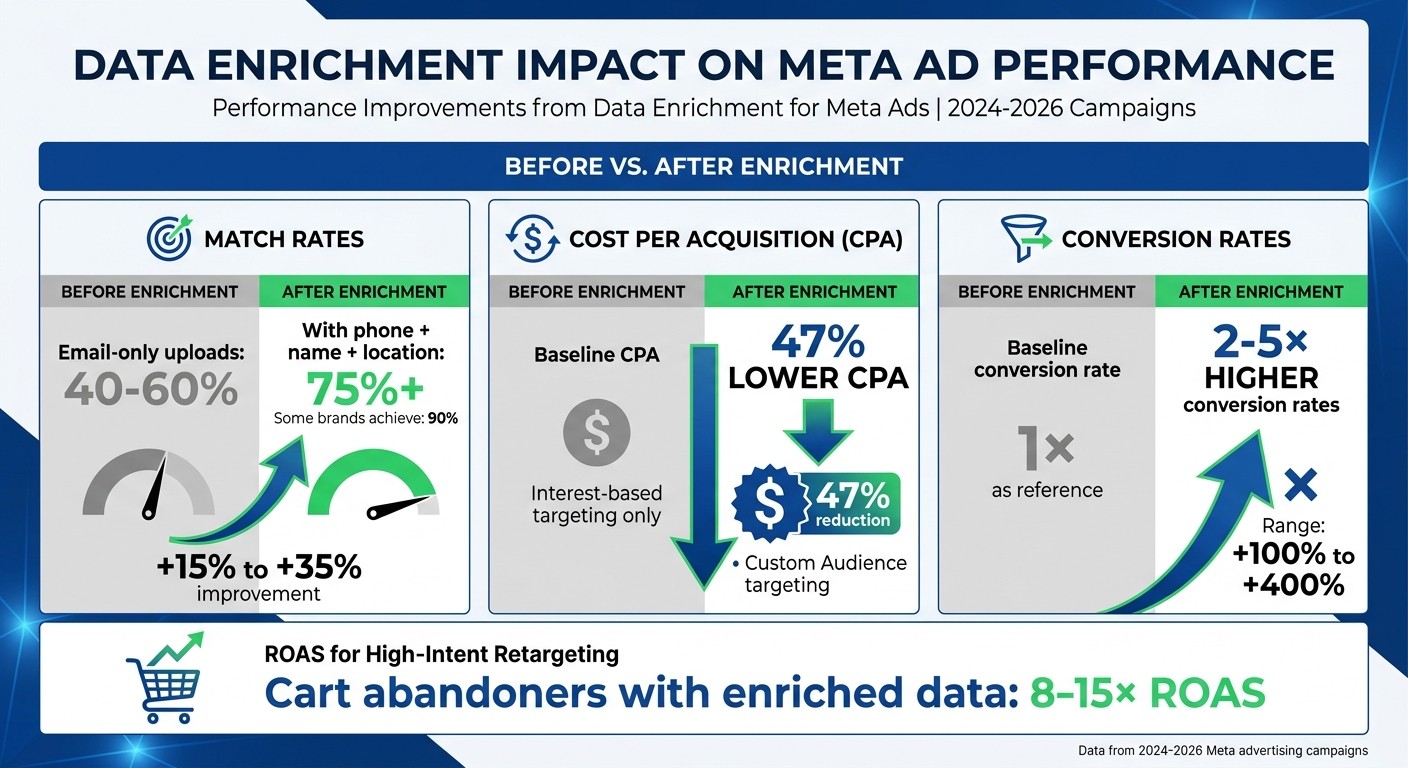
Data Enrichment Impact on Meta Ad Performance: Key Metrics Before and After
What Data Enrichment Is and How It Affects Meta Ads
What Is Data Enrichment?
Data enrichment involves adding extra details - like demographics, purchase history, or verified identifiers - to existing customer data to create a more complete profile. For instance, it can fill in missing information, such as names, phone numbers, or zip codes, for email-only signups.
This process works by consolidating scattered data fragments into one unified record using tools like identity graphs. When it comes to Meta ads, data enrichment means sending this enhanced first-party data server-side via offline data sync to complement pixel tracking. This allows Meta's algorithm to use additional identifiers - such as phone numbers, click IDs, or device fingerprints - to better connect website events with Facebook and Instagram users.
"Identity resolution tells you WHO they are. Enrichment tells you EVERYTHING you know about them. Together, they turn fragments into signal that powers Meta."
Now, let’s explore why these enriched data profiles are so impactful for Meta ad campaigns.
Why Data Enrichment Matters for Meta Ads
Enriched data plays a key role in improving Event Match Quality (EMQ) scores, which helps Meta better match events to individual users. By providing multiple identifiers instead of relying solely on pixel data, you enhance conversion tracking and enable Meta's algorithm to optimize campaigns more effectively.
The results speak for themselves. Brands that implement data enrichment often see Meta match rates rise from around 35% to over 90%. Adding details like phone numbers and names to email-only lists can push match rates from 40–60% to over 75%. On average, companies using enriched first-party data report a 40% increase in matched events.
This enriched data also helps create more precise Custom Audiences and Lookalike Audiences. Instead of supplying Meta with incomplete or noisy data, enriched profiles provide detailed, verified information, enabling the algorithm to target high-value customers more effectively. For example, Perfect White Tee, a successful DTC brand, used Upstack Enrichment to link mobile, desktop, and checkout data. By enriching profiles with emails, phone numbers, and click IDs, they recovered $92,000 per month in abandoned cart revenue.
Looking ahead, relying solely on browser-based pixel tracking could lead to a 20–40% loss in recorded conversion events by 2026. To stay competitive, combining server-side CAPI with enriched data has become the go-to approach for maintaining strong campaign performance. These advancements lay the groundwork for better targeting and improved results.
Main Benefits of Data Enrichment for Meta Ad Targeting
More Accurate Audience Targeting
Data enrichment takes audience segmentation to the next level by replacing vague assumptions with actionable behavioral insights. Instead of broadly targeting "fitness enthusiasts", you can zero in on high-value customers, cart abandoners, or frequent blog visitors based on their actual behaviors.
This precision shines when building Lookalike Audiences. By providing Meta's algorithm with enriched data - like the top 20% of customers by lifetime value - you create a stronger foundation for finding similar prospects. This way, you're not wasting effort on one-time buyers or low-intent visitors.
The results speak for themselves: campaigns using enriched targeting have shown up to a 47% drop in acquisition costs and conversion rates that are 2–5× higher compared to relying on interest-based targeting alone. These refinements translate to better overall campaign outcomes.
Better Campaign Performance Metrics
Retargeting high-intent groups, such as 7-day cart abandoners, can dramatically boost Return on Ad Spend (ROAS), with some campaigns achieving results between 8× and 15×. By focusing your budget on audiences most likely to convert, you not only lower your Cost Per Acquisition (CPA) but also improve match rates. For example, match rates typically increase from 40–60% for email-only lists to 75% or more when you include additional identifiers like phone numbers and names. Businesses using data enrichment strategies have reported conversion rate increases ranging from 11% to 30%.
Metric | Before Enrichment | After Enrichment | Improvement |
|---|---|---|---|
Conversion Rate | Baseline | 2×–5× higher | +100% to +400% |
Cost Per Acquisition | Baseline | 47% lower | –47% |
Match Rate | 40–60% (email only) | 75%+ (with phone numbers and names) | +15% to +35% |
These improvements also lead to better Event Match Quality Scores, further enhancing Meta ad performance.
Higher Event Match Quality Scores
Event Match Quality Scores are critical for Meta's campaign optimization. When enriched datasets - including identifiers like phone numbers and names - are uploaded via the Conversions API and GA4, Meta can more effectively connect website events to specific users on Facebook and Instagram.
This capability is particularly valuable in addressing data gaps caused by iOS 14.5+ restrictions and ad blockers, which can result in 20–40% of conversion data being missed with Pixel-only setups. By using enriched first-party data through server-side integrations, you recover these lost signals, improving attribution accuracy and overall campaign results.
How to Integrate Data Enrichment with Meta Ads
Collect and Prepare First-Party Customer Data
Segmenting your customer data by factors like lifetime value, purchase recency, and lifecycle stage is far more effective than using one massive, unorganized list. This approach helps Meta's algorithm better identify your most valuable customers, improving ad performance.
When uploading customer data, including multiple identifiers - such as phone numbers, names, city, and ZIP code - instead of just emails can significantly improve match rates. For example, email-only uploads typically achieve a 40–60% match rate, but adding other identifiers can push that rate to 60–75% or higher. However, Meta has specific formatting requirements for these uploads:
Identifier | Formatting Requirement | Example |
|---|---|---|
Lowercase, no spaces | user@example.com | |
Phone | Include country code, digits only | 15551234567 |
Country | Two-letter ISO code | us, uk, fr |
ZIP/Postal | First 5 digits (US) | 90210 |
Hashing | SHA-256 | (Required for PII via API) |
Keeping your data fresh is crucial. For businesses with high activity, update your CRM lists weekly. For others, a monthly update usually suffices. Once your data is segmented and formatted correctly, you’re ready to integrate a data enrichment tool to streamline the process.
Choose a Data Enrichment Tool Compatible with Meta
To simplify integration, choose a data enrichment tool that works seamlessly with Meta's API and supports server-side uploads through the Conversions API. The right tool should automatically format data, comply with Meta's privacy standards, and offer real-time syncing to keep your campaigns running smoothly. This automation ensures enriched data is consistently fed into Meta's algorithm without requiring constant manual updates.
One standout option is AdAmigo.ai, which combines data enrichment with automated campaign management. It not only uploads enriched audiences but also analyzes performance data in real time, adjusting targeting, budgets, and creative strategies for you. Think of it as your AI-powered media buyer, freeing you to focus on high-level strategy.
Another tool, LeadEnforce, specializes in delivering detailed audience insights and demographic enrichment. When comparing platforms, prioritize those that support multiple identifiers (like email, phone, name, and location) to maximize match rates and enhance campaign effectiveness.
Upload Enriched Data Using Meta's Conversions API
The final step is integrating enriched data through Meta's Conversions API. This method sends customer data directly from your server to Meta, bypassing the limitations of browser-based tracking that come with Pixel-only setups. Most enrichment tools automate this process, but there are a few details to keep in mind:
Ensure your app has the necessary ads_read and business_management permissions configured.
Watch for common sync errors. For instance, Error Code 400 usually means you haven’t accepted Meta’s Custom Audience Terms of Service, while "undefined" errors often indicate an expired access token requiring re-authorization.
If your audience size initially shows as "1,000", don’t panic. Meta applies a privacy threshold for smaller lists, and the number will update as your audience grows beyond the minimum threshold.
Top Data Enrichment Tools for Meta Ads
AdAmigo.ai: AI-Powered Audience Optimization
AdAmigo.ai acts as an autonomous AI-driven media buyer, streamlining audience targeting, creative testing, and budget management. It continuously syncs audience segments, tracks real-time performance, and adjusts targeting automatically based on the latest results.
One standout feature is the AI Autopilot, which combines customer data with Meta's performance signals. This enables the platform to run tests, scale successful audiences, and halt underperforming ones - all without requiring manual input. Additionally, AdAmigo Protect identifies anomalies early, helping to avoid costly syncing mistakes and unexpected performance drops.
By automating audience segmentation and campaign optimization, AdAmigo enables a single media buyer to handle 3–5 times more accounts. Plus, its AI Chat Agent provides real-time insights, such as explaining why high-LTV audience conversions might be declining.
Below is a brief comparison of top tools for data enrichment and Meta ad integration.
Comparison of Tools and Features
Each tool brings unique strengths to the table when it comes to data enrichment and Meta integration. Here's a quick look:
Tool | Primary Strength | Meta Integration | Key Enrichment Feature |
|---|---|---|---|
AdAmigo.ai | End-to-end automation | Real-time sync via Meta API | AI-segmented audiences with automated optimization |
Reverse-ETL workflows | Match Booster enrichment | Pulls data from warehouses and enriches before upload | |
Email marketing integration | Automated hashing and hourly sync | Combines ESP data with Meta audiences | |
Competitive intelligence | Indirect (informs targeting) | Analyzes competitor targeting patterns |
Measuring the ROI of Data-Enriched Meta Ad Campaigns
Tracking Key Performance Indicators
To gauge the success of your data-enriched Meta ad campaigns, focus on metrics like ROAS (Return on Ad Spend) and CPA (Cost Per Acquisition). Campaigns leveraging well-structured Custom Audiences tend to perform better, with a 47% lower CPA compared to interest-only targeting. For retargeting high-intent audiences, such as cart abandoners, enriched pixel data often achieves 8-15x ROAS.
Another critical metric is the Match Rate, which predicts the potential of your campaign. By adding identifiers like phone numbers and names, match rates can jump from 40-60% to over 60-75%.
Additionally, keep an eye on Event Match Quality (EMQ) scores in Meta Events Manager. This score reflects how well your server-side data aligns with Meta’s user profiles. Triple Whale suggests:
A score between 8 and 10 indicates effective user identification and strong matching.
To ensure accurate tracking, monitor deduplication rates to avoid double-counting events between server-side (CAPI) and browser-side (Pixel) data.
You should also track Conversion Rates to measure how enriched data impacts performance. Regularly use Meta’s Audience Overlap tool to confirm that your enriched segments aren’t competing for the same ad auctions. Keeping overlap below 30% helps prevent unnecessary budget waste.
Finally, validate these metrics by comparing performance before and after implementing data enrichment.
Proving ROI with Before-and-After Comparisons
Once you've tracked the key metrics, compare pre- and post-enrichment campaign data to measure the impact. For instance, evaluate Pixel ROAS and CPA before and after adding enriched data. The difference becomes even more apparent when comparing single-identifier uploads (email only) to multi-identifier uploads (email, phone, name, ZIP code).
To ensure accurate performance validation, use third-party attribution tools vs. Meta's reporting like Triple Whale. These platforms can cross-check in-platform data and confirm whether performance gains are legitimate. For best results, upload offline data daily, ensuring it’s no more than three days old.
Track match rate improvements as you incorporate more identifiers. Moving from a 40-60% match rate to over 60-75% demonstrates how data enrichment expands your targetable audience. Refresh your CRM-based seed audiences monthly to ensure lookalike audiences reflect up-to-date customer profiles rather than outdated data.
For agencies managing multiple clients, platforms like AdAmigo.ai simplify the process by automatically tracking these metrics. Their AI Chat Agent can answer questions like “Why did ROAS drop yesterday?” by performing Meta Ads anomaly detection and provide instant insights into factors like data quality, match rates, or audience fatigue. Understanding when ads start fatiguing is essential for maintaining these performance gains. This makes reporting to stakeholders much more efficient.
Boosting Facebook Ad Lead Quality with Advanced Meta Pixel Data | Step-by-Step Guide
Wrapping Up
In 2026, data enrichment is the backbone of competitive Meta ad strategies. With privacy shifts like Apple’s ATT and the end of third-party cookies, first-party data is now the key to effective ad targeting. By improving match rates from the typical 40–60% to over 60–75%, advertisers can significantly enhance their targeting capabilities.
The numbers speak for themselves: campaigns leveraging well-structured Custom Audiences see a 47% lower CPA compared to those relying solely on interest-based targeting. To maintain this edge, keep your CRM-based audiences updated - monthly for most businesses, or weekly for those with rapid customer turnover.
Getting started is straightforward. Collect first-party data, choose a tool that integrates with Meta, and upload it using the Conversions API with your Pixel. For better results, segment your data by customer lifetime value or purchase recency for AI-powered retargeting. This helps Meta’s AI generate more effective lookalike audiences by providing stronger seed signals.
If managing this process feels overwhelming, automation tools can simplify it. Platforms like AdAmigo.ai offer solutions tailored for agencies and in-house teams. Their AI Autopilot handles everything from account audits to testing, budget adjustments, and audience optimization - around the clock. Plus, their AI Chat Agent can quickly address performance issues and provide insights, making it easier to demonstrate ROI to stakeholders.
Advertisers who treat data enrichment as an ongoing effort will enjoy a lasting edge. Keep your data updated and let Meta’s algorithm deliver results with the best possible inputs.
FAQs
What customer fields boost Meta match rates the most?
Including email, phone number, name, and physical address in your customer data is key to improving Meta match rates. When these fields are combined and updated monthly, you’ll see more accurate audience targeting and better overall matches.
Do I need both Pixel and Conversions API for enrichment?
Combining the Pixel with the Conversions API enhances the quality of data by improving match rates and tracking accuracy. This combination allows for more precise audience targeting and boosts overall ad performance on Meta platforms.
How can I measure ROI without double-counting conversions?
To get a clear picture of ROI without inflating your numbers with duplicate conversions, rely on first-party data and tools like Sonar Optimize. These tools help deliver more accurate conversion data to Meta, improving attribution accuracy. The result? A more precise understanding of your campaign performance and ROI.