
Meta Ads Consent Rules: Legal Risks
Legal rundown of Meta ad consent: GDPR vs CCPA, fines, operational risks, and compliance steps with Consent Mode and server-side tracking.
Meta's ad consent rules are under intense scrutiny, and poor compliance could cost advertisers heavily. Here's what you need to know:
GDPR (EU): Requires explicit, informed, and voluntary opt-in consent. Non-compliance can result in fines up to 4% of global revenue or €20 million (~$21.5 million).
CCPA/CPRA (U.S.): Operates on an opt-out basis, with fines up to $7,500 per violation for intentional breaches.
Meta's "Pay or Consent" Model: Introduced in 2026, this system forces users to either pay for ad-free services or accept personalized ads, drawing criticism for unclear consent options.
Operational Risks: Poor consent management can lead to paused campaigns, restricted data access, and reduced ad performance.
Tools for Compliance:Meta Consent Mode and server-side tracking can help maintain up to 80% data accuracy, even when users opt out.
Key Takeaway: Advertisers must implement clear consent mechanisms, follow Meta conversion data compliance best practices, and use automation tools like AdAmigo.ai to avoid fines, maintain user trust, and optimize campaign performance.
Meta's BIG Change to Ad Personalisation in the EU?

Legal Rules for Meta Ads Consent
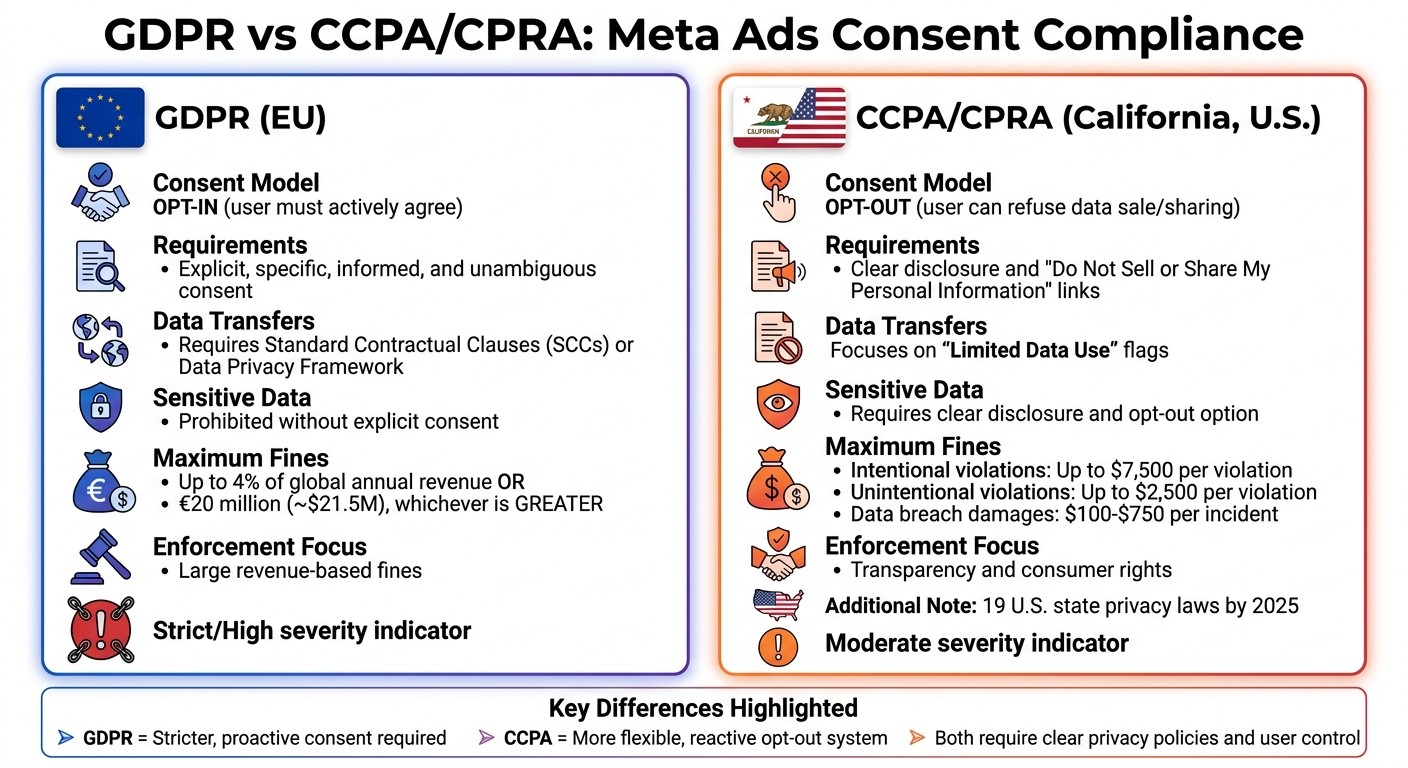
GDPR vs CCPA Meta Ads Compliance Requirements and Penalties
Clear legal frameworks shape how Meta and other advertisers must handle user consent for targeted ads, especially when operating across different regions.
GDPR Requirements for Advertisers
The General Data Protection Regulation (GDPR) establishes strict rules for managing personal data in the European Union. Under GDPR, consent must be freely given, specific, informed, and unambiguous - users must actively opt in to data collection. This applies to tracking methods like cookies and other tools used for ad targeting or analytics. Advertisers must implement robust consent mechanisms to ensure these tools remain compliant.
Failing to comply with GDPR can lead to severe penalties. Companies may face fines of up to 4% of their global annual revenue or €20 million (around $21.5 million), whichever is greater. For businesses processing significant amounts of user data across EU markets, even minor compliance issues can result in substantial financial risks, making it essential to follow best practices for Meta ad data privacy.
In contrast, U.S. privacy laws follow different consent models.
CCPA and New U.S. State Privacy Laws
The California Consumer Privacy Act (CCPA) and its updated version, the California Privacy Rights Act (CPRA), take a less stringent approach compared to GDPR. Instead of requiring users to opt in, these laws generally rely on an opt-out system. Businesses must clearly disclose data practices and offer mechanisms like "Do Not Sell or Share My Personal Information" links to allow users to decline targeted advertising.
By 2025, the U.S. will see 19 state-level privacy laws with varying requirements. States like Virginia and Connecticut require explicit opt-in consent for sensitive data, and for users under 16, explicit consent is mandatory. Additionally, Meta now acknowledges Global Privacy Control (GPC) signals from browsers, treating them as valid opt-out requests for logged-in users in applicable states.
Penalties for non-compliance differ based on intent. Intentional violations can result in fines of up to $7,500 per violation, while unintentional violations carry fines of up to $2,500. In cases of data breaches, affected individuals may seek statutory damages ranging from $100 to $750 per incident.
Compliance Aspect | GDPR (EU) | CCPA/CPRA (U.S. - California) |
|---|---|---|
Consent Requirement | Opt-in (Explicit, specific, informed) | Opt-out (Right to refuse data sale/sharing) |
Data Transfers | Requires SCCs or Data Privacy Framework | Focuses on "Limited Data Use" flags |
Sensitive Data | Prohibited without explicit consent | Requires clear disclosure and opt-out |
Enforcement Focus | Large fines based on global revenue | Emphasis on transparency and consumer rights |
The growing patchwork of state laws means Meta’s consent practices face increasing scrutiny.
Meta's Consent Problems in the U.S. and EU
In January 2026, Meta introduced a controversial "pay or consent" model, requiring users to either pay for ad-free services or agree to personalized ads. Critics argue that the language Meta uses in this model is biased, nudging users toward accepting personalized ads rather than presenting both options equally. This approach highlights the challenges Meta faces in balancing compliance with these diverse legal standards and regulatory risks across global markets.
Risks of Poor Consent Management in Meta Ads
Meta's legal troubles highlight the dangers of poor consent practices, which expose advertisers to legal, operational, and reputational risks. Mishandling consent not only violates laws but also disrupts business operations and damages brand trust.
Fines and Legal Liability
The financial consequences of poor consent management can be severe. For example, in May 2023, Meta Platforms, Inc. was hit with a €1.2 billion ($1.3 billion) fine by Ireland's Data Protection Commission. The penalty stemmed from transferring EU user data to the U.S. using Standard Contractual Clauses that failed to shield data from U.S. government access. Andrea Jelinek, Chair of the European Data Protection Board, emphasized the broader implications:
The €1.2 billion fine serves as a powerful warning to advertisers, signifying a major shift in enforcement across the industry.
Earlier that year, in January 2023, Meta faced another €390 million ($423 million) fine - €210 million for Facebook and €180 million for Instagram - for failing to secure explicit user consent for personalized ads. In total, European regulators issued over €2.92 billion in GDPR fines in 2024 alone.
Advertisers in the U.S. face their own challenges, with 19 state privacy laws expected to take effect by 2025. Navigating these varying regulations adds another layer of complexity to compliance efforts.
Compliance Costs and Operational Problems
Fines are just one piece of the puzzle. Poor consent management also leads to operational headaches. Meta, for instance, limits data access for businesses that fail to comply with its consent requirements and may even pause non-compliant campaigns. This can disrupt advertising efforts, resulting in wasted budgets and missed opportunities.
The impact on campaign performance is stark. Advertisers with strong consent frameworks can maintain over 80% conversion modeling accuracy. However, without proper consent or modeling, valuable data is lost, making it nearly impossible to optimize campaigns effectively.
Staying compliant across multiple jurisdictions is no small task. It requires ongoing investments in legal advice, system updates, and dedicated resources. These costs, combined with the risk of fines, create a significant financial burden for advertisers.
Damage to Brand Reputation and User Trust
The fallout from poor consent management extends beyond finances - it can also harm user trust and brand reputation. Confusing or manipulative consent prompts, designed to nudge users toward agreeing to personalized ads, often backfire. When users feel misled, their trust in both the platform and the advertisers diminishes.
Agustín Reyna, Director General of the European Consumer Organisation (BEUC), put it succinctly:
People deserve a real, fair choice, not another round of confusing prompts.
When users have negative experiences with consent mechanisms, they may associate those frustrations with the brands running the ads. This can lead to reduced customer loyalty, public backlash on social media, and even lower conversion rates, regardless of technical compliance. To avoid these pitfalls, advertisers must prioritize clear and fair consent practices, which we’ll dive into next.
How to Stay Compliant with Meta Ads
To navigate Meta ad compliance, you need to secure explicit consent, handle data responsibly, and maintain constant oversight. By putting the right systems in place, you can reduce legal risks while keeping your campaigns effective. These steps create a solid foundation for compliance within your Meta ad strategy.
Setting Up Proper Consent Mechanisms
Before you start tracking, users must give explicit, informed, and voluntary consent. Tools like Meta Pixel and Conversions API (CAPI) should remain inactive until users actively opt in. Forget pre-checked boxes or confusing language - your consent banners need to have clear "Accept All" and "Reject All" buttons, both equally visible. Additionally, users must be able to choose between tracking for analytics and personalized advertising.
Keep a detailed record of every consent action, including timestamps, user identifiers, and the permissions granted. This documentation is crucial given the current regulatory environment.
Your privacy policy should clearly identify both the advertiser and Meta as joint data controllers, outlining their specific responsibilities. To avoid legal issues, ensure the wording in your consent banners matches your privacy policy exactly. Using Meta Consent Mode can further help by requesting user permissions before activating tracking tools. Even if consent is denied, this mode supports privacy-friendly statistical modeling.
Using Server-Side Tracking
Pair your consent mechanisms with server-side tracking via the Conversions API for better data control. This method sends data directly from your server instead of relying on browser-based tracking, which ensures tighter security and keeps performance steady even when cookies are blocked.
If you're operating in sensitive industries like healthcare, disable "Advanced Matching" features and use only server-side tracking. This approach prioritizes securing data within your own infrastructure instead of depending on browser permissions.
Running Regular Audits and DPIAs
Regular audits and Data Protection Impact Assessments (DPIAs) are essential for staying ahead of legal requirements. DPIAs help identify and address privacy risks in your campaigns. During audits, ensure your consent logs are complete and tamper-proof. Use cryptographic methods to secure these records and create reliable audit trails that can stand up to regulatory scrutiny.
With European regulators issuing over $2.92 billion in GDPR fines in 2024 alone, and 19 U.S. state privacy laws in effect by 2025, compliance is becoming increasingly complex. Automated Consent Management Platforms (CMPs) with real-time updates and geo-targeted consent options can simplify managing these multi-jurisdictional requirements more effectively than manual processes.
Audits should also evaluate your data minimization practices. Only collect the data necessary for your campaigns - each additional data point increases your legal exposure. Regularly review which features you're using and whether they align with your advertising objectives.
Automation Tools for Consent and Compliance
Automation tools take consent protocols a step further by reducing human error and simplifying compliance across Meta ad accounts.
Managing consent manually across Meta ad accounts can lead to fines or account restrictions due to mistakes or slow responses to policy changes. Automation platforms tackle these challenges by keeping an eye on consent, reviewing creative elements, and instantly updating policies when needed.
Manual vs. Automated Consent Management
While manual consent mechanisms can reduce compliance risks, automated tools provide constant monitoring and faster responses to regulatory updates. Manual methods often depend on periodic audits and spreadsheet logs, which leave room for violations to slip through unnoticed. On the other hand, automated solutions like AdAmigo.ai work around the clock, flagging issues within minutes to avoid Meta ad rejections.
Compliance Process | Manual Approach | Automated Solution (e.g., AdAmigo.ai) |
|---|---|---|
Consent Tracking | Spreadsheet logs; prone to human error | Real-time automated monitoring and logging |
Creative Review | Manual audits (hours per campaign) | Instant AI-powered compliance scanning |
Data Usage | Quarterly manual audits | Continuous AI-driven data minimization |
Regulatory Updates | Manual policy reviews and updates | Automated alerts and instant adjustments |
Response Time | Days or weeks to adapt to changes | Minutes to hours for automated updates |
Meta’s Multimodal Ad Review System (MARS) processes most ads for compliance in under 60 seconds. In early 2026, 14% of all ad rejections on Meta were due to undisclosed AI-generated content. According to the AuditSocials Compliance Report:
Meta's 2026 policy cycle marks the transition from reactive enforcement... to proactive enforcement. The era of 'launch and see what happens' is over.
These advancements pave the way for tools like AdAmigo.ai to transform compliance management.
How AdAmigo.ai Maintains Compliance
AdAmigo.ai integrates directly with Meta's official API and compliance framework, ensuring all automated actions align with platform rules. Its AI Autopilot monitors ad accounts for compliance issues while also optimizing performance. When it detects issues - such as missing consent documentation or prohibited targeting - it either sends alerts or pauses non-compliant campaigns automatically, based on user preferences.
This real-time auditing reduces both workload and financial risks. AdAmigo Protect also tracks your account's health using Meta’s transparency score (0–100 scale). Accounts scoring below 25 risk "Restricted Delivery" status. The platform evaluates five key areas analyzed by Meta's MARS: text, visuals, audio, landing pages, and past violations. By catching problems early, it helps prevent costly penalties or account disruptions.
Additionally, AdAmigo.ai keeps detailed optimization logs, creating tamper-proof records that meet regulatory requirements during investigations.
Scaling Compliance for Agencies and Teams
Automation isn’t just for individual accounts - it’s a game changer for agencies managing multiple clients. Agencies face unique challenges due to varying consent laws across regions, industries, and campaign goals. AdAmigo.ai allows one media buyer to handle three to five times more clients by automating repetitive compliance tasks, all while upholding consistent standards across accounts.
The platform adjusts consent banners dynamically based on user location. For example, EU users see GDPR opt-ins, while Californians are presented with CCPA opt-outs. This geo-targeting ensures users see the right consent options without manual setup. For agencies, this means they can scale operations without increasing compliance risks or hiring extra staff to keep up with the 19 U.S. state privacy laws expected by 2025.
Conclusion
The risks tied to poor consent management in Meta ads are no small matter. Legal troubles, operational hiccups, and financial setbacks can derail your campaigns entirely. Non-compliance can lead to account suspensions, paused campaigns, and restricted data access - essentially bringing your marketing efforts to a grinding halt. Beyond potential fines, the inability to track and measure effectively can leave significant gaps in campaign performance. However, implementing proper consent frameworks, like Meta Consent Mode, can help maintain conversion modeling accuracy rates above 80%, even when users opt out of tracking.
Meta has been proactive in tightening its policies, introducing 47 updates in 2026 alone. The platform's Multimodal Ad Review System (MARS) now scans every ad, analyzing elements such as text, images, audio, and landing pages to ensure compliance. As highlighted in the AuditSocials Compliance Report:
Meta's 2026 policy cycle marks the transition from reactive enforcement... to proactive enforcement. The era of 'launch and see what happens' is over.
Keeping up with these changes manually is nearly impossible. Automated tools like AdAmigo.ai offer a solution by continuously monitoring campaign compliance, flagging issues in real time, and maintaining detailed audit logs. Thanks to its integration with Meta's official API, AdAmigo.ai ensures all actions are compliant while optimizing performance around the clock.
For agencies managing campaigns across different regions, automation simplifies compliance on a global scale. Tools that adjust consent mechanisms based on user location - offering GDPR and CCPA compliance for global visitors - make navigating multi-jurisdictional regulations far more efficient. By leveraging these technologies, businesses can stay compliant without adding unnecessary manual work.
FAQs
Do I need opt-in consent before using the Meta Pixel?
Yes, you need explicit opt-in consent before using the Meta Pixel. Under GDPR, Meta's advertising practices require clear and informed user consent for tracking tools like the Meta Pixel to align with privacy laws. Failing to manage consent properly can result in legal complications, making compliance a critical priority.
What’s the safest way to handle consent across the EU and U.S.?
Navigating consent laws can feel tricky, but sticking to regional legal guidelines is the best way to stay on track. In the EU, the GDPR requires that consent be explicit, opt-in, and specific. Many businesses rely on tools like Consent Management Platforms (CMPs) to ensure they're meeting these strict standards.
In the U.S., the focus shifts slightly. Transparency is key here - clear privacy policies and adherence to laws like the CCPA are essential.
To keep things running smoothly, consider automating your consent management processes and conducting regular audits. These steps can help you stay compliant and reduce the risk of legal issues.
How can I keep conversion tracking when users opt out?
To keep conversion tracking intact when users opt out, consider using server-side tracking methods such as the Conversions API. This method allows your server to send data directly to Meta, avoiding browser-based limitations and opt-out settings, all while adhering to privacy regulations.