
AI Audience Segmentation vs. Predictive Targeting
Compare AI audience segmentation and predictive targeting for Meta ads—uses, benefits, and when to combine them.
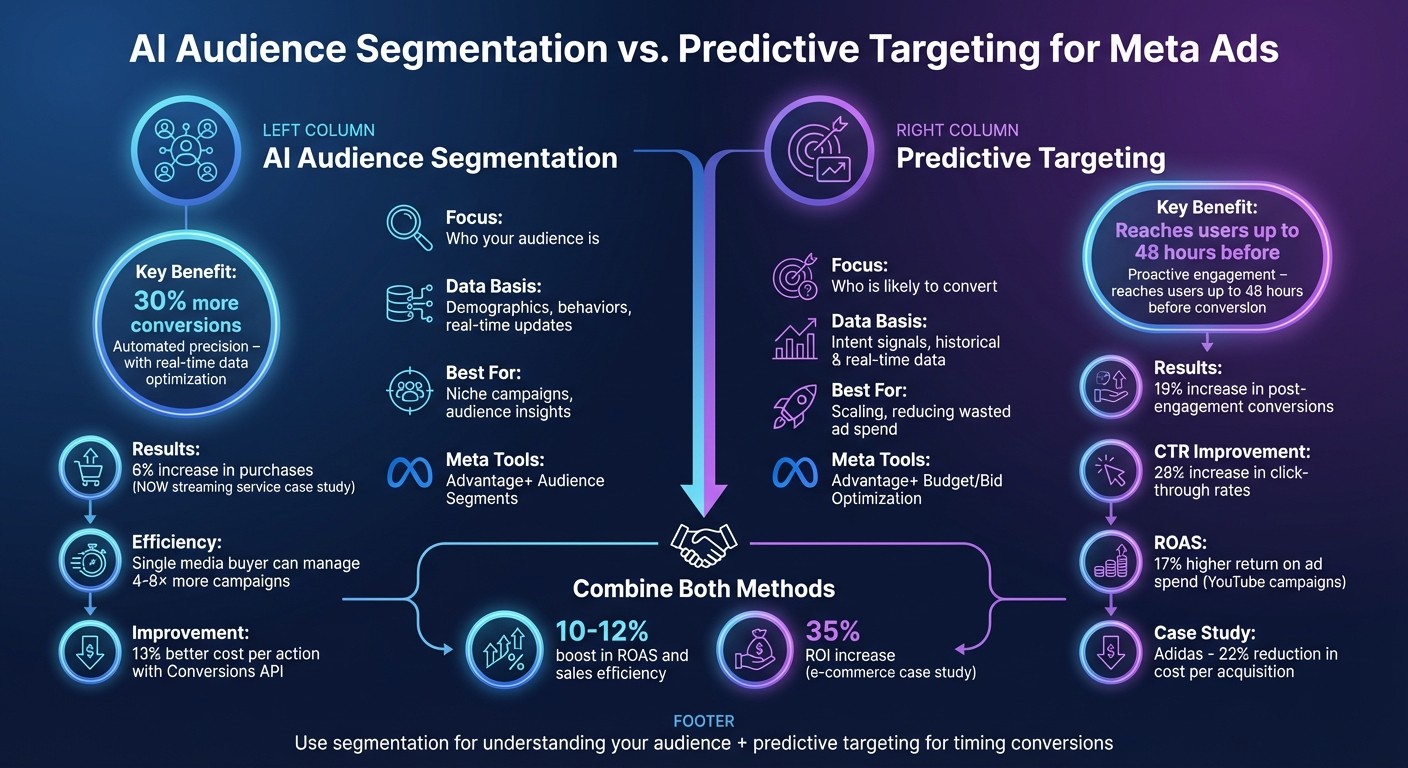
Want to improve your Meta ad performance? Two AI-driven strategies are changing the game: AI Audience Segmentation and Predictive Targeting. Both use machine learning to boost results, but they work differently:
AI Audience Segmentation: Groups users into micro-segments based on behaviors, interests, and demographics. It's about understanding who your audience is and targeting them with precision.
Predictive Targeting: Focuses on when users are likely to convert by analyzing intent signals and predicting future actions based on historical data.
If you're aiming for specific audience control, segmentation is the way to go. For scaling and optimizing ad spend, predictive targeting delivers results by prioritizing high-intent users. Combine these methods for better targeting, timing, and cost efficiency.
Quick Comparison
Feature | AI Audience Segmentation | Predictive Targeting |
|---|---|---|
Focus | Who your audience is | Who is likely to convert |
Data Basis | Demographics, behaviors, real-time updates | Intent signals, historical & real-time data |
Best For | Niche campaigns, audience insights | Scaling, reducing wasted ad spend |
Meta Tools | Advantage+ Budget/Bid Optimization |
Both methods work best with tools like Meta's Conversions API for better data signals and platforms like AdAmigo.ai for automation. Use segmentation for understanding your audience and predictive targeting for timing conversions.
AI Audience Segmentation vs Predictive Targeting for Meta Ads
Meta Ads Interest Targeting Is Changing!
As Meta evolves, leveraging AI-driven audience segmentation becomes essential for maintaining campaign precision. ###### sbb-itb-c2ebdc1
What Is AI Audience Segmentation?
AI Audience Segmentation uses machine learning to automatically group Meta users into highly specific clusters based on their behaviors, preferences, and demographics. These micro-segments uncover subtle patterns that human advertisers might overlook, enabling more targeted and effective campaigns.
The technology pulls data from various sources: the Meta Pixel and SDK track on-site behavior, while Meta itself collects insights from platform-wide activities like Reels views, page interactions, and product catalog engagement. Machine learning models, such as k-means and hierarchical clustering, analyze this data to classify users based on what they do and when they're most likely to act. Real-time updates - like browsing activity, video views, or cart abandonment - allow these segments to evolve dynamically, reflecting shifts in user intent.
"The big shift here is moving from static, assumption-based targeting to dynamic, data-driven audience engagement." - Evan Dunn, Head of Growth, Pixis
This approach delivers precision at scale - targeting users based on intent signals and serving them tailored ads at the right moment.
How AI Audience Segmentation Works for Meta Ads
Meta's AI segmentation system analyzes every interaction users have with your brand and the platform. It goes beyond demographics, focusing on behavioral velocity (how quickly someone moves from awareness to action) and psychographic signals like emotional triggers and engagement patterns.
Instead of relying on broad interest-based audiences like "women interested in fitness", the AI pinpoints micro-segments such as "users who watched workout videos in the past 48 hours, browsed activewear sites, and engaged with transformation stories." This level of detail ensures your ads are shown to people based on real intent, not generalized assumptions.
Meta's Advantage+ campaigns enhance this process by testing various audience combinations and reallocating budget to the best-performing segments. The AI system continuously refines its targeting using real-time performance data, leading to measurable results. For instance, companies leveraging real-time data optimization achieve 30% more conversions compared to those relying solely on historical data.
To get the most out of this technology, you can feed it value-based events through the Conversions API. Tracking actions like "Purchase" or "Predicted LTV" helps the AI prioritize users based on their long-term value, not just immediate actions. This method ensures your campaigns align with both short-term goals and long-term profitability.
Benefits of AI Audience Segmentation
The standout benefit is automated precision. AI handles the heavy lifting—automating your Meta ad campaigns by identifying high-performing segments, adjusting targeting, and reallocating budgets - so you can focus on creative strategy and broader campaign planning.
Efficiency is another major advantage. With AI tools for behavioral targeting, a single media buyer can manage 4-8× more campaigns compared to manual targeting. Real-time AI orchestration can improve overall ad efficiency by up to 42%.
AI also helps you uncover hidden opportunities. While traditional targeting is based on assumptions about your audience, AI reveals what your audience actually does. For example, NOW, a subscription streaming service, reported a 6% increase in purchases by running automated Advantage+ shopping campaigns alongside manual setups. Additionally, advertisers using Meta's Conversions API with the Pixel see an average 13% improvement in cost per action, thanks to the richer data signals that fuel the AI's decision-making.
Feature | Manual Targeting | AI Audience Segmentation |
|---|---|---|
Data Basis | Static demographics and broad interests | Dynamic behaviors, real-time intent, and historical CRM data |
Update Frequency | Manual/Periodic | Real-time/Continuous |
Precision | Broad personas (e.g., "Moms 25-34") | Micro-segments based on specific actions (e.g., "Recent hiking boot viewers") |
Effort | High manual research and testing | Automated discovery and optimization |
To get started, begin with broad targeting to give the AI enough data to work with. Regularly check your audience reports to identify overlaps, demographic trends, and conversion insights. Use parameters like location and language to maintain brand consistency while letting the AI optimize other variables.
What Is Predictive Targeting?
Predictive targeting uses machine learning to anticipate user actions - like purchases, sign-ups, or cart abandonment - by analyzing historical and real-time data.
This technology evaluates multiple data signals, such as engagement history, scrolling speed, click-through rates, and past conversion behavior, to identify early signs of intent. The result? Ads are delivered at the perfect moment - when curiosity turns into action.
"Predictive intelligence interprets user intent before it manifests, letting your campaigns align with decisions users haven't yet articulated." – Ihor Dervishov, Entrepreneur and Marketing Expert
Unlike AI audience segmentation, which focuses on analyzing past behaviors, predictive targeting forecasts future intent. Traditional targeting relies on broad categories, but predictive targeting hones in on users likely to convert within 48 hours. It’s a forward-thinking approach that prioritizes precision over generalization.
And it works. Advertisers using predictive timing for their campaigns have seen a 19% increase in post-engagement conversions in industries like retail and SaaS. Similarly, AI-powered YouTube campaigns have achieved a 17% higher Return on Ad Spend (ROAS) compared to manual efforts.
How Predictive Targeting Works for Meta Ads
Meta’s predictive models continuously process behavioral signals to identify users most likely to convert. These models analyze metrics like scroll velocity and engagement patterns to assign each user a probability score for taking action.
The system combines first-party data from tools like the Pixel and Conversions API with platform-wide signals - such as video watch time, Reels interactions, and product catalog engagement. Using techniques like logistic regression and clustering, it calculates a user’s likelihood to convert.
One of its standout features is real-time optimization. For example, if the system detects that a specific audience segment is most likely to convert between 8 PM and 11 PM, it can dynamically adjust AI bidding strategies and ad delivery during those hours.
To get the best results, ensure your data signals are accurate and reliable. Feeding high-quality first-party event data through the Conversions API allows the AI to make better predictions. Additionally, defining value-weighted segments can help prioritize users with higher predicted lifetime value.
Benefits of Predictive Targeting
The main advantage of predictive targeting is its ability to engage users before they make a decision. By reaching high-intent prospects up to 48 hours before conversion, advertisers gain a competitive edge over those relying on traditional methods.
This proactive approach drives better conversion rates. By zeroing in on users already leaning toward a purchase, brands can avoid wasting ad spend on uninterested audiences. For instance, dynamic AI targeting has led to a 28% increase in click-through rates (CTR), while predictive timing has boosted post-engagement conversions by 19%.
Another benefit is scalability. Predictive models can quickly identify lookalike audiences and micro-segments that resemble your most valuable customers. As the AI learns from live campaign data, it continuously fine-tunes its strategies.
"Real‑time AI orchestration can boost ad efficiency by up to 42%." – Neil Patel
Finally, predictive targeting minimizes wasted ad spend by identifying underperforming segments in real time. This ensures your budget is directed toward users most likely to engage, making your campaigns both efficient and effective.
Feature | Traditional Audience Targeting | Predictive Targeting (AI) |
|---|---|---|
Basis | Demographics, static personas, and "educated guesses" | Behavioral signals, intent patterns, and real-time data |
Adaptability | Static; requires manual updates to segments | Dynamic; learns and adapts in real time as behaviors shift |
Focus | Who fits a specific category (e.g., Age 25–34) | Who is showing signs they are ready to convert |
Timing | Reactive (based on past categories) | Proactive (anticipates future actions) |
Efficiency | Higher risk of wasted spend on broad segments | High cost efficiency by focusing on high-intent prospects |
This approach is a key component of full-funnel AI optimization for modern advertisers. Next, we’ll explore scenarios where predictive targeting outshines AI audience segmentation.
Key Differences Between AI Audience Segmentation and Predictive Targeting
This section breaks down how AI audience segmentation and predictive targeting differ in their approach and application.
The main distinction lies in focus and timing. AI segmentation groups users based on shared traits like demographics, interests, behaviors, or transactions. On the other hand, predictive targeting zeroes in on users who are most likely to convert, using browsing patterns, engagement history, and purchase behavior to make these predictions.
AI segmentation works by creating micro-segments of users with similar characteristics and keeps these groups updated in real-time. This method helps you understand who your audience is in granular detail.
Predictive targeting assigns a conversion probability to users, helping optimize ad spend by focusing on high-potential leads. Its strength lies in pinpointing who is most likely to take action.
Predictive models often combine data from multiple sources and work seamlessly across various platforms - search, display, social, video, and connected TV. This ensures consistent messaging and eliminates inefficiencies caused by fragmented campaigns, where the same user might be targeted differently across platforms. In contrast, AI segmentation typically operates within a single platform, often grouping users by intent to refine targeting.
Comparison Table: AI Audience Segmentation vs. Predictive Targeting
Here’s a side-by-side look at how these two methods compare:
Aspect | AI Audience Segmentation | Predictive Targeting |
|---|---|---|
Primary Focus | Grouping users by shared characteristics and behaviors | Predicting user intent and conversion probability |
Data Inputs | Demographics, interests, behaviors, transactions, psychographics | Browsing patterns, engagement history, purchase behavior, device type, time of day |
Optimization Approach | Real-time dynamic updates based on behavior changes | Conversion probability scoring and predictive modeling |
Core Advantage | Identifies who your audience is with granular detail | Identifies who is most likely to convert |
Targeting Precision | Broad, AI-optimized grouping into micro-segments | Highly specific, probability-based targeting |
Best For | Large-scale campaigns, quick optimizations, high ad budgets | Reducing wasted impressions, maximizing ROI, cross-channel consistency |
Meta Integration | Advantage+ Audience segments, Pixel, SDK, Catalog | Advantage+ Budget/Bid optimization, real-time performance trends |
Typical Results | Higher engagement rates |
Next, we’ll dive into when to use each method and how they can work together with tools like AdAmigo.ai to enhance campaign results.
When to Use AI Audience Segmentation vs. Predictive Targeting
Your campaign goals and available resources should guide your choice between manual and AI-powered management approaches. AI audience segmentation is the go-to option when you need precision and control. For example, launching a new product that requires highly targeted outreach benefits from segmentation, as it allows you to craft specific audience groups based on robust first-party data. This method gives you control over which data sources shape your targeting.
On the other hand, predictive targeting is ideal for efficient scaling. If you're entering a new market or trying to expand your reach while keeping acquisition costs in check, predictive models can pinpoint high-intent users - ones you might not have identified otherwise. This method relies on Meta's AI to handle discovery, which means you trade some control for broader reach. Below are examples of when each method works best.
Best Scenarios for AI Audience Segmentation
Segmentation is perfect when you have strong first-party data and need to connect with specific micro-audiences. For instance, it’s great for campaigns tailored to different stages of the customer journey. New visitors might see awareness ads, while cart abandoners receive retargeting ads showcasing the exact products they browsed. This method works especially well for niche audiences where customer profiles are clearly defined.
Keep in mind that segmentation requires a healthy budget to perform effectively. Meta suggests a minimum daily spend of $50 to ensure each audience group exits the learning phase with sufficient exposure. However, if your goal is rapid scaling, predictive targeting might be the better fit.
Best Scenarios for Predictive Targeting
Predictive targeting is your best bet when the goal is to boost conversions without the need to manually fine-tune every audience detail. It’s particularly effective for scaling campaigns that are already performing well. The AI analyzes patterns among your high-value customers and uses that data to find similar users across Meta's ecosystem. For example, Adidas utilized predictive conversion modeling to identify likely buyers up to 48 hours before their peak interest, cutting their cost per acquisition by 22%.
This approach also shines when you’re short on time for managing campaigns. Brands using automated Advantage+ shopping campaigns with predictive AI have reported incremental increases in purchases, making it a time-efficient way to drive results.
Combining AI Audience Segmentation and Predictive Targeting for Meta Ads
Using Both Methods Together
Pairing AI audience segmentation with predictive targeting creates a powerful strategy for Meta ads. Segmentation helps you pinpoint high-value audiences by grouping users based on their behavior and demographics. Predictive targeting, on the other hand, forecasts when and how likely these groups are to convert. Together, these methods give you precise control over defined audience groups while harnessing Meta's AI to find similar high-intent users across the platform. This synergy also lays the groundwork for smoother bid management and creative testing as your campaign progresses.
This combined strategy enhances value-based optimization by focusing on high-LTV (lifetime value) cohorts identified through segmentation instead of relying solely on broad conversion data. Meta's AI then targets users predicted to generate more revenue, not just those likely to click.
Another advantage is reducing wasted ad spend. Predictive analytics can identify at-risk segments or low-intent users, enabling you to exclude them or adjust bids before overspending. Meanwhile, segmentation ensures your creative messaging stays relevant, with predictive AI fine-tuning which ad variations resonate best in real time. Adding server-side signals to this mix allows for even more precise audience calibration.
To fully capitalize on this approach, leverage server-side signals through Meta's Conversions API. By feeding high-quality data from offline conversions and CRM events, you can refine both segmentation and predictive models. Defining value-weighted cohorts based on predicted LTV and linking them to event parameters enables the algorithm to prioritize high-margin customers.
Campaigns that integrate these AI-driven methods have been shown to boost ROAS (return on ad spend) and sales efficiency by 10% to 12% as part of a broader ROI optimization strategy. This combination paves the way for more streamlined and effective campaign execution.
Tools Like AdAmigo.ai for AI-Driven Audience Strategies
AdAmigo.ai Capabilities
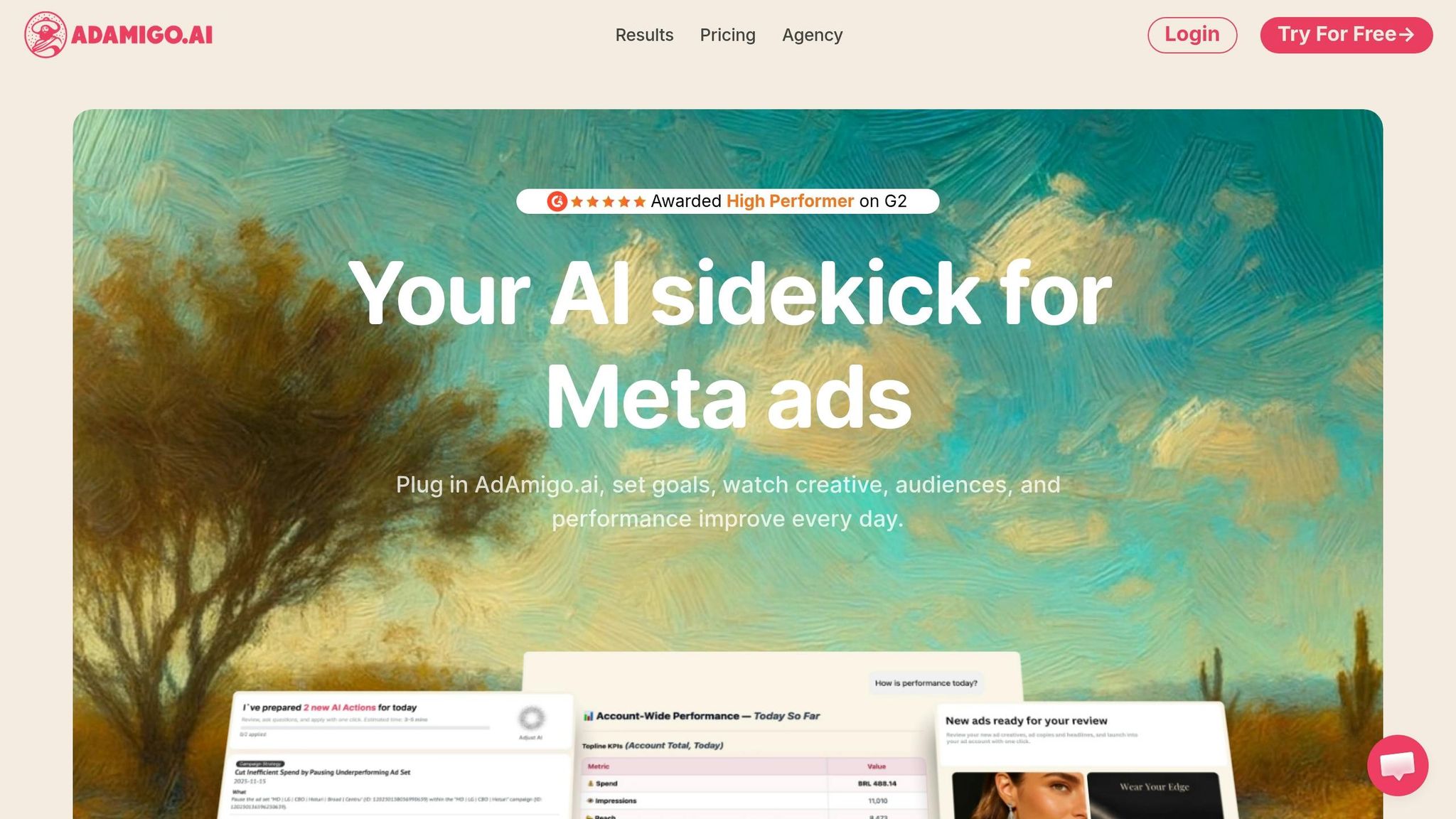
AdAmigo.ai, a Meta Business Technology Partner, combines AI audience segmentation and predictive targeting into one streamlined platform. Forget juggling multiple tools or spending hours on manual testing - this system can launch hundreds of ads and audience segments in just seconds.
One standout feature is the AI Action Agent, which evaluates your account daily and offers optimization recommendations complete with forecasts. It doesn’t just tell you what to tweak - it explains why and predicts the results. As one G2 reviewer put it, “It handles everything from [comparing AI vs manual audience creation to adjusting budgets in seconds](https://www.adamigo.ai/blog/bulk-ad-testing-predictive-analytics), saving significant time”.
For segmentation, the AI Chat Agent simplifies complex strategies. You can create lookalike audiences and execute campaigns using either text or voice commands. The platform also includes an Autopilot mode, which dynamically reallocates budgets to high-performing segments in real time.
Another key feature is AI Protect, which uses multiple AI agents to monitor your accounts around the clock. It flags spending anomalies and performance issues before they affect your ROAS. This is especially helpful when testing new audience segments or scaling campaigns. Users have reported noticeable improvements, with Rochelle D. sharing, “Our budgets are controlled, our spend is being smartly allocated and our ROAS is up massively”. AdAmigo.ai shows how AI-driven tools are reshaping both audience segmentation and predictive targeting.
Comparison Table: AdAmigo.ai Features for Both Approaches
Here’s a breakdown of how AdAmigo.ai supports AI audience segmentation and predictive targeting:
Feature | AI Audience Segmentation Support | Predictive Targeting Support | Meta Ads Benefits |
|---|---|---|---|
AI Action Agent | Refines targeting strategies based on performance. | Delivers daily recommendations with impact forecasts. | Focuses on high-ROAS opportunities using data insights. |
Bulk Ad Launcher | Launches hundreds of ads across diverse audience segments. | Optimizes ad delivery with AI enhancements. | Speeds up campaign deployment, saving time for strategy. |
AI Chat Agent | Creates lookalike audiences and executes strategies via commands. | Identifies optimization trends through comprehensive account audits. | Simplifies execution for all skill levels. |
AI Protect | Monitors audience segments for errors or disabled ads. | Detects anomalies and suspicious activity 24/7. | Protects budgets by addressing issues proactively. |
Conclusion
AI audience segmentation and predictive targeting serve distinct purposes in digital advertising. AI audience segmentation focuses on grouping users based on behavior, helping you tailor ads to specific audiences. Predictive targeting, on the other hand, identifies high-conversion prospects and optimizes ad delivery timing for better results.
Your choice between manual vs. AI budget testing and these targeting methods should align with your campaign objectives. If you're aiming for brand awareness or top-of-funnel discovery, segmentation offers the granular control needed to ensure the right people see your ads. For bottom-of-funnel conversions, where minimizing wasted ad spend is key, predictive targeting is the way to go. For example, a global e-commerce retailer saw a 35% ROI increase by using AI-driven predictive analytics to deliver personalized ads.
The real magic happens when you combine both approaches. Using segmentation to define audience groups and predictive targeting to time and focus your budget can lead to impressive outcomes - like a 30% boost in conversions and a 22% reduction in cost per acquisition. While segmentation tells you who your audience is, finding new audience interests through AI helps expand that reach, predictive analytics determines when they’re most likely to act.
Success with either strategy hinges on the quality of your data. Following Meta conversion data compliance best practices and using tools like Meta's Conversions API can improve cost per action by an average of 13%, thanks to reliable first-party data replacing less dependable browser signals. Defining value-weighted segments also helps predictive models adjust budgets during peak engagement periods, reinforcing the importance of clean, actionable data.
Platforms like AdAmigo.ai streamline this entire process, automating both segmentation and predictive optimization within a single system. By selecting the right AI strategy, you can ensure better data quality, smarter budget allocation, and real-time adaptability for your campaigns.
FAQs
What data do I need to start AI segmentation or predictive targeting?
To get started with AI segmentation or predictive targeting, you'll need to gather relevant data - think historical customer behaviors, preferences, and interactions. This data allows AI to spot patterns, define segments, and predict future actions. Adding real-time data takes things a step further, as it reflects current user behavior, making predictions more precise.
Some key data points to focus on include:
Past engagement metrics: How users interacted with your content or products in the past.
Demographics: Age, location, income level, and other defining characteristics.
Behavioral patterns: Purchase history, website activity, or app usage trends.
Behavioral signals: Indicators that help the AI anticipate needs and tailor personalized strategies.
By combining these elements, AI can craft dynamic targeting approaches that feel tailor-made for each segment.
How do I know which method is improving my ROAS?
To figure out which approach boosts your ROAS, start by monitoring key metrics, including how your ROAS shifts over time. Predictive targeting leverages data to fine-tune bids, understand audience behaviors, and enhance creative performance. On the other hand, audience segmentation zeroes in on connecting with the most relevant users. Platforms like AdAmigo.ai offer ongoing insights and adjustments, making it easier to compare your ROAS before and after implementing these strategies to gauge their impact.
When should I combine both approaches in one Meta campaign?
To achieve pinpoint accuracy and streamlined efficiency in your Meta campaigns, consider blending AI audience segmentation with predictive targeting. Here’s how it works:
AI audience segmentation uses real-time data to pinpoint specific audience groups based on their behaviors, preferences, and demographics.
Predictive targeting goes a step further by forecasting future behaviors and fine-tuning your strategies accordingly.
When you bring these two together, you unlock the ability to deliver highly personalized content, make real-time adjustments, and improve your ROI. This combination helps you focus on the right audiences, optimize ad bids, and scale up the most effective segments seamlessly.