
Ad Set Synergy vs. Individual Scaling: Key Differences
Compare ABO (individual ad set budgets) and CBO (ad set synergy): pros, cons, when to test or scale and optimization tips.
When running Meta ad campaigns, choosing between manual vs AI-powered management through Individual Scaling (ABO) and Ad Set Synergy (CBO) is critical. Each approach has unique benefits and challenges that can shape your results. Here's the quick breakdown:
Individual Scaling (ABO): You manually assign budgets to specific ad sets. Best for testing, precise control, and niche targeting. However, it requires more time and effort, risks audience overlap, and struggles with fragmented data. (See how to avoid common mistakes in bulk testing to protect your budget.)
Ad Set Synergy (CBO): Budgets are automatically distributed across the campaign by Meta's algorithm. Ideal for scaling proven campaigns efficiently with less manual work. But it sacrifices granular control and may lead to uneven budget allocation.
Quick Comparison
Factor | Individual Scaling (ABO) | Ad Set Synergy (CBO) |
|---|---|---|
Budget Control | Full manual control | Automated, algorithm-driven |
Best Use Case | Testing and niche targeting | Scaling and broad targeting |
Time Investment | High, requires constant monitoring | Low, automation reduces manual effort |
Audience Overlap | Higher risk | Lower risk |
Optimization Speed | Slower due to fragmented signals | Faster with consolidated data |
For most campaigns, start with ABO for testing, then transition to CBO for scaling. Use tools like AdAmigo.ai to simplify management and improve results.
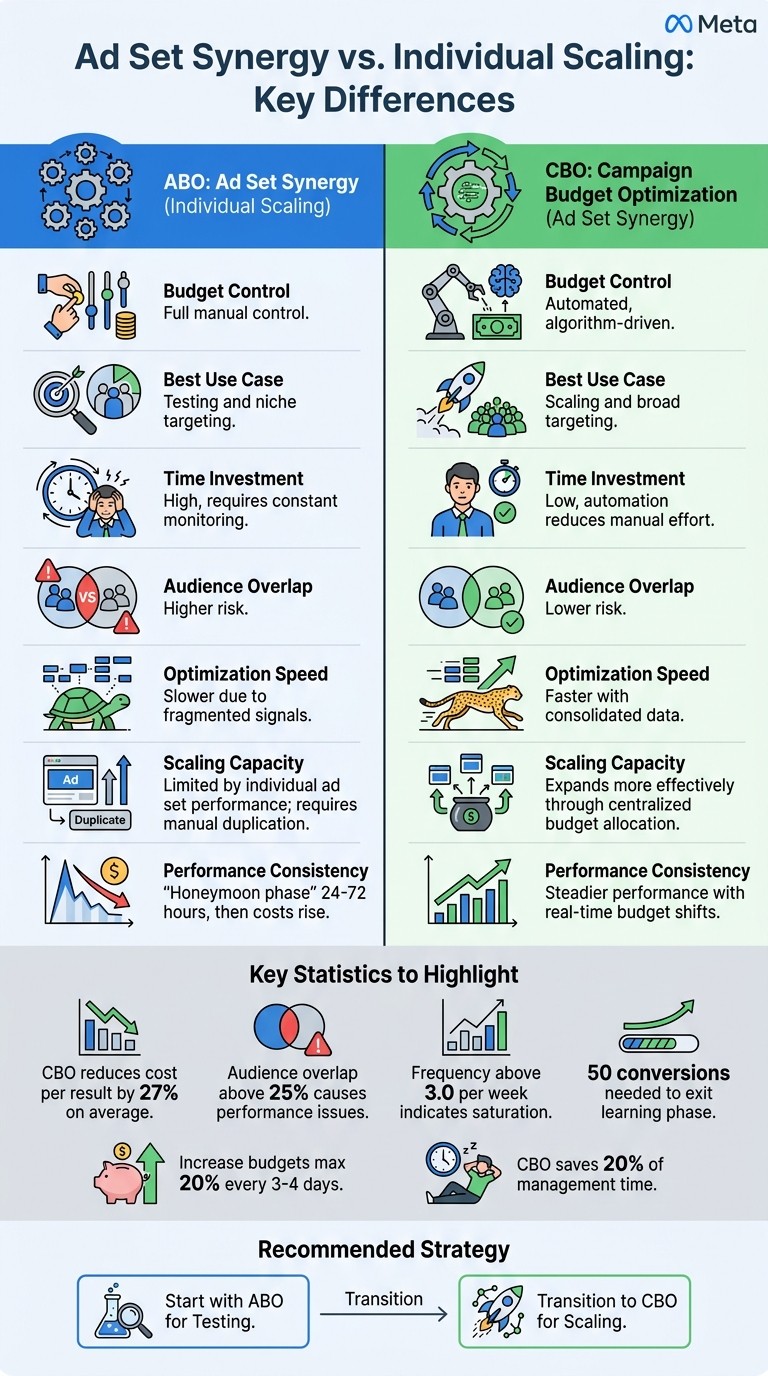
Individual Scaling (ABO) vs Ad Set Synergy (CBO) Comparison Chart
Facebook Ads ABO vs CBO In 2026
What is Individual Scaling?
Individual scaling is a hands-on budgeting strategy where you assign a specific budget to each ad set using Ad Set Budget Optimization (ABO). Instead of relying on algorithms to shift funds automatically, this approach gives you full control over how much money goes to each ad set. Think of each ad set as its own mini-campaign, making this method especially useful for testing and tracking performance. Once you've identified top-performing ad sets, you can increase their budgets gradually - a tactic called vertical scaling.
"Many experienced media buyers prefer ABO when scaling because it provides more control. You can deliberately allocate budget to specific audience segments, ensure adequate testing across all ad sets, and prevent Meta from prematurely deciding which audiences are 'winners.'" - AdStellar AI
Patience is critical for vertical scaling. Meta’s algorithm needs about 50 conversions per ad set to exit the learning phase. If you increase budgets too quickly, it can reset the learning phase, potentially hurting your results.
While vertical scaling focuses on increasing investment in successful ad sets, horizontal scaling takes a different approach. It involves duplicating a winning ad set to target new, similar audiences - like different age groups or locations. This helps avoid audience saturation while expanding your reach.
Benefits of Individual Scaling
Individual scaling gives you precise control over your budget, which is a big win for advertisers. You can decide exactly how much to allocate to each audience segment. This is particularly helpful when testing new markets or experimenting with different creative ideas. Since each ad set operates independently, performance tracking becomes simpler, allowing you to gather clear insights for decision-making. For businesses targeting niche markets, this method works well because it lets you optimize campaigns for specific product lines or customer groups.
Drawbacks of Individual Scaling
The biggest downside to individual scaling is the time and effort it takes. Managing multiple ad sets with separate budgets requires constant oversight and manual adjustments. As your campaigns grow, keeping track of everything can become overwhelming unless you have dedicated tools or a team to help.
Another hurdle is audience overlap. If multiple ad sets target similar users, they end up competing against each other in Meta's auction, driving up costs. When overlap exceeds 25%, it often leads to performance issues.
There’s also the risk of learning signal dilution. Spreading your budget across too many ad sets can prevent any single one from gathering enough data to optimize effectively. This can leave ad sets stuck in a "Learning Limited" state, unable to hit the 50-conversion milestone needed to exit the learning phase.
Lastly, watch out for high frequency levels. If your ad frequency exceeds 2.5 to 3.0 within a week, it’s a sign that your audience is being overexposed. In such cases, simply boosting the budget won’t help. Instead, you’ll need to refresh your creatives with multi-format assets or expand your targeting.
What is Ad Set Synergy?
Ad set synergy is an approach where multiple ad sets work together as a cohesive system, rather than functioning as separate entities. Instead of manually adjusting budgets for individual ad sets, synergy relies on automation to manage budgets across the entire campaign. This is often done through Campaign Budget Optimization (CBO), where you assign a single budget for the campaign, and the system automatically allocates it among the ad sets.
The main difference between individual scaling and synergy lies in how budgets are managed. With individual scaling, each ad set is treated separately. In contrast, synergy connects them into one system, allowing the algorithm to monitor performance and shift budgets to the best-performing audiences, creatives, or placements in real time. This automated process improves overall campaign performance without requiring constant manual adjustments.
One of the standout benefits of synergy is how it minimizes internal auction competition. When ad sets are managed individually with separate budgets, they can end up competing against each other for the same impressions - especially if audience overlap exceeds 25%. This unnecessary competition increases costs. By treating the campaign as a unified system, synergy helps the algorithm avoid this issue.
Benefits of Ad Set Synergy
Ad set synergy offers several advantages that can make campaigns more efficient and effective:
Dynamic Budget Reallocation: The algorithm continuously shifts budgets in real time, moving funds away from underperforming segments and toward areas showing better results. For example, if you're targeting similar audiences - like different age groups in the same region - the system can allocate more to the most active segment at any given moment.
Avoiding the Scaling Paradox: With individual ad sets, increasing budgets too quickly is one of the vertical scaling mistakes to avoid that can reset the Meta Ads learning phase, leading to unpredictable results. Synergy avoids this by spreading budget increases across multiple ad sets. Following the 20% rule - increasing the total campaign budget by no more than 20% every 3–4 days - helps maintain stability.
Effortless Horizontal Scaling: Instead of manually duplicating successful ad sets to reach new audiences, a synergistic campaign naturally tests and funds new segments as they show potential. This ensures your top-performing ad sets don’t become oversaturated while still expanding your reach.
Drawbacks of Ad Set Synergy
While ad set synergy has clear benefits, it does come with some challenges:
Less Granular Control: You lose the ability to control exactly how much budget goes to specific audiences or creatives. The algorithm prioritizes short-term performance, which might not always align with your broader business goals. For instance, it may focus on established markets that deliver quick results while underinvesting in newer regions that need more time to grow.
Budget Misallocation Risks: The algorithm’s focus on immediate performance can lead to uneven budget distribution, a common challenge when comparing AI vs manual audience creation. It might heavily favor one or two ad sets while neglecting others, even if those underfunded ad sets target important strategic audiences. Without advanced tools to monitor this, you could miss key insights into your campaign’s performance.
Creative Fatigue: High-frequency exposure can lead to audience saturation, especially if your frequency exceeds 3.0 per week. At higher spending levels, creative fatigue happens faster, requiring fresh content every 3–5 days to maintain efficiency. If these issues aren’t caught early, your campaign could waste money on overexposed audiences.
Ad set synergy offers a streamlined, automated way to manage campaigns, but it requires careful oversight to avoid pitfalls like budget misallocation and creative fatigue. Balancing automation with strategic monitoring is key to making this approach work effectively.
Individual Scaling vs. Ad Set Synergy: Side-by-Side Comparison
Now that we've explored how these strategies operate, let's put them head-to-head. The table below highlights the critical differences across five key factors that influence campaign management and scaling.
Comparison Table
Factor | Individual Scaling | Ad Set Synergy | Key Difference |
|---|---|---|---|
Scaling Capacity | Limited by how well each ad set performs; requires manual duplication to grow | Expands more effectively through centralized budget allocation across the campaign | Synergy leverages combined performance data, scaling faster without redundant ad sets. |
Performance Consistency | Often sees a "honeymoon phase" lasting 24–72 hours before costs rise and results drop off | Maintains steadier performance with real-time budget shifts toward top-performing ads | Synergy avoids the sharp performance fluctuations common with duplicated ad sets. |
Time Requirements | High; needs constant manual monitoring and ad set prioritization | Low when automated; manual vs AI budget testing determines how algorithms handle optimization continuously | Individual scaling demands hands-on effort, while synergy runs efficiently with minimal oversight. |
Audience Overlap Risk | High; duplicated ad sets frequently compete against each other in the same auction, driving up costs when overlap exceeds 25% | Low; the algorithm ensures delivery coordination as a single unit, preventing internal competition | Synergy eliminates the hidden cost of bidding against yourself. |
Optimization Speed | Slower; fragmented learning signals across multiple campaigns hinder progress for individual ad sets | Faster; consolidated data allows the algorithm to learn and optimize more effectively | Synergy speeds up optimization by treating the campaign as one cohesive system. |
This breakdown makes the strategic differences between the two approaches clear. While individual scaling often struggles with internal competition and inconsistent performance, ad set synergy provides a more stable and efficient path to growth.
Individual scaling relies heavily on manual adjustments and can suffer from rapid performance drops. On the other hand, synergy’s unified approach allows for faster scaling and steadier results. For instance, when ad frequency exceeds 3.0 weekly, individual scaling's inefficiencies become more apparent. By integrating ad sets, synergy reduces these challenges and keeps campaigns running smoothly.
When to Use Individual Scaling vs. Ad Set Synergy
Deciding between individual scaling and ad set synergy depends on your campaign's stage and how much time you can dedicate to managing it. There's no one-size-fits-all answer - it’s about aligning the method with your needs.
When Individual Scaling Works Best
Individual scaling (also known as ABO) gives you tight control over your budget, making it a great choice for testing new audiences or sticking to strict spending limits. If you're experimenting with creative variations and bulk testing or targeting niche groups, ABO ensures your budget stays focused on each test, without the algorithm reallocating funds away from your experiments.
This method is particularly useful for managing client accounts with diverse performance goals. However, it requires careful oversight. For instance, you’ll need to watch frequency closely and manually pause ad sets if the cost per acquisition (CPA) exceeds the target by 50% for more than two hours.
When duplicating successful ad sets, remember to allocate a higher budget to avoid audience overlap. Once your campaign has clear performance targets, though, transitioning to a more automated approach can improve efficiency.
When Ad Set Synergy Works Best
Ad set synergy (CBO) simplifies campaign management by relying on automation to handle budget allocation. It’s ideal for scaling campaigns that are already performing well or for managing broad targeting across multiple audiences. By letting the algorithm distribute budgets automatically, you can focus on higher-level strategy rather than fine-tuning individual ad sets. On average, this approach reduces the cost per result by 27% compared to manual allocation and speeds up the learning phase by optimizing across the entire campaign.
This method shines when you’ve already identified strong-performing creatives and audiences. Instead of juggling multiple ad sets, Meta’s algorithm dynamically shifts budgets to the best performers in real time. It’s especially effective for campaigns targeting large, diverse groups, where the algorithm can identify high-performing segments that manual allocation might overlook. That said, keep an eye on frequency limits and consider switching methods if they’re exceeded.
While ad set synergy can save around 20% of the time spent on management, it may not work as well for slow-starting audiences that need dedicated budgets to reach their potential. For campaigns where strict budget control is a priority, individual scaling remains the more reliable option.
Tools for Managing Ad Set Synergy: AdAmigo.ai
To truly harness the benefits of ad set synergy, managing it effectively is critical.
Handling synergy manually can be overwhelming - it involves juggling budgets, creatives, audiences, and bids across multiple ad sets. That’s where AdAmigo.ai (https://adamigo.ai) steps in. This AI Media Buyer automates the process by treating your Meta campaigns as a single, interconnected system rather than isolated components.
What sets AdAmigo.ai apart is its dynamic adaptability. Instead of relying on static rules, it continuously analyzes campaign performance, your brand identity, and even competitor ads. It then generates new creatives that maintain consistency across your campaigns. Advertisers using AdAmigo.ai have reported impressive results, including a 22% increase in ROAS and a 25% reduction in acquisition costs, thanks to its real-time optimization capabilities.
Key Features for Ad Set Synergy
AdAmigo.ai is packed with tools designed to simplify and enhance ad set synergy:
AI Ads Agent: Creates fresh ad variations to combat creative fatigue, ensuring your campaigns stay engaging and effective.
AI Actions: Provides a daily, prioritized to-do list, suggesting impactful adjustments across creatives, audiences, budgets, and bids. It doesn’t just react to past data - it identifies and acts on opportunities in real time.
Bulk Ad Launch: Allows you to launch dozens or even hundreds of Meta ads at once directly from Google Drive, ensuring consistency across large-scale tests.
AI Chat Agent: Offers instant answers to questions like “why” and “what next,” and even lets you launch campaigns through a conversational interface.
Together, these tools create a streamlined, unified optimization process that adapts to your needs.
Why AdAmigo.ai Works Well for Synergy
Traditional scaling methods often treat ad sets as separate entities, which can lead to audience overlap and fragmented results. AdAmigo.ai eliminates this issue by taking a connected approach - optimizing creatives, targeting, bids, and budgets as a cohesive system. This reduces the risk of learning phase resets and ensures that adjustments in one area don’t disrupt overall performance.
The platform’s efficiency also allows a single media buyer to manage 4–8 times more client accounts compared to manual strategies. Whether you prefer a fully autonomous setup or want to approve each change manually, AdAmigo.ai ensures compliance with your rules while continuously improving performance.
Conclusion: Choosing the Right Strategy for Your Campaigns
There's no universal strategy that works for every campaign. The right choice depends on your specific goals and the stage of your campaign. For instance, individual scaling (ABO) offers precise control, making it ideal during the testing phase when clean data on specific audiences or creatives is crucial. On the other hand, ad set synergy (CBO) shines during scaling, allowing Meta's algorithm to allocate your budget dynamically to the best-performing ad sets.
A smart approach is to use a hybrid strategy: start with individual scaling to validate your audiences and creatives, then shift to ad set synergy for optimized growth. This way, you maintain control early on while leveraging the algorithm's efficiency as you scale.
When scaling, it's important to manage budgets carefully. Increase budgets by no more than 20% every 3–4 days to avoid disrupting Meta's learning phase. Also, keep an eye on frequency - if it exceeds 3.0 per week, pause underperforming ads and refresh your creatives immediately. This helps prevent ad fatigue from tanking your performance.
To make this process smoother, automated campaign pausing and other automation tools can save you a lot of time and effort. Platforms like AdAmigo.ai (https://adamigo.ai) can automate campaign management by treating your campaigns as a unified system. Whether you prefer complete automation or want to review every change, the platform adapts to your preferred workflow, helping you manage campaigns efficiently.
FAQs
When should I switch from ABO to CBO?
Start with ABO (Ad Set Budget Optimization) during your testing phase. This approach gives you full control over individual ad set budgets, making it easier to experiment with different audiences or creatives. By doing so, you can identify which combinations perform best.
Once you've pinpointed your top-performing ad sets, it's time to transition to CBO (Campaign Budget Optimization). With CBO, Meta’s algorithm takes over budget allocation, automatically directing funds to the best-performing ad sets. This shift not only helps you scale more efficiently but also reduces the need for constant manual adjustments, saving time and effort while improving overall performance.
How do I avoid audience overlap when scaling?
When scaling Meta ad campaigns, keeping audience overlap in check is key. Overlap happens when your ad sets target the same people, causing them to compete against each other in auctions. Here's how to prevent that:
Segment Your Audiences: Break your audience into smaller, well-defined groups. This ensures each ad set focuses on a unique segment, reducing internal competition.
Leverage Meta's Tools: Use Custom Audiences to target people who've already interacted with your brand, and Lookalike Audiences to find new users similar to your existing customers. These tools help you reach distinct groups.
Monitor Targeting Regularly: Keep an eye on your targeting settings to ensure ad sets aren't overlapping. Adjust as needed to stay efficient.
Try Campaign Budget Optimization (CBO): CBO automatically allocates your budget across ad sets based on performance. This not only streamlines your budget but also minimizes overlap.
By focusing on these strategies, you can scale your campaigns effectively while keeping your targeting sharp and your ads performing at their best.
What metrics tell me to refresh creatives or change strategy?
Key performance indicators like ROAS (Return on Ad Spend), CPA (Cost Per Acquisition), CTR (Click-Through Rate), conversion rate, and frequency can provide valuable insights into when it's time to tweak your creatives or refine your strategy. For instance, if you notice a sharp decline in ROAS or a noticeable increase in CPA, it might be a sign to take action. Keeping a close eye on these metrics ensures your campaigns stay on track and continue delivering results.