
Top Vertical Scaling Mistakes to Avoid
Most Meta ad scale-ups fail from common mistakes—scale only with solid data, gradual budget increases, refreshed creatives, and daily monitoring.
When it comes to scaling Meta ads, many marketers make costly mistakes that can derail campaign performance. 73% of scaling attempts fail in the first week due to common pitfalls like increasing budgets too fast, neglecting ad fatigue, or scaling without enough data. Vertical scaling - boosting ad spend on proven campaigns - can drive growth, especially when scaling Meta ads with real-time updates, but only if done carefully. Here’s a quick breakdown of the most frequent mistakes and how to avoid them:
Scaling too early: Wait until campaigns exit the learning phase (50 conversions in 7 days).
Overnight budget jumps: Stick to small increases (10–25% every 2–3 days).
Ignoring ad fatigue: Rotate 3–5 ad variations to prevent performance drops.
Poor targeting: Avoid overly narrow or broad audiences; separate prospecting from retargeting.
Too many ad sets: Focus on fewer, high-performing campaigns to avoid algorithm confusion.
Pausing too soon: Temporary cost spikes are normal; give campaigns time to stabilize.
Scaling requires patience, data-driven decisions, and consistent monitoring. By avoiding these mistakes, you’ll improve your Return on Ad Spend (ROAS) while minimizing risks.
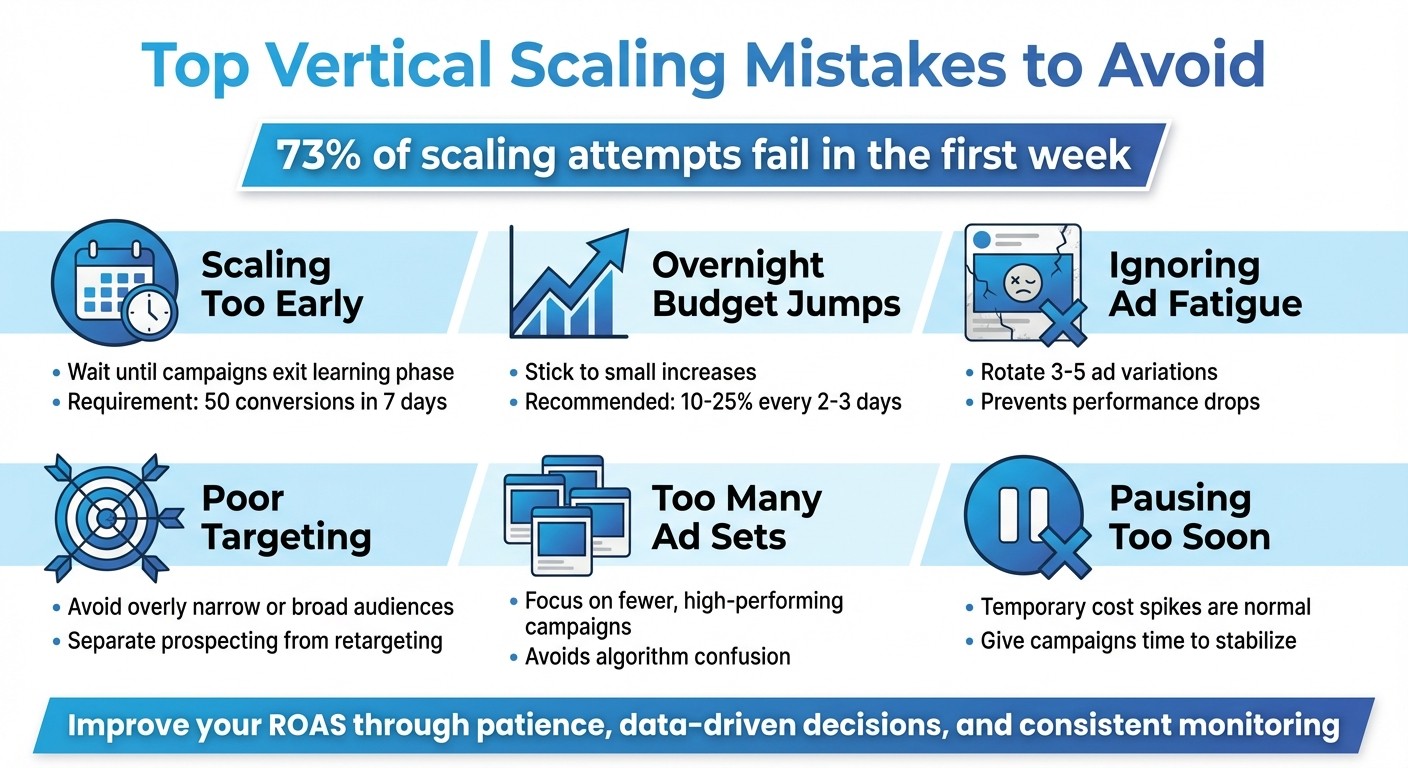
Top 6 Meta Ads Vertical Scaling Mistakes and How to Avoid Them
How to Scale Meta Ads in 2025
Effective scaling strategies for seasonal ad sets often require a mix of approaches. While vertical scaling focuses on budget vs. audience expansion and efficient budget management, you should also consider horizontal scaling strategies to reach new audiences using interest-based targeting using audience data for growth.
1. Scaling Before Your Test Data Is Complete
One common mistake that can derail campaign performance is ramping up budgets too soon - before the algorithm has had enough time to gather the data it needs for effective ROI optimization. Meta's machine learning system typically requires about 50 optimization events within a seven-day period to exit the learning phase. During this phase, performance can be unpredictable, and scaling too early can disrupt the optimization process entirely.
When you scale based on incomplete data, you risk misinterpreting random fluctuations as meaningful performance signals. For example, if a campaign shows a 6.2 ROAS but is based on only 12 conversions, that figure might just be statistical noise. To mitigate this, advertisers often use bulk ad testing to gather broader performance insights more quickly. Increasing the budget at this stage often leads to inefficiency, as results tend to regress toward a lower average. This is why many scaling efforts fail within the first week - there simply isn't a stable foundation of reliable data to support them.
To avoid this pitfall, ensure the campaign meets specific stability benchmarks and tests key variables before scaling. Implementing full-funnel AI optimization can further stabilize performance by automating these checks. These include:
Exiting the learning phase for at least seven days
Maintaining a ROAS within a 15% range over 30 days
Achieving a Pixel match quality score above 7.0
Keeping ad frequency below four by implementing AI frequency control
2. Raising Budgets Too Fast
Once your campaign moves past the learning phase, how you scale Meta ad budgets becomes just as important as when you do it. A drastic change - like a sudden 150% jump overnight - can cause major issues. As AdAmigo.ai puts it, "That 150% overnight budget increase? You just reset the algorithm's optimization, forcing it to relearn delivery patterns while your costs spike and efficiency tanks".
Large, abrupt budget increases throw off the algorithm. It has to recalibrate ad delivery, rethink audience targeting strategies, and adjust automated bidding strategies. The result? Higher costs and fewer conversions.
To avoid this, stick to the 20% rule: increase your budget by 10–25% every 2–3 days. For smaller budgets, like under $50/day, doubling the spend might not cause much disruption. But once you're spending more than that, smaller, gradual increases are a must. For example, if your campaign is running at $500/day with stable performance, you could raise it to $600/day, wait three days, and then increase to $720/day if metrics remain steady. This slow, steady approach allows the algorithm to adapt without compromising efficiency or overexposing your ads.
Keep an eye on frequency. If it climbs above 3.0–4.0, stop increasing the budget and refresh your creatives. Gradual budget increases not only help avoid major disruptions but also reduce the risk of creative burnout.
Speaking of burnout, higher budgets can wear out your ads faster. A video ad that performs well for two weeks at $500/day might only last five days at $2,000/day. To maintain your ROAS, plan to rotate in fresh creatives more often as you scale up.
3. Not Updating Creatives While Scaling
When scaling ad campaigns, failing to refresh your creatives can lead to audience fatigue fast. That ad that crushed it at $500 daily? It might not hold up when you bump the spend to $2,000. As one expert puts it, "Creative fatigue accelerates with increased spend. Your hero video ad that performed beautifully for 14 days at $500 daily? Scale to $2,000 and watch it burn out in 5 days as frequency spikes and audience response drops" [3\].
Here’s why: higher budgets mean more people see your ad more often, and that repetition can quickly turn into overexposure. As frequency rises and click-through rates (CTR) drop, costs climb, and conversions take a hit. Relying on one standout creative puts your campaign at serious risk - if that ad loses its edge, your entire budget could tank. In fact, 73% of scaling attempts fail within the first week due to issues like creative burnout.
The fix? Have 3–5 tested creatives ready to go before scaling. Instead of starting from scratch every time, use a creative matrix. Break your winning ad into parts - like the hook, body, and call-to-action - and tweak each element to create variations. A new opening line, a different background, or a fresh testimonial can keep your campaign feeling fresh without a full overhaul. Just as gradual budget increases help maintain return on ad spend (ROAS), rotating creatives helps avoid audience fatigue.
Keep a close eye on your metrics. If your ad frequency goes above 3.0 and CTR drops below 1%, it’s time for new creatives. Also, diversify your formats to include a mix of static and video assets. Mix product shots, lifestyle images, and videos with user-generated content (UGC). Authentic testimonials and UGC often perform better under high frequency compared to polished brand ads. Balancing these creative elements requires a strategic blend of AI and human management to maintain efficiency at scale.
4. Using Poor Targeting Combinations
If your targeting strategy is off, scaling your ad budget can quickly drain your resources. Narrow targeting limits your audience too much, leading to higher ad frequency and inflated costs. On the other hand, overly broad targeting sends your ads to people who have no interest in your product or service. Both approaches waste money and hurt your return on ad spend (ROAS).
One common mistake is layering too many interests or sticking to a tight 1% Lookalike audience. When you try scaling this setup - say, from $500 to $2,000 per day - you burn through your audience fast. Ad frequency spikes, cost per acquisition (CAC) rises, and performance plummets. On the flip side, if you launch campaigns with little to no targeting filters, your budget gets eaten up by clicks from users who are unlikely to convert.
Another misstep is combining prospecting and retargeting in the same campaign. This muddles your CAC data and wastes money re-engaging existing customers or recent visitors. Essentially, you’re paying to show ads to people you’ve already reached, when that money could be better spent finding new prospects.
The Fix: Smarter Targeting
Broad targeting can actually work in your favor if done right. Meta’s algorithm is designed to find high-intent buyers, and recent studies show that broad targeting - focusing only on age, gender, and location - can deliver 113% higher ROAS compared to Lookalike audiences. Using Advantage+ placements can also slash your CAC by 50% and reduce your cost per click (CPC) by 150%.
Here’s how to make it work:
Avoid over-complicating your targeting with excessive manual filters.
Let the algorithm do the heavy lifting by identifying users based on actual purchase behavior.
Exclude current customers and recent visitors from prospecting campaigns.
Keep prospecting and retargeting campaigns separate to accurately measure acquisition costs.
5. Running Too Many Ad Sets at Once
When scaling vertically, the focus should be on increasing budgets for successful campaigns, not managing a flood of ad sets. A common mistake marketers make is scaling Meta ads with bulk launching dozens of ad sets simultaneously, thinking that more tests will lead to quicker results. But this strategy often backfires. It fragments your data, pits ad sets against one another, and spreads your budget so thin that individual ad sets struggle to leave the learning phase.
This fragmentation disrupts the algorithm's ability to optimize. If your budget is scattered across too many ad sets, none of them will likely hit the required 50 conversions within seven days. This results in erratic performance and higher costs. It's a phenomenon often referred to as "learning phase chaos", where campaigns experience unstable delivery and inflated expenses. In fact, 73% of scaling attempts fail within the first week when campaigns are overly complex.
Another problem is auction overlap. When your campaigns target similar audiences, your ads end up competing against each other in the same auction, wasting budget and driving up costs unnecessarily. Essentially, you're bidding against yourself.
The solution? Simplify your Meta ad account structure. Just like with managing budgets and creatives, focusing on fewer, high-performing ad sets allows the algorithm to work more efficiently. Combine similar audiences into fewer ad sets to give Meta's algorithm clearer signals to analyze Meta ad metrics and optimize. Using Campaign Budget Optimization (CBO) can also help, as it automatically reallocates your budget in real time to maximize performance, while automated campaign pausing can protect your spend on underperforming sets. Additionally, keep an eye on the Auction Overlap section in Ads Manager and review your frequency reports weekly. If your frequency goes above 3.0, it’s a sign that your audience pool is too small for the number of ad sets you’re running.
Vertical scaling is most effective when you're spending between $1,000 and $3,000 per day on a handful of proven winners. Keep things straightforward, give the algorithm time to learn, and avoid the temptation to launch too many ad sets at once.
6. Moving to CBO at the Wrong Time
Jumping into Campaign Budget Optimization (CBO) too early can lead to higher costs and a drop in your return on ad spend (ROAS). Many marketers make the mistake of moving their ad sets into a CBO structure after seeing early success, assuming it will automatically scale their results. Unfortunately, this often backfires, causing performance to nosedive.
"Scaling a campaign in learning phase is like accelerating while the engine is still warming up - you'll damage performance." - AdStellar.ai
To avoid these pitfalls, ensure your campaign data is solid before making the switch. Here’s what to look for:
Your campaign should be out of the learning phase, which means achieving at least 50 conversions per week.
ROAS should remain consistent, staying within a 15% range for at least 30 days.
Event Manager match quality scores should be above 7.0. This requires real-time conversion tracking via the Conversions API.
You should have 3–5 creatives that are consistently performing well.
If these metrics aren’t in place yet, stick with manual budget adjustments at the ad set level until your campaign stabilizes.
"Campaign Budget Optimization (CBO) campaigns scale more reliably than ad set budget campaigns because Meta can redistribute spend dynamically." - AdStellar.ai
Once your campaign data is stable, CBO becomes a powerful tool. By allowing Meta to dynamically allocate your budget, you can set the foundation for more effective scaling.
7. Editing Campaigns During the Learning Phase
Once you've tackled budget management and creative updates, there's another crucial misstep to avoid: editing campaigns during the learning phase. This is when the algorithm is actively gathering data and fine-tuning delivery. This is one of the primary reasons why advertise on meta is so effective—the platform's AI-driven optimization is powerful, but it requires stability to work. Making changes during this time can completely derail your scaling efforts. Why? Because every edit forces the system to start over.
"By editing an ad, ad set or campaign during the learning phase, you reset learning and delay our delivery system's ability to optimize." - Meta Business Help Center
Even small adjustments - whether it's changing creatives, targeting, optimization events, or increasing the budget by more than 20–30% - will reset the algorithm. This can lead to a 25–40% increase in CPA and disrupt ROAS. Even minor tweaks, like edits while ads are still under review, can trigger resets, keeping your campaigns stuck in learning mode and wasting your budget.
To avoid these setbacks, wait until your ad sets display an "Active" status in the Delivery column before making changes. If you want to test new creatives or targeting options, create separate ad sets instead of altering existing ones. Using a bulk launch workflow can help you manage these tests efficiently without disturbing active campaigns. This way, you protect the progress your campaigns have already made while still exploring fresh opportunities.
8. Scaling Without a Working Funnel
Trying to scale a campaign without a functional funnel is a losing game. Pouring more money into something that doesn’t convert won’t magically fix the problem - it just burns through your budget without delivering results.
Start by ensuring your funnel is solid. This means setting up tools like the Meta Pixel and Conversions API to track critical events. Aim for a landing page conversion rate between 2–5% and make sure your unit economics work in your favor. For example, maintaining a Media Efficiency Ratio (MER) with an Average Order Value (AOV) above $40 is key. You can use an ad performance benchmark tool to see how your metrics stack up. If your AOV falls below $40, scaling vertically becomes much harder to make profitable.
"Scaling a weak campaign is like building a skyscraper on sand - it collapses under its own weight." - AdStellar
Once your tracking, landing page performance, and unit economics are in good shape, it’s time to structure your funnel for targeted outreach. Proper segmentation is essential. Using AI audience profiling can help identify these segments more accurately. Allocate 70–80% of your budget to cold audiences (Top of Funnel) and 20–30% to retargeting efforts (Middle and Bottom of Funnel). To avoid wasting money, make sure warm audiences are excluded from your cold campaigns. A great example of this strategy in action: Digital Silk worked with AutogenAI in 2025 to refine their funnel messaging and targeting. Over a three-month period, they increased leads by 48% and cut the cost per acquisition by 68%.
Before scaling, do a thorough check. Audit your Event Manager tracking and debug conversion issues to ensure accuracy, confirm your landing page can handle 5–10× the traffic, and make sure your Return on Ad Spend (ROAS) stays within a 15% range over a 30-day period. Once everything checks out, your funnel is ready for the next level. You can also use an AI media buyer to automate these optimizations and scale more efficiently.
9. Ignoring Organic Content and Social Proof
Trying to scale without social proof is like asking someone to trust a stranger - it’s a tough sell. When you duplicate a successful ad but leave behind its likes, comments, and shares, you’re essentially starting over. Cedric Yarish from admanage.ai explains it best: "Your scaled version starts from scratch, looking about as trustworthy as a 'Make Money Fast' scheme".
Here’s why this matters: Ads with existing social proof - those likes, comments, and shares - can boost click-through rates by 40–100% compared to fresh ads. Reusing social proof when targeting new audiences can also slash your cost per acquisition by up to 50%. Plus, Meta’s Engagement Rate Ranking tends to favor ads with higher engagement, creating a cycle where engaged ads perform better and keep improving.
So, what’s the solution? It’s simpler than you might think. When duplicating a winning ad, use the "Use Existing Post" feature in Ads Manager to keep all the engagement intact. You can also build initial social proof by targeting your past customers or email subscribers - these are people more likely to engage positively.
Another effective trick is social stacking. By using the same Post ID across multiple ad sets, you consolidate engagement, making your ads appear even more popular. This is especially useful when scaling to different audiences or regions and addressing common performance issues. Don’t forget to manage comments - hide spam and respond to genuine questions to foster trust. To streamline these tasks, you can use an AI copilot for Meta ads to automate optimization.
Organic-style content is another secret weapon. User-generated content, testimonials, and short-form videos (under 15 seconds) tend to hold up better during scaling than polished brand ads. For example, new ads without engagement often struggle to hit a 0.5% click-through rate, but ads with built-up social proof can achieve CTRs between 0.7% and 1.0%. By weaving organic engagement into your strategy, your scaled campaigns can maintain credibility and drive stronger results.
10. Not Checking Performance Metrics Daily
Skipping daily performance reviews during scaling can lead to missed opportunities and unchecked issues. As you increase budgets, Meta's algorithm can behave unpredictably, and creative fatigue may set in faster than expected. What works well with smaller budgets might collapse under the pressure of rapid scaling.
Here’s the reality: Meta’s algorithm typically needs about 50 conversions per week to stabilize and exit the learning phase. Without enough data, decisions can be based on random fluctuations rather than real trends. On top of that, 73% of scaling attempts fail within the first week due to structural weaknesses that could have been caught with daily monitoring. Keeping a close eye on performance metrics helps you spot these problems early.
So, what should you be looking at? Focus on these key performance indicators:
Frequency: If the frequency for cold audiences hits 3–4, it’s a sign of oversaturation.
CTR (Click-Through Rate): A drop in CTR often points to creative fatigue.
CPA (Cost Per Acquisition): A sudden rise in CPA after increasing your budget suggests the algorithm is struggling.
Conversion Rate: If your CTR is steady but conversions are dropping, your landing page might not be delivering on the ad’s promise.
Dive into your data daily. Break it down by age, gender, device, and placement to identify areas where your budget might be wasted. Also, check for "Auction Overlap" to make sure your ad sets aren’t competing against each other, which can drive up costs unnecessarily. If you’re consistently hitting your target CPA, you’re likely ready to scale further. If not, pause and investigate before throwing more money into the campaign.
Meta ads budget automation rules and tools can make this process much easier. Platforms like AdAmigo.ai can streamline monitoring by using "Stop Loss" tactics to pause underperforming ad sets, preventing wasted budgets. Their AI Actions feature provides a daily list of prioritized tweaks for your creatives, interest-based audiences, budgets, and bids. You can either approve these changes manually or let the system handle them automatically, ensuring your campaign stays on track.
11. Expecting Smooth, Predictable Growth
Scaling your campaigns vertically is rarely a straightforward process. When you increase budgets, don’t expect immediate, steady results. Instead, you may notice temporary spikes in your cost per acquisition as the algorithm adjusts to the new budget. During the learning phase, the algorithm is still refining its strategy, often requiring AI tools for Meta ad account analysis to identify performance shifts, which can lead to unpredictable fluctuations in performance.
Another factor to watch out for is the illusion of early success. An initial boost in performance might just be statistical noise rather than a reliable indicator of long-term trends. As you scale, results often settle at more realistic levels. Plus, creative fatigue can kick in faster - ads that perform well with smaller budgets might lose their impact in just a few days when spending ramps up significantly.
Increasing your budget also impacts auction dynamics. With Meta bidding more aggressively at higher budgets, you’ll often face higher average costs per click or view.
To manage scaling effectively, take a gradual approach. Aim to increase your budget by only 10–20% per week, giving the algorithm enough time to adjust. Before making additional changes, ensure your campaign has been running consistently for at least seven days outside of the learning phase. You can also A/B test Meta Ads conversion rules to find the most stable scaling parameters. Keep an eye on your ad frequency (ideally below 3.0) and rotate between 3–5 different creative variations using a dynamic creative optimization checklist to avoid over-relying on a single ad. Expect some natural fluctuations and give the system the time it needs to optimize.
12. Relying Only on Vertical Scaling
Focusing solely on vertical scaling isn’t a complete strategy. Increasing the budget on a single ad set might seem like an easy way to boost results, but it has limits. As you pour more money into the same audience, you eventually hit saturation. This approach speeds up creative fatigue and drives up both CPAs and CPCs because you're repeatedly targeting the same group of people.
Another major issue is risk concentration. Relying heavily on vertical scaling puts all your eggs in one basket. If that single ad set starts to underperform - whether due to creative fatigue, audience saturation, or a frequency metric climbing above 4 - it can drag down your entire campaign. At some point, performance will plateau, and no matter how much budget you add, you won’t see additional growth from that audience segment.
"Horizontal scaling is considered a safer approach compared to vertical scaling, as it minimizes the risk of performance drops when significantly increasing budgets." – PPC Panos
To address these challenges, it’s crucial to integrate horizontal scaling into your strategy. This means diversifying your efforts to reduce risk and reach new audiences. A balanced approach combines vertical scaling with horizontal expansion. For example, you can increase budgets on high-performing ad sets while also duplicating them to explore new audiences - such as fresh lookalikes, scaling Meta ads with behavioral clustering, or untapped geographic regions. Using AI audience segmentation can help identify these high-potential pockets more efficiently. A good rule of thumb is to allocate 15–30% of your budget to testing new segments, while keeping the majority focused on proven winners. If performance starts to plateau in top-tier regions, try using broader regional segmentation to reach new prospects in areas you haven’t yet saturated.
While vertical scaling can drive quick growth, horizontal scaling ensures your performance doesn’t stall over time. Together, they create a more sustainable and balanced strategy.
13. Pausing Campaigns When Costs Spike Temporarily
When you're scaling ad campaigns, temporary cost spikes are part of the process, so hitting the pause button right away might do more harm than good. Cost-per-acquisition (CPA) increases or return on ad spend (ROAS) dips are common as the algorithm adjusts to new budgets. The key here is patience - abruptly pausing campaigns can disrupt the algorithm's ability to optimize effectively using historical data.
Scaling budgets often pushes the algorithm to explore new audience segments using AI tools, which naturally takes time to stabilize. For instance, a 20–40% dip in ROAS during scaling can actually indicate progress. Imagine scaling a campaign from $10,000 at a 4× ROAS to $50,000 at 2.5× ROAS. While the ROAS drops, your monthly profit jumps from $30,000 to $93,750 - a clear win. These temporary cost spikes are simply part of the growth equation.
As PPC Panos wisely puts it:
"Performance may fluctuate initially, so patience is key during the scaling process." – PPC Panos
Rather than pausing the campaign, consider pausing additional budget increases for a few days to allow the algorithm to stabilize, or set specific KPIs and rules for your AI media buyer to follow. Another option is to use tools like Cost Caps or ROAS Goals in your bidding strategy. These settings automatically adjust spending if costs rise above your set threshold, helping you manage your budget without constant manual oversight.
If you notice frequency climbing above 3.0–4.0 alongside rising costs, the problem might not be scaling - it could be creative fatigue. In this case, testing and refreshing your creatives is a smarter move than pausing the campaign altogether.
Admetrics sums it up perfectly:
"Your goal isn't maintaining perfect ROAS at all costs. Instead, focus on profitable ways to increase total spend and revenue." – Admetrics
This strategy ties back to the broader principle of making gradual adjustments rather than abrupt campaign interruptions. To simplify this process, you can scale your performance using AI-driven media buying tools.
How AI Tools Like AdAmigo.ai Can Help
Scaling ad campaigns can be tricky, especially when you're dealing with Meta's constantly changing algorithms. Mistakes often happen because manual monitoring can't keep up, leading to missed performance signals or late adjustments. Tools like AdAmigo.ai step in to solve these problems with Meta ads automation with real-time, 24/7 optimization. It keeps an eye on budgets, creatives, and targeting, making adjustments as needed without missing a beat.
One standout feature is AI Actions, which simplifies campaign management. Every day, it scans your account and offers a prioritized list of tweaks to make. For example, it might pause an ad set that's overspending during its learning phase or suggest refreshing a creative that's starting to underperform. You can either approve these suggestions with one click or let the system handle them automatically.
AdAmigo.ai also tackles creative fatigue, a common scaling issue, with its AI Ads Agent. Here's how it works:
It studies your brand identity while keeping an eye on competitors.
It automatically generates fresh, on-brand image and video ads, ensuring a constant stream of creative assets.
This automation fills the gaps where manual adjustments often fall short, making scaling much smoother.
Aspect | AI Automation (AdAmigo.ai) | |
|---|---|---|
Time Investment | Daily hands-on management | Concise, daily recommendations |
Creative Production | Dependent on design teams | Auto-generates on-brand creatives |
Budget Optimization | Periodic, reactive adjustments | Real-time, data-driven adjustments |
Audience Research | Manual competitor analysis | Continuous monitoring and scaling lookalike audiences |
Learning Curve | Requires deep Meta expertise | Beginner-friendly with expert-level results |
These features directly address the scaling hurdles we talked about earlier. For agencies managing multiple clients, AdAmigo.ai allows one media buyer to handle 4–8× more accounts by automating execution while maintaining strategic control. In-house teams benefit in a similar way. The AI learns from real campaign results, improving over time. You can set parameters like budget caps, geographic rules, and ROAS targets, and the system will stick to them while optimizing every aspect - creatives, targeting, bids, and budgets - as a unified process.
Conclusion
Vertical scaling can seem simple, but it’s easy to make mistakes when handling budgets, creatives, and Meta's learning algorithm. The errors we’ve highlighted - such as scaling too soon without enough data, increasing budgets too aggressively, overlooking creative fatigue, often solved by dynamic creative optimization, or tweaking campaigns during the learning phase - are responsible for 73% of scaling failures within the first week. These missteps often result from impatience or a lack of real-time insights, emphasizing the need for a disciplined, data-focused approach.
To succeed, prioritize meaningful metrics like CPA, ROAS, and Marketing Efficiency Ratio instead of superficial numbers. Aim for a Meta Pixel match quality score above 7.0, and ensure you’re capturing at least 50 conversions per week before scaling. Double-check your tracking setup and app event mapping and give Meta's algorithm a full seven days to stabilize after making budget adjustments.
It’s worth noting that 90% of Meta ad performance issues stem from marketer errors, not flaws in the algorithm. Managing multiple campaigns manually is not only time-consuming but also prone to oversight. Automation rules for scaling can be a game-changer here. For instance, you can set time-based rules to manage performance during specific hours. Tools like AdAmigo.ai can simplify tasks like budget pacing, creative rotation, and audience monitoring. With AI that learns from actual results, one media buyer can manage 4–8× more accounts effectively.
The key to successful vertical scaling lies in letting data guide your decisions. Stick to structured scaling, refresh your creatives regularly, and practice patience. Following a Meta Ads scaling checklist can help ensure you don't miss critical steps. By consistently applying these strategies, you’ll set yourself up for success while staying aligned with the best practices outlined in this guide.
FAQs
What are the dangers of scaling Meta ads too fast?
Scaling Meta ads too quickly can lead to a range of problems that can derail your campaign’s success. For starters, you might notice higher costs as the algorithm struggles to adjust to the rapid changes. Audience saturation can also become an issue, limiting your reach and reducing the effectiveness of your ads. On top of that, creative fatigue can set in, leading to lower engagement rates. Perhaps most importantly, rushing the process can disrupt the algorithm’s learning phase, making it harder to maintain steady performance and hit your desired return on ad spend (ROAS).
The key to avoiding these setbacks? Take it slow. Scaling incrementally while keeping a close eye on performance metrics is essential. Tools like AdAmigo.ai can make this process smoother by automating optimizations, testing fresh creatives, and maintaining a healthy balance across budgets, targeting, and bids. This way, you can scale your campaigns effectively without compromising your results.
What’s the best way to avoid ad fatigue when scaling budgets?
Keeping your ads fresh and engaging is key to avoiding ad fatigue as you scale your budgets. One effective way to do this is by rotating your ad creatives and messaging regularly. This ensures your audience isn’t bombarded with the same ads over and over, which can lead to disinterest or even annoyance.
When it comes to scaling your budget, take it slow and steady. Increase your ad spend by 10-25% every few days. This gradual approach helps maintain algorithm stability and prevents overwhelming your audience with a sudden surge in ad exposure.
To expand your reach, consider strategies like:
Lookalike audiences: Target people who share similarities with your existing customers.
Interest-based targeting: Focus on users with specific interests relevant to your product or service.
Testing new geographic areas: Explore untapped regions to find new prospects.
For larger campaigns, tools like AdAmigo.ai can be a game changer. They automate tasks like creative updates, audience targeting, and budget adjustments, helping you keep your campaigns optimized without constant manual input.
By combining gradual budget increases, creative rotation, and audience expansion, you can effectively minimize ad fatigue and keep your campaigns running smoothly.
Why do you need a strong data foundation before scaling Meta ads?
A solid data setup is key to successfully scaling Meta ads. Why? Because reliable data ensures your campaigns are fine-tuned for performance. Without it, scaling too fast can trigger issues like algorithm resets, audience burnout, or higher costs.
When you focus on stabilizing your data upfront, you give Meta’s algorithm the clarity it needs to pinpoint effective strategies, sharpen targeting, and keep things efficient as your budget grows. This method lets you scale with confidence while steering clear of expensive pitfalls.