
Meta Ad Variations: AI Testing Framework
Compare three AI-driven Meta ad testing frameworks—3-3-3, high-velocity, and full autopilot—to improve ROAS and speed iterations.
Meta ad performance now hinges on structured testing, not guesswork. With AI managing targeting and bidding, ad quality directly impacts ROI - up to 56% by 2026. Random testing can tank results, but structured frameworks prevent wasted budget and ensure better outcomes.
Key frameworks for testing Meta ad variations:
Pilothouse 3-3-3: Tests 3 concepts, formats, and variations. This approach is a foundational step for AI-powered creative scaling. Ideal for smaller budgets; balances manual effort with AI for better results.
Segwise High-Velocity: Focuses on speed, testing 20–50 variations weekly using AI. Best for high-budget accounts ($100k+ monthly).
AdAmigo.ai AI Autopilot: Fully automated, handles everything from ad creation to optimization. Increases efficiency and scales campaigns for all budgets.
Key benefits:
Structured testing boosts ROAS — Meta Ads ROAS benchmarks by industry show 28% improvements.
AI tools cut iteration time by 40%.
Prevents performance drops from random testing.
Choose the right framework based on your budget, team size, and need for automation. Smaller budgets benefit from Pilothouse’s precision, while larger accounts thrive with Segwise or AdAmigo’s automation.
Copy This Meta Ads Testing Strategy for Better Results
1. Pilothouse 3-3-3 Framework
The Pilothouse 3-3-3 Framework simplifies creative testing into three layers: three messaging concepts, three ad formats, and three tactical variations. This structure keeps advertisers from feeling overwhelmed by untested ideas while giving Meta's algorithm enough data to identify what works best.
Here's how it works: Start by testing three distinct messaging angles - like comparing transformation stories to expert credibility - rather than making small tweaks to one idea. Once a clear winner emerges, test it across three formats (such as static images, short-form videos, and carousels). Finally, refine the top-performing combination with three tactical variations, adjusting elements like headlines, calls-to-action, or visuals.
This method focuses on impactful changes rather than superficial tweaks. Research shows that testing core messaging and formats can improve ROAS by 3–8×, while minor changes, like button colors, rarely deliver meaningful results.
Test Velocity
The framework ensures testing aligns with your budget. For accounts spending $100–$200 daily, it suggests testing 3–6 new creatives each week. Higher-budget accounts (over $1,000 daily) can scale up to 10–15 weekly tests. This balance prevents the algorithm from being overloaded and ensures each creative gets enough data to move past the learning phase.
Automation Level
This system blends manual strategy with AI-driven automation. Following an AI-driven creative testing checklist can help streamline this process. While you oversee high-level concepts and maintain brand consistency, AI tools handle tactical variations. This hybrid approach speeds up campaign iterations by up to 40% compared to manual testing alone.
Creative Iteration
Creative fatigue is identified when your CPA rises 15–20% above baseline for two consecutive days or when ad frequency exceeds 3–4. To counter this, the 3-3-3 framework uses systematic refresh cycles. Winning themes are updated with fresh executions, ensuring a steady flow of effective creative variations.
Scalability
The framework adapts to different budget sizes while maintaining its core structure. Smaller accounts (spending $100–$200 daily) typically run two testing ad groups alongside one Business-as-Usual (BAU) group. Larger accounts (spending over $1,000 daily) can manage multiple testing tracks at once. Successful creatives transition into the BAU rotation, with budgets reallocated to support continued performance.
Next, we’ll dive into another framework tailored for rapid creative iteration across key pillars.
2. Segwise High-Velocity Testing Framework
The Segwise framework takes a fast-paced, high-volume approach to creative testing. Unlike Pilothouse's structured, layered method, Segwise focuses on speed and quantity. Using AI, it generates a large number of creative variations from a single brief, quickly identifying top performers. This process includes creating multiple headlines, body copy options, and image concepts. Predictive models then filter out weaker variants early on, saving budget by avoiding investment in underperforming options. This rapid iteration cycle sets it apart from slower, more deliberate testing strategies.
Test Velocity
Segwise evaluates creative performance within just 24–48 hours, relying on early indicators like click-through rates and engagement metrics. These quick insights allow marketers to decide which creatives deserve further investment, ensuring resources are allocated efficiently.
Automation Level
This framework is fully automated, handling everything from generating creative variations to scoring their potential and allocating budgets. By eliminating manual input, Segwise prioritizes speed and scalability, though it sacrifices some level of manual control in the process.
Scalability
The AI-driven variant generation scales effortlessly across different budget levels. However, to ensure brand consistency, it’s essential to establish clear guidelines and conduct periodic reviews. This balance helps maintain alignment with brand identity while leveraging the system's efficiency.
3. AdAmigo.ai AI Autopilot Framework
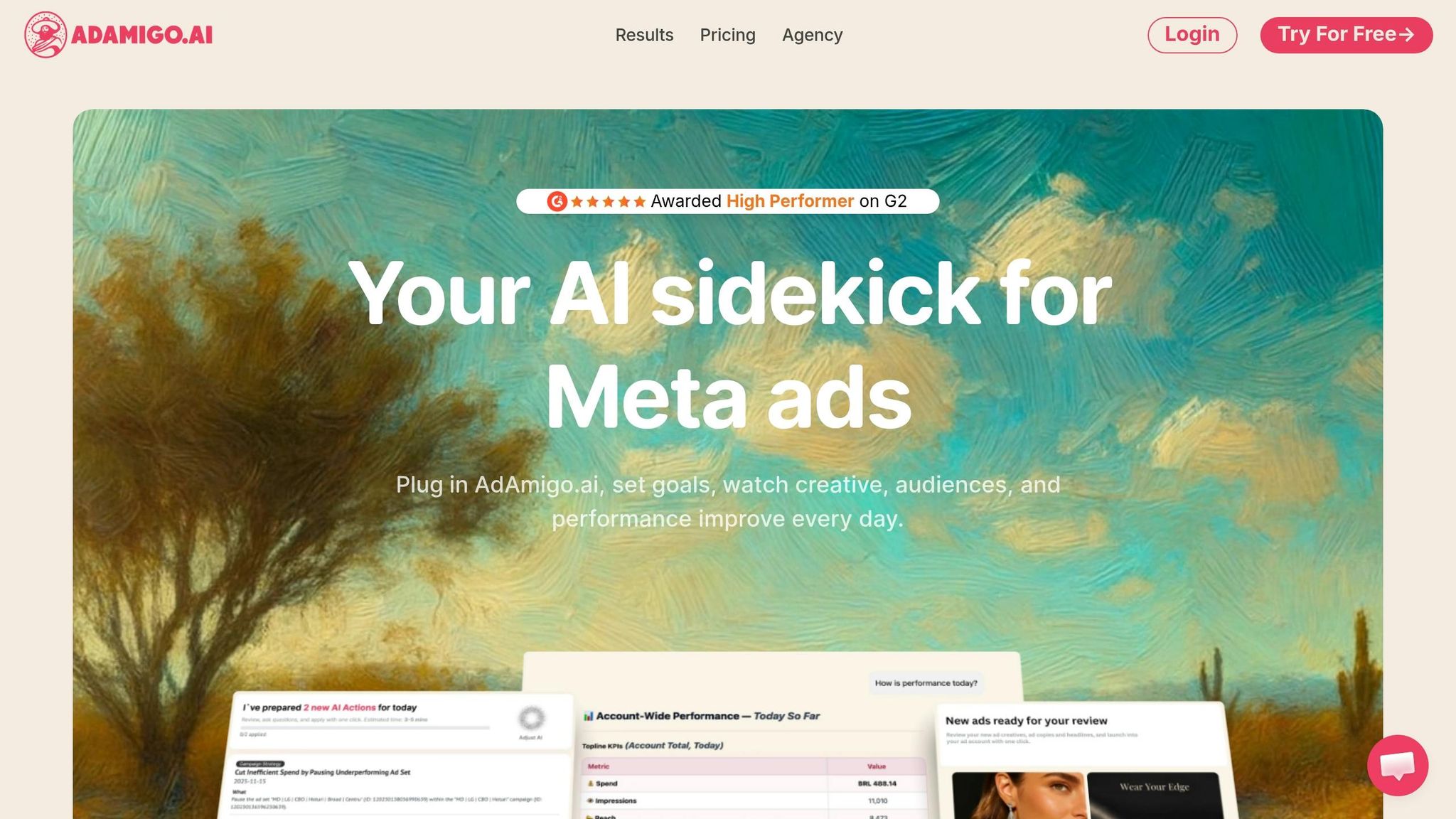
The AdAmigo.ai framework offers a fully automated solution for managing ad campaigns, combining creative development, budget management, and campaign execution into a streamlined process. Acting as an autonomous media buyer, it audits your Meta ad account, identifies areas for improvement, and makes changes either automatically or with your approval.
Test Velocity
AdAmigo focuses on speed, automating the entire creative testing process. Its Bulk Ad Launcher can test hundreds of ad variations in mere seconds. All you need to do is upload your creatives, provide a brief, and the system handles everything - from generating ad copy to structuring campaigns and publishing ads directly to your Meta account. This approach can speed up campaign iterations by as much as 40% compared to traditional manual workflows.
Automation Level
This platform takes care of the entire optimization cycle with minimal manual input. The AI Autopilot continuously launches tests, reallocates budgets, scales successful ads, pauses those that underperform, and adjusts campaign structures based on performance metrics and your goals. You can decide how much control to give the system, opting for either full automation or pre-approval for specific actions. Additionally, the AI Chat Agent allows for conversational management of your account. For example, you can ask, "Why did ROAS drop yesterday?" or issue commands like, "Increase budgets on top performers."
Creative Iteration
AdAmigo's Ad Factory ensures your ads stay fresh and effective by analyzing high-performing and competitor ads to create new variations. This helps avoid creative fatigue while maintaining a steady flow of new ideas.
Scalability
Whether you're working with a small budget or managing complex accounts, AdAmigo is designed to handle it all. Agencies can manage 3–5× more clients by automating repetitive tasks, while in-house teams can execute advanced Meta strategies without requiring large paid media teams. To ensure smooth operations, AdAmigo Protect monitors account health, detects anomalies, and helps prevent costly mistakes.
Framework Comparison
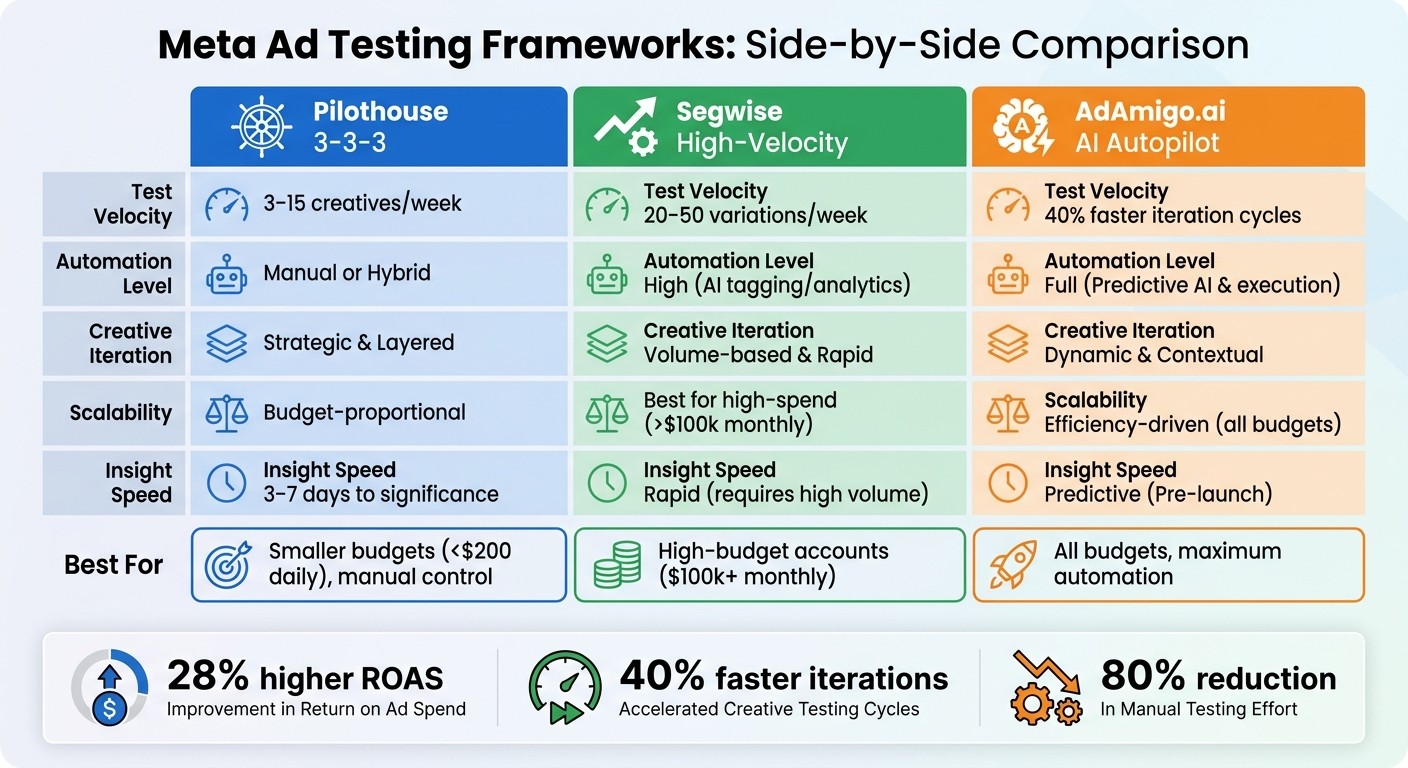
Meta Ad Testing Frameworks Comparison: Pilothouse vs Segwise vs AdAmigo
Frameworks vary in their approach, so selecting the right one depends on factors like budget, team size, and the level of control you want.
The Pilothouse 3-3-3 Framework focuses on careful, strategic testing by experimenting with 3 concepts, 3 formats, and 3 variations. This method avoids overwhelming Meta's algorithm with excessive untested creatives. Typically, it takes 3–7 days to achieve creative testing benchmarks, making it a solid choice for smaller budgets or teams looking to establish a baseline before scaling. Its manual nature is particularly well-suited for smaller-scale operations.
On the other hand, the Segwise High-Velocity Testing Framework prioritizes rapid scaling over manual precision. It tests 20–50 creative variations weekly, using AI tagging to quickly analyze which elements - like hooks, visuals, and audio - drive performance. However, this framework requires at least 50 conversions per variant for reliable results, making it better suited for accounts spending over $100,000 per month.
For maximum automation, AdAmigo.ai AI Autopilot takes over the entire optimization process with no human input required. It speeds up campaign iteration by 40% compared to traditional workflows and offers predictive performance insights even before a campaign launches. By reducing manual testing efforts by 80%, it supports 20+ simultaneous tests without disrupting account structures. Advertisers using this system have reported up to 28% higher ROAS compared to unstructured testing methods.
Here’s a quick breakdown of how these frameworks compare across key metrics:
Feature | Pilothouse 3-3-3 | Segwise High-Velocity | AdAmigo.ai AI Autopilot |
|---|---|---|---|
Test Velocity | 3–15 creatives | 20–50 variations | 40% faster iteration cycles |
Automation Level | Manual or Hybrid | High (AI tagging/analytics) | Full (Predictive AI & execution) |
Creative Iteration | Strategic & Layered | Volume-based & Rapid | Dynamic & Contextual |
Scalability | Budget-proportional | Best for high-spend (>$100k monthly) | Efficiency-driven (all budgets) |
Insight Speed | 3–7 days to significance | Rapid (requires high volume) | Predictive (Pre-launch) |
For advertisers spending under $200 daily, testing 3–6 new creatives per week is recommended. If your daily spend exceeds $1,000, you can scale up to 10–15 weekly tests. These distinctions help guide the choice of framework to match specific campaign goals and resources.
Conclusion
As creative testing evolves from guesswork to precise, data-driven strategies, picking the right framework is crucial. A structured approach not only boosts performance but also aligns with your specific needs, whether that's budget constraints, team capacity, or the level of control you want.
The Pilothouse 3-3-3 Framework focuses on quality over quantity, making it a great fit for Meta Ads budget planner. By testing three concepts, three formats, and three variations, it avoids overwhelming algorithms while establishing a solid performance baseline. This hands-on method gives you full control but requires patience as data accumulates to reach statistical significance.
For advertisers with larger daily budgets, the Segwise High-Velocity Framework is built for speed and scale. Testing dozens of creative variations, it uses AI tagging to pinpoint what works - whether it's a specific hook or a call-to-action. This constant iteration helps fight creative fatigue, ensuring campaigns stay fresh and effective.
If efficiency and automation are your priorities, AdAmigo.ai AI Autopilot takes the wheel. Handling everything from launching tests to tweaking budgets and generating new creatives, it speeds up iteration cycles by up to 40% while improving ROAS by as much as 28% compared to unstructured testing, per the ultimate guide to Meta Ads ROI optimization. This fully automated system seamlessly integrates creative optimization, audience targeting, budget management, and bidding.
These frameworks offer a range of solutions, from hands-on precision to fully automated ease. Start with Pilothouse if you're working with a smaller budget, and as your daily spend surpasses $500, consider shifting to high-velocity or automated testing for greater scalability and efficiency.
FAQs
How do I pick the right testing framework for my budget?
To select the best testing framework, it's all about designing experiments that not only spark creativity but also deliver the best return on investment (ROI) while keeping expenses in check. A smart approach is to start with smaller budgets. This allows you to pinpoint high-performing variations before committing to larger investments.
A great resource allocation strategy is the 60-30-10 rule:
60% goes to your top-performing variations.
30% is reserved for secondary options.
10% is dedicated to trying out new, exploratory tests.
By setting clear success metrics upfront, you can avoid unnecessary spending and confidently scale only those variations that prove their worth.
How many ad variations should I test each week?
The number of ad variations you should test each week on Meta largely depends on your specific goals and strategy. For a high-paced approach, aiming to launch around 5 variations weekly (or 20+ per month) can help you pinpoint the best-performing ads while minimizing the risk of creative fatigue. To get the most out of your tests, concentrate on tweaking a few critical elements - like the hook, visuals, or call-to-action (CTA) - per campaign. This way, you can gather actionable insights without disrupting the platform’s learning phase.
How do I know when creative fatigue is happening?
Creative fatigue sets in when an ad's ability to drive purchase intent drops by around 16% after being viewed six or more times. To combat this and keep performance steady, leading brands often update their ad creatives every 10 days.