
Meta Ads Privacy Training: Key Topics
Privacy essentials for Meta ads: AI disclosure, consent management, CAPI, Advantage+, strict targeting and 1‑day attribution.
Running ads on Meta platforms like Facebook and Instagram requires strict adherence to privacy rules. Here's why it matters and what you should focus on:
Non-Compliance Risks: Fines up to €20M or 4% of global revenue, ad account suspensions, and eroded customer trust.
Key Changes in 2026:
AI use in ad creation must be disclosed to avoid rejection.
Lookalike Audiences replaced by Advantage+ predictive audiences.
Stricter attribution windows (only 1-day click/view options).
Data sources must be declared, with legal consent verified.
Tools to Help:
Conversions API (CAPI): Server-to-server data transfer for better tracking.
Privacy-Enhanced Match: Protects user data using cryptographic hashing.
Meta Consent Mode: Blocks tracking until explicit consent is given.
Ad Targeting Rules: Avoid sensitive categories like religion, health, or financial status.
To ensure compliance, implement Meta ad policy training for your team, audit your accounts, and leverage AI tools for privacy-safe ad optimization. Failing to adapt could lead to penalties and reduced ad performance.
Next Steps:
Train staff with Meta Blueprint courses on privacy and data compliance.
Audit ad accounts to ensure proper consent and data handling.
Use privacy-focused tools like CAPI and Advantage+ to align with new policies.
Meta is tightening its privacy standards - staying updated and compliant is no longer optional.
Meta's Advertising Standards and Privacy Policies

Advertising Policy Requirements
Meta has laid down clear rules for advertising on Facebook and Instagram. These guidelines are designed to prevent harmful practices like spreading false health claims or using discriminatory language, ensuring a safer experience for both users and advertisers.
Starting in 2026, Meta will require advertisers to disclose any use of AI in creating or modifying ad content. If you don't include these disclosures, your ads could be rejected on the spot, and your account might even face suspension. This rule applies to all AI-driven creative processes, leaving no room for exceptions.
Meta is also stepping up its enforcement with the HEC (Housing, Employment, and Credit) detection system. This tool uses advanced computer vision and audio analysis to identify content that might relate to these sensitive categories. To avoid false positives, it's a good idea to review your creatives carefully before submitting them for approval.
Next, let’s look at the updated privacy and data use policies that will further impact advertisers.
Privacy and Data Use Requirements
In 2026, Meta is rolling out significant changes to how user data is handled. One of the biggest updates is the replacement of traditional lookalike audiences with Advantage+ predictive audiences, effective February 2026. These new audiences aim to cut acquisition costs by 15–20%, but they come with a tradeoff: advertisers will have less visibility into the makeup of these audiences.
"Meta's 2026 privacy overhaul is a paradox: the platform is collecting more AI-generated user data than ever while simultaneously restricting how advertisers can use their own data." - AuditSocials
Another key update is the requirement for advertisers to declare their data sources. You'll need to specify whether your data comes from tools like CRM systems, Meta Pixel, or Lead Ads, and you must confirm that you have legal consent to use this data for remarketing or custom audience campaigns. Additionally, custom audiences built with data older than 180 days will no longer be accepted, meaning advertisers must refresh their lists regularly to stay compliant.
Meta is also tightening attribution windows. The previous 7-day and 28-day options are being eliminated, leaving only 1-day click and view windows. This change could affect how advertisers measure return on ad spend (ROAS), especially for campaigns involving long sales cycles. adjusting your benchmarks and optimizing attribution settings will be essential to align with these new reporting limitations.
Meta Tools for Privacy Compliance
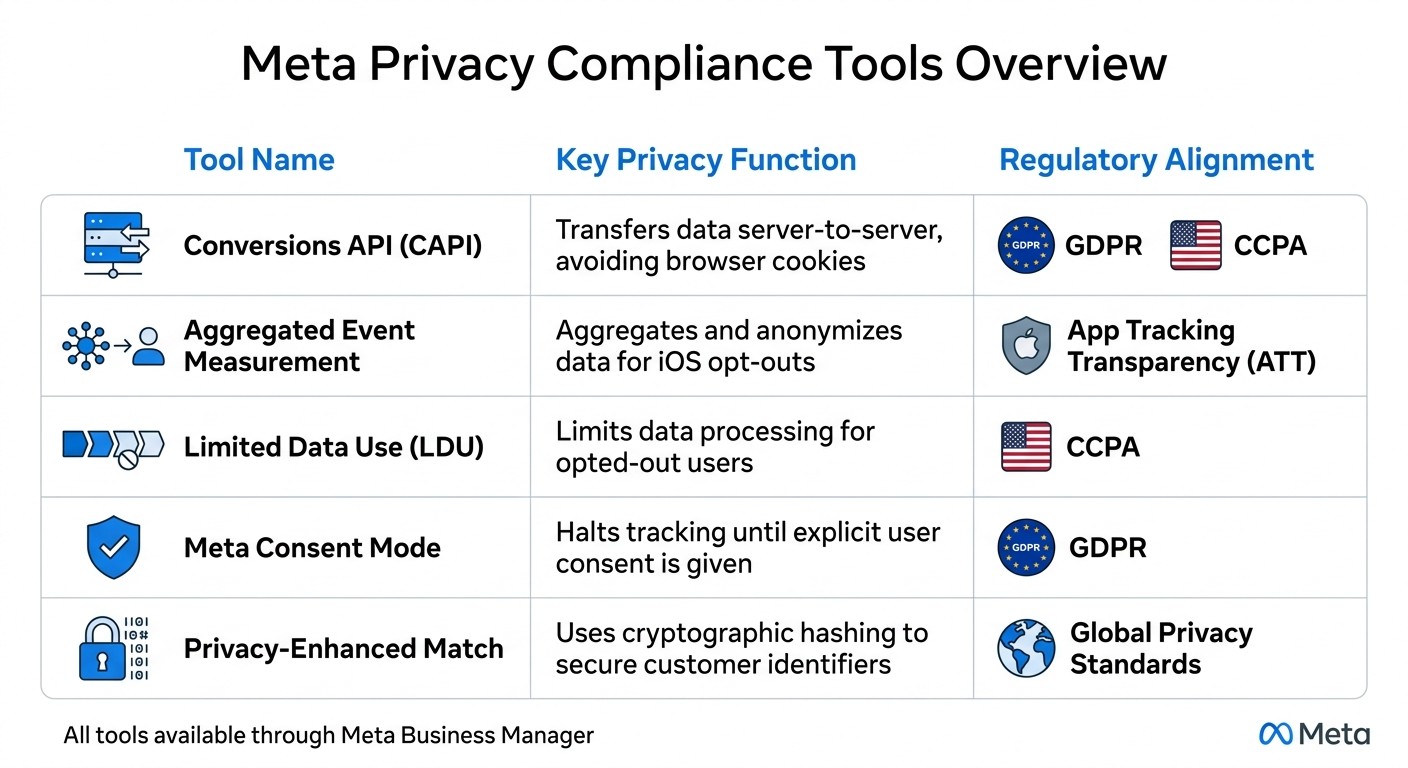
Meta Privacy Tools Comparison: Features and Regulatory Compliance
Meta Pixel and Conversion API (CAPI)
Meta offers several tools designed to help businesses track conversions while respecting user privacy. One standout is the Conversions API (CAPI), which enables data to be sent directly from your server to Meta. This server-to-server setup avoids reliance on browser cookies, making it a more reliable option as third-party cookies are phased out. It also supports compliance with privacy laws like GDPR and CCPA.
Another key feature, Aggregated Event Measurement, anonymizes data for users who opt out via Apple's App Tracking Transparency (ATT) framework. This ensures that even when users decline tracking, businesses can still gather aggregated performance insights.
For businesses operating in California, Limited Data Use (LDU) restricts how Meta processes data for users who opt out under CCPA. Additionally, Meta Consent Mode takes privacy a step further, blocking tracking until users explicitly opt in - a requirement in many GDPR-regulated markets.
Feature | Key Privacy Function | Regulatory Alignment |
|---|---|---|
Conversions API (CAPI) | Transfers data server-to-server, avoiding browser cookies | GDPR, CCPA |
Aggregated Event Measurement | Aggregates and anonymizes data for iOS opt-outs | App Tracking Transparency (ATT) |
Limited Data Use (LDU) | Limits data processing for opted-out users | CCPA |
Meta Consent Mode | Halts tracking until explicit user consent is given | GDPR |
Privacy-Enhanced Match | Uses cryptographic hashing to secure customer identifiers | Global Privacy Standards |
Another important tool is Privacy-Enhanced Match, which uses cryptographic hashing to secure customer identifiers like email addresses and phone numbers. When you upload a customer list, Meta hashes the data before matching it to user profiles, ensuring sensitive information remains protected.
On top of these tools, Meta enforces strict rules for ad targeting to further safeguard user data.
Ad Targeting and Privacy Settings
Meta has implemented stringent rules for ad targeting to ensure compliance with privacy regulations. For example, advertisers are prohibited from targeting users based on sensitive personal attributes like medical conditions, financial status, religion, or sexual orientation. Even indirect references to these categories can lead to ad rejection or account suspension.
Meta employs over 3,000 privacy-focused personnel, though many advertisers now use an AI Media Buyer to automate compliance checks, who review an average of 1,400 products, features, and data practices monthly to mitigate potential privacy risks. This rigorous review process highlights the importance of adhering to compliant targeting practices.
To stay within compliance, you should focus on building custom audiences using privacy-safe data, such as website visitors or app users. Avoid creating audiences that could be perceived as discriminatory or overly invasive. For industries like housing, employment, credit, or health (HEC categories), stricter targeting rules and additional verification steps are mandatory.
Although Meta no longer enforces its 20% text rule as a strict rejection criterion, keeping text below 20% of your ad's image area can still improve delivery and create a more seamless user experience.
Account Security and User Permissions
Ensuring the security of your ad account is another critical aspect of privacy compliance. Implementing two-factor authentication (2FA) for all users with access to your Business Manager is a basic yet effective way to prevent unauthorized access.
Using Meta Business Manager allows you to centralize control over your campaigns across Facebook, Instagram, and the Audience Network. This tool lets you manage permissions, track audience insights, and ensure compliance with Meta's policies - all from one dashboard. To further secure your data, you can set up strict API access controls, like IP whitelisting for your Conversions API connections, to ensure only trusted systems interact with Meta.
Regularly auditing user access and data logs is another essential practice. This helps you identify anomalies in permissions and ensures that only authorized users have access. Enabling real-time alerts for ad reviews, account quality updates, and policy changes can also help you stay ahead of compliance issues.
In addition, it's important to minimize data exposure by purging outdated user data and collecting only what’s necessary for active campaigns. This not only reduces the risk of breaches but also aligns with data retention rules. Be sure to document user consent with timestamps and IP addresses, so you have detailed records available if needed.
Lastly, if you're using Meta Pixel, remember that it establishes joint controller status. Make sure your privacy policy clearly outlines the responsibilities of both your business and Meta to maintain transparency.
Using Automation and AI While Maintaining Privacy Compliance
AI Tools for Privacy-Compliant Optimization
AI-powered automation simplifies privacy compliance while boosting campaign performance. The key is selecting tools that adhere to Meta's official API and data policies.
Take platforms like AdAmigo.ai, for example. They use Meta's Conversions API (CAPI) to transfer data server-to-server, bypassing the need for cookies. This method aligns with GDPR and CCPA regulations while ensuring accurate tracking even as third-party cookies phase out. These tools handle tasks like generating creatives, optimizing audiences, and adjusting budgets - all while respecting privacy rules, such as geo-restrictions, placement limits, or data minimization protocols.
Additionally, AI tools proactively scan ad copy and visuals before launch, flagging potential policy violations like banned "before-and-after" images or references to sensitive attributes. Instead of waiting for Meta to reject ads, these tools catch compliance issues early in the creation process. This saves time, minimizes disruptions, and helps maintain account quality by avoiding manual reviews.
Maintaining Performance While Following Privacy Rules
Privacy-first advertising doesn't have to mean compromising results. When Apple introduced the App Tracking Transparency framework in 2021, Meta advertisers initially experienced up to 37% signal loss. However, combining CAPI with AI automation allowed advertisers to recover 20-30% of that performance through smarter optimization and aggregated modeling.
For instance, in Q1 2024, e-commerce brand Allbirds used Meta's Advantage+ Shopping Campaigns alongside CAPI, achieving a 25% increase in ROAS (rising from 2.8× to 3.5×) over 90 days. By leveraging AI to automate product catalog optimization and server-side event tracking, the campaign also delivered an 18% bump in conversions - all while staying GDPR-compliant.
Automation also streamlines routine compliance tasks. Agencies, for example, can have one media buyer manage 4-8× more client accounts because AI takes care of daily budget adjustments, audience targeting, and creative testing. Senior strategists can then focus on growth strategies. According to a 2024 Gartner survey, 78% of marketers using AI-driven tools reported easier compliance with regulations like GDPR and CCPA, thanks to automation consistently enforcing privacy rules across campaigns.
Training Resources and Certification Programs
Meta Blueprint and Certification Programs
The Meta Business Help Center is a go-to source for understanding ad review processes, managing business asset restrictions, and adopting quality best practices. For a more structured approach, Meta Blueprint offers courses that delve into essential topics like data use policies, consent management, and targeting limitations.
Additional Learning Resources
If you're looking beyond Meta Blueprint, there are tools that provide real-time support to keep your campaigns compliant. For example, third-party tools like AuditSocials Policy Tracker and Keyword Risk Checker help teams stay updated on regulatory changes and scan ad copy for potential "HEC signals" (housing, employment, or credit-related attributes), helping to avoid automated policy flags.
Another helpful tool, AdAmigo.ai, simplifies compliance by automatically flagging policy violations as they occur. It also keeps teams informed about critical updates, such as the February 2026 transition from Lookalike Audiences to Advantage+ predictive models. Together, these resources empower teams to stay ahead of policy changes and maintain a privacy-focused strategy for Meta advertising.
Conclusion: Building a Privacy-First Approach to Meta Advertising
Key Takeaways
Privacy compliance isn't just about avoiding penalties - it plays a key role in boosting ad performance and cutting costs. Ads that follow privacy guidelines tend to perform better. To achieve this, focus on strictly following Meta's Advertising and Privacy Policies, using tools like Meta Pixel and CAPI for privacy-conscious tracking, and ensuring your ad targeting aligns with GDPR and CCPA regulations. Teams certified through Meta Blueprint consistently report fewer policy violations and improved ROAS (Return on Ad Spend).
AI tools can be a game-changer for managing compliance at scale. Platforms like AdAmigo.ai automate compliance while staying within Meta's ecosystem, ensuring privacy rules such as geo-restrictions and consent requirements are respected. These tools streamline operations, allowing one media buyer to handle 4–8× more clients without increasing compliance risks. With Meta's ongoing transition toward automation (Advantage+), adopting a privacy-first strategy is becoming even more essential. The platform’s quarterly updates aim to address challenges like signal loss, reinforcing the need for a proactive approach.
Next Steps for Your Team
To put these insights into action, consider the following steps for optimizing your Meta ad campaigns:
Train Your Team: Schedule quarterly Meta Blueprint training sessions for all staff, focusing on "Advertising Privacy" and "Data Compliance" courses. Certifications should be renewed every 12 months to stay current.
Audit Your Accounts: Within 30 days, review your ad accounts to confirm proper attribution settings, CAPI integration, and consent management are in place. Assign a dedicated privacy officer to oversee these processes and establish a routine audit schedule, including weekly checks for disapprovals, monthly campaign reviews, and quarterly strategic evaluations.
Stay Updated: Subscribe to Meta's policy update newsletters and activate automated alerts for regulatory changes. Advertisers who monitor updates proactively have seen a 40% drop in policy violations.
Use AI Wisely: If you're leveraging AI tools, ensure they're configured for privacy-safe operations. Set clear KPIs with strict data retention policies, review AI-generated campaigns daily for compliance, and enable semi-autonomous modes that require human approval for sensitive adjustments. This approach balances performance scaling with the trust and compliance needed for long-term success.
FAQs
What counts as “AI-generated” content that I must disclose in Meta ads?
When it comes to Meta ads, any content created with the help of AI tools needs to be disclosed. This includes ad elements like creatives, copy, or targeting that are produced using artificial intelligence.
For instance, tools such as AdAmigo.ai’s AI Ads Agent can automatically handle tasks like generating and optimizing ad creatives, defining target audiences, and managing bids. If you're using these AI-powered outputs in your ads, it's crucial to maintain transparency with your audience.
How do I prove user consent for Pixel, CAPI, and Custom Audiences?
To ensure compliance when using tools like Pixel, CAPI, and Custom Audiences, it's essential to gather explicit, opt-in, and specific consent from users. Use reliable Consent Management Platforms (CMPs) to manage this process effectively. Additionally, keep thorough records of these permissions to meet privacy regulations and show proper adherence to legal standards.
What should I change when attribution is limited to 1-day click/view?
When your attribution window is limited to 1-day click/view, the focus shifts to prioritizing immediate conversions in both your reporting and optimization efforts. To adapt, fine-tune your creative and targeting strategies to encourage quicker actions from your audience. Since longer attribution windows aren't an option, it's crucial to ensure your campaigns are designed to deliver results within this tighter timeframe.