
Meta Ads Data Retention Policies Explained
How Meta stores ad account, audience, Pixel, creative, and performance data—and what advertisers must do to comply and optimize.
Meta's ad data retention policies directly impact how your campaigns perform, what data you can analyze, and how long it's stored. Here's the key takeaway: understanding these policies helps you optimize campaigns, stay compliant with privacy laws, and manage data effectively.
Key Points:
Retention vs. Collection: Data retention is about how long Meta keeps ad-related data, while collection is about gathering user signals like clicks and conversions.
Impact on Campaigns: Retention affects your ability to analyze performance history, optimize targeting, and use AI tools reliant on historical data.
Data Types & Retention: Meta retains campaign settings, audience data, creative assets, and performance metrics for varying durations, depending on their purpose.
Privacy Laws: GDPR, CCPA, and Apple's ATT framework heavily influence what data Meta can store and for how long.
Advertiser's Role: You must manage permissions, maintain compliance, and refresh audience/event data regularly.
Quick Tip:
Set clear internal data retention policies, use automation tools to monitor ad performance, and ensure compliance with privacy regulations to maximize ad efficiency.
The 3 Reasons Audience Retention for Purchase Events Has Increased in Meta Ads!

What Data Meta Retains and For How Long
Meta keeps a variety of advertising data tied to your account, and the retention period depends on the type of data, its purpose, and how the platform's systems are designed. This data not only helps you manage your campaigns but also enables Meta to refine its ad delivery algorithms.
Ad Account and Campaign Data
Meta stores campaign-related information - such as objectives, ad set configurations, placement settings, and budget history - at the account level. This data is typically accessible as long as your account is active. It’s crucial for reviewing past campaigns, comparing performance over time, and auditing earlier decisions. Essentially, this historical data forms the foundation of your account’s operational history.
Audience and Event Data
Audience attributes and event details have a more complex retention approach. Meta collects user data like age, location, and engagement signals from both ads and organic content. This information, gathered through tools like the Meta Pixel, Conversions API, and Custom Audiences, powers Meta’s ad delivery algorithms.
Meta’s Generative Ads Recommendation Model (GEM) analyzes vast sequences of events to map out user purchase journeys. It focuses on high-intent behaviors rather than simply tracking the volume of interactions.
Creative Assets and Performance Metrics
Meta also retains ad creatives - text, images, audio, and video - along with their performance metrics. How AI learns from this performance data allows Meta's systems to actively measure effectiveness. Since the "Andromeda" update in late 2025, creative assets have become a key targeting signal. The longer a creative runs and gathers performance data, the better Meta’s system can optimize its delivery. This data retention plays a direct role in improving ad delivery and ensuring compliance.
Here’s a quick breakdown of how Meta handles different types of advertising data:
Data Type | What's Retained | Why It Matters |
|---|---|---|
Campaign metadata | Objectives, ad sets, placements, budgets | Enables historical analysis and account audits |
Audience & event data | User attributes, engagement signals, conversion events | Supports delivery algorithms and audience modeling |
Creative assets | Ad content across text, image, audio, and video formats | Serves as a primary targeting signal in the post-Andromeda era |
Performance metrics | Impressions, clicks, conversions, ROAS by creative | Helps with optimization, reporting, and detecting creative fatigue |
The key takeaway? Your creative performance history is no longer just for reporting - it’s now an active factor in how Meta determines who sees your ads and when.
Laws and Regulations That Shape Meta's Data Retention Practices
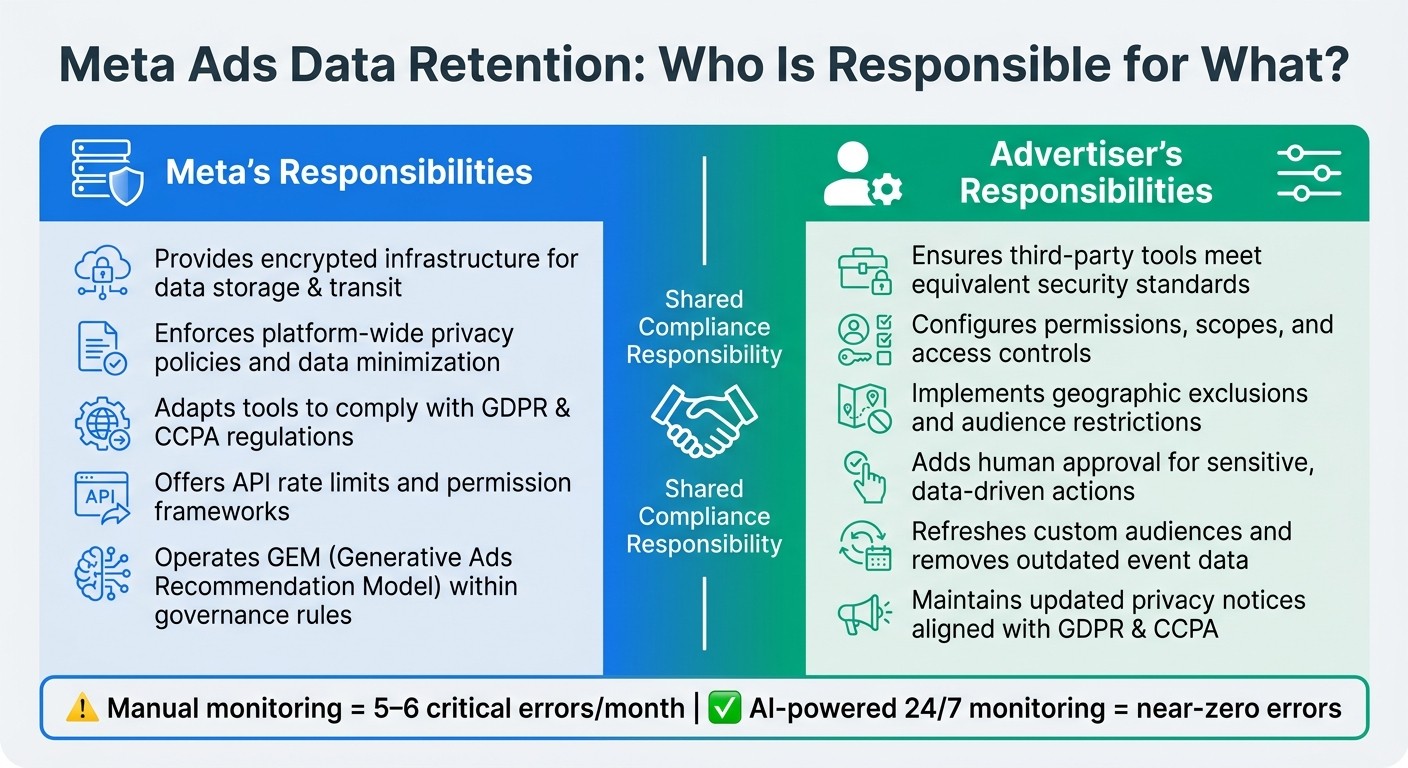
Meta Ads Data Retention: Meta vs. Advertiser Responsibilities
Data retention policies are shaped by a mix of platform-specific rules and broader legal requirements. For advertisers, understanding these aspects is key to staying within legal boundaries and avoiding potential pitfalls.
Meta's Privacy Policies and Platform Rules
Meta's data policies emphasize data minimization - only collecting what’s necessary for specific purposes. Its ad infrastructure, including tools like the Generative Ads Recommendation Model (GEM), processes vast amounts of user data while adhering to its internal data governance framework.
To safeguard sensitive information, Meta employs encryption for data such as tokens, keys, and configurations, both while stored and during transmission. Third-party tools that integrate with Meta’s ecosystem are also expected to maintain high security standards. Many of these tools aim for SOC 2 Type 2 compliance, which verifies their data handling and storage practices.
How GDPR, CCPA, and Other Privacy Laws Apply
Privacy laws like GDPR (for the European Union) and CCPA (for California residents) have significantly influenced how Meta collects, stores, and uses data. Both regulations require explicit user consent for data collection and impose strict limits on retention and usage. These laws have directly shaped the functionality of Meta’s tools, such as the Meta Pixel and Conversions API.
Apple’s App Tracking Transparency (ATT) framework has further restricted real-time data collection from iOS users, forcing Meta to rely more heavily on AI-driven modeling and historical data to compensate for reduced tracking. For advertisers in the U.S. or those targeting international audiences, the varying regulations across regions mean that data collection and retention policies must follow Meta conversion data compliance best practices tailored to the audience's location. These legal constraints directly impact how advertisers configure their data settings.
Advertiser Responsibilities vs. Meta's Role
Ensuring compliance is a shared responsibility between advertisers and Meta. While Meta provides secure API infrastructure, encryption, and platform-level privacy features, advertisers are responsible for managing account configurations and ensuring proper data usage.
For example, advertisers must carefully set permissions and scopes when connecting third-party tools to their Meta accounts. This allows them to control data access and maintain compliance. Many advertisers are also adopting Policy & Constraint Engines to enforce geographic exclusions and ensure adherence to privacy laws. For critical actions, introducing human oversight - where sensitive, data-driven changes are reviewed and approved manually - adds an extra layer of security to automated workflows.
Responsibility Area | Meta's Role | Advertiser's Role |
|---|---|---|
API security & encryption | Provides encrypted infrastructure for data storage & transit | Ensures third-party tools meet equivalent security standards |
Platform compliance | Enforces privacy policies and data minimization | Configures permissions, scopes, and access controls |
Regional law adherence | Adapts tools to comply with regulations like GDPR & CCPA | Implements geographic exclusions and audience restrictions |
Automated action oversight | Offers API rate limits and permission frameworks | Adds human approval for sensitive, data-driven actions |
This division of responsibilities highlights the importance of understanding both Meta’s role and the advertiser’s obligations for successful and compliant campaign management.
Best Practices for Managing Data Retention as an Advertiser
Managing Custom Audiences and Event Data
Staying on top of your custom audiences is crucial for keeping your campaigns compliant and effective. Regularly refresh these audiences to make sure they remain relevant and don’t include outdated information. The same principle applies to event data - review it periodically to ensure you’re only keeping data tied to active campaigns. Removing unused or redundant events not only keeps your data clean but also aligns with privacy regulations.
Using Automation Tools to Support Data Retention
While manual updates are essential, automation tools can take your data management to the next level. For example, platforms like AdAmigo.ai's AdAmigo Protect offer continuous monitoring of account activities. These tools can detect issues like downtime or stock shortages that might otherwise drain your ad budget. With AI-powered monitoring operating around the clock, you significantly reduce the risk of costly errors. Plus, automation allows one media buyer to effectively manage a much larger number of accounts compared to manual oversight alone.
Setting Up Clear Data Retention Policies
To complement both manual and automated efforts, a well-documented internal data retention policy is essential. This policy should align with global privacy regulations like CCPA and GDPR and include clear guidelines on how long different types of data - such as customer lists, Pixel events, or Conversions API data - should be retained. Assign specific review intervals and designate responsible team members for each type of data. Additionally, ensure your privacy notices accurately reflect these practices.
Having a clear process for handling data deletion requests is equally important. Promptly addressing these requests not only ensures compliance but also builds trust with your audience. Centralizing all anomaly and incident logs in a single dashboard can simplify compliance reporting, especially during audits.
Key Takeaways for Advertisers
Meta collects and retains various types of data, including ad account history, audience data, Pixel events, and creative metrics. Each type of data follows its own retention schedule, which can directly influence campaign performance and targeting precision.
While Meta handles the bulk of its data infrastructure, advertisers have their own responsibilities. These include keeping custom audiences well-organized, responding quickly to deletion requests using governance tools, and ensuring privacy notices are regularly updated to stay compliant with GDPR and CCPA regulations.
Relying on manual monitoring during business hours often results in 5–6 critical errors per month. In contrast, AI solutions like AdAmigo.ai offer 24/7 monitoring with almost no errors, which can make a noticeable difference in campaign spending.
Additionally, maintaining consistent, high-quality event data enhances Meta’s behavioral models, leading to better audience targeting.
FAQs
How long does Meta retain Pixel and Conversions API event data?
The specific retention period for Pixel and Conversions API event data isn't mentioned in the provided details. For precise information, it's best to check Meta's official Business Help Center. If you're looking to maximize performance with the available event data, AdAmigo.ai can help. Their autonomous AI media buyer audits your ad account, spots opportunities, and manages campaigns using its AI Action Agent and Chat Agent tools.
Does deleting old creatives or audiences affect Meta’s optimization?
When it comes to Meta's optimization, deleting old creatives or audiences isn't necessary. Meta's systems rely on historical account data to spot patterns and audience segments, so removing them won't disrupt this process. Instead of outright deletion, try pausing underperforming assets. Tools like AdAmigo.ai can help streamline this process.
This strategy allows you to refine and build on successful creative ideas and audience signals. Plus, it helps you avoid creative fatigue while keeping your targeting sharp and performance steady.
What should my team do to stay GDPR/CCPA compliant with Meta ads?
To ensure your Meta ads comply with GDPR and CCPA, start by properly installing the Meta Pixel and enabling advanced matching. Double-check that your event tracking is accurate and functioning as intended. Connect your Business Manager account and consider using tools like AdAmigo.ai. Platforms like this work within Meta’s official API and compliance guidelines, helping you uphold privacy standards while automating monitoring to keep your ad account aligned with regulatory requirements.