
Meta Ads Policy 2026: Stay Compliant, Avoid Rejections
Stay compliant with Meta's 2026 ad rules — personal attributes policy, misleading claims enforcement, AI disclosure, landing-page checks, and Account Health.
Meta's 2026 ad policies have shifted dramatically, introducing stricter rules, AI-driven ad reviews, and a new Account Health Score system. These changes are designed to prevent violations before ads go live. Key updates include:
AI-Powered Ad Reviews: The new Multimodal Ad Review System (MARS) scans text, visuals, audio, and landing pages pre-launch.
Account Health Score: Scores below 50 lead to slower reviews, while scores under 25 result in penalties like restricted ad delivery.
Policy Updates: 47 new rules target personal attributes, landing page consistency, misleading claims, and undisclosed AI-generated content.
EU-Specific Rules: Compliance with the Digital Services Act includes mandatory AI disclosure, financial disclaimers, and user data transparency.
To stay compliant:
Follow Meta ad policy training to avoid personal attribute references in ads.
Match landing page claims with ad content.
Follow FTC and Meta AI disclosure rules for generated elements.
Maintain an Account Health Score above 70.
Automated tools like AdAmigo.ai can help by scanning ads for violations, suggesting fixes, and generating compliant ad variations. Staying ahead of these policies ensures smoother campaign approvals and better ad performance.
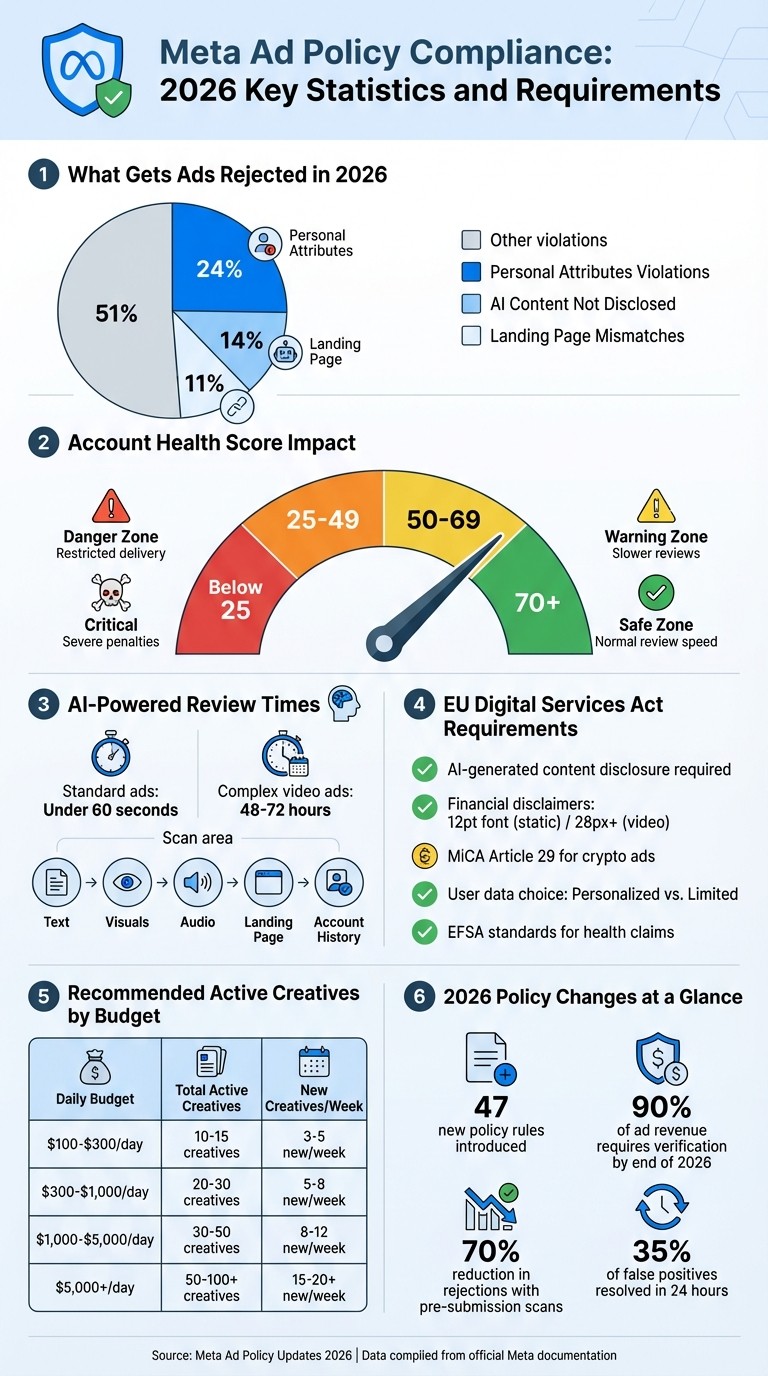
Meta Ad Policy Compliance Statistics and Requirements for 2026
Facebook Ads NEW Rules for 2026 (learn this ASAP)
What Changed in Meta Ad Policies for 2026

Meta introduced major updates to its ad policies in 2026, reshaping the Meta ad review process. Three standout changes include stricter rules for personal targeting, increased scrutiny of landing page quality, and new compliance requirements for EU campaigns.
Stricter Rules on Personal Attributes
Meta has tightened its enforcement of Personal Attributes under Policy 4.3. The platform now uses semantic intent detection to flag both explicit and implied messages. For example, phrases like "For people managing diabetes" or "Those dealing with blood sugar spikes" are treated the same as direct "you" statements and are rejected at the same rate.
Violations of this policy now represent 24% of all ad disapprovals. Even visual content is under the microscope - before-and-after photos are often flagged as "implied transformations" because they suggest guaranteed outcomes, even if claims are not explicitly stated. Meta's MARS (Multimodal Ad Review System) processes ads, including images, video frames, and audio, in under 60 seconds to identify such issues.
To stay compliant, focus on highlighting product benefits rather than addressing personal traits. For instance, instead of asking "Are you tired?" you could say, "Our supplement supports natural energy levels". Avoid any language or imagery that assumes specific conditions, lifestyles, or traits.
Misleading Claims: How Meta Enforces Policy 4.3 in 2026
Misleading claims are now one of the most aggressively enforced policy areas, closely intertwined with personal attributes enforcement. Under Meta's Advertising Standards, a misleading claim is any ad content that could deceive a reasonable consumer — whether through explicit promises, implied outcomes, or visual cues like before-and-after imagery.
The most common violation pattern is an ad that pairs a personal-attribute trigger with an unsubstantiated result. For example, an ad showing a "before" image of someone appearing fatigued next to an "after" image of the same person looking energized — without a cited study or verifiable data backing the transformation — is treated as both a misleading claim and a personal-attribute violation. Meta's MARS system flags side-by-side imagery as "implied transformations," and while Meta's July 2026 health and wellness policy update stopped auto-rejecting every before-and-after image, these creatives remain high-risk when paired with any claim that suggests guaranteed outcomes.
Other forms of misleading claims that draw enforcement include:
Unsubstantiated health promises: "Lose 10 pounds in one week" or "Cure your back pain permanently" — any health or wellness claim must be backed by competent and reliable scientific evidence.
False urgency or scarcity: "Only 3 left in stock" when inventory is plentiful, or "Sale ends at midnight" that refreshes daily — these are classified as deceptive practices under Meta's fraud and scams policy.
Hidden conditions: Advertising "Free trial" but burying auto-renewal terms in fine print. This type of landing-page mismatch is a leading cause of ad rejections in 2026.
The supplement industry has been hit especially hard. Agency data shows that 64% of supplement advertiser accounts were reviewed at least once in Q1 2026 — a 41% increase from the previous quarter — making it one of the most scrutinized verticals on the platform.
To avoid misleading claims rejections, ground every claim in verifiable evidence. Instead of "Our serum erases wrinkles," write "Our serum is clinically shown to reduce the appearance of fine lines in 8 weeks." Link to the study or third-party validation on your landing page, and ensure the ad and landing page tell the same story — MARS crawls both in real time.
Disability and Health Conditions: Compliant Ad Language
Disability is one of 17 personal attribute categories that Meta's Policy 4.3 explicitly protects, alongside race, ethnicity, religion, age, sex, sexual orientation, gender identity, family status, medical or genetic conditions, physical or mental health, vulnerable financial status, voting status, trade union membership, criminal record, and name. Ads that assert or imply a user has any of these traits — directly or indirectly — will be rejected.
Meta's own Business Help Center provides a canonical example of what not to write: "Are you disabled? We can help!" This is a violation because it uses the word "you" alongside a personal attribute, implying the reader has a disability. Even phrasing that avoids "you" — like "For people with depression" — is now caught by semantic intent detection and treated identically.
The compliant approach is to describe the product or service without ever implying the user has the condition. Meta's Transparency Center lists these approved alternatives:
"Bulimia counseling available"
"Depression counseling"
"New diabetes treatment available"
Each describes a service that exists, not a person who needs it. The rule is straightforward: frame your offering as a resource, not a diagnosis. For example, a mobility aid brand should write "Lightweight wheelchairs designed for everyday use" rather than "Struggling to get around? Our wheelchair can help."
The same logic applies to health conditions more broadly. "Supports healthy glucose levels" is compliant; "Struggling with blood sugar spikes?" is not. When in doubt, remove any language that could be read as assuming the reader's medical history, and let the product's features speak for themselves.
Increased Focus on Landing Page Quality
Meta now evaluates ads and their landing pages as a single unit. The MARS system scans destination URLs in real time, ensuring that the claims in your ad align with the content on the landing page. Landing page mismatches, such as advertising "Free Shipping" while requiring a minimum purchase, account for 11% of rejections in 2026.
For EU campaigns, additional requirements apply. Financial risk disclosures, for instance, must be clearly visible - using at least 12pt font for static images and 28px or larger for video. If your landing page fails to meet these standards, your ad could be disapproved. Maintaining FTC compliance for Meta ads is equally critical to avoid penalties.
EU Digital Services Act Requirements
As of January 2026, Meta offers EU users two options: fully personalized advertising or a "less personalized" experience with limited data sharing. This change aligns with the EU Digital Services Act (DSA) and Digital Markets Act (DMA), bringing stricter transparency requirements for campaigns targeting EU audiences.
Cryptocurrency ads must adhere to the Markets in Crypto-Assets (MiCA) Article 29, which mandates specific disclosure requirements. Additionally, ads using AI-generated or modified content - such as synthetic visuals, background replacements, or voiceovers - must include an "AI-generated" label. Undisclosed AI use now accounts for 14% of ad rejections, making it one of the top rejection categories. Beyond AI-specific rules, advertisers should also follow foundational FTC ad disclosure guidelines for all sponsored content, endorsements, and material connections.
Requirement Area | 2026 EU Compliance Standard |
|---|---|
AI Content | "AI-generated" disclosure tag required for synthetic visuals/audio |
Crypto Ads | MiCA Article 29 disclosures and tiered authorization |
Health Ads | Claims must align with EFSA standards; disclaimers required |
User Data | Choice between fully personalized or limited data models |
Financial Ads | Risk warnings standardized; verification required in 38 countries |
The European Commission emphasized the importance of user choice:
Users in the EU must have full and effective choice, which is their right under the DMA.
Advertisers who fail to meet these standards risk not only ad disapprovals but also potential account restrictions. If you are already facing issues, follow these steps to recover disabled Meta ad accounts.
How to Stay Compliant Before Launching Ads
Meta now uses AI classifiers to scan all ads before they go live. This means you need to address potential issues early in the planning stage to avoid wasting time and money on campaigns that get rejected.
"Meta's 2026 policy cycle marks the transition from reactive enforcement (reviewing ads after complaints) to proactive enforcement (scanning every ad through AI classifiers before the first impression is served). The era of 'launch and see what happens' is over." - AuditSocials
The MARS system reviews most ads in less than a minute, checking five key areas: text, visuals, audio (for video ads), landing page content, and your account's compliance history. If any of these fail to meet the standards, the ad will be rejected. For complex video ads, the process can take up to 48–72 hours.
5-Step Pre-Launch Compliance Checklist
Follow these steps to minimize the risk of ad rejections:
Targeting & Data Verification
Double-check that your ad copy and visuals don’t reference personal attributes. If your ad falls under Housing, Employment, or Credit (HEC), make sure the correct Special Ad Category tag is applied. Note that as of 2026, Buy Now Pay Later (BNPL) and crypto lending are included under Credit.
Landing Page Review
Meta evaluates your ad and landing page as one unit. Ensure the claims in your ad match the landing page exactly. For example, if your ad says "Free Shipping", the landing page shouldn’t require a minimum purchase. Check for dark patterns in your checkout flow, as these inconsistencies account for 11% of rejections.
AI Disclosure Check
If your content includes AI-generated elements, select the "AI-generated" box to avoid issues. Failure to disclose AI use is now responsible for 14% of ad disapprovals.
Account Health and Anomaly Check
Visit your Account Quality Dashboard in Ads Manager to ensure your Account Health Score is above the safe threshold. A low score can lead to slower reviews and more rejections.
Enable Business Manager Alerts
Turn on real-time notifications for "Ad Review" and "Account Quality" under Business Settings > Notifications. This way, you’ll know immediately if an ad is rejected, rather than finding out after spending part of your budget.
By following these steps, you align with Meta's updated compliance policies and reduce the risk of costly campaign delays. Once your ad passes these checks, focus on creating multiple compliant variations to stay prepared.
scaling with multi-format compliant ad variations
Having backup ad creatives is now essential. Meta’s Andromeda algorithm prioritizes creative variety over a few polished ads, recommending between 15 and 50 active creatives depending on your budget. These backups allow you to quickly replace flagged ads without disrupting your campaign.
Start by testing one variable at a time in the following order:
Hook or opening line
Offer
Format (video vs. image)
Call to Action (CTA)
Landing page
For instance, instead of "Struggling with blood sugar spikes?" try "Supports healthy glucose levels" while keeping the rest of the ad consistent.
Use Advantage+ Creative Optimizations to let Meta’s AI test different combinations and improve click-through rates. For video ads, a simple way to refresh content is by changing the first three seconds while keeping the rest of the video intact.
Track your approved and flagged ads in a spreadsheet with columns for ad ID, rejection reasons, fix dates, and approval status. If your approval rate falls below 90%, pause scaling and review your creative templates before launching new campaigns.
Daily Budget | Min. Active Creatives | New Creatives/Week |
|---|---|---|
$100–$300 | 10–15 | 3–5 |
$300–$1,000 | 20–30 | 5–8 |
$1,000–$5,000 | 30–50 | 8–12 |
$5,000+ | 50–100+ | 15–20+ |
Tools like AdAmigo.ai simplify this process by scanning your ads for policy violations before submission. It also offers one-click fixes for common issues and generates compliant creative variations tailored to your brand. For agencies managing multiple accounts, this automation allows one media buyer to handle significantly more clients, freeing up time for strategic growth.
Tools for Automated Compliance Monitoring
Once pre-launch compliance is handled, automated tools step in to ensure your campaigns stay aligned with Meta's ever-changing policies, often by integrating with governance tools for better data retention. Meta now uses proactive enforcement, where AI classifiers scan every ad before it goes live. Within 60 seconds, their system - MARS - analyzes text, visuals, audio, landing pages, and even historical violation data. This proactive approach has made manual compliance checks less effective, especially as policies evolve. Studies show that pre-submission scans can prevent up to 70% of potential ad rejections. The best compliance tools also adapt automatically to Meta's policy updates, identify AI-generated content needing disclosure, and flag elements tied to Special Ad Categories, such as floor plans or office images. Advanced tools like AdAmigo.ai take this proactive system further by simplifying ongoing compliance.
How AdAmigo.ai Handles Compliance and Optimization
AdAmigo.ai combines compliance monitoring with full campaign management and automation. Its AdAmigo Protect feature runs continuous, around-the-clock scans across your ad account. It looks for violations, broken landing page links, and unusual spending patterns to help maintain your Account Health Score. If it detects issues like undisclosed AI-generated content or personal attribute violations, the system flags the ad and suggests compliant alternatives.
The platform's AI Ads Agent takes things a step further by generating new creatives that are pre-checked for compliance. It evaluates your brand's style and top-performing ads to create variations that align with both your messaging and Meta's policies. For easier management, the AI Actions tool provides a daily list of prioritized compliance fixes and performance improvements. You can approve these changes one by one or let the system handle them automatically in autopilot mode. Additionally, the AI Chat Agent can answer questions like "Why was this ad rejected?" and even launch multiple compliant campaigns directly through a chat interface. Just connect your Meta account, set your KPIs, and let the system handle the rest.
Comparing Automated Compliance Tools
Here’s a breakdown of how AdAmigo.ai stacks up against manual compliance methods and Meta's built-in tools:
Feature | AdAmigo.ai | Manual Compliance | Standard Meta Tools |
|---|---|---|---|
Review Timing | Pre-submission scan | Post-submission reactive | Post-submission reactive |
Audit Frequency | 24/7 real-time monitoring | Weekly or bi-weekly | On-demand only |
Scan Speed | Under 60 seconds | Hours per week | N/A |
Policy Updates | Automatic (syncs with Meta changes) | Requires manual research | Automatic |
AI Disclosure Detection | Automated flagging with one-click fix | Manual checkbox review | Manual checkbox only |
Landing Page Crawl | Real-time dark pattern detection | Manual spot-checks | Not included |
Account Health Tracking | Continuous monitoring with alerts | Manual dashboard checks | Dashboard view only |
Creative Generation | Compliance-checked creative variations | N/A | N/A |
AdAmigo.ai offers two pricing tiers. The Full Access plan, at $349 per month per ad account, includes unlimited ad spend, full compliance features, and a dedicated account manager. For smaller needs, the Signals plan costs $99 per month and provides two daily optimization recommendations with one-click fixes. Agencies managing five or more accounts can opt for custom pricing, which also includes white-labeling options.
Working with Meta Support for Compliance
While automated tools can handle routine compliance checks, there are times when direct interaction with Meta Support becomes essential. Whether you're appealing a rejected ad or seeking approval for a restricted category, understanding how Meta operates internally can save you weeks of back-and-forth. Plus, taking these extra steps can help you avoid account-level penalties and ensure a smoother experience.
Steps to Protect Your Ad Account
To safeguard your ad account and maintain compliance, there are a few key steps you should prioritize:
Complete Business Verification: In the Business Settings, completing verification unlocks higher spending limits and speeds up appeal processes. Meta plans to extend advertiser verification to cover 90% of ad revenue by the end of 2026. Delaying this step could mean losing access to essential features.
Enable Two-Factor Authentication (2FA): Meta requires 2FA for all users. A B2B SaaS company in 2025 revamped its Business Manager permissions and required 2FA and corporate email logins after a phishing attack. The outcome? Zero account suspensions over the following 18 months. Using corporate domain emails can also improve your trust score with Meta.
Monitor Your Account Health Score: Check your score weekly. A score below 70 can lead to longer review times, while anything under 25 may trigger severe ad delivery restrictions. Address any issues immediately to avoid escalating penalties.
Scale Budgets Gradually: Avoid increasing your daily budget by more than 20% every 3–4 days. Sudden spikes can raise red flags and disrupt the learning phase. To avoid unexpected delivery halts, increase your Account Spending Limit (ASL) in the "Billing & Payments" section before scaling budgets.
Appealing Policy Violations and Getting Special Permissions
Once your account is secure, understanding how to navigate policy violations and obtain special permissions becomes crucial.
Appealing Policy Violations: Meta operates a three-tier appeal system. About 35% of false positives are resolved through an automated re-review within 24 hours. If that fails, a manual review takes 3–5 business days, and complex cases may escalate to the Policy Advisory Board, which can take 10–15 business days. Never resubmit a rejected ad without changes, as common testing mistakes like this could harm your Account Health Score. Instead, use the official appeal process via Business Support Home.
Applying for Special Permissions: For restricted categories like dating services, cryptocurrency, or online gambling, specific permissions are required:
Dating advertisers must complete an application outlined in Meta's Advertising Standards.
Cryptocurrency advertisers need to provide regulatory licensing documents and proof of custody insurance.
Financial services must complete advertiser verification in 38 required countries and follow standardized risk warning templates.
Recovering a Disabled Account: If your account gets disabled, Meta’s Recovery Action Plans can help you regain access within 30 days. This includes compliance training, corrective actions, and passing a re-certification quiz. Demonstrating an understanding of the violated policies can speed up the process compared to waiting for a manual review.
Conclusion
Navigating Meta's ad policies in 2026 is essential for maintaining successful campaigns. With MARS driving proactive enforcement, staying informed about Meta's transparency and reporting standards - like mandatory AI disclosure, rules on personal attributes and misleading claims, AI-driven privacy threat detection, and changes to HEC categories - is a must.
To put these policies into action, use a pre-launch compliance checklist to avoid Meta ad rejections by identifying and resolving violations early. Keep a close eye on your Account Health Score every week - scores below 70 signal potential problems, while those under 25 can lead to Restricted Delivery, which may take significant time to recover from.
Tools like AdAmigo.ai can make compliance easier by scanning and optimizing ads automatically, cutting rejections by up to 70%. These tools also allow media buyers to handle 4–8× more accounts without sacrificing quality or compliance.
When violations occur, Meta's three-tier appeal process provides a clear path to resolving issues. Staying compliant not only protects your campaigns from disruptions but also helps you maintain a competitive edge in the ad auction, keeping costs in check with guardrails and ensuring access to critical performance data. By treating compliance as a strategic priority, you can achieve stronger results while others struggle with rejections and delivery challenges. As Meta continues to refine its systems, diligent monitoring will remain key to long-term success in advertising.
FAQs
How do I raise my Account Health Score fast?
To boost your Account Health Score quickly, focus on staying ahead of potential issues. Conduct regular audits to spot and fix problems early, set up automated alerts to catch violations as they happen, and use real-time monitoring tools to keep everything on track. Make it a priority to stay informed about Meta’s policy updates and address any violations immediately. Tools like AdAmigo.ai can be a game-changer - they can flag potential issues, simplify compliance processes, and improve ad performance. This way, you can keep your ads compliant while minimizing the chances of rejections or restrictions.
What counts as a “personal attribute” in ad copy?
When crafting ad copy, a "personal attribute" refers to characteristics such as race, ethnicity, color, national origin, religion, age, sex, sexual orientation, gender identity, family status, disability, medical or genetic conditions, physical or mental health, vulnerable financial status, voting status, trade union membership, criminal record, or name. These traits are legally protected and should never be directly mentioned in your advertisements.
When do I need to label content as AI-generated?
When using AI tools like AdAmigo.ai to create or assist with ad creatives, it's important to label the content as AI-generated. This step ensures compliance with Meta's transparency policies and aligns with their standards.