
Meta Financial Services Ad Policies: Current Rules (October 2026)
Meta's current financial-services ad rules, audience limits, prohibited products and authorization requirements, checked October 21, 2026.
Meta's financial-ad rules combine a U.S. Special Ad Category, location-dependent audience limits, restrictions on prohibited products and data, and licensing requirements where applicable. Policy check: October 21, 2026. See Meta's current Special Ad Category guidance and financial-services advertising policy.
For relevant financial ads, U.S.-based advertisers and advertisers targeting U.S. audiences must select Meta's "Financial products and services" Special Ad Category; Meta says this requirement took effect January 21, 2025.
Audience limits: Available options depend on advertiser and audience locations; ZIP/postal-code targeting and some audience controls are unavailable in affected markets, and radius rules differ by country.
Audience tools: Some audience options, including Lookalike Audiences, are limited or unavailable in affected markets; Meta specifically says Advantage+ lookalike is unavailable.
Licensing and verification: Meta may require identity verification and proof of authorization where the product and target country's rules require it. Confirm requirements with the relevant regulator; U.S. securities information is available from the SEC.
Data restrictions: Meta prohibits ads that directly request personally identifiable information or certain financial information. Separately, Meta may limit or fully restrict event sharing based on a data source's category and region; check its data-sharing guidance and Conversions API documentation.
Use only audience and measurement methods permitted for your campaign and the data you collect. First-party signals, on-platform lead forms, and ad copy and visuals do not override Meta's restrictions or applicable privacy and advertising laws. Violations could lead to ad rejection, disabled ad accounts, or legal consequences.
Meta says its audience limits aim to promote fairness and help protect people from unlawful discrimination. Stay informed through Meta's Transparency Center, monitor industry benchmarks and use tools like AdAmigo.ai to create and manage advertising campaigns.
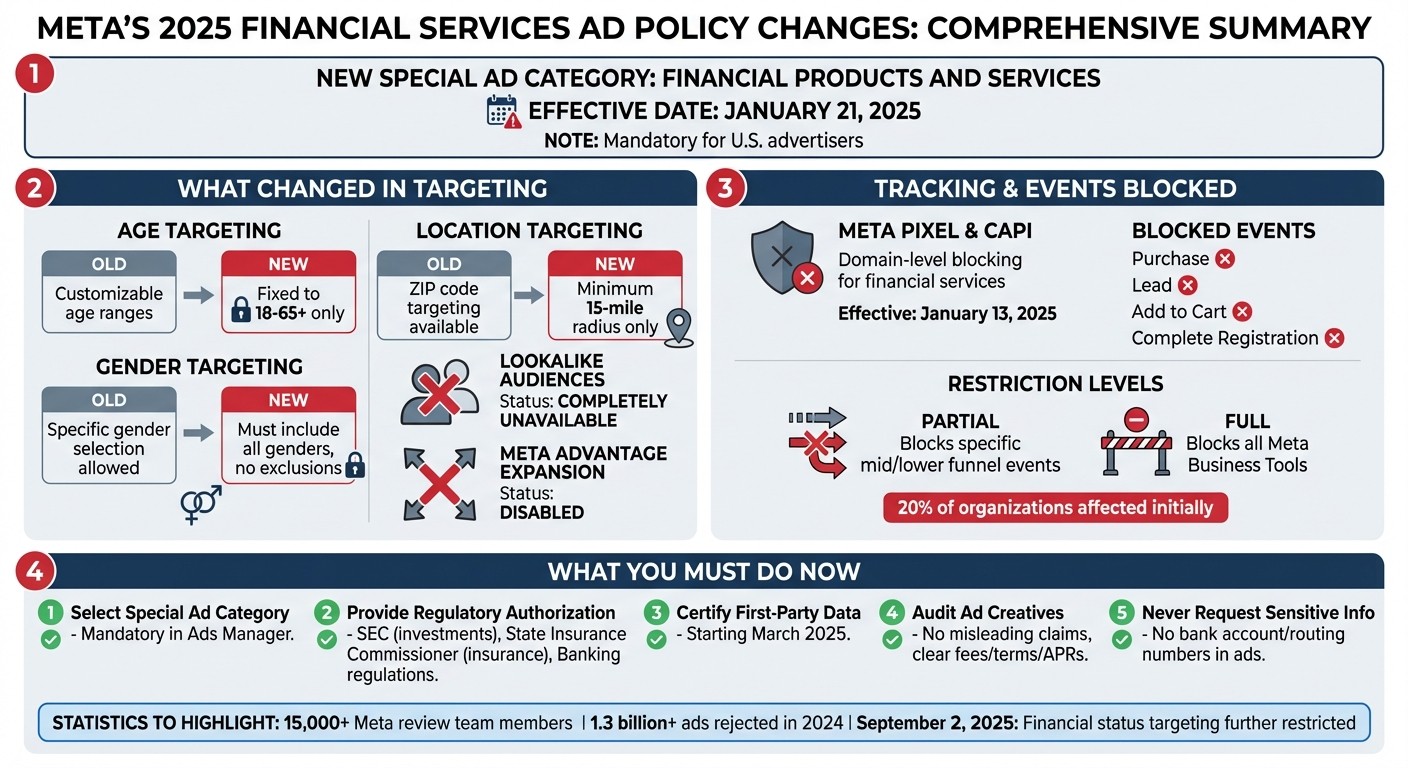
Meta 2025 Financial Services Ad Policy Changes: Targeting Restrictions and Tracking Limitations
Check Financial Ads Against Meta's Current Rules
What Meta's Current Financial-Services Rules Require
As of October 21, 2026, Meta's help center says advertisers based in the United States, or showing financial-products-and-services ads to U.S. audiences, must select the "Financial products and services" Special Ad Category (effective January 21, 2025). Meta says ads may be rejected if the appropriate category is not selected. Choose it in Ads Manager when it applies. The category covers ads promoting or directly linking to a financial product or service; the exact requirements depend on the campaign's market and product.
Audience restrictions depend on where the advertiser is based and where the ads will run. In affected markets, Meta limits or removes options such as age, gender, postal-code targeting, exclusions, lookalike audiences, saved audiences and some interests. Its current help page says audiences must include all genders, some demographic and interest options are unavailable, and Advantage+ lookalike is unavailable. A 15-mile expanded radius applies to specific-location audiences in the United States and Canada; listed European countries use a 10-mile radius. Do not treat these limits as universal across every country or financial product. Check Meta's current audience guidance, then plan creative strategies and policy changes around the controls available in your campaign. Some remaining audience criteria must still be used without discrimination.
What Meta Wants to Achieve
Meta says Special Ad Category audience limits are part of its efforts to promote fairness and help protect people from unlawful discrimination. The available targeting controls depend on the campaign and market. Read Meta's current Special Ad Category guidance.
Meta may require identity verification and proof that an advertiser is authorized by the relevant regulator when licensing is required in the country targeted. Its policy lists insurance, mortgages, loans, investment products and credit-card applications as examples that may require authorization; Meta may review the documents. Advertisers must also meet applicable legal disclosure requirements. Check the rules for the product and country you are targeting rather than assuming one regulator or proof requirement applies everywhere. See Meta's financial-services policy.
New Special Ad Category Rules
Meta's current policy prohibits ads promoting payday loans, paycheck advances, bail bonds, loans due in 90 days or less, binary options, contracts for difference, initial coin offerings, and penny auctions or similar pay-to-bid models. It also bars misleading student-loan consolidation, forgiveness or refinancing claims. These are examples in Meta's prohibited financial products policy; review that page for its current wording. For broader team training, see this Meta ad policy guide.
Meta prohibits ads that directly request personally identifiable information or certain financial information, including bank-account details and routing numbers. That prohibition is separate from audience selection: available Custom Audience features vary by campaign and market, and data use must comply with Meta's policies and applicable law. See Meta's current financial-services rules and this guide to Custom Audiences.
Feature | Financial Products and Services Rules |
|---|---|
Age Targeting | Generally 18–65+ where these Special Ad Category age limits apply; credit-ad exceptions may apply in Europe, and ads for credit cards, loans or insurance must target adults 18+ |
Gender Targeting | All genders must be included in affected Special Ad Category campaigns; audience exclusions are also limited or unavailable |
Location Targeting | No ZIP/postal-code targeting in affected markets; specific-location radius is 15 miles in the U.S. and Canada and 10 miles in listed European countries |
Lookalike Audiences | Some forms are limited or unavailable in affected markets |
Detailed Targeting | Some interests and behaviors are unavailable; detailed-targeting exclusions are unavailable |
Meta Advantage Expansion | Advantage+ lookalike is unavailable; this does not mean all Advantage+ expansion is disabled |
How Audience Limits Vary by Location
Meta limits or removes several audience controls for Special Ad Category campaigns in affected markets; the exact restrictions depend on advertiser and audience location. Some audience options, including lookalike audiences, are limited or unavailable, while Meta specifically identifies Advantage+ lookalike as unavailable. Custom Audience options may remain available through Ads Manager, but their availability does not remove privacy or non-discrimination obligations. Read Meta's audience targeting guide alongside the current platform rules.
Meta's current public audience guidance says available criteria must not be used to discriminate and that some audience features are unavailable; it does not support a blanket claim that all first-party lists require a new certification from March 2025.
"Custom audiences are your best friend. Use your own first-party data to refine targeting while ensuring compliance with Meta's rules."
– Natasia Langfelder, Content Marketing Manager, Data Axle
Which Audience Options Are Unavailable
Meta's current help page identifies Advantage+ lookalike as unavailable for these Special Ad Category audience restrictions. This does not establish that every Advantage+ feature or all audience expansion is disabled; check the controls shown for your campaign.
"With reduced targeting precision, your creative elements become the primary targeting tool."
– Joshua Gosseck, Financial Advisor Marketing
Now, you’ll need to rely heavily on AI-generated ad copy and visuals to draw in the right audience.
Stricter Rules for Custom Audiences
Meta says some audience options, including Custom Audiences, may be available only in Ads Manager. Its current public guidance does not support a universal rule that every Custom Audience must be uploaded separately to one ad account or that audience sharing is always prohibited. Check the account's available controls and follow Meta's terms and applicable privacy requirements before using customer data.
Targeting criteria must not be used to discriminate, and data practices must comply with privacy rules. Do not assume that removing or disguising sensitive fields makes an audience compliant. Review your consent and data-use practices before using customer information; policy violations can lead to account restrictions.
Meta's published audience rules vary by location and campaign; check the current controls rather than relying on predictions about future restrictions.
Financial-Status Targeting: Check Current Availability
Meta limits or removes some audience criteria in affected markets. Its current help page lists age, gender, ZIP or postal code, audience exclusions, lookalike audiences, saved audiences and some interests as limited or unavailable; the specific controls depend on advertiser and audience location. Check the settings available for your campaign rather than assuming a control is available in every market.
Creative choices do not change which audience controls Meta makes available for a campaign.
How Tracking, Events, and Optimization Are Affected
Meta's financial-services policy prohibits ads that directly request personally identifiable or certain financial information and may require licensing or identity verification. Separately, Meta may limit or fully restrict event sharing through Business Tools based on a data source's assigned category and location. These restrictions can affect Pixel and Conversions API (CAPI) event data; check the status and notices for your data source in Meta Events Manager guidance. Changing from browser to server-side transmission does not bypass a restriction.
Limits on Meta Business Tools
Meta's financial-services ad policy does not say those events are blocked for every advertiser. A separate Meta data-source restriction can limit specific standard mid- or lower-funnel events, or all events in specified regions. Check the category and notifications for your data source in Events Manager before choosing events or optimization goals.
Meta says event-sharing restrictions vary by data-source category and may apply only in specified countries or regions or globally. It will notify you by email and in Events Manager when it limits or fully restricts a data source; review the current data-sharing rules before implementing Pixel or CAPI events.
Meta says custom events are automatically blocked when a data source has restrictions until you review and confirm them; they may be unavailable under full restrictions. Before using custom conversions or optimizing delivery, check which events are allowed and do not rename or disguise data to evade a restriction.
Full vs. Partial Restrictions: What's the Difference
Meta assigns categories to data sources such as websites and apps based on their topics and products or services. Some categories have additional data-sharing restrictions that can vary by category and apply in specified regions or globally. Meta identifies three data-sharing restriction types: Core Setup, restrictions on certain standard events, and full restrictions. Core Setup limits sharing custom parameters and parts of URLs; restrictions on standard events limit specific mid- and lower-funnel event sharing. Restrictions can vary by data-source category and region. In this table, “Partial Restrictions” refers to restrictions on certain standard events. See Meta's current data-sharing guidance.
Restriction Level | Impact on Tracking & Tools | Optimization Capabilities |
|---|---|---|
Partial Restrictions | Blocks sharing specific mid/lower funnel standard events; which events are blocked depends on the data-source category and region shown in Meta's notice. | Affects mid- and lower-funnel optimization; upper-funnel events may be considered where permitted. Meta suggests reviewing restricted events and considering upper-funnel options. |
Full Restrictions | Completely blocks sharing all events through Meta Business Tools in specified regions or globally; these tools cannot be used for ads purposes where restrictions apply. | Prevents ads use of event data in regions where the full restriction applies. Meta suggests objectives that do not rely on Business Tools data, including Awareness, Engagement and Traffic. |
Review the categories assigned by you or Meta in Meta Events Manager. If a category assigned by Meta seems inaccurate, Meta says you can request a review. When it limits or fully restricts event sharing, it says it will notify you by email and in Events Manager.
How to Use First-Party Data Effectively
Use first-party data only when its collection, use and disclosure comply with applicable rules and Meta's terms. It is not a way around data restrictions. Review this audience-data guide with those limits in mind:
Review offline conversion data: Before sending an event such as a funded loan or bound policy through CAPI, confirm that the data is permitted and does not contain prohibited information.
Do not disguise restricted data: Renaming events or URLs does not make prohibited information permissible. Check the policy and data terms before sharing event data.
Consider on-platform lead forms only where appropriate: They do not bypass Meta's advertising, privacy or data-use rules.
Use event names accurately: A custom event name does not authorize sharing information that Meta's policies restrict.
These checks help prevent a change in event name or transmission method from being mistaken for permission to share restricted data.
How to Check a Financial Services Campaign Before Launch
A practical prelaunch check is to confirm the Special Ad Category, audience controls, product restrictions, required licenses and disclosures, and any data-source limits that apply in your target market. Rules differ by location and product, so use Meta's current help and policy pages as a reference.
Getting Certified and Staying Compliant
As of October 21, 2026, Meta says the "Financial products and services" Special Ad Category is required for relevant campaigns from advertisers based in the United States or showing ads to U.S. audiences. Audience limits vary by market; in affected campaigns, some age, gender, postal-code, exclusion and interest options are limited or unavailable. Review Meta's current Special Ad Category guidance and this non-discrimination policy checklist rather than assuming the same controls apply everywhere.
Meta may require identity verification and proof of licensing for financial products where the target country requires authorization; its policy lists insurance, mortgages, loans, investments and credit-card applications as examples. Advertisers must meet disclosure requirements imposed by law. The exact documents and disclosures depend on the product and jurisdiction, so confirm them with the relevant regulator and Meta. See this guide to advertiser identity verification.
Ads must not directly request personally identifiable information or certain financial information, including bank-account or routing numbers. Stay updated on policy changes by regularly checking Ads Manager and the Meta Transparency Center.
Campaign tools can help with workflow, but they do not replace review of Meta's current requirements.
Using AdAmigo.ai to Manage Campaigns
AdAmigo.ai is an AI media-buying platform for businesses and agencies: it helps you create ads, build and launch campaigns, monitor accounts and optimize paid media. AdAmigo.ai does not replace the advertiser's responsibility to check Meta's current policies. If you test multiple ad variations, review each ad and its targeting against the rules that apply to your market before launch.
AdAmigo.ai supports campaign management, but it does not determine which data Meta permits. If you plan to use offline conversion data, confirm that Meta's current rules and applicable law allow the specific information for your account before sending it; an API or optimization feature does not override data restrictions.
Feature | Manual Compliance | AI-Driven (e.g., AdAmigo.ai) |
|---|---|---|
Review Timing | After submission | Before submission |
Response Time | Hours or days | Instant fixes |
Efficiency | One media buyer per account | One buyer handles 4–8× more accounts |
Monitoring | Periodic checks | 24/7 real-time |
For lead generation, use the "Higher Intent" form to filter accidental clicks and improve lead quality. AdAmigo.ai can also launch multiple compliant ads directly from Google Drive, saving valuable setup time. Its AI Chat Agent makes managing your ad account easier by providing instant reports, audits, and bulk campaign tools - all while keeping you within policy guidelines.
Using Meta's Transparency Tools
Meta’s Transparency Center and Ad Library are invaluable for staying informed and compliant. The Transparency Center shares real-time policy updates, helping you adapt before changes impact your campaigns. The Ad Library lets you analyze competitors’ ads, giving insights into what’s currently working under the new rules.
Whether you use the Meta Pixel or Conversions API, send only information permitted by Meta's current data policies and applicable law. Neither CAPI nor an attribution setting makes data permissible when Meta's policy restricts it.
Before Launch: Verify the Current Financial-Ad Rules
Meta's financial-services and Special Ad Category guidance was checked on October 21, 2026. Requirements vary by market and product. As a practical step, review the current rules and your campaign settings before launch.
For each campaign, check whether the financial-products Special Ad Category applies, which audience controls are available in the target market, and whether licensing, identity verification or legal disclosures are required. Use first-party data and account-analysis tools only in ways permitted by policy. Neither the Conversions API nor any specific attribution window overrides restrictions on the data you may share.
"With reduced targeting precision, your content and creative elements will be your main means of 'targeting.'" - Joshua Gosseck, Financial Advisor Marketing
AdAmigo.ai supports campaign creation, launch, monitoring and optimization across Meta and Google Ads. Treat it as a media-buying platform, not as a guarantee that an ad complies with Meta's rules; review campaigns against the current requirements for the target market. See this AI compliance guide for related background.
Keep any required licenses, identity-verification records and legal disclosures current. Review Meta's consent settings guidance only alongside the rules that apply to your own data collection. Meta's policies and audience controls can change. For a practical check, review its Transparency Center and your campaign settings before launch.
FAQs
How do I know if my ads must use the new Special Ad Category?
As of October 21, 2026, Meta's help center says advertisers based in the United States or showing relevant financial ads to U.S. audiences must select the Financial products and services Special Ad Category; Meta says the requirement began January 21, 2025. See its audience guidance for current limits.
What targeting options are available for financial ads now?
Audience controls depend on campaign and audience location. Meta's current help page says some age, gender, postal-code, exclusion, lookalike, saved-audience and interest options are limited or unavailable in affected markets; radius rules also vary by country. Separately, Meta's financial-services policy says ads for credit cards, loans or insurance must target people 18 or older. Review the audience limits and financial-services policy for your market.
Select only the options available for the campaign and follow the requirements that apply to its location and product.
How can data-source restrictions affect tracking?
Meta may limit specific standard events or fully restrict all event sharing in specified regions or globally, depending on the data-source category. Check its notifications and status in Events Manager. A server-side route or custom event does not bypass a restriction; only share data permitted by Meta's terms and applicable law.