Ultimate Guide to FTC Ad Disclosures
Clear rules for FTC ad disclosures on social and Meta ads: what must be disclosed, placement, common mistakes, and a compliance checklist.
FTC ad disclosures are mandatory for paid or sponsored content to ensure transparency and compliance with advertising laws. They help consumers identify when content is influenced by a material connection, such as payment, free products, or affiliate links. Non-compliance can lead to fines up to $51,744 per violation, legal actions, or loss of trust.
Key Points:
What to Disclose: Any material connection - payments, free products, affiliate links, or sponsorships.
How to Disclose: Use clear terms like "#ad" or "Sponsored by [Brand]" prominently at the start of captions or within the first 3 seconds of videos.
Why It Matters: Avoid fines, protect brand reputation, and build trust with your audience.
Who is Responsible: Advertisers, brands, influencers, and agencies all share accountability.
Compliance Tips:
Disclosures must be clear and conspicuous, not hidden in hashtags or buried in captions.
Use Meta’s partnership ads tools but pair them with additional text or visual disclosures.
For videos, include both visual and verbal disclosures within the first 3 seconds.
By following these guidelines, you can stay compliant, avoid penalties, and maintain transparency in your AI-driven Meta ad campaigns.
FTC Disclosures 101 for Social Media Influencers & Creators
Core FTC Disclosure Guidelines
The FTC's updated rules provide specific methods to ensure your disclosures are clear, visible, and fully compliant.
Clear and Visible Disclosures
The FTC's "clear and conspicuous" standard emphasizes that disclosures must be unavoidable, easy to read, and prominently displayed so viewers can immediately identify paid content.
For visual disclosures on Meta platforms, use a font size of at least 24 points (or equivalent) with high-contrast text that remains visible for at least 3 seconds at the start of the video. In audio disclosures, mention the sponsorship within the first 3 seconds. For text-based content, include terms like "#ad" or "Sponsored by [Brand]" within the first 1–2 lines of your caption - ensuring it’s visible before the "See More" button cuts off the text.
For Reels and Stories, follow branded content FTC rules for Instagram by using Meta's "Paid Partnership" tag along with static on-screen text (e.g., "Sponsored by [Brand]") displayed for at least 3 seconds. A brief verbal disclosure at the beginning is also necessary. Avoid burying disclosures within hashtags or placing them at the end of captions where they might be overlooked.
Material Connections That Require Disclosure
A material connection refers to any relationship between you and a brand that could influence your endorsement. According to the FTC, promo codes, affiliate links, and brand tags are considered paid endorsements, even if no direct payment is involved.
Disclosures are required for the following types of connections:
Payments or monetary compensation
Free products or gifts
Discounts or store credits
Affiliate commissions from links
Promo codes that provide personal benefits
Sponsored trips or brand partnerships
Even non-monetary perks, like a free hotel stay, must be disclosed.
Material Connection Type | Example | Compliant Disclosure |
|---|---|---|
Free product received | A skincare brand sends moisturizer for an Instagram Reel | "#ad Thanks to [Brand] for the free product - my honest review" |
Affiliate commission | A Facebook post with a discount link earning you 10% | "Use my link for 20% off #ad" |
Sponsored travel | A hotel offers a complimentary stay for Story content | "Sponsored stay at [Hotel] #partner" |
Payment for content | A brand pays $500 for a carousel post | "Paid partnership with [Brand]" (placed in the first line) |
Both brands and creators share responsibility for compliance. Using an AI Media Buyer can help teams manage these requirements across multiple accounts efficiently. Contracts should clearly specify the required wording and placement of disclosures. Relying solely on Meta's "Paid Partnership" tool is insufficient; additional clear text, audio, or visual disclosures are necessary.
Honest Endorsements and Avoiding Misleading Claims
Endorsements must reflect genuine opinions and be supported by evidence. Avoid making unverified claims like "cures acne" or "guaranteed results" unless they can be substantiated. Influencers should only make statements that align with their actual experiences. The FTC mandates that all claims must be backed by proof before publishing.
Recent enforcement actions highlight that violations can result in fines of up to $51,744 per incident.
Teams should avoid using terms like "organic" without proper disclosure when a material connection exists. Keep detailed records of all transactions and free products to ensure compliance before content goes live. This level of transparent ads build trust on Meta over time.
FTC Rules for Different Meta Ad Formats
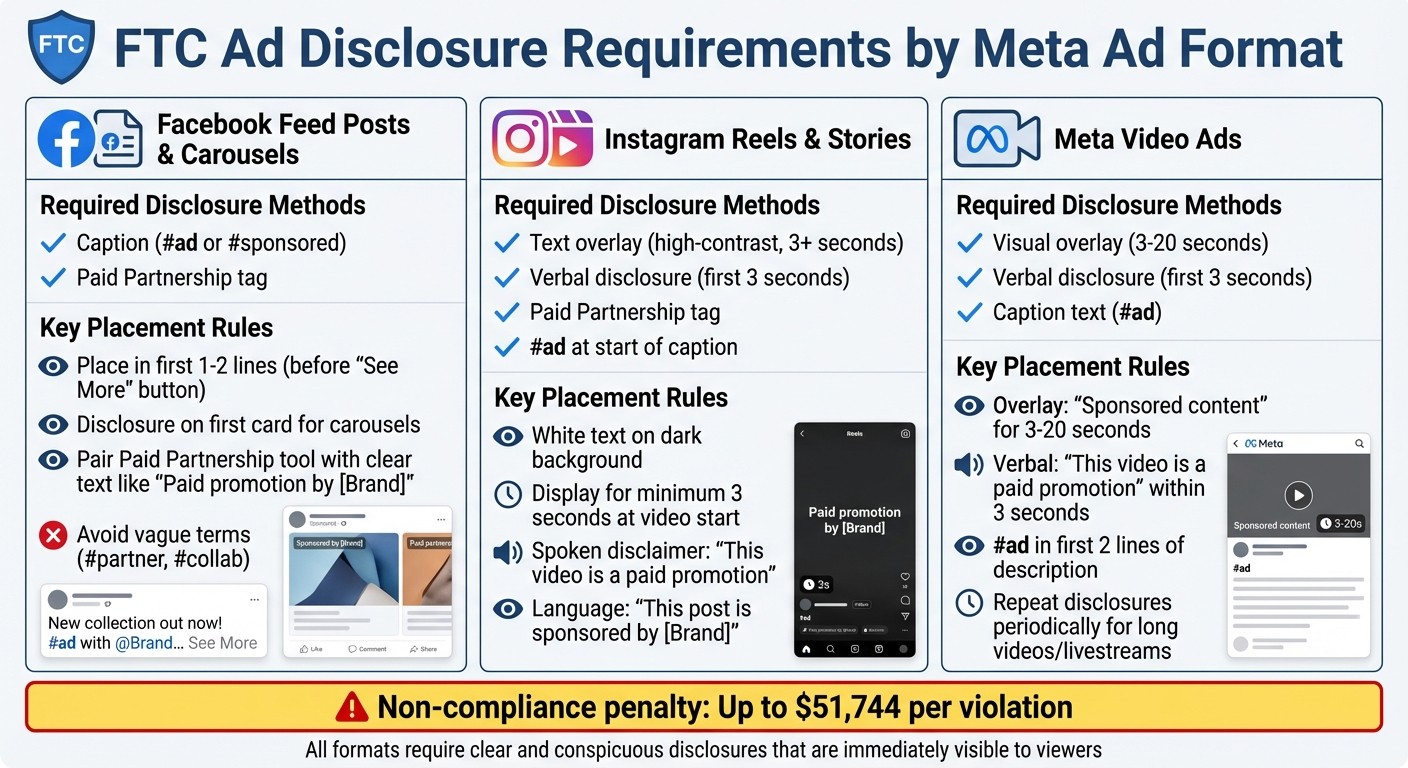
FTC Ad Disclosure Requirements by Meta Ad Format
The Federal Trade Commission (FTC) has specific guidelines for disclosures in Meta ad formats, ensuring transparency across platforms. Each format requires clear, well-placed disclosures tailored to its unique structure and user experience, which is why understanding Meta ad format benchmarks is essential for compliance and performance.
Facebook Feed Posts and Carousels
For Facebook Feed Posts and Carousels, disclosures like #ad or #sponsored should appear in the first one or two lines of the AI ad copy generator - before the "See More" button truncates the text. This placement ensures users can spot the disclosure immediately without expanding the post. Additionally, Meta's Paid Partnership tool adds a "Paid partnership with [Brand]" label above your content. While this tool is helpful, the FTC advises pairing it with a clear textual disclosure, such as "Paid promotion by [Brand]", for added clarity. Avoid vague terms like #partner or #collab, as they may not meet FTC standards; you can use a Meta ad policy checker to identify potential Meta ad policy compliance. For carousel ads, make sure the disclosure is visible on the very first card to catch users' attention at the start of their interaction.
Instagram Reels and Stories
Instagram's fast-paced formats - Reels and Stories - require a more layered approach to ensure disclosures are clear and unavoidable, especially since ad copy vs. visuals in Meta ads impact performance differently in these placements. Use a high-contrast text overlay, such as white text on a dark background, and display it for at least 3 seconds at the start of the video. Include language like "This post is sponsored by [Brand]." Always activate the Paid Partnership tag and add #ad at the very beginning of your caption. If your video includes audio, include a spoken disclaimer within the first 3 seconds, such as "This video is a paid promotion", to account for users who may view the ad on mute or join mid-way through. This ensures your message lands even when you are optimizing Meta ads for ROI across different audience segments.
Meta Video Ads
Meta Video Ads demand a combination of visual, verbal, and textual disclosures to meet FTC guidelines. Start with a visual overlay that remains on-screen for the first 3 to 20 seconds (depending on the video's length) with text like "Sponsored content." Include a verbal disclosure, such as "This video is a paid promotion", within the first 3 seconds. In the video description, place #ad within the first two lines to ensure visibility before the text is truncated. For longer videos or live streams, repeat disclosures periodically to account for viewers who join mid-way or watch without sound.
Ad Format | Required Disclosure Methods | Key Placement Rules |
|---|---|---|
Facebook Feed/Carousels | Caption (#ad/Sponsored), Paid Partnership tag | Above "See More"; disclosure on the first card for carousels |
Instagram Reels/Stories | Text overlay, verbal (first 3 seconds), Paid Partnership tag | Overlay persists for at least 3 seconds; clear and prominent placement |
Meta Video Ads | Audio (verbal), visual text overlay, caption text | Disclosures integrated throughout; not limited to the description |
Common Mistakes and How to Avoid Them
Even seasoned advertisers can slip up - rushed campaigns, unclear messaging, or failing to understand what "clear and conspicuous" actually means can result in hefty fines of up to $51,744 per violation, content removal, and prolonged FTC scrutiny. Building on earlier discussions, this section identifies FTC disclosure rules for brands to ensure transparency. Below, we’ll explore frequent pitfalls and offer a checklist to help you stay compliant.
Hidden or Hard-to-Find Disclosures
One frequent mistake is hiding disclosures behind the "See More" button on platforms like Instagram or Facebook. When users have to expand a post to find the disclosure, it violates the FTC's rule that it must appear within the first one or two lines of text. Another misstep is using vague hashtags like #Thanks, #Partner, or #Collab, which fail to clearly communicate material connections. Instead, opt for clear terms like #ad or Sponsored by [Brand] to avoid confusion and liability.
Relying solely on Meta's Paid Partnership tool without adding additional text or visual disclosures is another common error. While the tool is helpful, it doesn’t replace the FTC’s requirement for layered disclosures. For video content, low-contrast overlays, fleeting text (less than three seconds), or disclosures placed only at the end of a video don’t meet the standards. To comply, disclosures in video formats should:
Appear within the first three seconds.
Persist for at least three seconds.
Use high-contrast text (similar to 24-point font size).
Include a spoken disclosure if audio is present. Advertisers should also ensure they are following Meta Consent Mode requirements to maintain data privacy compliance alongside FTC rules.
These adjustments ensure your content meets FTC requirements and minimizes compliance risks.
Penalties for Non-Compliance
The FTC takes enforcement seriously. In April 2023, the agency warned nearly 700 advertisers to back up their claims or face consequences. Penalties can be steep, as seen in several high-profile cases. For example, Google paid $22.5 million between 2016 and 2023 after influencers failed to disclose paid endorsements for Chrome extensions. Similarly, YouTubers Trevor "TmarTn" Martin and Thomas "ProSyndicate" Cassell each paid over $30,000 in 2016 for not disclosing their ownership stakes in CSGO Lotto, a gambling site they promoted. Teami, a detox tea brand, also faced fines and injunctions for undisclosed influencer sponsorships.
Both brands and influencers bear equal responsibility. If a brand neglects to include disclosure requirements in contracts or instructs influencers to avoid using terms like #ad, the FTC holds the advertiser accountable. To avoid these pitfalls, agencies and in-house teams should include clear disclosure guidelines, placement rules, and auditing rights in all influencer agreements. Following the checklist below can help you steer clear of costly mistakes.
Compliance Checklist
Before launching any Meta campaign, run through this Meta ads compliance checklist to catch potential issues:
Visible Disclosures: Use terms like #ad or Sponsored by [Brand] in the first line of captions, ensuring they’re visible on both mobile and desktop.
Video Overlays: On-screen disclosures in videos, Reels, or Stories must persist for at least three seconds and use high-contrast text.
Audio Disclosures: Include a spoken disclosure within the first three seconds of any audio content.
Layered Disclosures: Activate Meta's Paid Partnership tag and supplement it with additional text or visual disclosures.
Avoid Vague Hashtags: Replace terms like #partner with clearer language.
Contract Clarity: Ensure influencer agreements explicitly mandate proper disclosures.
Embed the Checklist: Use this checklist for all Meta ad formats to maintain consistency.
Automating compliance checks can save time and reduce risk. Tools like AdAmigo.ai can scan your Meta ad account for missing or poorly placed disclosures, ensuring campaigns meet FTC standards before going live. Its AI features, like the Chat Agent and Actions tool, can audit ads and provide prioritized daily tasks for compliance adjustments, allowing you to focus on strategy while maintaining full oversight.
Common Mistake | Why It Fails FTC Rules | Fix |
|---|---|---|
Hidden in captions/hashtags | Not clear or conspicuous; buried or vague | Use #ad or #sponsored at the start, above "See More" |
End-of-video or description only | Viewers miss it; not immediately apparent | Overlay in the first 3 seconds with early verbal disclosure |
Single platform tool (e.g., Paid Partnership) | May not suffice alone | Layer with additional text and verbal disclosures |
No repetition in livestreams | New viewers may miss the initial disclosure | Repeat disclosures periodically throughout the stream |
Tools to Automate FTC Compliance
Relying on manual checks for FTC compliance can lead to mistakes, missed details, and costly penalties. As Meta ad campaigns grow, managing dozens - or even hundreds - of ads manually becomes impractical. Automation steps in to handle this complexity, scanning ad copy, overlays, and captions for missing disclosures and flagging potential issues before your ads go live. These tools ensure adherence to platform-specific rules, like requiring #ad in the first line of captions or three-second overlays for Reels. By automating these tasks, you can minimize the risk of FTC penalties while focusing your efforts on campaign strategy.
How AdAmigo.ai Simplifies Disclosure Compliance
AdAmigo.ai takes the guesswork out of staying compliant by embedding disclosure checks at every stage of your ad creation and campaign management process. Acting as an AI media buyer for Meta ads, it ensures compliance by automatically including disclosures - like #ad or Sponsored by [Brand] - in prominent positions within creatives. This eliminates the risk of human error and ensures your ads meet FTC guidelines right from the start.
The platform’s AI Actions feature offers a daily list of recommended fixes, such as correcting misplaced #ad tags or adding verbal disclosures in the first three seconds of audio. It even suggests adjustments, like moving disclosures to more visible spots in captions to prevent them from being truncated.
AdAmigo.ai also includes an AI Chat Agent, which answers questions about compliance issues, explains gaps (e.g., why a Reel lacks a proper overlay), and enables bulk analysis. For large-scale campaigns, its Bulk Ad Launch feature generates hundreds of Meta ads - complete with pre-configured disclosures tailored to each format, such as static overlays for Stories or audible disclaimers for Reels. As an official Meta Business Technology Partner, AdAmigo.ai integrates securely with your campaigns, providing 24/7 monitoring to catch issues like disabled ads or setup errors before they become costly.
Rochelle D. from G2 shared, "Our budgets are controlled, our spend is being smartly allocated and our ROAS is up massively. Agencies charging 7 times the cost of AdAmigo have been put to shame quite frankly!"
This seamless integration makes compliance a natural part of your workflow.
Adding Compliance to Your Workflow
Getting started with AdAmigo.ai is straightforward. Connect your Meta ad account (a process that takes about five minutes), set your performance goals by configuring Meta ad guardrails like ROAS thresholds or spending targets - and let the AI handle the rest. For example, you can instruct the AI to "Scale spend 30% at ≥3× ROAS", and it will generate creatives with built-in disclosures, audit campaigns for issues like hidden tags, and even auto-publish adjustments when needed.
The platform also provides a daily feed of actionable tweaks, such as updating influencer-style posts with prominent disclosure tags. This allows you to streamline compliance checks across formats, from video overlays to caption placements. Agencies using AdAmigo.ai report managing 4–8× more clients by automating these tasks, reducing non-compliance by 90%, and avoiding FTC penalties through pre-launch scans. For instance, one brand increased its ad spend by 30% while maintaining a 3× ROAS by automatically adding compliant overlays, avoiding issues like undisclosed influencer perks.
By configuring the AI Ads Agent to include pre-approved disclosure snippets in captions and overlays, you can ensure compliance at scale. The AI Actions feature then prioritizes disclosure fixes across accounts, making bulk approval quick and efficient.
Manual vs. Automated Compliance
Manual compliance methods rely on human checklists and reviews, which are prone to errors like buried #ad tags. These oversights can lead to fines of up to $50,120 per violation. Additionally, manual processes are time-consuming and struggle to keep up with evolving FTC rules.
Automated tools like AdAmigo.ai, on the other hand, handle compliance 24/7. They enforce templates, detect errors instantly, and scale effortlessly to manage hundreds of ads. While there’s an initial setup phase - usually taking about five minutes - automation consistently outperforms manual methods by integrating compliance checks directly into your workflow.
Here’s a side-by-side comparison:
Aspect | Manual Compliance | Automated Compliance (AdAmigo.ai) |
|---|---|---|
Monitoring | Periodic manual checks by staff | Continuous 24/7 monitoring |
Error Detection | Human review of ad content | AI detection of setup mistakes and broken links |
Ad Creation | One-at-a-time disclosure updates | Bulk launch with AI-optimized templates |
Account Auditing | Manual spreadsheets | Instant, automated audits |
Response Time | Delayed by staff availability | Immediate alerts and fixes |
Cost of Errors | High risk of FTC penalties | Reduced risk through preventative checks |
Unlike static tools, AdAmigo.ai evolves based on real campaign results. It refines its methods, adapting to new standards like automated disclosures for brand tags or promo codes. By testing compliant variations and scaling Meta ads while maintaining ROAS, it ensures your campaigns remain effective and compliant across Meta’s ad formats.
Conclusion and Key Takeaways
Why Transparency Matters in Advertising
Being transparent in advertising isn't just a legal box to check - it’s a way to build trust and protect your brand’s reputation. Following FTC compliance for Meta ads, like clearly using #ad at the beginning of a post or adding a visible three-second overlay in Meta ads, can save you from hefty fines that can reach up to $50,120 per violation. But it’s not just about avoiding financial penalties. Failing to comply can erode your credibility, making consumers less likely to trust your brand.
Transparency can also set you apart from competitors. With the FTC now focusing on promo codes, brand tags, and affiliate relationships, advertisers who prioritize clear disclosures are viewed as more reliable. While others may face user consent auditing for Meta ads, corrective actions, or even avoiding Meta ad rejections, your campaigns can keep running smoothly. By making transparency a core part of your advertising strategy, you not only stay compliant but also turn it into a strength that builds consumer trust and loyalty.
Using Technology to Maintain Compliance
Maintaining transparency at scale requires more than manual checks - it calls for AI compliance tools. Relying on manual reviews can lead to missed issues like poorly placed #ad tags, missing overlays, or inconsistent messaging across multiple ads. Tools like AdAmigo.ai simplify this process by AI tools for Meta ad account analysis to catch problems like truncated captions or missing disclaimers, helping you fix them immediately.
Features like AI Actions in AdAmigo.ai make it easy to approve or auto-correct flagged issues quickly. Plus, its 24/7 monitoring ensures that setup errors, disabled ads, or broken links are caught early - saving you from losing money or drawing FTC attention. By integrating directly with your ad account, the platform ensures all your creatives, whether they’re Reels, carousels, or videos, meet the specific rules of the platform you’re using.
FAQs
What happens if I don't follow FTC ad disclosure rules?
Failing to follow the FTC's ad disclosure rules can lead to legal penalties, substantial fines, and harm to your brand's reputation. Perhaps even more damaging is the potential loss of consumer trust - a fragile asset that's tough to regain once broken.
On top of that, the FTC might launch investigations or enforce sanctions, which could seriously disrupt your business operations. Following these rules isn’t just a legal obligation - it’s a way to ensure transparency and protect your business from avoidable risks.
How do I make sure my ad disclosures are clear and easy to understand on different platforms?
To make your ad disclosures clear and easy to grasp, place them near the main message and use simple, plain language. Ensure they are highly visible, even on mobile screens, and steer clear of small fonts, unclear phrasing, or hard-to-read layouts.
Stick to FTC guidelines by adjusting disclosures to match the platform's design and user experience. Regularly review and update them to stay compliant and keep up with changes in platform standards.
How can I simplify FTC compliance for ad disclosures?
Managing FTC compliance for ad disclosures becomes a breeze with tools like AdAmigo.ai. This platform simplifies ad management on channels like Meta by using AI to seamlessly incorporate required disclosures into your campaigns.
Beyond compliance, AdAmigo.ai fine-tunes your creatives, targeting, and budgets, ensuring your ads remain effective. It takes care of the tedious details, allowing you to stay compliant while keeping your attention on strategy and scaling your business.