
Why Regular Privacy Policy Updates Matter for Meta Ads
Meta's AI now scans ads and landing pages; outdated privacy policies risk rejections, account limits, and higher costs. Audit quarterly and disclose data use.
Outdated privacy policies can hurt your Meta ad campaigns in 2026. Meta now uses AI to scan every ad and landing page for compliance before they go live. If your privacy policy is outdated or inconsistent with your ad content, your ads may be rejected, your account restricted, or your ad performance reduced.
Key Takeaways:
AI Scans Everything:Meta’s AI reviews text, images, video, and landing pages for policy violations.
Frequent Updates: Meta introduced 47 policy changes in Q1 2026 alone.
Risks of Non-Compliance:
Ad rejections
Lower ROI and higher costs
New Requirements:
Documented user consent for custom audiences
Clear privacy policy language on AI use and data handling
Stricter rules for sensitive categories like health and finance
Action Steps:
Audit and update your privacy policy quarterly.
Use tools like AdAmigo.ai to automate compliance checks.
Ensure transparency in AI-generated content and data usage.
Regular updates and automated tools can help you avoid penalties and maintain ad performance.
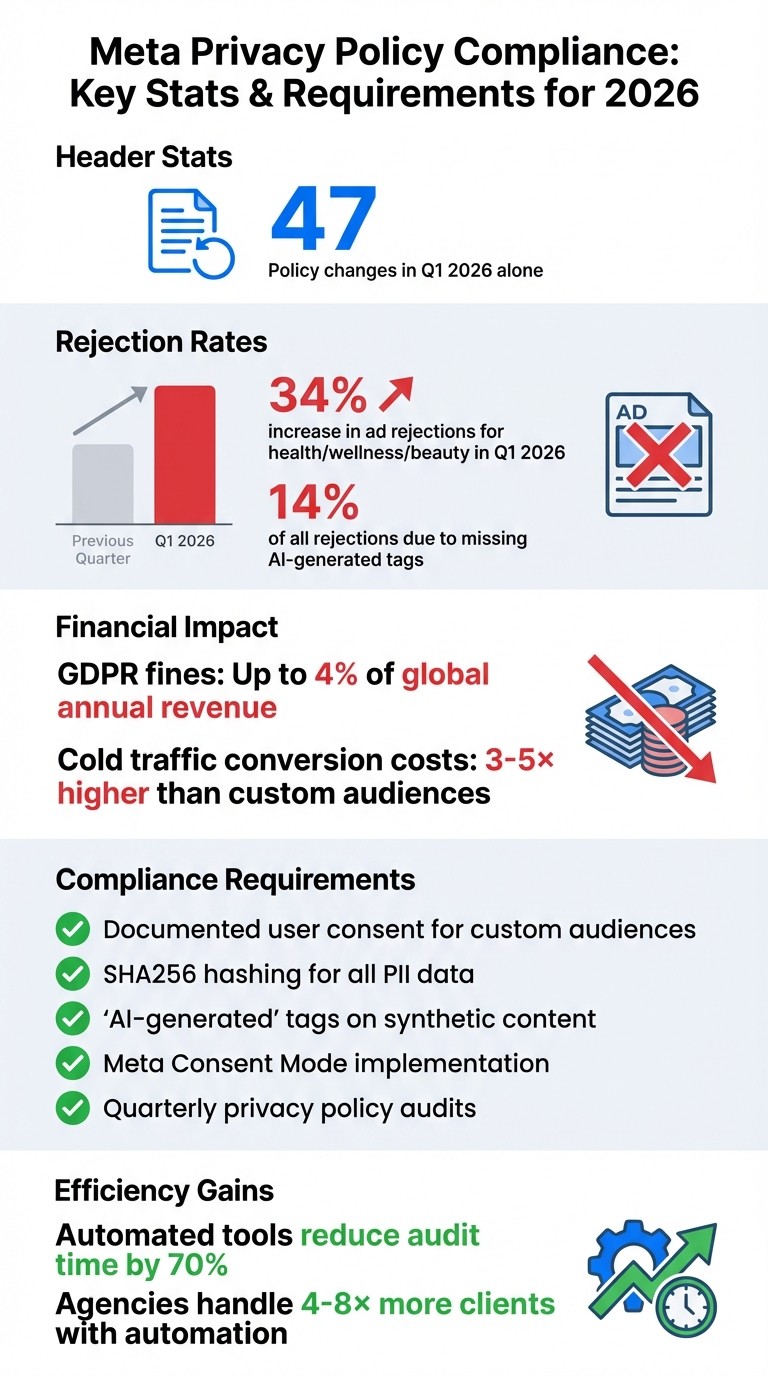
Meta Privacy Policy Compliance: 2026 Statistics and Requirements
Problems Caused by Outdated Privacy Policies
Non-Compliance with Meta's Privacy Standards

Having an outdated privacy policy can lead to some serious headaches, especially when it comes to Meta's strict requirements. If your privacy policy isn't up to date, Meta's automated systems - like the "Andromeda" engine - can flag your ads before they even reach your audience. This system scans for landing pages that either lack a visible privacy policy or use outdated language. Even a single violation can result in account-level restrictions, significantly limiting your ads' reach.
Meta also has strict rules against ads that suggest the use of sensitive personal data. If your privacy policy doesn't clearly disclose how you handle data, you're at risk of even harsher restrictions. And it's not just about ad delivery - these issues can also open the door to legal troubles and financial penalties.
Legal and Financial Penalties
Outdated privacy policies don't just upset platforms like Meta - they can also land you in hot water with privacy laws in the U.S. and abroad. For instance, failing to meet GDPR's opt-in requirements or CCPA/CPRA's opt-out standards puts you at risk of legal action.
If you're using tools like Meta Pixel to collect sensitive data, such as health or wellness information, and your privacy policy doesn't explicitly address this, you could face lawsuits or even HIPAA violations. Regulators like California's Attorney General, the California Privacy Protection Agency, and EU Data Protection Authorities aren't shy about enforcement. Under GDPR, fines can reach up to 4% of your global annual revenue, not to mention the legal fees and potential damage to your brand's reputation.
Impact on Ad Performance and ROI
Outdated or non-compliant privacy policies don't just create legal risks - they also hurt your advertising performance. Meta's systems compare the privacy policies on your landing pages with the claims in your ads. If there's a mismatch, your ad delivery might be restricted. This can lead to fewer impressions, higher costs per click, and a weaker return on ad spend (ROAS).
Another major issue is losing access to Custom Audiences if you can't provide proper consent documentation. Custom Audiences are often made up of people already familiar with your brand and more likely to convert. Without them, you'll have to rely on cold traffic, which typically costs 3–5× more to convert and results in a much lower ROAS. Simply put, an outdated privacy policy can cost you both money and opportunities.
Meta's Current Privacy Requirements
In 2026, Meta introduced significant updates to its policies, shifting from a reactive approach to a more proactive enforcement model. If you're running ads on Meta's platform, your privacy policy must align with these changes to avoid ad rejections or delivery restrictions.
The updates focus on reducing risks associated with outdated policies by enforcing stricter transparency and verification standards.
Required Data Transparency and Source Declarations
Meta now mandates documented user consent before uploading any contact information for custom audience targeting. This means you can no longer rely on pulling email lists from your CRM without proof of consent. You must have clear documentation showing users agreed to their data being used for advertising purposes.
Additionally, Meta Consent Mode is now required to manage Pixel and Conversions API (CAPI) tracking in accordance with user preferences. If a user opts out, your systems must respect their choice immediately. On top of that, all personal data - such as emails, phone numbers, and names - must be hashed using SHA256 before being transmitted via CAPI.
Stricter Identity Verification for Sensitive Categories
Advertisers in sensitive categories face more rigorous verification processes. For example, if you're promoting financial services, you must complete verification in 38 countries before your ads can go live. Cryptocurrency advertisers are required to obtain a "Verified Crypto Advertiser" badge and secure pre-approval for individual campaigns.
Health, wellness, and beauty advertisers have been hit particularly hard. Following Meta's "March Crackdown" in 2026, rejection rates for these ads increased by 34% in Q1. If you're promoting supplements or similar products, your ads must include the disclaimer: "This product is not intended to diagnose, treat, cure, or prevent any disease."
Meta's Multimodal Ad Review System (MARS) now evaluates text, images, videos, audio, and landing pages simultaneously to flag potential violations. This includes identifying ads that imply health transformations or make unverified claims. These measures are part of broader efforts to ensure compliance across all aspects of ad content.
AI-Driven Ad Personalization Requirements
Meta's AI systems now play a central role in ad personalization. Any AI-modified content must include the "AI-generated" tag. Failing to disclose AI involvement is now the third most common reason for ad rejections, contributing to 14% of all rejections in 2026.
Meta has also implemented semantic intent detection, which flags the implied meaning of ad content. For instance, phrases like "For people managing blood sugar" can trigger violations, even if they don't contain specific restricted keywords. This underscores the need for advertisers to carefully review their messaging to ensure compliance with Meta's evolving standards.
Steps to Keep Your Privacy Policy Compliant
With 47 updates introduced in 2026, keeping your privacy policy up-to-date is essential. Staying compliant not only helps reduce legal risks but also ensures your ad performance remains unaffected.
Audit Current Privacy Policies
Start by reviewing your privacy policy to ensure it aligns with Meta's latest requirements. Check that it explicitly documents user consent for custom targeting, outlines data collection and usage practices, and addresses newer elements like AI-generated content, data hashing, and consent management.
Make sure your privacy policy URL is functional and returns a "200 response" using the Meta Sharing Debugger. Additionally, test your Lead Ads on mobile devices to confirm that the link is accessible.
After completing the audit, update your policy to reflect the new consent requirements. Use Meta's tools to test and verify these updates.
Add AI and Data-Use Consent Language
If your audit reveals gaps, update your privacy policy to include clear language about AI and data usage. For example, explain how AI-driven personalization and synthetic content are handled. Any AI-modified ad creative should be labeled as "AI-generated" to avoid rejection.
Include details about how you use Meta Consent Mode to manage Pixel and Conversions API tracking based on user preferences. Ensure that personally identifiable information (PII) is hashed using SHA256 before transmission. This level of transparency builds trust with users and demonstrates that your practices meet compliance standards.
Test Updates with Meta's Compliance Tools
Before rolling out your updated policy, use Meta's compliance tools to verify everything is in order. The Account Quality Dashboard and Meta Event Manager are great resources for checking compliance.
To streamline this process, consider tools like AdAmigo.ai. Their free Meta Ad Policy Checker can help you pre-screen ad text and images for compliance, reducing the chances of last-minute fixes after rejections.
Audit Category | Key Action Item | Compliance Standard |
|---|---|---|
AI Content | Apply "AI-generated" label to synthetic media | 2026 AI Transparency Policy |
Data Transmission | Hash all PII using SHA256 before sending via CAPI | Meta Security Standards |
Consent Management | Implement Meta Consent Mode for tracking permissions | Meta Consent Mode Requirements |
Best Practices for Regular Privacy Policy Reviews
Keeping privacy policies up to date is crucial to avoid legal, financial, and performance setbacks. What worked yesterday might not work tomorrow, as platforms like Meta frequently update their policies. Ads that once passed compliance checks can unexpectedly be flagged as non-compliant. This is why regular reviews and audits of your privacy policies are not just helpful - they're essential.
Conduct Quarterly Privacy Audits
Set aside time every three months to review your privacy policies and ad practices. Meta’s policies evolve quickly, and quarterly audits help you stay ahead of these changes. During each audit, focus on these four critical areas:
Compare your privacy policy against Meta's latest standards.
Check ad accounts for any potential issues related to sensitive data.
confirm that AI personalization practices and consent language meet global privacy rules and current compliance requirements.
Use Meta’s compliance checker to test your active ads.
For example, during a Q1 2026 audit, a wellness brand discovered that some of its ad copy included sensitive data claims that no longer aligned with updated policies. After revising the copy and removing flagged claims, the brand saw its account health improve significantly, with ad approval rates increasing by 40%.
Use Automated Compliance Tools
Manual audits are important, but automation can make staying compliant much easier. By Using automated compliance tools, you can monitor your ad accounts 24/7 for potential issues. These tools can identify non-compliant practices before ads even go live, reducing manual audit time by about 70%. They’re particularly effective at catching problems like blocked custom audiences or missing AI transparency disclosures in real time.
Take AdAmigo.ai as an example. This tool continuously tracks account health, flags sensitive data use, and ensures compliance with current policies. It even goes a step further by generating ad creatives that include proper transparency language. Plus, it provides teams with a daily to-do list to prioritize compliance tasks. For agencies, this means one media buyer can handle 4–8× more clients without compromising on compliance. Meanwhile, in-house teams can eliminate the need for manual audits entirely, freeing up resources to focus on strategic goals.
Tools to Simplify Privacy Compliance for Meta Ads
Keeping up with Meta's privacy rules can feel overwhelming, especially when outdated policies put your campaigns at risk. That's where automated tools like AdAmigo.ai step in. By monitoring Meta ad compliance and maintaining ad performance around the clock, these tools save you from dealing with rejected ads or account penalties. Instead of stressing over the details, you can focus on crafting winning strategies while automation takes care of the rest.
AdAmigo.ai for Privacy and Performance
AdAmigo.ai acts as a smart AI media buyer, balancing compliance and performance with ease. Its AI Ads Agent creates ad creatives that align with Meta's 2026 AI transparency guidelines. It even filters out restricted keywords - like "cure" or "guaranteed" - before your ads go live. The system scans campaigns in under two minutes, a huge improvement over Meta's typical 24-hour manual review process.
With its AI Actions feature, AdAmigo.ai provides a daily list of flagged issues, helping you tackle violations in real time. For instance, it identifies blocked custom audiences using sensitive attributes (banned since September 2, 2025) or missing AI disclosure language. This proactive system helped advertisers avoid a 34% increase in ad rejections in industries like health and beauty after Meta's March 2026 policy update.
Another standout feature, AdAmigo Protect, continuously monitors account health, catching unusual activity or delivery problems that might indicate compliance issues. Agencies managing multiple clients can handle 4–8× more accounts without compromising on compliance. For in-house teams, this eliminates the need for AI tools for Meta ad account analysis, freeing up time for more strategic efforts.
Integration Benefits of AdAmigo.ai
AdAmigo.ai doesn’t just simplify compliance - it also integrates seamlessly into your Meta ad account to boost efficiency. In just five minutes, you can connect your account, set KPIs (e.g., "Increase spend by 30% while maintaining ≥3× ROAS"), and let the system generate campaigns that align with your goals. Its Bulk Ad Launch feature pre-screens all creatives and targeting combinations, ensuring they meet Meta's transparency and content standards across text, images, and video.
The AI Chat Agent makes managing compliance tasks even easier. Need to add "Synthetic" tags to hundreds of AI-generated ads? Just ask. Curious why a campaign was rejected? The chat agent provides insights and fixes issues directly. This tool adapts to Meta's changing rules while tailoring its approach to your account's specific performance trends.
Feature | Manual Compliance | AdAmigo.ai (AI-Driven) |
|---|---|---|
Review Timing | Reactive (post-submission) | Proactive (pre-submission) |
Time Required | Hours per week | Less than 5 minutes weekly |
Monitoring | Periodic or weekly reviews | 24/7 real-time monitoring |
Error Rate | Higher (human oversight) | Lower (automated checks) |
Scalability | Linear (staff-dependent) | Scalable without extra staff |
AdAmigo.ai not only simplifies compliance but also helps you scale your campaigns efficiently, keeping you ahead in the fast-changing world of Meta advertising.
Conclusion
Staying ahead in Meta's fast-changing ad environment depends heavily on privacy compliance. With Meta's 2026 policies requiring advertisers to declare data sources, disclose AI usage, and verify identities more rigorously, outdated privacy practices can quickly derail your campaigns. Advertisers who haven't updated their workflows since 2024 are already facing higher rejection rates and declining account health. On the other hand, those who keep up with compliance enjoy smoother ad approvals, fewer disruptions, and continued access to Meta's powerful AI personalization tools.
The stakes are particularly high in industries like health, wellness, and beauty. Non-compliant advertisers in these sectors experienced a 34% increase in ad rejections during Q1 2026. Meanwhile, their competitors with updated policies scaled their campaigns without interruption, gaining a growing advantage. Every rejected ad or account suspension widens this gap, making it harder to catch up.
Relying on manual compliance processes just doesn't cut it anymore. Meta's AI-driven audits are too proactive and complex. Tools like AdAmigo.ai make compliance manageable by automating pre-submission checks, identifying Meta ad policy issues instantly, and optimizing campaigns to align with Meta's privacy standards. In just five minutes, you can connect your account, set your goals (like "Increase spend by 30% with a 3× ROAS"), and let the AI handle execution. Agencies using AdAmigo.ai report managing 4–8× more clients without sacrificing compliance, while in-house teams eliminate the need for time-consuming manual audits.
Regularly updating your privacy policies and leveraging automation is essential for long-term success on Meta's platform. Quarterly consent audits and tools like AdAmigo.ai not only protect your account health but also ensure you can adapt to policy changes without missing a beat. By integrating these strategies now, you safeguard your campaigns, maintain user trust, and stay competitive in Meta's evolving ad landscape.
FAQs
What privacy policy changes most often trigger Meta ad rejections?
Meta ads frequently face rejection because of outdated or non-compliant privacy policies. Common problems include vague explanations about how user data is handled and not obtaining the necessary user consent, particularly under regulations like GDPR (General Data Protection Regulation) and CCPA (California Consumer Privacy Act). To avoid interruptions, it's important to review and update your privacy policy regularly, ensuring it meets current standards and clearly communicates data practices.
What proof of consent do I need for Custom Audiences?
You need to gather clear, explicit, and documented user consent in real time when using Custom Audiences. This approach not only aligns with privacy laws but also establishes tamper-proof records of user preferences, protecting your business while maintaining user trust.
How can I quickly check if my landing page privacy policy will pass Meta’s AI review?
Make sure your privacy policy is crystal clear about how data is collected, used, and shared. It should be easy to find, regularly updated, and compliant with regulations like GDPR and CCPA. Transparency here isn’t just a legal requirement - it builds trust with your audience.
To stay on top of compliance, utilize tools like Meta’s Account Quality dashboard to identify and address potential issues. You can also explore AI-driven tools such as AdAmigo.ai. These tools can help automate compliance checks, ensuring your landing page aligns with Meta’s guidelines before you submit it.