
Meta Ads and FTC Compliance
Guide to running FTC-compliant Meta ads: truthful claims, visible disclosures, correct placement, penalties to avoid, and automation options.
Running Meta ads without following FTC rules can lead to severe penalties, including fines up to $53,088 per offense. The FTC requires ads to be truthful, backed by evidence, and include clear disclosures. Non-compliance risks include financial penalties, long-term restrictions, and damage to your brand's reputation. Here's what you need to know:
Truthful Claims: Every statement in your ad must be supported by reliable evidence.
Clear Disclosures: Ads must clearly indicate sponsorships or material connections using terms like "Ad" or "Sponsored."
Placement Matters: Disclosures should be visible and not hidden behind "More" buttons or buried in hashtags.
Meta-Specific Rules: Use tools like the "Paid Partnership" tag but ensure manual disclosures are also in place.
Global Reach: U.S. FTC rules apply to ads targeting U.S. consumers, even if posted from outside the country.
Automation Tools: AI tools like AdAmigo.ai can help monitor and maintain compliance across campaigns.
Ignoring these rules can lead to fines calculated per ad impression, as seen in cases like Facebook's $5 billion penalty in 2019. Stay compliant to avoid legal trouble and protect your brand.
Don't Let FACEBOOK Ban Your Ad Account Follow These Rules
Staying ahead of Meta ad policy compliance is essential to keeping your account active and your campaigns running smoothly.
FTC Principles for Digital Advertising
Following FTC principles isn’t just about staying compliant with regulations - it’s also key to building customer trust and ensuring your Meta ad campaigns are effective. The FTC’s guidelines for digital advertising are straightforward: every Meta ad must feature truthful claims, supported by competent and reliable scientific evidence. This requirement is grounded in Section 5 of the FTC Act.
Transparency and Honest Representation
The FTC mandates that advertisers disclose any "material connection" between themselves and the brands they promote. This includes financial arrangements (like payments, free products, or discounts), as well as employment, family, or personal relationships.
"If you endorse a product through social media, your endorsement message should make it obvious when you have a relationship ('material connection') with the brand."
All ad formats must clearly indicate that the content is advertising. Endorsers are also required to share authentic experiences without exaggeration. Transparency is the cornerstone of these disclosure practices, as outlined below.
Requirements for Ad Disclosures
Disclosures must be clear, conspicuous, and immediately visible. They should appear directly alongside the endorsement or claim, not buried on a profile page, hidden at the end of a long caption, or placed behind a "click more" button.
"Disclosures are likely to be missed if they appear only on an ABOUT ME or profile page, at the end of posts or videos, or anywhere that requires a person to click MORE."
Federal Trade Commission
Placement matters. On Meta platforms, disclosures need to be incorporated visibly within the content. For example:
Superimposed on visuals in Stories.
Included in both video and audio for standard videos.
Repeated periodically during live streams.
Language is just as crucial. Disclosures should use straightforward terms like "Ad", "Paid link", "Sponsored", or "Promotion." Avoid vague abbreviations such as "sp", "spon", or "collab". While Meta offers tools like the "Paid Partnership" tag, the FTC recommends using these alongside your own clear disclosures, not as a substitute. For high-volume advertisers, automating Meta ad campaigns can help ensure these disclosures are applied consistently across all creatives. If hashtags are used (e.g., #ad or #sponsored), make sure they are not buried among other hashtags or links where they could be overlooked.
Lastly, if you're posting from outside the United States but your Meta ad is likely to reach U.S. consumers, you are still subject to U.S. FTC regulations.
Meta-Specific Disclosure Requirements

Meta's advertising policies are designed to align with FTC regulations, but implementing these rules on platforms like Facebook and Instagram requires a tailored approach. In 2023, the FTC updated its Endorsement Guides to stress the need for a clear distinction between promotional and regular content. Here's how these guidelines translate into actionable steps for Meta ads.
Complying with Meta's Ad Policies
Meta mandates that advertising claims remain truthful (often requiring a precise ad copy generator), backed by evidence, and free from deception, in line with Section 5 of the FTC Act. Additionally, any material connection between the advertiser and the brand - whether it's payment, free products, discounts, employment, or family ties - must be clearly disclosed. Meta has specific requirements for various ad formats:
Instagram Stories: Disclosures must be overlaid on the image or video, with clear contrast and enough display time for viewers to read them.
Video Ads (including Reels): Disclosures should be incorporated into both the visual and audio portions of the content.
Live Streams: Disclosures need to be repeated periodically to inform viewers who join mid-stream.
Even tagging a brand in a post qualifies as an endorsement and requires disclosure, regardless of when the product was received.
Best Practices for FTC-Compliant Meta Ads
To meet both FTC and Meta-specific requirements, it's essential to address the unique challenges posed by these platforms. Here are some best practices:
Placement of Disclosures: On Facebook and Instagram, include disclosures in the first few lines of captions - before the "More" button cuts off the text. Avoid placing them at the end of posts, within hashtags, or on profile pages.
Clear Language: Use straightforward terms like "Ad", "Advertisement", "Sponsored", or "Paid partnership." Steer clear of vague abbreviations like "sp", "spon", "collab", or "thanks", which may not clearly indicate a paid relationship.
Built-in Tools: While Meta provides tools like the "Paid Partnership" label, the FTC advises not to rely solely on these tools. Instead, combine them with your own clear disclosures.
For video content, ensure disclosures are synchronized across both audio and visual elements so they are accessible to all viewers, regardless of sound settings. In Stories, disclosures should remain visible long enough for viewers to read them - quick flashes don't meet the "clear and conspicuous" standard. Lastly, remember that U.S. laws apply even to ads posted from outside the country if they are likely to reach U.S. audiences.
Creating FTC-Compliant Meta Ad Campaigns
When Designing Meta ad campaigns, compliance with FTC standards isn't optional - it's essential. Every claim, image, and piece of copy must align with the FTC's "truthful and non-deceptive" standard. When using a Facebook ad copy generator, ensure the output is reviewed for factual accuracy. Non-compliance can result in hefty fines of up to $53,088 per day per ad. Following these steps can help ensure your campaigns meet regulatory requirements from the ground up.
Step 1: Build Compliance Into Your Campaign Plan
Start by ensuring that every claim in your ad is backed by solid evidence. The FTC mandates advertisers to have proof on hand before any ad goes live. This is especially critical when launching Meta ads at scale to avoid common bulk testing mistakes and prevent systemic errors. For claims related to health, safety, or performance, you’ll need "competent and reliable scientific evidence". For example, customer testimonials like "reduces wrinkles by 30%" or "boosts energy" aren’t enough - you’ll need lab data or credible third-party studies to substantiate such statements.
"Advertisers must have proof to back up express and implied claims that consumers take from an ad." - Federal Trade Commission
Step 2: Use Clear and Conspicuous Disclosures
Disclosures must be easy to find and understand - this means they should be "clear and conspicuous". Use straightforward terms like "Ad", "Sponsored", or "Paid Advertisement" instead of vague abbreviations. Placement matters, too. For example:
Instagram Stories: Overlay the disclosure directly on the image or video in high contrast, ensuring it stays visible long enough for viewers to read.
Video Ads and Reels: Include the disclosure in both audio and visual formats to accommodate viewers watching without sound.
Live Streams: Repeat the disclosure periodically so anyone joining mid-stream is informed.
While Meta offers tools like the "Paid Partnership" label, the FTC advises against relying on them as your sole method of disclosure. Use these tools as a supplement to your own manual efforts.
Step 3: Keep Monitoring for Compliance
Compliance doesn’t stop once the ad goes live. Regularly audit running campaigns to ensure disclosures remain visible and claims hold up. Platform changes can sometimes alter layouts, causing disclosures to be hidden behind "More" buttons or pushed off-screen on mobile devices.
"As an influencer, it's your responsibility to make these disclosures, to be familiar with the Endorsement Guides, and to comply with laws against deceptive ads. Don't rely on others to do it for you." - FTC Staff
If you’re collaborating with influencers or third-party partners, don’t assume they’ll handle compliance for you. It’s your legal duty to make sure every endorsement includes proper disclosures. Review influencer content for clear language, proper placement, and accurate timing before it goes live. Additionally, if your campaign uses customer reviews, verify their authenticity - manipulated or fake reviews are a major focus for FTC scrutiny.
Common FTC Violations in Meta Ad Campaigns
Examples of Non-Compliant Ads
The FTC has taken action against several advertisers for practices that are more common on Meta platforms than you might expect. Knowing these cases can help you identify and avoid similar pitfalls in your campaigns.
CarShield was hit with a $10 million penalty in July 2024 for deceptive advertising. The company used celebrity endorsements to promise "peace of mind" and coverage for "every engine part", but many repairs weren’t covered. By December 2025, the FTC had refunded over $9.6 million to affected customers.
Fashion Nova, LLC faced charges in January 2025 for suppressing negative reviews to inflate star ratings.
The Bountiful Company was penalized in March 2024 for "review hijacking." They manipulated product pages on third-party sites by transferring positive reviews from older products to newer ones.
In November 2023, the American Beverage Association (ABA) received an FTC warning over Instagram and TikTok posts by paid dieticians. These posts failed to include clear disclosures, with "#ad" buried in truncated text descriptions. The FTC demanded corrective actions within 15 days, threatening penalties of up to $50,120 per violation.
NextMed, a telehealth provider, faced a final order in January 2026 for deceptive practices, including fake reviews, misleading pricing, and false advertising claims for GLP-1 weight-loss programs.
These examples highlight frequent mistakes that advertisers need to address promptly to avoid legal trouble.
How to Fix Violations
If your ads have inadequate disclosures or unverified claims, pause them immediately and make the necessary corrections.
For disclosure issues, ensure that labels like "#ad" or "Sponsored" are placed at the very beginning of captions, so they’re visible before the "More" button cuts off text. In video content, add permanent text overlays or verbal disclosures instead of relying on the description alone.
When working with influencers or partners, establish a formal review process for their posts. Remember, you're legally responsible for their claims and disclosures, so enforce corrections swiftly.
If your campaign involves reviews, remove any fake or suppressed ones. Avoid reusing reviews across different products. If deceptive review practices have occurred, you may need to run corrective ads as part of an FTC settlement.
For unsubstantiated claims, either remove them or back them up with credible evidence. Understanding Meta's fact-checking process for ads can help you ensure your claims meet these standards. Make sure testimonials clearly reflect typical customer experiences.
"If there is a connection between the endorser and the marketer of a product which would affect how people evaluate the endorsement, the connection should be disclosed." - Federal Trade Commission
Finally, document all corrective actions and maintain detailed records of your compliance efforts. These records can demonstrate good faith and may help reduce penalties if the FTC investigates your campaigns.
Tools for Managing FTC Compliance
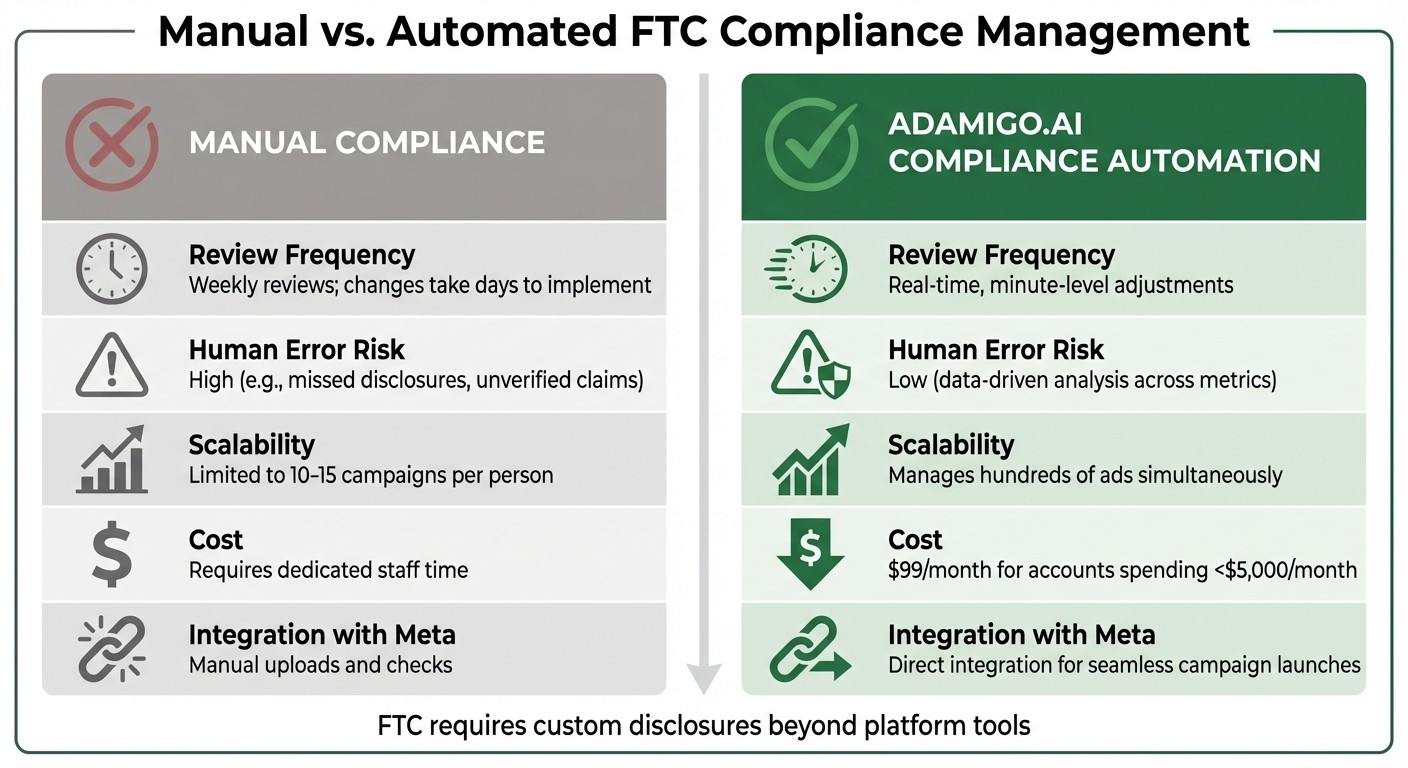
Manual vs Automated FTC Compliance for Meta Ads Comparison
AdAmigo.ai: Automating Compliance Checks
Keeping up with FTC compliance for Meta ads can feel like an uphill battle, especially as your campaigns grow. That’s where AdAmigo.ai steps in, weaving compliance essentials directly into its AI-powered creative and optimization processes.
Here’s how it works: the AI Ads Agent dives into your brand identity and competitor insights to craft image and video ads that are on-point for your brand. These ads are launched into your Meta account with optimized targeting. What’s more, the system ensures that proper disclosures are baked right into the creatives. For example, in Instagram Stories, disclosures are superimposed over visuals, making them impossible to miss - even with the sound off, as required by the FTC.
The tool’s AI Actions feature takes things further by offering a daily, prioritized list of tweaks across your campaigns - covering creatives, audiences, budgets, and bids. Unlike traditional weekly reviews, this system scans real-time data every few minutes, catching potential issues early. For instance, if your click-through rate suddenly nosedives, it might point to a problem with disclosure placement. This gives you a chance to fix compliance issues and avoid Meta ad rejections before they hurt your performance.
Need to manage large-scale campaigns? The Bulk Ad Launch feature lets you create hundreds of Meta ads directly from your Google Drive, complete with compliant copy, creative, and targeting. For agencies juggling multiple clients, this means you can apply disclosure standards across all campaigns without manually checking each one. Plus, the AI Chat Agent can answer questions like, “Which of my active ads are missing disclosures?” and even guide you through fixing them using simple, conversational commands.
Start with manual approval workflows to get comfortable with the AI’s decision-making. Then, as you build trust, you can shift to full automation. Just connect your Meta account, set clear goals (like “Increase spend by 30% while maintaining a ROAS of 3×”), and review the daily feed of AI-recommended changes. You can approve, tweak, or auto-publish suggestions, staying in control while the system handles the heavy lifting.
Next, let’s compare manual compliance processes with automated solutions to see how they stack up.
Manual vs. Automated Compliance
When it comes to managing compliance, the choice between manual checks and AI-driven systems boils down to speed, accuracy, and scalability. Manual processes usually involve weekly reviews where team members check ads for proper disclosures, verify claims, and monitor for any policy violations. While this can work for smaller campaigns, it quickly becomes unmanageable as your ad volume increases.
On the other hand, automated tools like AdAmigo.ai operate in real time, monitoring campaigns minute by minute. They flag issues and suggest fixes on the spot. While a human reviewer might effectively handle 10-15 campaigns, an AI system can manage hundreds at once, analyzing factors like time-of-day performance, device usage, and audience behavior - all of which can influence compliance risks.
Here’s a quick breakdown of how manual and automated compliance compare:
Feature | Manual Compliance | AdAmigo.ai Compliance Automation |
|---|---|---|
Review Frequency | Weekly reviews; changes take days to implement | Real-time, minute-level adjustments |
Human Error Risk | High (e.g., missed disclosures, unverified claims) | Low (data-driven analysis across metrics) |
Scalability | Limited to 10-15 campaigns per person | Manages hundreds of ads simultaneously |
Cost | Requires dedicated staff time | $99/month for accounts spending <$5,000/month |
Integration with Meta | Manual uploads and checks | Direct integration for seamless campaign launches |
The FTC has made it clear: advertisers cannot rely solely on a platform’s built-in disclosure tools. It’s up to you to include clear, custom disclosures in your ads, even when using Meta’s native features. Automated systems like AdAmigo.ai can ensure this by embedding tailored disclosure language into every creative, reducing the risk of violations - especially when platform tools fall short or ads appear in unexpected placements.
For example, in Meta Live streams, disclosures must be repeated periodically to account for viewers who join mid-stream. This is easy to overlook with manual processes but can be automated to ensure compliance every time.
The trade-off here is between control and efficiency. Manual processes give you hands-on oversight of every decision but demand a significant time commitment. Automated systems, meanwhile, handle tasks at scale but require clear guidelines and occasional human checks to ensure compliance rules are being applied correctly. Most advertisers find a semi-autonomous approach works best: let AI handle routine checks and optimizations while you focus on strategy and edge cases that need human judgment.
Conclusion
Key Takeaways
Staying compliant with FTC regulations isn’t just a one-time task - it’s an ongoing responsibility. Running FTC-compliant Meta ads is essential for earning your audience’s trust and safeguarding your brand’s reputation. The FTC's guiding principle is straightforward: advertising claims must always be truthful, non-deceptive, and backed by evidence. Whether you're promoting products, collaborating with influencers, or comparing branded content vs. ads for native placements that seamlessly blend into social feeds, such as branded content on Instagram, transparency is non-negotiable.
Every claim you make should be supported by solid evidence, and clear FTC ad disclosures must be included to meet regulatory standards and foster consumer trust. For influencer partnerships or customer reviews, ensure all material connections are disclosed in line with updated FTC guidelines. With new rules like the "Click to Cancel" requirement and the prohibition of hidden junk fees, staying up-to-date with evolving regulations is more important than ever.
Because manual compliance checks can’t keep up with the pace of digital advertising, tools like AdAmigo.ai are invaluable. These tools automate disclosure monitoring and adjustments, helping brands and agencies maintain compliance effortlessly. For agencies managing multiple clients or brands scaling rapidly, automation ensures consistent adherence to compliance standards without the burden of manual oversight.
Ultimately, compliance not only protects consumers but also strengthens your brand. As the Federal Trade Commission aptly states:
"If you advertise online, remember the rules and guidelines that protect consumers also help businesses by maintaining the credibility of the Internet as a marketing medium".
FAQs
How can I ensure my Meta ads comply with FTC regulations?
To keep your Meta ads in line with FTC regulations, start by ensuring that every claim in your ad is truthful, not misleading, and backed by solid evidence. Disclosures should be clear, easy to understand, and placed close to the related claims. If you're using endorsements or influencer content, always be upfront about any paid or gifted arrangements. Use straightforward, platform-friendly language like "#ad" or "Sponsored" to make it obvious. Adding labels such as "Advertisement" or "Sponsored" can also help differentiate ads from regular content.
Make sure these disclosures are visible and readable on all devices, including mobile screens. Tools like AdAmigo.ai can make this process smoother by creating ad creatives with disclosures already built in and identifying any missing or unclear elements before your campaign goes live. Following these steps can help you stay compliant while keeping your focus on driving results.
How can tools like AdAmigo.ai help ensure FTC compliance for Meta ads?
Automated tools like AdAmigo.ai make staying compliant with FTC regulations easier by weaving essential transparency measures directly into your Meta ad campaigns. The FTC requires advertisers to include clear disclosures for paid partnerships, ensure claims are truthful, and properly label endorsements. With AdAmigo’s AI Ads Agent, you can automate the addition of disclosure language, flag misleading claims, and maintain compliance across your ad copy and creative assets.
AdAmigo’s AI Actions feature provides a daily checklist of prioritized tasks, such as updating disclosures or verifying claims, ensuring nothing slips through the cracks. The platform also keeps a detailed audit trail by logging every change, which aligns with FTC documentation requirements. Features like Bulk Ad Launch let you run compliance checks across multiple ads simultaneously, minimizing errors and maintaining consistency. Plus, by analyzing ad performance over time, the tool helps ensure your claims remain accurate and well-supported, keeping your campaigns in line with FTC standards.
What happens if my Meta ads don’t comply with FTC rules?
Failing to comply with the FTC’s transparency and disclosure rules can have serious consequences. The FTC is committed to ensuring that advertisements are truthful and that any required disclosures are clear and easy to spot. If an ad is deemed deceptive or falls short of these standards, advertisers can face investigations, fines, or even be required to make corrections.
Ignoring these rules doesn’t just risk legal trouble - it could also lead to civil penalties, lawsuits, and damage to your brand’s reputation. Beyond avoiding penalties, following these guidelines helps maintain your audience’s trust, keeping your campaigns effective and reliable.