
Top 7 Creative Testing Tips for AI-Managed Campaigns
Structured creative testing for AI-managed Meta ads: isolate variables, run 3–5 variations, use DCO, sequential tests, naming standards, and AI tools.
Meta ad campaigns thrive on one thing: testing the right creative variations. With iOS 14.5 limiting audience targeting, your creative assets now drive more than 50% of your campaign’s performance. But here’s the catch: without a structured approach, you risk wasting budget and missing insights.
Here’s what you need to know:
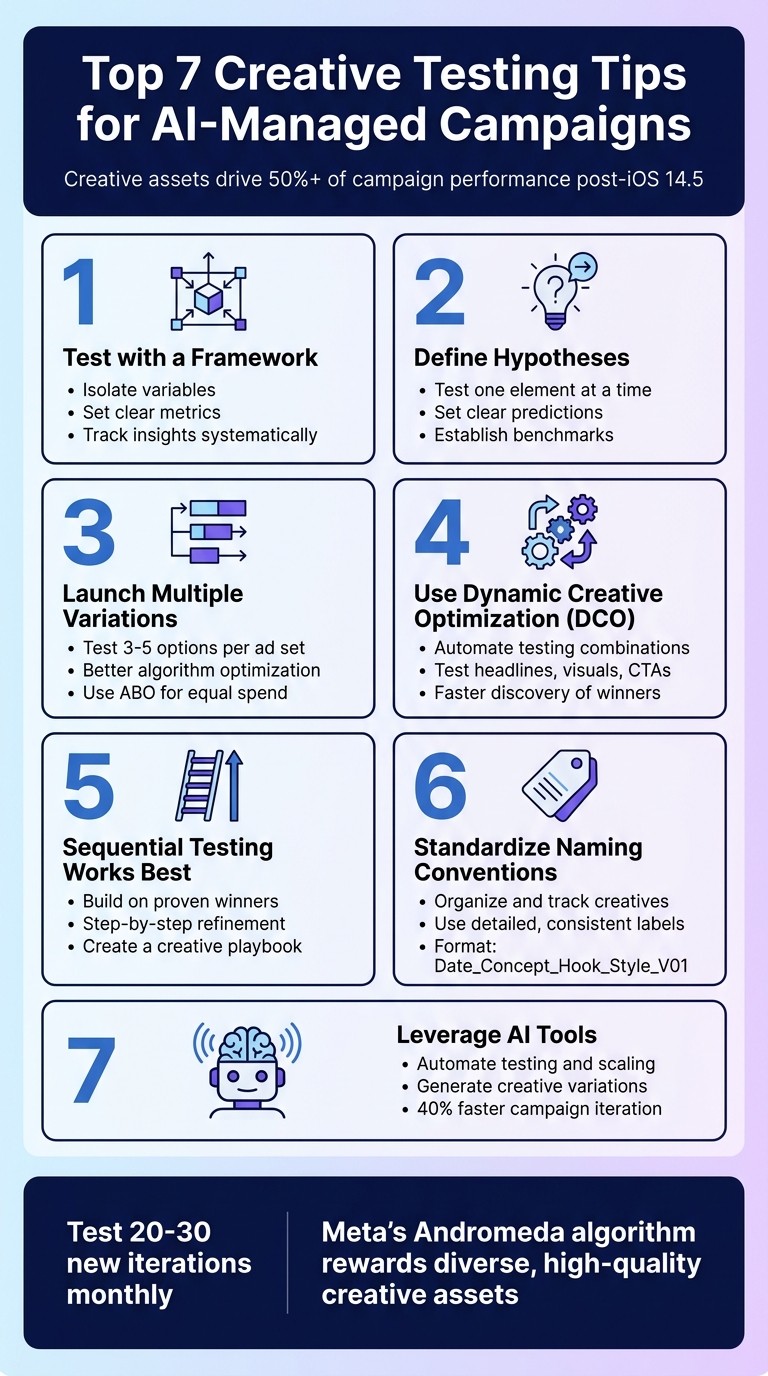
Test with a framework: Isolate variables, set clear metrics, and track insights systematically.
Define hypotheses: Test one element at a time (e.g., hooks, visuals) with clear predictions and benchmarks.
Launch multiple variations:Test 3–5 options per ad set for better algorithm optimization.
Use Dynamic Creative Optimization (DCO): Automate testing combinations of headlines, visuals, and CTAs.
Sequential testing works best: Build on proven winners step by step to refine and scale.
Standardize naming conventions: Organize and track creatives with detailed, consistent labels.
Leverage AI tools: Platforms like AdAmigo.ai automate testing, scaling, and creative generation.
Why it matters: Meta’s AI algorithms, like Andromeda, reward campaigns with diverse, high-quality creative assets. Testing 20–30 new iterations monthly ensures your ads stay relevant and effective. Tools like AdAmigo.ai can speed up this process by up to 40%, helping you scale faster while reducing manual effort.
Want better results? Follow these steps to keep your campaigns fresh and profitable.
7 Creative Testing Tips for AI-Managed Meta Ad Campaigns
The New Meta Ads Creative Testing Framework for 2026
1. Build Campaigns Around Clear Testing Frameworks
Unstructured testing can drain your budget and leave you with no actionable insights. To avoid this, every test should follow a structured testing framework to avoid common pitfalls. This means isolating variables, defining clear success metrics, and creating a library of insights you can rely on for future campaigns. As Angad Singh from Segwise explains:
"The difference between mediocre performance marketing and exponential growth often lies... in the efficiency of your creative testing framework."
Testing Frameworks and Methodologies
To truly understand what works, test one variable at a time. For example, change the hook or the visual while keeping everything else constant. This method helps you identify the exact element driving performance - whether it's the benefit-focused hook, the feature-focused one, or even the type of content (user-generated vs. studio-produced). Without this level of precision, you'll struggle to pinpoint what’s actually making an impact.
For testing, use Ad Set Budget Optimization (ABO) to ensure each variation gets equal spend . Separate your testing campaigns from scaling efforts so every creative has a fair shot at producing results. Once you identify a winning creative in the testing phase, move it to your scaling campaign with a fresh asset ID. This allows the algorithm to treat it as a new asset, giving it an extra boost.
This disciplined approach is the foundation for effective creative iteration.
Creative Iteration and Optimization
Aim to test 20–30 new creative concepts every month. Use kill criteria to pause underperforming ads within 48–72 hours or after spending $50–$100 . This way, you protect your budget while giving high-performing creatives the time and space to shine. For reliable results, aim for 50–100 conversion events per variant or let the test run for 7–10 days before deciding on a winner .
Instead of just analyzing entire ads, dig deeper into individual elements - like emotional tone, color schemes, or even audio styles. This granular approach can help you uncover patterns that you can replicate across future campaigns . To stay organized, use clear naming conventions such as Date_Concept_Hook_Style_V01. This makes it easier to categorize and track creatives, especially when using AI tools .
Once you've identified what works manually, you can scale those insights with AI-driven tools for even greater efficiency.
Automation and AI-Driven Insights
AI tools like AdAmigo.ai can take your creative testing to the next level. For example, AdAmigo's AI Autopilot continuously monitors your account, identifies opportunities, and automatically launches new tests, adjusts budgets, and refines creatives. Meanwhile, its AI Creative Generation feature analyzes your top-performing ads to produce fresh variations, helping you avoid creative fatigue.
2. Define Clear Hypotheses for Each Creative Test
Random testing can drain your budget without delivering meaningful insights. Instead, using structured testing frameworks with well-defined hypotheses helps you refine your creative strategy. A solid hypothesis outlines the variable being tested, the expected outcome, and the reasoning behind it. This method replaces guesswork with a system you can replicate and improve over time.
Testing Frameworks and Methodologies
A strong hypothesis includes four key elements: the variable being tested (like the hook or visual style), your prediction (e.g., "videos will outperform static images"), your rationale (why you believe this will happen), and your success metric (CPA, ROAS, or CTR). Here’s an example: "I believe a testimonial hook will reduce CPA by 20% because social proof builds trust more quickly than product visuals".
Before launching tests, set clear statistical benchmarks. For instance, Meta’s algorithm typically requires around 50 conversions per ad set to move beyond the learning phase. Additionally, aim for a 95% confidence level before declaring a winner. Without these benchmarks, you may end up making decisions based on incomplete or unstable data.
Component | Description | Example |
|---|---|---|
Variable | The specific element being tested | Hook (first 3 seconds of the video) |
Prediction | The expected performance change | "Testimonial hook lowers CPA by 20%" |
Rationale | Reasoning behind the prediction | "Social proof builds trust faster" |
KPI | Key metric to measure success | Cost Per Acquisition (CPA) |
Threshold | Data needed to make a decision | 95% confidence level / 50 conversions |
This framework ensures your hypotheses are detailed and actionable, laying the groundwork for consistent creative improvement.
Creative Iteration and Optimization
tracking and documenting your test results is essential for creating a repeatable system. This process encourages you to focus on your audience’s needs and emotional triggers rather than relying on intuition. Over time, the insights you gather will form a valuable hypothesis library - a creative playbook that grows stronger with every test you conduct.
3. Launch Multiple Ad Variations at the Same Time
When you combine clear testing frameworks with AI-driven tools, launching multiple ad variations simultaneously can supercharge your campaign's creative performance. Testing several creative options at once gives AI algorithms, like Meta's Andromeda, the data they need to optimize effectively. This algorithm thrives on diversity in ad creatives, rewarding accounts that provide a range of options. Simply put, the more variations you test, the faster you'll uncover what resonates with your audience.
Testing Frameworks and Methodologies
To get actionable insights, focus on isolating variables. Change just one key element per test group - whether that’s the hook, visual style, or call-to-action (CTA). For example, if you're testing hooks, keep the body copy and CTA consistent across all variations. This approach ensures that any performance differences are tied directly to the variable you're testing.
Budget allocation plays a critical role in this process. Use Ad Set Budget Optimization (ABO) instead of Campaign Budget Optimization (CBO). Why? CBO tends to favor one variation prematurely, which can skew results. ABO, on the other hand, ensures an even spend across all variations, giving each ad a fair shot. Stick to testing 3–5 variations per ad set to avoid spreading your budget too thin. Ads need around 50 conversions weekly to exit Meta's learning phase, so testing too many variations at once can hinder meaningful results.
This methodical approach not only identifies strong performers but also lays the groundwork for continuous improvement.
Creative Iteration and Optimization
Ad performance isn’t evenly distributed - most results often come from a small number of standout ads, sometimes referred to as "unicorn" ads. As advertising legend David Ogilvy famously said:
"One ad can outsell another by 19 times simply by using a better appeal".
Launching multiple variations increases your chances of finding these high-performing ads. Leading brands refresh their creatives approximately every 10 days to maintain momentum. Why? When users see the same ad six or more times, purchase intent can drop by about 16%.
To stay ahead, monitor mid-funnel metrics like thumb-stop ratio (3-second video views) to gauge how engaging your hooks are. Also, track click-to-install rates to measure how well your offer resonates. This constant cycle of testing, learning, and refreshing keeps your campaigns dynamic, feeds algorithms with new winners, and prevents creative fatigue from setting in.
4. Use Dynamic Creative Optimization in AI Campaigns
Testing Frameworks and Methodologies
Dynamic Creative Optimization (DCO) simplifies the testing process by breaking creative assets into modular components - think images, videos, headlines, body copy, and CTAs - and then automatically combining them to find the most effective pairings. Instead of manually creating dozens of ads to test combinations of five images, five headlines, and five copy variations, DCO handles it all in real time. Platforms like Meta's Andromeda algorithm allocate budgets toward the best-performing combinations as results come in.
To make DCO work effectively, it’s important to prepare 3–5 distinct options for each component. The key here is to test fundamentally different ideas rather than small tweaks. For instance, compare a headline focused on pricing with one that highlights social proof, or pit a product demo video against customer testimonials. The algorithm thrives on meaningful contrasts, helping it identify what truly resonates with your audience. This approach sets the stage for automated systems to fine-tune creative delivery further.
Automation and AI-Driven Insights
Once the initial testing phase is underway, automation steps in to refine and scale your creative strategy. DCO is excellent for exploring a wide range of possibilities, but there’s a catch: the reporting is aggregated. While you’ll quickly see which overall patterns perform well, it’s harder to pinpoint the exact combination driving those results. To address this, many advertisers use a hybrid approach - leveraging DCO for rapid discovery, followed by manual A/B testing to confirm which specific elements work best.
Establish 48–72 hour checkpoints to monitor which combinations are gaining traction. For campaigns running in 2026, aggressive optimization involves pausing underperforming combinations after spending $50–$100 or within that initial evaluation window. This ensures your budget isn’t wasted and keeps your creative fresh and relevant.
AI-powered platforms like AdAmigo take DCO to the next level by using AI agents to test creatives and automate the entire creative cycle. Its AI Ads Agent generates new variations that align with your brand’s style, while its bulk ad launcher can deploy hundreds of variations with a single click. These tools can speed up campaign iterations by up to 40%, enabling a single media buyer to manage multiple accounts while the AI handles continuous optimization and testing around the clock.
5. Apply Sequential Testing for Continuous Learning
Testing Frameworks and Methodologies
Sequential testing works by refining ad performance step by step, building on what’s already proven to work. Instead of running 20 random ad variations and hoping for the best, this method organizes tests into structured batches. Each round focuses on improving the previous winner, making it easier to pinpoint what’s driving results. This approach avoids the confusion that arises when too many elements change at once, leaving you guessing which adjustment made an impact.
Here’s how a structured workflow typically unfolds:
Phase 1: Start by testing the core idea or hook to validate the main concept. This is where you figure out if your big idea resonates.
Phase 2: Once you have a winning concept, test different formats - like videos, static images, or carousels - using that proven idea.
Phase 3: Finally, refine the details. Experiment with headlines, calls-to-action, and body copy to boost conversion rates.
For an even more efficient approach, the "Concept Testing Ladder" emphasizes testing low-cost, rough concepts before investing heavily in production. For instance, use simple phone-filmed footage or basic graphics to gauge effectiveness. If a concept performs well at this stage, it’s worth scaling up. Over time, this process builds a library of reliable creative elements, giving your AI-driven campaigns a stronger starting point and improving overall performance.
Creative Iteration and Optimization
The key to effective sequential testing is isolating one variable at a time. Whether it’s the hook, the visual, or the headline, changing just one element ensures you understand exactly why a creative worked. As Angad Singh from Segwise explains:
"If you don't know why a winner won, you can't repeat the success".
To keep testing efficient, apply your standard pause criteria while waiting for statistically significant data - aim for at least 100 conversion events per variant. In the meantime, monitor mid-funnel metrics like thumb-stop rate and click-through rate as early indicators of what’s resonating. Document every finding in a creative playbook. For example, note observations like “benefit-focused hooks outperform feature-focused hooks” or “customer testimonials drive better engagement than product demos for cold audiences.” These insights become invaluable for future campaigns.
Automation and AI-Driven Insights
Once you’ve identified what works, automation can speed up the optimization process. Predictive pre-testing models, for example, can estimate metrics like click-through rates (CTR) and return on ad spend (ROAS) before you even launch. This helps weed out weak ideas early, letting you focus on refining the strongest concepts. Automation tools streamline this process by pausing underperformers and launching new variations without requiring manual input.
AdAmigo's AI Autopilot is a standout example of how automation can simplify sequential testing. It audits your ad account to identify top-performing creatives, then automatically launches new test batches that build on those successes. The platform’s AI Creative Generation tool analyzes your best ads and creates fresh variations, introducing small but strategic changes to test new ideas while sticking to proven formulas. Its bulk ad launcher can deploy hundreds of test variations in just minutes, and the system’s 24/7 monitoring ensures that underperformers are paused quickly, redirecting budget to stronger options. This automated approach can speed up campaign iteration by as much as 40% compared to manual methods.
6. Use Clear Naming Conventions for Creatives
Testing Frameworks and Methodologies
Having a standardized naming system is crucial for effective creative testing. Without it, figuring out which specific element impacted performance becomes a guessing game - especially when managing dozens or even hundreds of ad variations. To gain deeper insights into performance, your naming system should include details like the hook, style, and call-to-action (CTA).
Here’s a recommended format:
[Date]_[Concept]_[Hook Variable]_[Style]_[CTA Color]_[Iteration Number]
For example:
20260504_PainPoint_UGCVoice_Cartoon_RedButton_V02
This name shows a May 4, 2026 iteration focused on a pain-point concept, using a user-generated content voiceover, a cartoon style, and a red CTA button.
Angad Singh from Segwise highlights the importance of this approach:
"A robust framework demands a standardized nomenclature (file naming convention). This is essential for human teams quickly identifying the variable being tested and automated systems to ingest and categorize performance data accurately."
This method doesn’t just help with the initial analysis - it also sets the stage for refining and improving your creatives over time.
Creative Iteration and Optimization
Clear naming conventions allow teams to track how creatives perform and provide precise data for AI systems to map elements like hooks or CTA colors to metrics like ROAS (Return on Ad Spend) and CPI (Cost Per Install). When a specific hook or design tweak leads to better results, you’ve found a repeatable insight worth scaling.
To keep everything organized, document your naming system and ensure everyone on the team follows it consistently before testing begins. Maintaining a database or spreadsheet that links each creative variation ID to its hypothesis and expected outcomes can also be a game-changer. Always include version numbers (e.g., V01, V02) to track how ideas evolve through multiple testing rounds.
Automation and AI-Driven Insights
Once your naming system is in place, automation can take creative tracking to the next level. For large-scale tests, AI tools for optimizing paid ads can ensure consistent naming across hundreds of variations, cutting down on manual errors. AI-powered platforms can make the process even smoother by automatically tagging variables from file names and linking them to performance data.
A tool like AdAmigo's Bulk Ad Launcher is a great example. It allows you to upload creatives to Google Drive along with a brief, and it automatically structures campaigns while applying consistent naming conventions to all variations. This is especially useful when launching a high volume of ads, making it easier to spot trends and patterns in performance while ensuring every creative sticks to your standards.
7. Use AI Tools Like AdAmigo.ai for Automated Creative Iteration
Creative Iteration and Optimization
Comparing manual ad testing and DCO can be a slow and inefficient process, especially when market conditions change quickly. AI-powered creative tools offer a solution by enabling campaigns to iterate 40% faster. What once took weeks can now be done in just a few hours.
These tools allow for testing at an incredible scale. They can analyze thousands of creative combinations at once, identifying the exact elements - like hooks, visuals, or CTAs - that drive results. For instance, in early 2026, the retail tech agency Optopus used Dragonfly AI's predictive testing to analyze product packaging and digital hero images. By leveraging AI heatmaps to refine their designs, they achieved a 40% increase in sales.
This level of efficiency positions AI to take over the entire creative testing process, from initial analysis to final optimization.
Automation and AI-Driven Insights
Platforms like AdAmigo.ai take creative iteration to the next level. Instead of manually creating and tracking ad variations, AdAmigo's AI Creative Generation (Ad Factory) studies top-performing ads - both yours and your competitors' - to generate fresh, high-performing variations. By analyzing historical data, it identifies patterns that work and creates new ads designed to keep your campaigns fresh and effective.
The Bulk Ad Launcher simplifies the process even further. You can upload your creatives and a brief to Google Drive, and the AI generates ad copy, structures the campaigns, and directly publishes them to your Meta account. This tool can launch dozens or even hundreds of ad variations in just minutes. Paired with AI Autopilot, the system doesn’t just create ads - it also monitors their performance. Within 48–72 hours, it pauses underperforming ads, scales the winners, and reallocates budgets automatically. You can let the system run independently or review each action for approval.
Another major advantage is how AI detects creative fatigue early. Instead of waiting for key metrics like CTR to drop, AI monitors early warning signs of creative fatigue such as declining engagement or rising ad frequency. This proactive approach ensures your campaigns stay effective, keeping your budget focused on creatives that deliver results.
Conclusion
Making Meta advertising profitable requires a systematic approach to testing. Random experimentation won’t cut it. Instead, structured creative testing lays the groundwork for campaigns that don’t just perform once but keep improving over time.
Here’s the core idea: by isolating variables, setting clear hypotheses, and testing multiple variations at the same time, you create a process that’s repeatable and scalable. This method helps build a library of proven elements - like attention-grabbing hooks, striking visuals, and persuasive calls-to-action - that you can reuse in future campaigns.
Fast forward to 2026, with Meta's Andromeda algorithm prioritizing creative diversity and quality, structured testing becomes more than just helpful - it’s essential. Creative quality already drives over 50% of ad performance, making systematic testing a must.
Sequential testing also brings clarity. It uncovers consistent performance patterns that guide future campaigns, so you’re not starting from scratch every time.
AI tools like AdAmigo.ai make this process even faster. For example, its AI Creative Generation feature (Ad Factory) analyzes top-performing ads - yours and your competitors’ - to automate creative production and generate new variations. Add to that its AI Autopilot, which pauses low-performing ads within 48–72 hours and scales the winners, and you’ve got a tool that speeds up campaign iteration by as much as 40%. This lets you focus on strategy while keeping your campaigns fresh and effective.
FAQs
What’s the fastest way to test creatives without wasting budget?
To test ad creatives effectively and at a fast pace, adopt a structured method that focuses on isolating variables and using AI tools to pinpoint promising assets early on. Establish clear benchmarks - like pausing creatives that underperform within 48 to 72 hours or after spending $50 to $100 per asset. By combining automation with quick iterations, you can identify what works best while keeping wasted ad spend to a minimum.
When should I stop a creative test and pick a winner?
You should end a creative test and pick a winner when you've gathered enough data to clearly determine the best-performing option. This usually takes about 7–10 days. This timeframe gives you the chance to review the outcomes before running into creative fatigue, which can impact performance. It's common for brands to update their creatives around this point to keep engagement and results strong.
Should I use DCO or manual A/B tests for Meta ads?
When it comes to managing ad campaigns, Dynamic Creative Optimization (DCO) often outshines traditional manual A/B testing. Why? Because AI-powered tools, like AdAmigo.ai, take the guesswork out of creative testing and significantly speed up the process.
Instead of manually setting up and analyzing A/B tests - a process that can be slow and tough to scale - DCO leverages automation to test multiple creative variations at once. This means quicker iterations and faster identification of the ads that truly resonate with your audience.
By relying on automated, data-driven methods, AI-driven tools not only save time but also boost engagement and Return on Ad Spend (ROAS). In today’s fast-paced advertising world, this approach ensures that campaigns remain efficient and adaptable to ever-changing dynamics.