
5 Benefits of Real-Time E-commerce Data in Meta Ads
Boost Meta Ads with real-time e-commerce data: sharper targeting, higher conversions, accurate attribution, and less wasted spend.
Real-time e-commerce data is transforming Meta Ads by providing better insights, sharper targeting, and faster decision-making. Here's how it helps:
Improved Targeting: Combining Meta Pixel and Conversions API increases conversion tracking accuracy from 60–70% to 85–95%, improving audience segmentation and ad relevance.
Higher Conversion Rates: Dynamic ads powered by live catalog updates show shoppers the exact products they’re interested in, leading to better performance.
Accurate Attribution: Real-time data clarifies which campaigns drive sales, enabling smarter budget allocation and reducing wasted spend.
Faster Campaign Adjustments: Real-time insights allow for optimization cycles within hours, not days, improving ad performance quickly.
Reduced Waste: Immediate updates prevent budget loss from outdated data, broken links, or inventory issues.
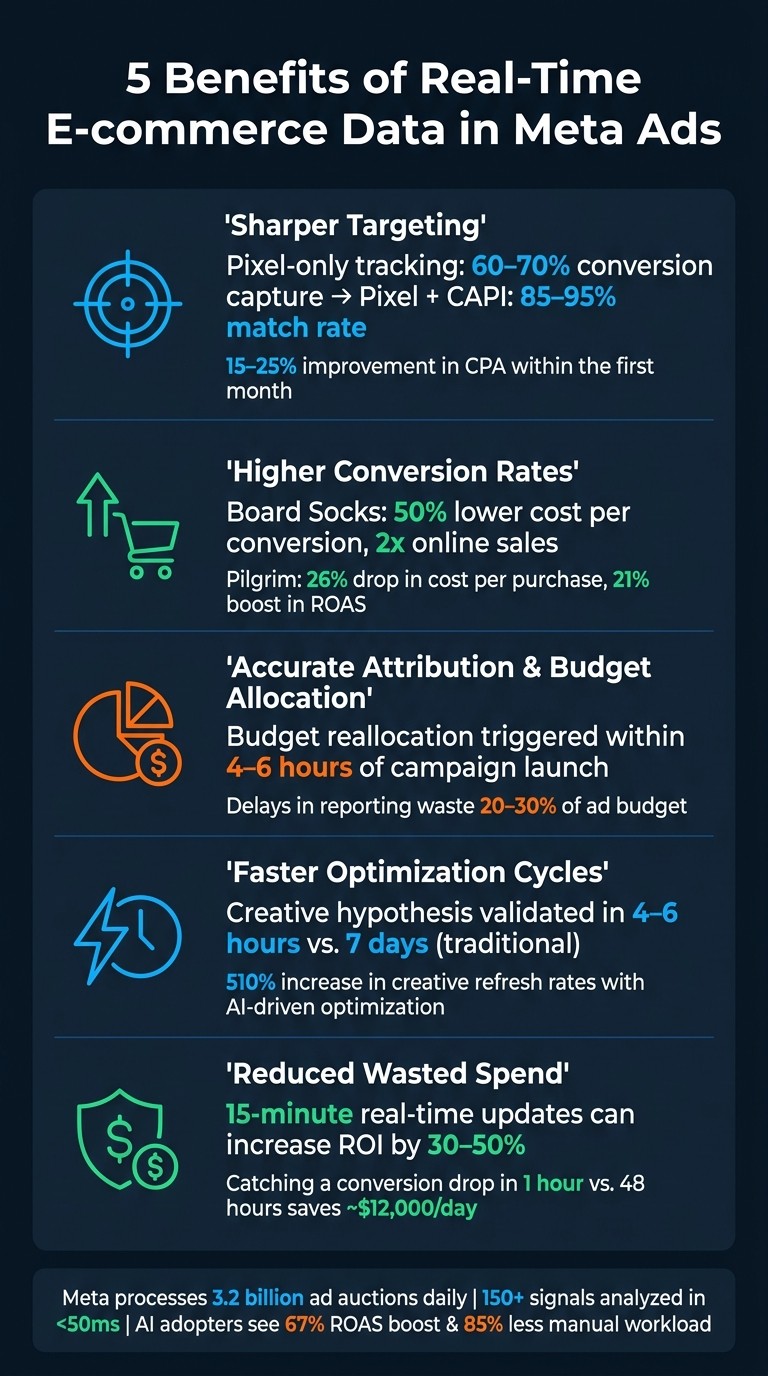
5 Benefits of Real-Time E-commerce Data in Meta Ads: Key Stats
1. Sharper Targeting and Audience Segmentation
Incomplete data can seriously impact Meta’s algorithm, leading to weaker performance metrics like ROAS, CAC, and CTR.
The core problem? Limited data coverage. Pixel-only tracking captures just 60–70% of conversions, but when you combine the Meta Pixel with the Conversions API (CAPI), that match rate jumps to 85–95%. Brands that adopted CAPI saw a 15–25% improvement in CPA within the first month, thanks to better signal quality. This richer data enables more accurate audience segmentation and sharper targeting.
When it comes to targeting, quality beats quantity. For instance, a 1% Lookalike Audience built from 500 recent purchasers often outperforms one derived from 10,000 general site visitors. Why? The algorithm thrives on high-intent behavioral data, not just large datasets. That’s why using your top 20% of customers by lifetime value (LTV) or recent 180-day purchasers as seed audiences typically delivers stronger results than relying on broader site traffic lists.
"Advantage+ amplifies whatever signals it receives. Broken data produces broken optimization." - Abhinav Singh, The Interconnections
With better data quality, the trend in 2026 has moved away from manual vs. autopilot targeting. Instead, broad targeting (age, gender, location) has taken center stage. Meta’s Andromeda AI engine analyzes over 150 behavioral signals in under 50 milliseconds to decide who sees your ad, helping you reach your ideal customers more effectively and at scale.
2. Higher Conversion Rates with Dynamic Personalization
With better audience segmentation in place, real-time catalog updates take ad personalization to the next level. By syncing your product catalog in real time, Dynamic Product Ads can retarget shoppers with the exact items they browsed or left behind, making ads more relevant to high-intent buyers. This increased relevance often translates directly into higher conversion rates.
Take the example of Board Socks, an online retailer. In early 2025, they implemented Meta Advantage+ Shopping Campaigns, which use dynamic product recommendations. The result? They slashed their cost per conversion by 50% and doubled their online sales. Similarly, fashion brand Pilgrim saw a 26% drop in their cost per purchase and a 21% boost in ROAS after adopting Advantage+ campaigns powered by live data signals.
Keeping your catalog updated is critical. If your product feed isn’t refreshed at least daily, Meta might show ads for items that are out of stock, wasting ad spend and hurting your conversion rates. Beyond catalog updates, dynamic creative optimization takes personalization even further. This feature uses algorithms to test and mix headlines, text, and images, finding the combinations that perform best based on live user behavior. Instead of running static ads, dynamic creative optimization ensures your ads adapt to what resonates most with your audience.
Platforms like AdAmigo.ai amplify these efforts. Its Ad Factory feature continuously analyzes top-performing creatives and generates fresh variations in real time, ensuring your personalization strategy stays sharp and effective.
3. More Accurate Attribution and Budget Allocation
Figuring out which ads are driving sales is the backbone of smart advertising. Without precise attribution, you're left guessing which campaigns to scale up and which ones to cut. The problem? Relying on pixel-only tracking captures just 60–70% of conversions. But when you combine the Meta Pixel with the Conversions API, those match rates jump to an impressive 85–95%. As Gaultier D'Acunto, Co-founder of Benly, explains:
"Conversions API is mandatory in 2026 - pixel-only tracking captures just 60-70% of conversions, while CAPI combined with pixel achieves 85-95% match rates."
This more accurate, real-time data doesn't just clarify attribution - it also allows you to make quick, informed budget adjustments.
With proper attribution, Meta's algorithm can focus on optimizing your ad spend using reliable, high-intent conversion signals. When those signals are incomplete or delayed, the algorithm ends up targeting the wrong audience. Advertisers who implement CAPI often see a 15–25% improvement in cost per acquisition (CPA) within the first month because the algorithm finally has the right data to work with.
Real-time attribution also means smarter and faster budget decisions. For example, you can establish specific ROAS or CPA thresholds that trigger immediate budget reallocations - shifting spend from underperforming ad sets to winners, sometimes within just 4–6 hours of launching a campaign. A practical tip: compare the conversions Meta reports with your backend data (like Shopify) over a 90-day period to calculate a lift ratio. If Meta consistently over-reports by 20%, you can multiply reported ROAS by 0.8 to adjust for inflation, ensuring your financial planning stays realistic.
Automation tools like AdAmigo.ai make this process even easier. Its AI Autopilot monitors performance data in real time, reallocating budgets automatically - scaling up winning campaigns and pausing those that underperform. This kind of speed is critical, especially since delays in reporting can waste 20–30% of your ad budget. Real-time adjustments like these ensure quicker optimization cycles and better results moving forward.
4. Faster Optimization Cycles and Creative Testing
Meta advertising thrives on speed, and making decisions quickly is crucial. Traditional optimization methods often rely on 3–7 day data cycles, which means decisions are based on outdated information. However, with real-time e-commerce data, this process is drastically shortened. Teams can now validate or discard a creative hypothesis within just 4–6 hours, instead of waiting an entire week for statistical significance.
This immediacy allows marketers to shift budgets from underperforming ad sets to top performers on the same day - sometimes even within hours of a campaign launch. This flexibility paves the way for quicker creative iterations and more effective campaigns.
"Real-time ROAS tracking isn't just a technical upgrade - it's a growth accelerator. In today's high-speed marketing environment, data delay equals lost opportunity."
Om Rathod, Co-founder & CRO, Trivas
Live performance data also supercharges creative testing benchmarks. AI-powered tools can detect creative fatigue and audience saturation in just hours, enabling updates every 2.3 days compared to the 14-day cycle of manual methods. This leads to a staggering 510% increase in creative refresh rates for brands that leverage AI-driven real-time optimization.
"AI-powered tools analyze creative fatigue in real-time, identify audience saturation within hours instead of days, and automatically reallocate budgets to high-performing campaigns 24/7."
Ira Bodnar, Ryze AI
For even faster decision-making, use a 4-hour validation scorecard to determine whether to scale or pause new creatives. Include clear thresholds for CTR, ROAS, and CPM. Tools like AdAmigo.ai's AI Autopilot can monitor campaign performance, flag underperformers, and use its Ad Factory feature to generate and test new ad variants, ensuring campaigns stay optimized and competitive.
5. Less Wasted Spend and Better Day-to-Day Efficiency
Real-time e-commerce data is a game-changer for Meta Ads campaigns, especially when it comes to reducing wasted spend and improving daily operations. Unlike delayed reporting (which can lag by 24–48 hours), real-time updates allow you to act on the most current information. This immediacy is critical - delayed data forces decisions based on outdated insights, potentially wasting 20–30% of your ad budget. On the other hand, 15-minute real-time updates can increase ROI by 30–50%. With these updates, budget allocation becomes sharper, and operational mistakes are caught before they snowball.
One of the standout benefits of real-time data is its ability to quickly identify technical failures. Imagine a payment gateway glitch or a broken landing page - conversion rates could nosedive from 2% to 0.8%. For a store earning $10,000 daily, catching such an issue within an hour instead of waiting 48 hours could save approximately $12,000 in lost revenue. Setting up real-time alerts, such as triggers for a 30% drop from your rolling 7-day conversion average, is an easy yet powerful way to safeguard your campaigns.
Real-time inventory visibility is another major advantage. It enables brands to pause or adjust ad spend for specific products up to four days before they go out of stock. Without this insight, you might continue advertising items that are no longer available, wasting budget and frustrating customers.
"The brands that pull away from the competition are the ones who build systems around their real-time data - turning it from a dashboard they glance at into an intelligence layer that drives decisions." - Om Rathod, Co-founder & CRO, Trivas
Automation tools take this efficiency even further. Platforms like AdAmigo.ai monitor campaigns continuously, handling routine tasks like pausing underperforming ads, reallocating budgets, and flagging anomalies. Features like AdAmigo Protect ensure your account health stays intact by catching delivery issues and unusual behavior early. This not only prevents silent budget drains but also frees your team to focus on high-impact decisions instead of getting stuck in Ads Manager all day.
Conclusion
Real-time e-commerce data plays a crucial role in running effective Meta Ads campaigns. The five benefits discussed - more precise audience targeting, enhanced ad relevance, improved attribution accuracy, quicker creative updates, and reduced ad spend waste - are all tied to better campaign outcomes.
The numbers back it up: adopting a combined Pixel and Conversions API setup can push match rates to 85–95%, leading to a 15–25% improvement in CPA within the first month. Additionally, leveraging real-time ROAS data to shorten optimization cycles from days to mere hours can deliver a 30–50% increase in ROI compared to delayed reporting.
At the scale Meta operates - processing over 3.2 billion ad auctions daily and analyzing more than 150 signals in under 50 milliseconds - manual adjustments simply aren’t practical. This is where automation steps in. Platforms like AdAmigo.ai handle the heavy lifting by turning real-time insights into immediate, strategic actions. These tools continuously manage accounts by reallocating budgets, scaling high-performing ads, and detecting anomalies, all without waiting for human intervention. Brands adopting AI-driven Meta strategies have reported a 67% boost in ROAS and an 85% reduction in manual workload, allowing teams to shift their focus to higher-level planning rather than day-to-day execution.
FAQs
How do I set up Meta Pixel and Conversions API together?
To set up Meta Pixel and Conversions API together, follow these steps to improve your event tracking and data accuracy:
Install Meta Pixel: Add Meta Pixel to your website to monitor user actions effectively.
Connect Your Server: Link your server to Meta's API to implement the Conversions API (CAPI), which sends event data directly to Meta.
Use the
event_idParameter: Include theevent_idin both Pixel and CAPI events to prevent duplicate data.Verify Your Setup: Check everything in Meta’s Events Manager to confirm that tracking is working as expected.
These steps will help you achieve more precise tracking and reliable data insights.
How often should my product catalog feed update for Dynamic Ads?
Your product catalog feed needs to be updated at least once a day. If you're dealing with fast-moving inventory, consider updating it hourly. This helps prevent ad disapprovals and ensures your pricing and availability information stays accurate.
What’s the fastest way to catch tracking or checkout issues in real time?
The fastest way to identify tracking or checkout problems as they happen is by using Meta's Conversions API. Pair this with routine diagnostics, event deduplication, and performance monitoring in Events Manager to catch irregularities quickly and resolve them before they escalate.