
How Meta Ads Use Real-Time Data Sync Systems
Real-time conversion sync via Meta's APIs cuts wasted ad spend, improves ROAS, and enables instant campaign optimization.
Real-time data synchronization in Meta Ads allows advertisers to instantly update data between their systems and Meta’s platform. This ensures faster targeting adjustments, reduced wasted ad spend, and improved campaign performance. Unlike batch processing, which syncs data at set intervals, real-time sync processes events like purchases or page views within seconds. This immediate data flow is especially important after iOS privacy updates, which disrupted traditional tracking methods.
Key Takeaways:
Instant Updates: Purchases or actions are reflected immediately, excluding converted users from retargeting within seconds.
Reduced Wasted Spend: Advertisers report up to 37% less wasted spend and improved ROAS by 20-30%.
Better Campaign Adjustments: Real-time metrics enable budget reallocations and creative tweaks during live campaigns.
Offline Event Integration: Connects in-store purchases with online campaigns for a unified view of performance.
Meta’s Conversions API and Marketing API power these capabilities, ensuring faster decision-making and better ad performance.
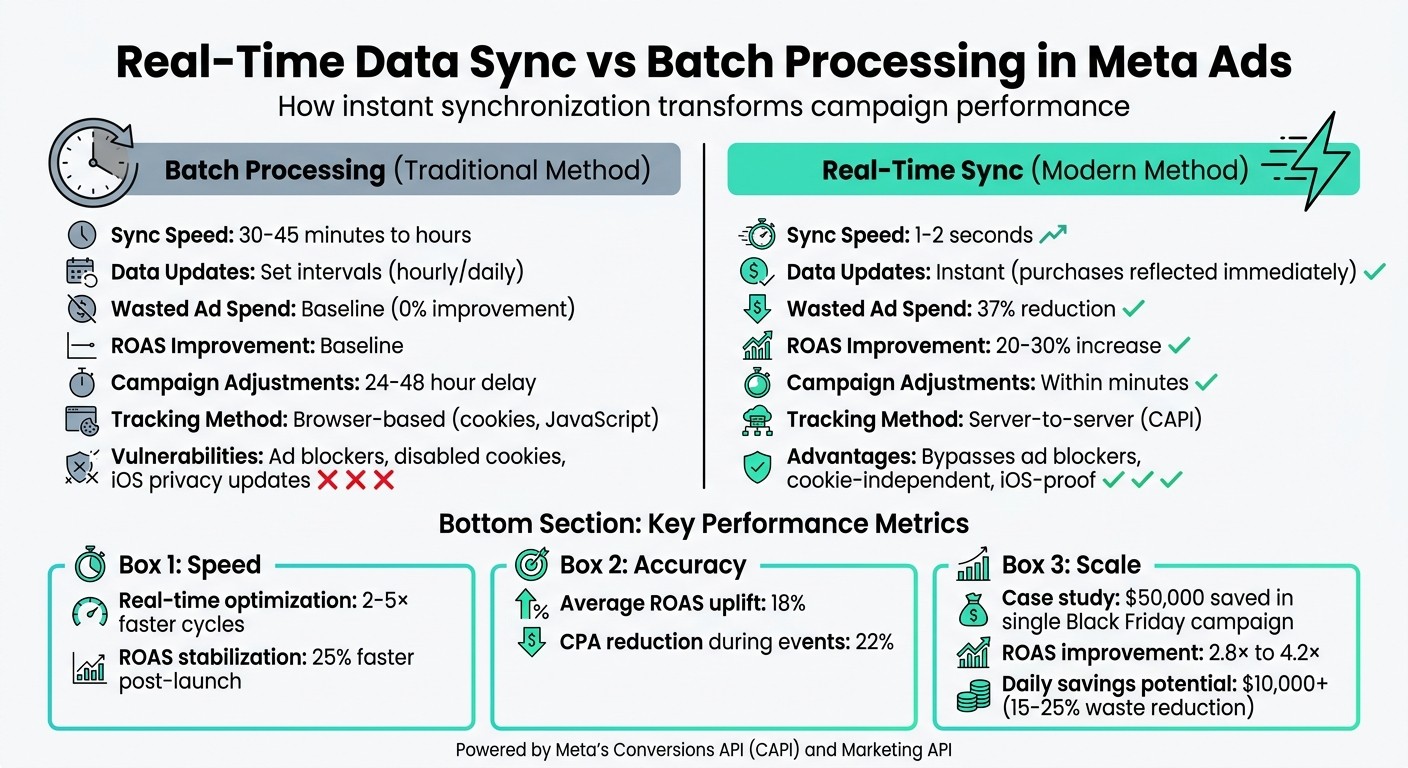
Real-Time vs Batch Data Sync in Meta Ads Performance Comparison
How Real-Time Data Sync Works in Meta Ads
Meta's Conversions API (CAPI)
Meta's Conversions API establishes a direct server-to-server connection between your business systems and Meta's ad platform. Unlike traditional browser-based tracking, which relies on cookies and JavaScript, CAPI sends data directly from your server to Meta’s servers. For instance, if a purchase happens at 3:47 PM, your server instantly relays that conversion to Meta. This approach bypasses common tracking obstacles like ad blockers, disabled cookies, and browser restrictions.
To ensure accuracy, CAPI uses a unique event_id to deduplicate events from both Pixel and CAPI. This prevents double counting and allows Meta to suppress converted users from retargeting in just seconds. Additionally, CAPI can send hashed user identifiers, purchase details, currency codes, and product information to enrich data, following Meta API integration best practices. This extra context enhances Event Match Quality (EMQ) scores, helping Meta’s algorithms better understand conversions and refine targeting.
For authentication, it’s recommended to use a System User Token instead of OAuth. This avoids issues caused by token expiration and ensures uninterrupted data flow.
Meta Marketing API for Performance Metrics
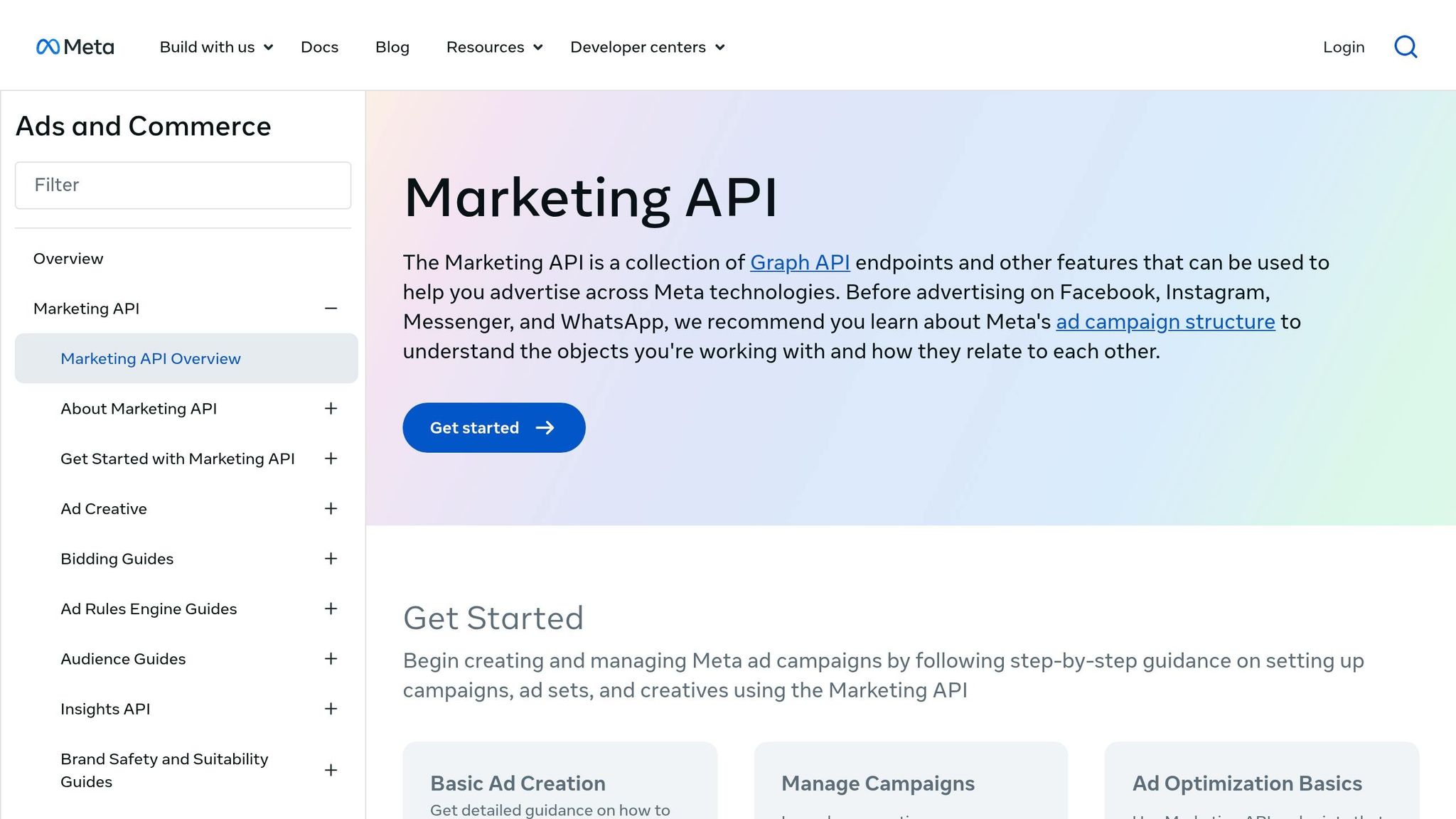
Building on the accuracy of CAPI, the Meta Marketing API provides real-time access to campaign performance data. This API allows third-party tools to pull up to 561 metrics and 151 dimensions, offering detailed insights into metrics like ROAS, CTR, impressions, and frequency caps. While manual updates in Meta Ads Manager can take 30–45 minutes to reflect changes, API-integrated systems sync updates in just 1–2 seconds.
"Running Facebook ad campaigns without proper reporting is like driving blindfolded. You're spending money but you can't see where it's actually going or what's working." - Cedric Yarish, Co-Founder, AdManage.ai
This rapid syncing capability lets advertisers respond to performance shifts instantly. For example, if an ad set’s ROAS drops below your target, an API-connected system can quickly detect the issue and adjust budgets within seconds, ensuring you don’t miss opportunities to optimize your ad spend.
Offline Event Syncing
Offline event syncing connects physical store purchases to your online ad campaigns, bridging the gap between in-store transactions and digital ad performance. Through CAPI, your point-of-sale system or CRM can send offline transaction data to Meta using identifiers like loyalty program IDs or CRM IDs. This data creates "Omni Audiences", which combine online behavior with offline conversions, allowing you to target users who clicked your ad but completed their purchase in-store.
To maximize accuracy, upload offline transaction data daily, focusing on the last three days. Meta uses a 7-day deduplication window for offline events (compared to 48 hours for web events) and matches transactions using the unique event_id. Improve match rates by including multiple hashed identifiers, such as email, phone number, ZIP code, and city, all encrypted with SHA-256 before transmission. Regularly monitor your EMQ scores in Meta Events Manager - scores below 8.5 often indicate missing or improperly formatted identifiers.
Benefits of Real-Time Data Sync for Meta Ads
Better Targeting and Audience Updates
With real-time data sync, targeting becomes sharper by updating customer lists in just minutes. For example, when a customer makes a purchase, Meta's Conversions API instantly registers the event, removing that customer from retargeting campaigns. This immediate exclusion helps avoid wasted impressions and improves lookalike audience accuracy by incorporating the latest purchase data. Meta case studies reveal that eCommerce campaigns using real-time sync can see 20-30% improvements in ROAS by keeping audience segments up to date.
But it doesn’t stop at exclusions. Real-time sync also enables automated audience segmentation based on customer behavior. Updates from your CRM feed directly into Meta, creating dynamic groups like new leads, cart abandoners, and repeat buyers. This ensures your ads are delivered to the right people at the right stage of their journey, with messaging that matches their current interaction with your brand. This capability builds on Meta’s previously demonstrated ability to process data flows instantly.
Less Wasted Ad Spend
Real-time data sync doesn’t just improve targeting - it also reduces wasted ad spend. With performance metrics from the Marketing API updating in real time, you can pause underperforming ads within seconds instead of hours. For instance, during a Black Friday campaign, one brand noticed a 40% drop in conversions for a specific audience due to stockouts. By reallocating budgets to better-performing lookalike audiences immediately, they avoided $50,000 in wasted spend and boosted their ROAS from 2.8x to 4.2x - something that would have been delayed by 24 hours with batch syncing.
Automated budget rules further help by pausing ads with low ROAS (e.g., below 1.5x) and reallocating budgets to higher-performing campaigns. This approach can cut wasted spend by 15–25%, saving over $10,000 daily. The quicker you identify underperforming campaigns, the faster you can redirect resources to what’s working.
Faster Campaign Adjustments
Real-time feedback also allows for quicker campaign tweaks. During product launches or major sales events, metrics like CTR and CPA are updated in under an hour, enabling you to adjust bids or swap creatives while traffic is still high. In one product launch, real-time signals of low engagement prompted audience refinements within two hours, increasing performance by 35% compared to the delays caused by manual checks over 48 hours. Meta reports that brands using CAPI experience an average 18% ROAS uplift, with real-time adjustments during events reducing CPA by 22% by scaling successful ad sets.
This speed is especially critical for campaigns with large budgets. Real-time sync users report 25% faster ROAS stabilization post-launch, with optimization cycles running 2–5× faster compared to batch reporting systems. Instead of waiting until the next day to analyze performance, you can make adjustments to budgets, creatives, and targeting while your campaign is still active and your audience is engaged.
Tools That Use Real-Time Data Sync for Meta Ads
AdAmigo.ai: Real-Time Optimization in Action
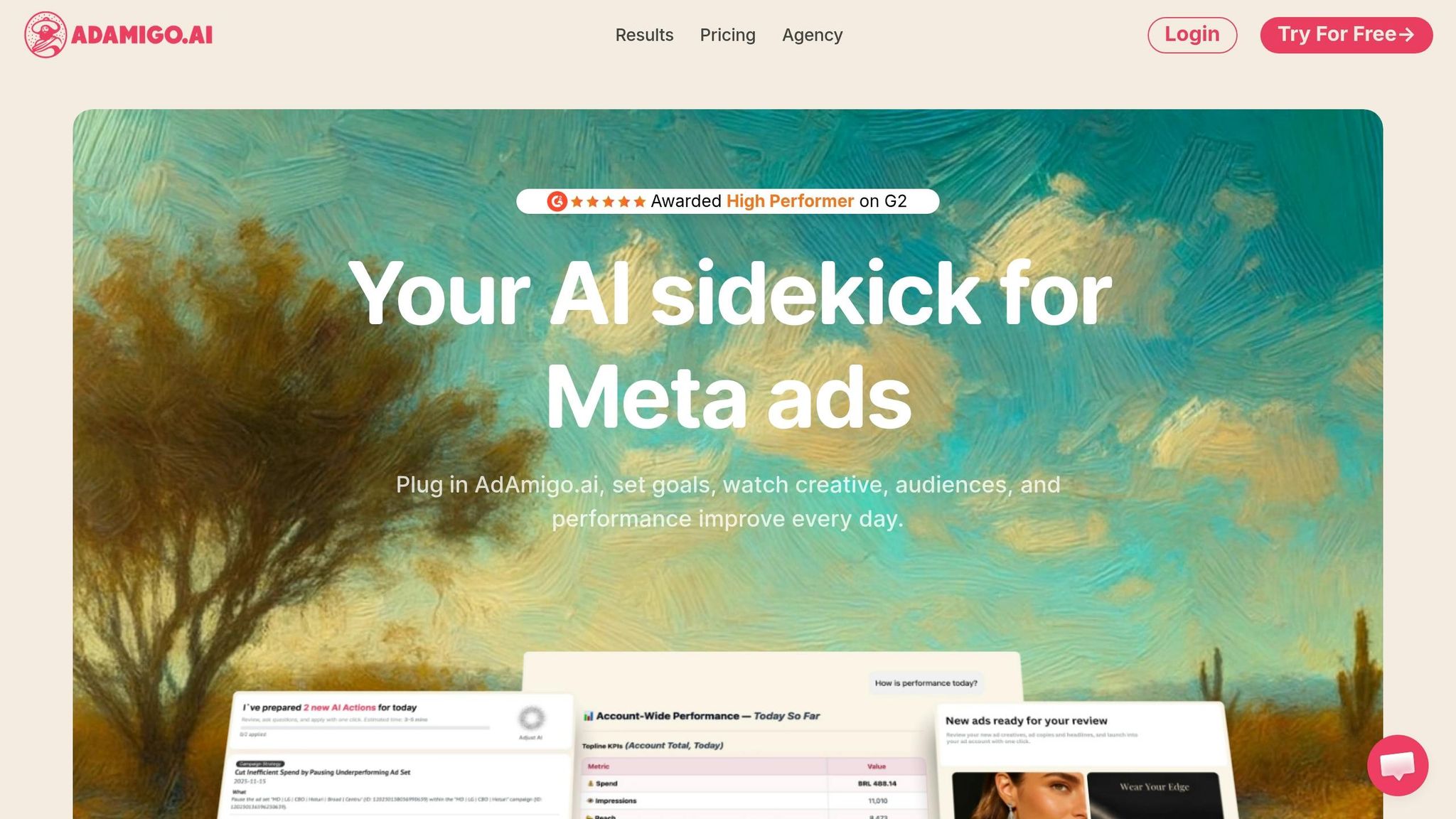
AdAmigo.ai acts as an autonomous AI media buyer, seamlessly connecting to Meta's official API to monitor and optimize campaign performance. By pulling data from Meta's Marketing API and Conversions API for offline data sync, it makes decisions on budget allocation, creative effectiveness, and audience targeting.
Its AI Autopilot feature is particularly noteworthy. This tool continuously analyzes performance metrics as they update, automatically pausing ads that underperform, scaling successful ones, and testing new ideas - all without manual intervention. This constant adjustment helps campaigns stay aligned with performance goals.
Another standout feature is the Bulk Ad Launcher, which simplifies the process of deploying large-scale ad campaigns. By uploading creatives to Google Drive and providing a basic brief, the AI generates ad copy, structures campaigns, and directly publishes them to your Meta account. It also monitors early performance indicators to identify potential winners quickly. Similarly, the AI Creative Generation system evaluates top-performing ads and competitor strategies, using real-time data to refine concepts and counter creative fatigue.
These tools work directly with Meta’s API, ensuring campaigns are always fine-tuned in real time.
CDPs and Analytics Platform Integrations
Real-time data sync isn’t limited to AI-driven tools - it also plays a critical role in broader marketing integrations. Platforms like Customer Data Platforms (CDPs), including Adobe Real-Time CDP, and analytic tools like Windsor.ai, extend this functionality beyond Meta's ecosystem. For example, Windsor.ai consolidates data from over 300 sources - such as Meta, Google Ads, TikTok, Shopify, and various CRMs - into unified dashboards in tools like Power BI or Tableau. This provides a clear, comprehensive view of the customer journey and enables data-backed attribution models to measure Meta ads' impact on conversions.
As Mary Rybalchenko, CMO of Windsor.ai, puts it:
"The champion in 2025 and the years to come is not the one with the largest budget, but the one who makes more timely and accurate decisions".
For those interested, Windsor.ai offers a 30-day free trial, allowing teams to test its synchronization capabilities across their marketing stack.
How to Set Up Facebook Pixel & Meta Conversion API | Facebook CAPI Setup Server-Side 2026 Part 02
Conclusion
Real-time data synchronization plays a key role in optimizing Meta ads. Tools like Meta's CAPI, Marketing API, and offline event syncing ensure instant updates on conversions, improving ad responsiveness. This approach minimizes wasted ad spend, ensures accurate attribution even with browser restrictions, and allows campaigns to adapt within minutes instead of days. For example, targeting new prospects instead of users who have already made a purchase can make a huge difference in profitability.
Meta ads automation tools, such as AdAmigo.ai, further simplify these processes. By automating repetitive tasks like pausing underperforming ads, scaling successful ones, and updating creatives, AdAmigo.ai enables media buyers to manage significantly more client accounts - up to 3–5× more - without sacrificing quality. This automation eliminates the need for manual rule setups, giving teams more time to focus on strategic decisions.
Incorporating real-time synchronization allows businesses to make faster, more accurate budget decisions. As campaigns expand and customer journeys become more complex, the ability to integrate user actions instantly and adjust targeting becomes essential for maximizing ROI. This capability ensures businesses remain competitive in an ever-evolving digital landscape.
FAQs
Do I need both Meta Pixel and Conversions API?
Pairing Meta Pixel with the Conversions API can boost event match quality by as much as 20%. This combination allows for real-time data synchronization, which leads to more precise targeting and better overall ad performance.
How do I prevent double-counting with event_id?
To prevent duplicate data and ensure accurate tracking, make sure each event_id is unique across both your Pixel events and Conversions API events. This helps accurately track individual user actions without double-counting.
What data should I send to improve Event Match Quality?
To get the best results with Event Match Quality, focus on sending accurate and complete data through both the Conversions API and Pixel. This means including details like user actions, contact information, and device data. Make sure everything is synced in real-time and use unique event IDs to handle deduplication effectively. These steps ensure your data stays precise, which in turn helps improve ad performance.