
Meta Ads and FTC Endorsement Rules Explained
Clear, unavoidable disclosures are essential for Meta ads; noncompliance risks costly penalties and erodes campaign trust.
Running ads on Meta platforms like Facebook and Instagram? Here's what you need to know: The FTC requires clear, upfront disclosures for all sponsored content to avoid misleading your audience. Failure to comply can lead to hefty fines - just ask CarShield, which paid $10 million in 2024 for deceptive advertising. Even if only 10% of your audience misses a disclosure, it’s a violation.
Key takeaways:
Disclosures must be clear and easy to spot - no hidden tags, vague language, or unlabeled AI-generated content.
Placement matters: Instagram Reels need visible text overlays for at least 3 seconds, while Facebook Feed posts must show disclosures before the "See More" button—both require you to optimize Meta ad placements for compliance.
Brands are accountable for influencer compliance - if they skip disclosures, it’s on you.
Automation tools like AdAmigo.ai can help by monitoring ads 24/7, flagging issues, and automating proper disclosure setups.
Maintaining Meta ads FTC compliance isn’t just about avoiding fines - it builds trust and keeps your campaigns running smoothly. Tools like AdAmigo.ai simplify this process, reducing risks and saving time.
1. FTC Endorsement Rules
Transparency in Disclosures
The FTC mandates that any material connection between advertisers and endorsers must be clearly disclosed in Meta ads. This includes payments, free products, employment ties, or even family relationships - essentially, anything that could influence how consumers view the endorsement. These disclosures need to be easy to spot - consumers shouldn't have to hunt for them or click on additional links to find the information.
For Meta ads, disclosure placement is crucial. On Facebook Feed, the disclosure must appear within the first two lines of the caption, before the "See More" button. For Instagram Reels, a text overlay should be visible for at least three seconds, paired with a verbal disclosure within the first three seconds. On Instagram Stories, the text should be in high contrast and placed centrally on the screen. These specific guidelines highlight how serious the FTC is about ensuring transparency and auditing user consent.
Risk Mitigation
The FTC uses a "significant minority" standard when assessing harm, which means that even if only 10% of your audience fails to recognize a post as sponsored, you're at risk of violating the rules. You can't rely on viewers to "figure it out" on their own.
Brands are also responsible for monitoring the posts of their endorsers. Simply providing influencers with a disclosure guide isn't enough - if they fail to comply, the liability falls on you. This extends to reposting endorsements that lack proper disclosures or when the endorser's opinion has changed. Disclosures must also align with the language of the ad. For example, if you're targeting Spanish-speaking audiences, the disclosure must be in Spanish as well. With so many moving parts, using third-party compliance tools becomes a necessity to stay compliant.
Automation Capabilities
Keeping up with the FTC's strict disclosure rules can be overwhelming, especially when managing multiple Meta ads. Comparing manual vs AI-powered ad management shows that manual compliance checks aren't practical at scale. Tools like AdAmigo.ai simplify this process by continuously monitoring your ad account for missing disclosures, incorrect placements, or truncated text. The platform also allows for bulk campaign launches with pre-configured disclosures, making it easier to maintain compliance across all your ads.
2. AdAmigo.ai
FTC Compliance Features
AdAmigo.ai is an AI-powered media buyer designed to simplify compliance with FTC endorsement rules during ad creation. It actively scans Meta ad accounts in real-time, identifying issues like missing disclosures, truncated captions, or misplaced #ad tags before your ads go live. By combining real-time scanning with automatic activation of required disclosure tags, the platform streamlines the process and reduces the chances of human error. It even integrates Meta's "Paid Partnership" tag, along with the text and visual disclosures mandated by the FTC, ensuring your ads meet all necessary standards.
Need quick answers? The AI Chat Agent is ready to assist. Whether you're unsure why a specific Reel lacks proper overlays or need to review multiple campaigns for missing disclosures, this tool delivers instant insights, helping you avoid costly mistakes.
Together, these features work to ensure your Meta ads consistently comply with the FTC's stringent requirements.
Automation Capabilities
AdAmigo.ai doesn’t just stop at compliance checks - it also automates ongoing adherence to FTC guidelines. The AI Actions tool generates a daily list of prioritized fixes to address compliance risks. For instance, if your #ad tag is hidden below the "See More" button on a Facebook Feed post, it flags the issue and suggests moving it to the top. For video ads, it ensures disclosures - both visual and verbal - appear within the first three seconds and remain visible for at least three seconds, meeting FTC timing rules.
On top of that, the Bulk Ad Launch tool simplifies large-scale campaign management. You can create hundreds of Meta ads with pre-set, format-specific disclosures. Whether it’s high-contrast text overlays for Stories or audible disclaimers for Reels, the platform automates these setups. By connecting your Meta ad account, you can also audit all active creatives for proper disclosure placement. With 24/7 monitoring, AdAmigo.ai catches errors and missing tags that manual reviews often overlook, significantly lowering your compliance risks.
The Briefing: Beyond the Hashtag - FTC Revises Guidelines for Endorsement Use in Advertising
Pros and Cons
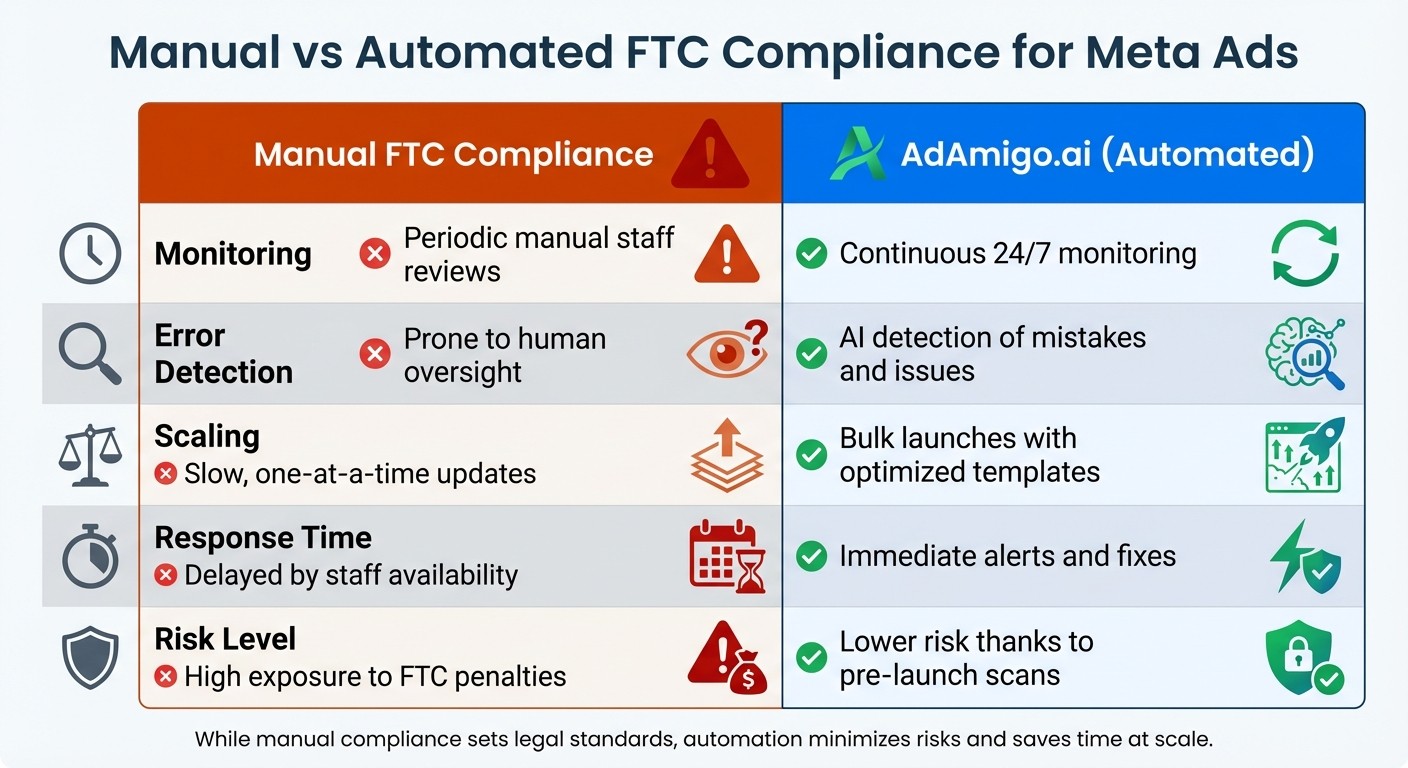
Manual vs Automated FTC Compliance for Meta Ads Comparison
Navigating the Meta ads ecosystem means juggling legal compliance and operational efficiency. Manually adhering to FTC endorsement rules can offer legal safeguards and foster consumer trust, but it’s a time-consuming and error-prone process. The FTC's "unavoidable" disclosure standard adds to the challenge: even if a small fraction of your audience misses or misinterprets a disclosure, your brand could face scrutiny. Ensuring compliance manually involves regular audits of every ad and influencer post - an overwhelming task when managing hundreds of campaigns. A single misplaced #ad tag or a disclosure hidden behind a "See More" button can lead to investigations and penalties that exceed $50,000. These hurdles highlight the growing need for automation in compliance management.
Enter AdAmigo.ai, a platform designed to tackle these pain points by eliminating human error through real-time, automated scanning. It monitors your Meta ad account 24/7, ensuring disclosures are properly placed across formats like Reels, Stories, and Feed posts. The Bulk Ad Launch feature allows you to scale campaigns effortlessly, using pre-configured disclosures tailored to each format - like white text overlays for Stories or audible disclaimers for Reels - saving you hours of manual effort. Additionally, the AI Actions tool delivers a daily list of prioritized compliance fixes, enabling you to address flagged issues immediately instead of waiting for manual reviews.
However, automation isn't entirely hands-off. AdAmigo.ai requires an initial setup, which takes about five minutes, and integration with your Meta ad account. While it automates checks and optimizations, you’ll still need a solid understanding of FTC rules to configure the system effectively and review AI-recommended changes. The platform works best when paired with a clear understanding of what the FTC considers "clear and conspicuous."
Aspect | Manual FTC Compliance | AdAmigo.ai (Automated) |
|---|---|---|
Monitoring | Periodic manual staff reviews | Continuous 24/7 monitoring |
Error Detection | Prone to human oversight | AI detection of mistakes and issues |
Scaling | Slow, one-at-a-time updates | Bulk launches with optimized templates |
Response Time | Delayed by staff availability | Immediate alerts and fixes |
Risk Level | High exposure to FTC penalties | Lower risk thanks to pre-launch scans |
While manual compliance sets the legal standard and safeguards your brand’s reputation, it’s tough to sustain as your campaigns grow. AdAmigo.ai minimizes compliance risks and saves significant time, but it still requires you to define your strategy, approve key decisions, and stay informed about FTC rules for effective oversight.
Conclusion
Staying compliant with Meta ad regulations ensures not only legal protection but also effective campaign performance. The main rule is straightforward: disclosures must be clear, immediate, and easy to spot - users shouldn’t have to click "See More" or take extra steps to find them. This means adding #ad tags within the first couple of lines of captions, displaying high-contrast text overlays on Instagram Reels for at least three seconds, and including verbal disclosures throughout video content. The risks of non-compliance are real: if even 10% of your audience misses a disclosure, the FTC considers that a "significant minority". And the penalties? They can climb into the millions.
Given the challenges of manually overseeing compliance, AI compliance tools like AdAmigo.ai simplify the process. It offers features like continuous monitoring, pre-launch scans, and customizable disclosure templates while leaving you in control of strategy. With its bulk ad launch best practices and AI Actions, you can scale campaigns confidently, knowing that 24/7 monitoring will catch potential issues before they lead to fines. However, success still depends on your ability to shape strategies and make informed decisions aligned with FTC guidelines.
For agencies managing multiple clients or in-house teams scaling ad spend, pairing a strong understanding of FTC rules with AI-powered tools ensures compliance and efficiency. This approach allows growth without the constant worry of audits or expensive enforcement actions.
FAQs
What counts as a “material connection” in Meta ads?
A "material connection" in Meta ads refers to any relationship that could affect how consumers perceive an endorsement. This includes things like payments, free products, affiliate links, or sponsorships. To meet FTC guidelines, these connections need to be disclosed in a way that's both clear and easy to notice.
Where should I place disclosures on Reels, Stories, and Feed posts?
Disclosures need to be immediately noticeable - either at the very beginning of a caption or within the first 3 seconds of a video. Use straightforward language such as #ad or Sponsored by [Brand] to make sure they stand out and align with compliance rules.
What should I do if an influencer forgets to disclose a partnership?
If an influencer overlooks disclosing a partnership, it's important to remind them to clearly state the connection to meet FTC guidelines. They can include hashtags like #ad or phrases such as “Sponsored by [Brand]” right at the beginning of their content. This approach helps maintain transparency and aligns with endorsement regulations.