
FTC Endorsement Rules: Guide for Meta Ads
New rules require clear, unavoidable sponsorship disclosures across social ads and AI influencers — noncompliance risks heavy fines and account penalties.
The FTC is cracking down on deceptive advertising in 2026, with stricter rules for Meta ads involving influencers, testimonials, and endorsements. Brands and creators must now disclose material connections clearly or face heavy fines and account penalties. Here's what you need to know:
Disclosure Basics: Always reveal financial ties, free products, or employment relationships. Use clear tags like #ad or #sponsored prominently in captions or overlays.
Meta Ad Formats: Disclosures must be visible without user interaction. For example:
Facebook ads: Place disclosures in the first 1-2 lines of captions.
Instagram Reels/Stories: Use text overlays visible for at least 3 seconds.
Video ads: Include both visual and audio disclaimers.
Virtual Influencers: AI avatars endorsing products must disclose both sponsorships and their synthetic nature.
Penalties: Non-compliance risks fines exceeding $50,000 per violation, damaged reputation, and account bans.
Stay compliant by combining Meta's tools like partnership ads with manual disclosures. Automated AI tools for Facebook and Instagram ads like AdAmigo.ai can help monitor and enforce compliance across campaigns.
The Briefing: Beyond the Hashtag - FTC Revises Guidelines for Endorsement Use in Advertising
FTC Disclosure Requirements for Meta Ads

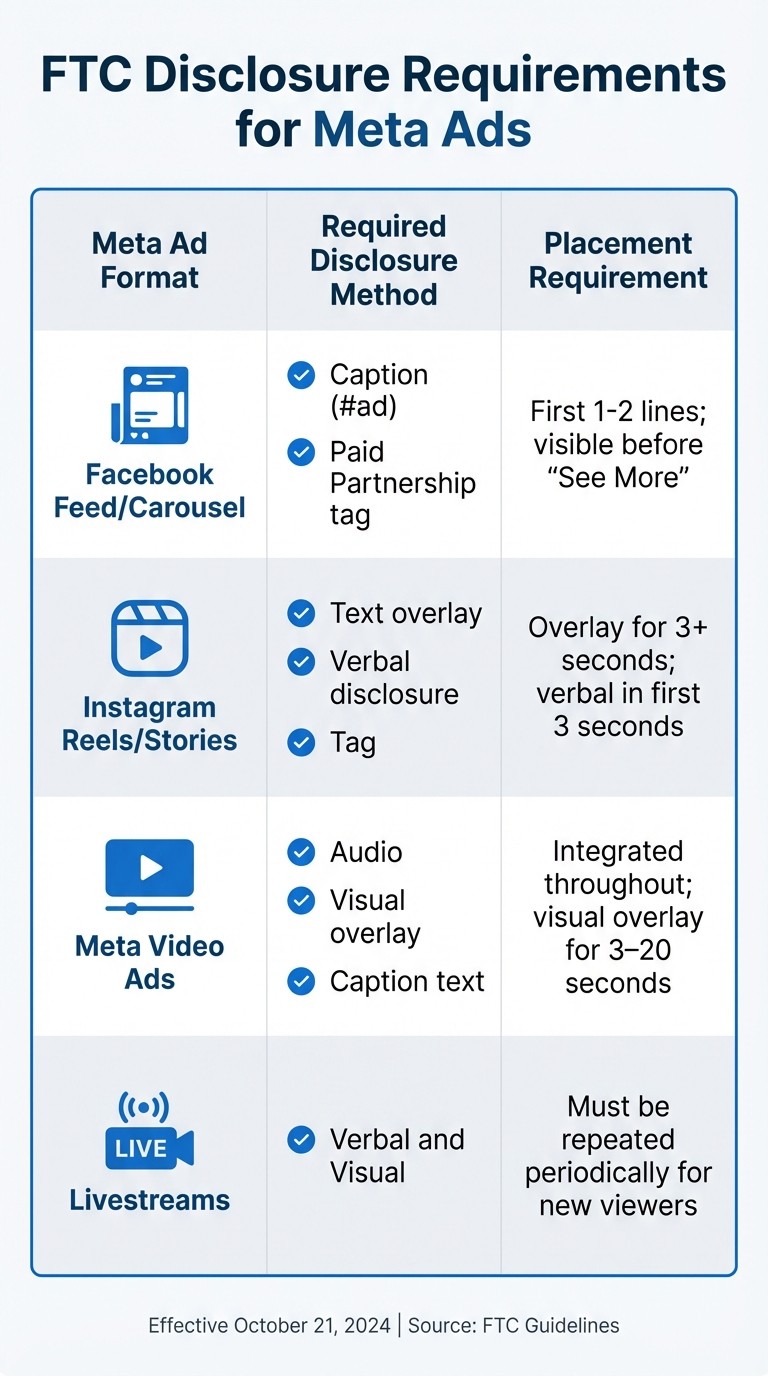
FTC Disclosure Requirements for Meta Ad Formats: Quick Reference Guide
As part of the ongoing effort to ensure compliance with FTC regulations, here’s a breakdown of disclosure requirements specifically for Meta ads. The FTC's updated "Rule on the Use of Consumer Reviews and Testimonials", effective October 21, 2024, emphasizes stricter enforcement of material connection disclosures. Understanding what qualifies as a material connection and how to disclose it properly is essential for running compliant Meta campaigns.
How to Disclose Material Connections
When using Meta ads, any relationship that might influence consumer perception - such as direct payments, free products, affiliate commissions, or employment - must be disclosed clearly and immediately.
"A disclosure is avoidable when 'a consumer must take any action, such as clicking on a hyperlink or hovering over an icon, to see' it." - Federal Trade Commission
Disclosures should never be hidden behind buttons or buried in lengthy captions. They must be immediately visible without requiring user interaction. For example:
Facebook Feed and Carousel Ads: Include #ad or #sponsored in the first one to two lines of your caption, ensuring it appears before the "See More" truncation.
Instagram Reels and Stories: Use a high-contrast text overlay that remains on screen for at least three seconds.
Video Ads: Incorporate both audio disclaimers and visual overlays. The visual elements should stay visible for three to 20 seconds, depending on the video's length.
Here’s a quick reference table for Meta ad formats and their disclosure requirements:
Meta Ad Format | Required Disclosure Method | Placement Requirement |
|---|---|---|
Facebook Feed/Carousel | Caption (#ad), Paid Partnership tag | First 1-2 lines; visible before "See More" |
Instagram Reels/Stories | Text overlay, Verbal disclosure, Tag | Overlay for 3+ seconds; verbal in first 3 seconds |
Meta Video Ads | Audio, Visual overlay, Caption text | Integrated throughout; visual overlay for 3–20 seconds |
Livestreams | Verbal and Visual | Must be repeated periodically for new viewers |
Next, we’ll cover specific guidelines for influencers and creators to ensure consistent compliance across all Meta ad formats.
Disclosure Rules for Influencers and Creators
Influencers and creators are equally responsible for adhering to FTC disclosure rules. Simply tagging a brand in a post is considered an endorsement, and if there’s a material connection, it must be disclosed. Acceptable hashtags like #ad, #sponsored, or #paidpartnership work well, but they must be clear, easy to spot, and placed prominently.
Avoid vague or unclear terms like #collab or #partner, and never bury disclosure hashtags in a long list of unrelated tags. For video content, verbal disclosures should occur within the first three seconds, and visual overlays need to use high-contrast colors and large, legible fonts. For livestreams, periodic reminders are necessary to account for new viewers who may join mid-stream.
"If the audience understands the relationship, a disclosure isn't needed... But people viewing a review on social media, in a blog, or in an online video might not realize that the reviewer has a relationship with the company." - Federal Trade Commission
Meta's Built-In Disclosure Tools
Meta provides tools like the Paid Partnership tag, which adds a standardized label above your content to indicate a brand relationship. While this tool enhances transparency, it shouldn’t be the sole method of disclosure. The FTC warns that some built-in tools may fall short due to fleeting visibility, poor contrast, or placement that’s easy to overlook.
To ensure compliance, combine Meta's Paid Partnership tag with manual disclosures. For example, include #ad in captions or use text overlays in videos. This dual approach not only meets FTC standards but also reinforces transparency. Additionally, Meta's Ad Library archives all ads, allowing regulators and consumers to review them as needed.
These practices align with Meta's broader advertising policies, which we’ll explore further in the next section.
FTC Rules for Virtual Influencers and AI-Generated Endorsements
The FTC's updated Guides, effective October 21, 2024, now explicitly include virtual influencers - computer-generated avatars and AI - under the definition of an "endorser". This means AI-generated content in Meta ads is held to the same truthfulness standards as traditional endorsements, with added disclosure requirements. Below, we break down the specifics for virtual and AI-generated endorsements.
Disclosure Requirements for Virtual Influencers
When using virtual influencers, advertisers must disclose two key things: any paid relationship and the fact that the avatar is synthetic. While virtual influencers are allowed, misleading consumers about their identity violates the FTC Act.
"Section 465.2 of the rule is drafted specifically so as to not prohibit companies from using virtual influencers." – FTC Staff
The main concern is ensuring consumers aren't tricked into believing the endorsement comes from a real person. For example, if an AI avatar resembles a celebrity without their consent - or falsely implies the celebrity endorsed the product - it would breach FTC rules. Regardless of the avatar's nature, all claims must be truthful and backed by evidence.
For Meta ads, disclosures about virtual influencers should be clear and easy to spot. Use the first line of Feed captions, high-contrast text overlays for Reels/Stories, and audio-visual cues in video ads. Phrases like "AI-generated spokesperson" or "Virtual influencer · #ad" work well, especially when paired with Meta's Paid Partnership tag.
AI-Generated Endorsements and FTC Compliance
Endorsements generated by AI - whether they come from virtual influencers or stock avatars - must follow the same transparency rules as human endorsements. This means advertisers need to ensure that any claims made by AI, like "reduces wrinkles by 50%", are backed by solid scientific evidence. If an AI-generated endorsement is deceptive, liability extends not only to the advertiser but also to agencies or intermediaries who were aware - or should have been aware - of the issue.
"The term 'endorser'... can be an actual or fictitious party and may even include 'virtual influencers' powered by computer-generated avatars and artificial intelligence." – Baker Botts L.L.P.
Compliance Risk Comparison: AI vs. Traditional Endorsements
The table below highlights the differences in disclosure risks and liabilities between traditional and AI-generated endorsements:
Feature | Traditional Influencers | Virtual Influencers / AI Avatars |
|---|---|---|
Endorser Status | Real individuals | Computer-generated avatars |
Experience Requirement | Must reflect honest, personal experience | Cannot have human experience; claims must still be truthful |
Primary Disclosure Risk | Hidden material connections | Misleading consumers about human identity |
Liability for False Claims | Both influencer and advertiser are accountable | Advertiser and intermediaries share responsibility |
This framework ensures that whether endorsements come from humans or AI, they meet the same standards for transparency and truthfulness.
How Meta's Policies Work with FTC Rules
Meta's policies align with FTC rules by reinforcing disclosure practices and establishing enforcement mechanisms. Both frameworks share a common goal: promoting truthful advertising. While Meta prioritizes platform integrity and user experience, the FTC focuses on protecting consumers and ensuring honesty in advertising. Understanding the overlap - and distinctions - between these two systems is essential for advertisers aiming to remain compliant.
The key difference lies in how each enforces compliance. Meta uses measures like ad rejections, warnings, and limiting ad reach. Meanwhile, the FTC has broader authority, including imposing civil penalties of up to $51,744 per violation, issuing injunctions, and requiring compliance audits. Meta holds account holders accountable for violations, while the FTC extends liability to brands, agencies, and influencers alike.
Both Meta and the FTC require advertisers to disclose material connections clearly. Meta provides tools such as the "Paid Partnership" tag and Branded Content labels. However, the FTC often deems these tools insufficient on their own. To meet the FTC's standard for "clear and conspicuous" disclosures, advertisers typically need to combine Meta's tools with additional cues, like including "#ad" prominently in captions. This layered approach ensures compliance with both Meta's policies and FTC guidelines.
Using Meta's Ad Library for Transparency
Meta offers tools to enhance transparency, including the Ad Library - a searchable public database that aligns with FTC requirements. The Ad Library allows users, competitors, and regulators to verify that disclosures are present and properly formatted. This tool displays all active ads from any Page, enabling advertisers to audit their campaigns for compliance.
One key feature of the Ad Library is ensuring disclosures are "unavoidable." Consumers shouldn't have to click, hover, or expand text to view them. Advertisers can use the Ad Library to check for potential formatting issues, especially on mobile devices, where captions might get shortened behind "See More" buttons. By catching these issues early, advertisers can fix problems before they draw FTC scrutiny. Many advertisers also use third-party compliance tools to automate these checks and ensure creative assets meet all platform requirements.
Understanding Meta's Enforcement Actions
Meta enforces compliance through both automated and manual reviews. Ads with improper disclosures or misleading claims may be blocked before they air or removed after publication. Repeat violations can lead to warnings, restrictions, or even account bans.
Unlike the FTC, Meta's enforcement is immediate. If an ad violates Meta's policies, it won't run - even if it technically complies with FTC rules. This puts the responsibility squarely on advertisers to ensure that all claims are truthful, well-supported, and properly disclosed. Meta's enforcement practices aim to maintain credibility while helping advertisers avoid regulatory penalties.
"The Guides, at their core, reflect the basic truth-in-advertising principle that endorsements must be honest and not misleading." – Federal Trade Commission
Meta Ads Compliance Checklist
Having a clear, repeatable process in place can help avoid hefty penalties from the FTC. With civil penalties reaching up to $51,744 per violation, even small mistakes can lead to significant costs. A structured checklist ensures advertisers meet both FTC regulations and Meta's platform requirements.
Steps to Ensure FTC Compliance
Audit Disclosures for Visibility
Check that every disclosure is immediately visible across all devices. The FTC mandates that disclosures must be "unavoidable", meaning users shouldn’t need to click "See More", hover over icons, or scroll to find them.
Clarify Material Connections
If a connection would surprise or influence even
10% of your audience, it must be disclosed. Use Meta’s tools alongside clear text disclosures like "#ad" or "#sponsored" in captions to meet this requirement.
Review Endorsement Claims
Ensure all endorsement claims are honest and can legally be made by your brand. The FTC emphasizes:
"An endorsement must reflect the honest opinion of the endorser and can't be used to make a claim the marketer of the product couldn't legally make".
For example, if an influencer claims your product "cured" something, you must have evidence to back that claim - or risk violating FTC rules.Conduct Regular Campaign Audits
Live campaigns should be reviewed periodically since platform updates can alter how ads display. This helps catch issues like hidden disclosures, broken links, or missing tags before they draw regulatory attention.
For larger campaigns, automated tools for Meta ads can simplify these checks and reduce the risk of human error.
How AdAmigo.ai Helps Maintain Compliance

Manual compliance checks can be unreliable and difficult to scale. AdAmigo.ai offers a smarter solution by automating compliance monitoring and integrating safeguards into your advertising workflow.
The platform continuously scans ads to detect issues like missing disclosures, truncated text, or setup errors that could lead to FTC violations.
Here’s how AdAmigo.ai simplifies compliance:
The Bulk Ad Launcher applies pre-set disclosure templates across all creatives, ensuring uniformity even in high-volume campaigns.
The AI Chat Agent provides real-time answers to compliance questions, explaining why specific disclosures are necessary and how to fix flagged issues on the spot.
Why Automation Beats Manual Checks
Aspect | Manual Compliance | Automated (AdAmigo.ai) |
|---|---|---|
Monitoring | Periodic spot checks | Continuous 24/7 monitoring |
Error Detection | Prone to human oversight | AI detects missing tags and truncated text |
Scalability | Challenging for large accounts | Handles hundreds of ads with ease |
Response Time | Limited by staff availability | Instant alerts for faster resolution |
Conclusion: Maintaining FTC Compliance in Meta Advertising
Staying compliant with FTC regulations requires constant attention, especially as advertising campaigns grow and rules become stricter. With penalties exceeding $50,000 per violation, even a single oversight - like a missed disclosure - can lead to steep financial consequences. The FTC’s guiding principle is simple yet critical:
"The Guides, at their core, reflect the basic truth-in-advertising principle that endorsements must be honest and not misleading."
This highlights the importance of transparency - not just for legal compliance but also for maintaining consumer trust and brand integrity on Meta’s platforms. Advertisers need to ensure that disclosures are clear, endorsement claims are backed by evidence, and all placements meet visibility requirements. However, as Meta introduces new ad formats and platform updates, compliance gaps can emerge, requiring advertisers to stay vigilant with internal training and monitoring.
For brands managing multiple campaigns or a high volume of ads, manual compliance checks can quickly become impractical. This is where automation proves invaluable. Tools like AdAmigo.ai integrate directly into the advertising workflow, offering automated safeguards. Features like continuous monitoring flag missing disclosures, truncated text, or setup errors before ads go live, while the Bulk Ad Launcher applies pre-set disclosure templates across hundreds of creatives at once.
Failing to comply doesn’t just risk hefty fines - it can also damage your reputation and erode customer trust. By prioritizing clear disclosure practices and leveraging automated tools, advertisers can protect both their budgets and their credibility.
FAQs
What counts as a “material connection” I must disclose?
A material connection is any relationship that might influence how trustworthy an endorsement or testimonial appears. This can include things like payments, free products, affiliate links, or sponsorship deals. To stay transparent and follow FTC guidelines, these connections must always be disclosed.
Where should I put disclosures in Reels, Stories, and video ads?
When it comes to Reels, Stories, and video ads, the Federal Trade Commission (FTC) has a straightforward rule: disclosures must be clear and easy to spot.
Don't hide them in a sea of hashtags or bury them deep in captions where they're easy to miss. For video content, the best practice is to place disclosures within the first 3 seconds or right at the start of the caption. This ensures viewers immediately understand any sponsorship or material connection, keeping everything transparent and compliant.
Do AI avatars and virtual influencers need special disclosures?
Yes, AI avatars and virtual influencers need to clearly disclose their artificial nature. The Federal Trade Commission (FTC) mandates transparency to avoid misleading audiences. Existing endorsement and disclosure rules also apply to AI-generated content, ensuring people are aware of the content's origins and helping maintain trust.