Branded Content vs. Ads: Disclosure Rules
FTC rules for influencer branded content and ads - where to place disclosures, approved wording and compliance tips.
Confused about disclosure rules for branded content and ads? Here's what you need to know:
The FTC requires transparency when promoting products or services, whether it's through influencer-branded posts or paid ads. Failing to disclose sponsorships or material connections can lead to fines of up to $50,120 per violation.
Key Takeaways:
Branded Content: Influencers must clearly disclose material connections (gifts, payments, perks, etc.) using terms like #ad or #sponsored upfront in captions or videos.
Ads:Paid ads must display unavoidable disclaimers directly next to claims, ensuring viewers immediately understand the context.
Disclosure Placement: Disclosures should be clear, visible, and in the same language as the content.
Platform Tools: Features like Instagram's "Paid Partnership" tag help, but manual disclosures remain essential.
Bottom line: Transparency isn't optional - it builds trust and keeps you compliant with FTC guidelines. Use clear disclosures to avoid penalties and maintain credibility. For deeper insights into performance, consider using AI tools for Meta ad account analysis to ensure your compliant campaigns are also effective.
Branded Content Disclosure Rules
What Counts as Branded Content
Branded content covers any post where a creator or influencer has a connection with a brand. This could involve paid sponsorships, affiliate earnings, free products, discounts, or even employment relationships. According to the FTC endorsement rules for Meta ads, a branded connection exists whenever a brand provides value - whether it's money, products, perks, or discounts - in exchange for a post.
"Publishers must 'disclose when [they] have any financial, employment, personal, or family relationship with a brand. Financial relationships aren't limited to money.'" - FTC Guidelines via FindMeCreators
For example, if an influencer receives a free hotel stay, a gift card, or ambassador perks, they must disclose it. The form of compensation doesn't matter - disclosure is always required. The FTC's Endorsement Guides (16 CFR Part 255) emphasize that any arrangement that could influence the credibility of an endorsement must be disclosed.
Once you've identified that a post qualifies as branded content, the next step is ensuring proper disclosure according to FTC guidelines.
Where and How to Disclose
Disclosures need to be clear, easy to spot, and placed where users will see them without extra effort.
Instagram and Facebook: Include #ad or #sponsored in the first two lines of your caption - before the "See More" section cuts off.
TikTok: Use a verbal disclosure at the start of your video and add a text overlay that stays visible for at least three seconds.
YouTube: Make a verbal disclosure within the first 30 seconds and check the "Includes paid promotion" box.
X (formerly Twitter): Start your post with #ad to ensure the disclosure isn’t hidden.
"Your audience should never have to guess whether a post is sponsored. The disclosure should be impossible to miss." - HumanAdsAI
Avoid unclear tags like #collab, #partner, #sp, or #ambassador. These are not sufficient to indicate a paid relationship. Instead, use straightforward terms like #ad, #sponsored, or "Paid partnership with [Brand]".
Platform Disclosure Tools
Social platforms offer tools to help creators meet disclosure requirements. For instance:
Instagram and Facebook: Use the "Paid Partnership" label available through the Branded Content Tool. To ensure your creative assets also meet platform standards, you can use a Meta ad policy checker before publishing.
TikTok: Enable the "Branded Content" toggle to display a disclosure banner.
YouTube: Check the "Includes paid promotion" box to show an overlay at the start of your video.
While these tools are helpful, they don’t replace manual disclosures. Advertisers must also adapt to Meta policy changes to ensure long-term compliance. The FTC advises combining platform labels with text-based disclosures like #ad in captions, as well as verbal mentions in videos. For X (Twitter), where no built-in tool exists, manually adding #ad is essential.
"The FTC requires that any material connection between an endorser and an advertiser must be clearly and conspicuously disclosed." - Federal Trade Commission
Additionally, disclosures should match the language of the content. For example, if your post is in Spanish, the disclosure must also be in Spanish.
These rules ensure transparency in branded content, setting it apart from traditional advertising guidelines discussed next.
What Are FTC Disclosure Requirements For Influencer Contracts? - Marketing and Advertising Guru
Traditional Ad Disclosure Rules
Branded content isn't the only area where transparency is critical; traditional ads also come with strict rules to ensure claims are clear and supported by evidence.
What Qualifies as a Traditional Ad
Traditional ads refer to paid promotions directly shown to users. These include formats like sponsored social posts, paid search and social ads, display banners, video pre-rolls, and carousel ads purchased via platforms like Meta Ads Manager. Unlike influencer-branded content, these ads are entirely managed by the brand, giving them full control over the message, creative elements, and placement.
Since these ads are commercial in nature from the outset, they require equally strict disclosure standards.
Clear and Visible Disclosure Standards
The Federal Trade Commission (FTC) mandates that all disclosures in traditional ads meet an "unavoidable" standard. In simple terms, this means that consumers should immediately notice the disclosure without needing to click "See More" or take any other action to find it.
"Unavoidable means that a consumer cannot miss the disclosure and must not be required to click through or take other actions to see material information." - Allison Fitzpatrick and Paavana Kumar, Partners, Davis+Gilbert LLP
Disclosures must be placed directly next to the claims they qualify. For instance, if an ad promises "Lose 10 pounds in two weeks", any disclaimers about typical results must be right there - not hidden in fine print at the bottom. Use high-contrast text, ensure the font size is no smaller than 24 points, and, for video ads, keep on-screen disclosures visible for at least three seconds.
If your ad targets a specific audience in a non-English language, the disclosure must also be in that language. The FTC does not allow exceptions for platform constraints or character limits. Advertisers must also stay updated on technical requirements like Meta Consent Mode to ensure tracking remains compliant with privacy standards.
Ad Format | Required Disclosure Method | Key Placement Rule |
|---|---|---|
Social Feed/Carousel | #ad or #sponsored in caption | Above the fold |
Reels & Stories | High-contrast text overlay | Must persist for at least 3 seconds at the start |
Video Ads | Audio and visual disclosures | Both must occur within the first 3 seconds |
Native Articles | "Paid Promotion" or "Sponsored" | Near the headline or focal point of the content |
Proving Your Claims
Disclosures are just one layer of accountability. Traditional ads must also back up their claims with credible evidence. Whether you're making health, financial, or performance-related statements, you need solid proof - think clinical studies, financial records, or real customer data. This process of backing up claims is known as substantiation.
When using testimonials, ensure you include typical outcomes alongside any extraordinary results. A vague disclaimer like "results not typical" won't cut it. Instead, clearly state what most people can realistically expect.
"The watchword is transparency. An advertisement or promotional message shouldn't suggest or imply to consumers that it's anything other than an ad." - Federal Trade Commission
Branded Content vs. Traditional Ads: Main Differences
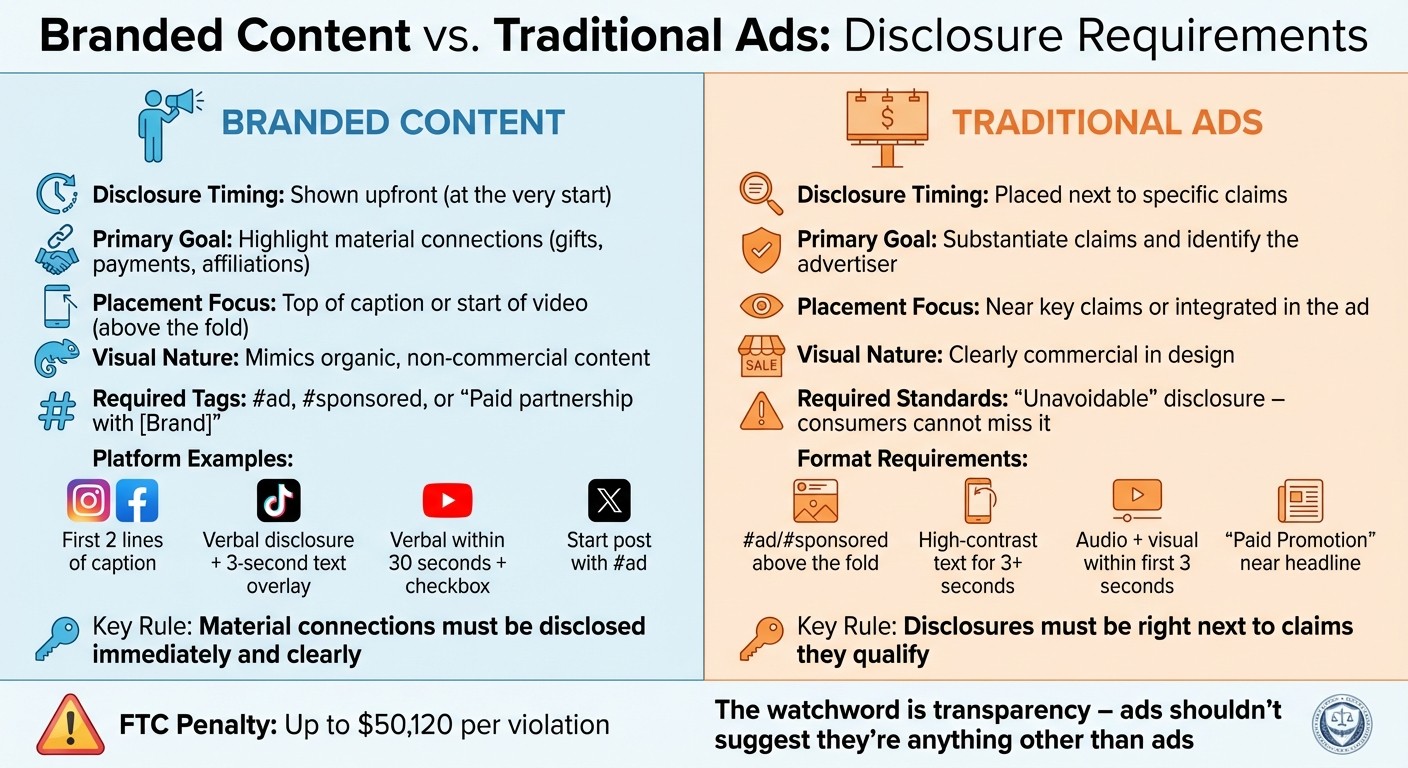
Branded Content vs Traditional Ads Disclosure Requirements Comparison
Branded content and traditional ads both require transparency, but they handle disclosures differently. These distinctions are crucial for staying compliant with Meta ads policies.
Placement and Timing Rules
For branded content, disclosures need to be front and center - usually at the start of a caption or video. This ensures consumers are informed about material connections before engaging with the content. Using tags like #ad or #sponsored at the very beginning is essential. Hiding disclosures behind extra hashtags or under a "see more" button doesn’t meet transparency standards.
"Knowing that something is an ad likely will affect whether consumers choose to interact with it and the weight or credibility consumers give the information it conveys." - Federal Trade Commission
On the other hand, traditional ads follow a different approach. FTC compliance for Meta ads requires that disclosures be placed right next to the claims they clarify. For example, if a weight-loss product ad makes bold promises, the disclaimer about typical results should appear prominently near the headline or claim. This ensures the information is immediately noticeable and accessible to consumers.
Aspect | Branded Content | Traditional Ads |
|---|---|---|
Disclosure Timing | Shown upfront | Placed next to specific claims |
Primary Goal | Highlight material connections (e.g., gifts, affiliations) | Substantiate claims and identify the advertiser |
Placement Focus | Top of caption or start of video (above the fold) | Near key claims or integrated in the ad |
Visual Nature | Mimics organic, non-commercial content | Clearly commercial in design |
These placement rules highlight how the two formats differ in their approach to catching the viewer's attention.
Relationship Disclosure Requirements
For branded content, disclosing material connections is non-negotiable and must happen immediately and clearly. Whether an influencer is gifted free products, has a familial tie to the brand, works for the brand, or earns affiliate commissions, these relationships need to be stated upfront. Consumers shouldn’t have to dig for this information by clicking or scrolling.
Traditional ads, meanwhile, focus more on the payment arrangement between the advertiser and the platform. Since the ad format itself often signals its commercial intent - like a sponsored post on Meta Ads Manager (which requires proper Meta ads schema for tracking) or a Google search ad - the emphasis shifts to backing up the claims made rather than revealing personal connections.
"The public deserves to know what they're looking at & when they're being sold to." - FindMeCreators
This distinction underscores the different expectations for transparency based on the ad type and its format.
Compliance Challenges and Best Practices
When it comes to branded content and ads, strict disclosure practices are non-negotiable. They play a key role in maintaining consumer trust. But compliance isn't simple - mistakes can lead to serious consequences like disabled Meta ad accounts or even enforcement actions from the FTC.
Advertiser Duties and Platform Limitations
Platform tools, such as Meta's "Paid Partnership" tag or Instagram's branded content labels, are helpful but not a complete solution. The FTC emphasizes that advertisers are ultimately responsible for making sure disclosures are clear and visible before consumers interact with content. Relying solely on automated tools won’t cut it.
For example, hiding #ad within a cluster of hashtags or creating native ads that are indistinguishable from editorial content can be considered deceptive. Native ads often walk a fine line - if consumers can't tell it's an ad before clicking, the FTC may classify it as misleading.
"The FTC considers misleadingly formatted ads to be deceptive regardless of whether the underlying product claims that are conveyed to consumers are truthful." - Federal Trade Commission
These rules highlight just how critical it is to stay transparent.
Avoiding Penalties
Non-compliance doesn’t just risk fines - it can also lead to Meta ad rejections or platform bans and damage your brand’s reputation. Repeated violations of disclosure rules can result in account restrictions, including Meta permission errors that block campaign management, while FTC penalties may include hefty fines and public warnings.
To avoid these pitfalls, make your disclosures impossible to miss. Place #ad or #sponsored at the very beginning of captions so they’re immediately visible, whether on mobile or desktop. This ensures users don’t have to click "more" to see the disclosure. Regular audits of your content can also help catch any compliance errors. Implementing Meta ad policy training for your team can further ensure that every post meets these strict standards. Double-check past posts to confirm disclosures are clear and any claims made are well-supported.
"Your audience should never have to guess whether a post is sponsored. The disclosure should be impossible to miss." - @paji_a, Founder of HumanAds
Ultimately, compliance isn’t just about avoiding penalties - it’s about building trust with your audience and ensuring smooth, effective campaigns.
AdAmigo.ai for Compliance and Performance
AdAmigo.ai provides a smart AI automation platform for Meta ads to tackle the challenges of manual compliance while also boosting ad performance. Managing disclosure rules across a multitude of Meta ads and partnership campaigns can be overwhelming, with the risk of compliance errors and penalties always looming. AdAmigo.ai solves this by seamlessly integrating compliance checks into ad creation and optimization workflows.
How AdAmigo.ai Simplifies Ad Management
AdAmigo.ai works tirelessly in the background, auditing your Meta ad account 24/7 and implementing necessary updates. The AI Ads Agent ensures compliance by automatically inserting required labels like #ad or Sponsored by [Brand] into the first two lines of captions. This ensures these disclosures are visible before users click "See More." For video formats, such as Instagram Reels, the system enforces FTC rules for Instagram branded content by adding a 3-second high-contrast text overlay.
With the AI Actions feature, the platform identifies issues like misplaced tags, missing verbal disclosures in video ads, or poorly positioned text that risks being cut off. You can choose to approve changes manually or let the AI handle everything in autopilot mode. Additionally, the AI Chat Agent simplifies account-wide audits with straightforward commands like "Check all campaigns for missing disclosures", eliminating the need to dig through spreadsheets for analysis.
While compliance is a core focus, AdAmigo.ai also enhances ad performance, making it a dual-purpose tool for hitting industry ROAS benchmarks.
Features for Compliance and Optimization
AdAmigo.ai streamlines ad creation with tools like Bulk Ad Launch, which generates hundreds of ads in one go, complete with format-specific disclosures. Whether it’s audible disclaimers for Reels, static overlays for Stories, or correctly positioned text for feed posts, the platform ensures compliance without setup errors. As an official Meta Business Technology Partner, it continuously monitors ad performance, catching disabled ads or setup mistakes before they escalate into penalties.
Feature | Manual Compliance | AdAmigo.ai (Automated) |
|---|---|---|
Monitoring | Staff performs periodic checks | AI provides continuous 24/7 monitoring |
Error Detection | Relies on human review | AI identifies setup and disclosure errors |
Ad Creation | Updates ads individually | Launches ads in bulk with pre-configured templates |
Account Auditing | Spreadsheet-based manual tracking | Instant, automated AI-driven audits |
Response Time | Delayed by staff availability | Immediate alerts and automated fixes |
Risk Mitigation | High chance of human error | Reduced risk with proactive AI scans |
AdAmigo.ai doesn’t stop at compliance - it also optimizes targeting, budgets, and bids, all within a unified system. You can set performance thresholds, such as "Scale spend 30% at ≥3× ROAS", while the AI continues to monitor for compliance gaps. By using pre-approved disclosure templates across all campaigns, the platform helps maintain consistent branding and legal transparency without compromising ad performance.
Conclusion
Branded content and traditional ads require clear disclosure methods to maintain transparency. Branded content typically uses upfront #ad tags or quick verbal mentions, while traditional ads rely on adjacent, unavoidable disclaimers. The Federal Trade Commission (FTC) makes it clear: advertisements must not mislead consumers into thinking they are anything other than ads.
But compliance goes beyond just avoiding penalties - it’s about fostering trust. When audiences recognize they’re viewing an ad, they can better assess the credibility of the information. Transparency safeguards your brand’s reputation and ensures an honest relationship with your audience. That’s why automating compliance isn’t just helpful - it’s necessary.
Managing disclosures manually across multiple Meta ads is both time-intensive and prone to common manual errors. AdAmigo.ai simplifies this process by embedding FTC-compliant disclosures, monitoring accounts 24/7 to manage volatility, and identifying issues before ads go live. On top of that, it optimizes performance, adjusting targeting, budgets, and bids to help you meet your goals while staying compliant.
No matter the type of campaign, clear and ethical disclosures aren’t optional - they’re essential. Tools like AdAmigo.ai allow you to maintain compliance effortlessly, so you can focus on what truly matters: achieving results and growing your business. You can also use an ad performance analyzer to ensure your compliant campaigns are hitting their KPIs.
FAQs
Do I need to disclose gifted products or discounts?
Yes, you need to disclose gifted products or discounts if they establish a material connection with a brand, like receiving free items or special discounts. This aligns with FTC guidelines, ensuring transparency and honesty with your audience. Clear disclosure helps build trust and prevents any potential misunderstandings.
What’s the simplest FTC-safe disclosure wording?
The most straightforward way to meet FTC disclosure requirements is by stating: "This is an ad for [Brand]" or "This video is paid for by [Brand]." Make sure to place this disclosure clearly and prominently at the very beginning of the content to maintain transparency and adhere to FTC guidelines.
Who’s liable if an influencer forgets to disclose?
Influencers are responsible for disclosing any material connections, such as payments or sponsorships, to their audience. They must ensure these disclosures are clear and easy to notice in order to meet FTC guidelines. Failing to do so can make them liable for non-compliance.