Branded Content FTC Rules for Instagram
Follow FTC rules on Instagram: use clear #ad disclosures above the 'more' button, pair Paid Partnership tag with visible text/audio for Stories, Reels, live.
If you post sponsored content on Instagram, you must follow the FTC's rules. These rules are designed to ensure transparency so your audience knows when you're being paid or incentivized to promote a product. Here's what you need to know:
Disclose any material connection: This includes payments, free products, discounts, affiliate links, or even personal relationships with the brand.
Make disclosures clear and visible: Use terms like #ad or #sponsored at the very beginning of captions (above the "more" button) and in visible text overlays for Stories or Reels.
Don't rely solely on Instagram's "Paid Partnership" tag: While helpful, it must be paired with manual disclosures.
Follow content-specific rules: For example, in videos, include both audible and visible disclosures, and repeat them during live streams.
Failing to comply can lead to fines, legal action, and loss of audience trust. Tools like AdAmigo.ai can help monitor and ensure compliance. Always prioritize transparency - it's not just a rule; it's how you maintain credibility with your followers.
When and How to Disclose Sponsored Content
When You Must Disclose
The FTC disclosure rules require disclosure whenever there’s a "material connection" between you and a brand that could influence your endorsement. This isn’t limited to direct payments - it also includes affiliate earnings, free products, discounts, or any perks you receive. Even personal connections, like endorsing a friend’s or family member’s product, need to be disclosed.
The rules cover more than you might think. For example, if a brand pays you to enter a sweepstakes in exchange for a post, that’s a material connection. Even aspirational posts - like saying you want a product while being paid to mention it - require disclosure. If you’re paid by one brand and criticize a competitor, you must reveal your relationship with the sponsoring brand. And if you own the brand you’re promoting, disclose that unless it’s already obvious to your audience.
Honesty doesn’t exempt you. Even if your review is completely genuine and unbiased, the FTC insists that any material connection still needs to be disclosed. Why? Because knowing about the relationship helps people assess your endorsement.
Now that we’ve covered when to disclose, let’s dive into how to make sure your disclosures are clear using the best AI tools for Meta ads and meet FTC guidelines on Instagram.
How to Make FTC-Compliant Disclosures
Start by placing your disclosure in the first three lines of your caption - before Instagram’s "more" button cuts off the text on mobile. Most users scroll on their phones, so if your disclosure is hidden, it won’t be effective.
Use straightforward, unmistakable language. Terms like #ad, #sponsored, or "Paid partnership with [Brand]" should appear right at the beginning of your caption. Avoid vague tags like #sp, #spon, #partner, or #collab, as these can confuse people and don’t meet FTC standards. Simply thanking a brand isn’t enough either.
For Stories and Reels, overlay your disclosure directly on the image or video. Use high-contrast text that stands out and stays on-screen long enough for viewers to read. If you’re creating video content, include both on-screen and audible disclosures - don’t rely on captions alone. For livestreams, repeat your disclosure multiple times throughout the broadcast so new viewers joining in aren’t left in the dark.
Avoid burying disclosures at the end of captions or mixing them into a block of hashtags. While Instagram’s "Paid Partnership" label is helpful, the FTC doesn’t consider it enough by itself. Pair it with a clear written or verbal statement. And remember, tagging a brand in a photo is considered an endorsement. If there’s a material connection, you must disclose it.
"If there is a 'material connection' between an endorser and an advertiser – in other words, a connection that might affect the weight or credibility that consumers give the endorsement – that connection should be clearly and conspicuously disclosed." - Mitchell J. Katz, Office of Public Affairs, FTC
FTC Rules 2020 | Sponsored Instagram Post GUIDELINES
Instagram's Built-In Disclosure Tools
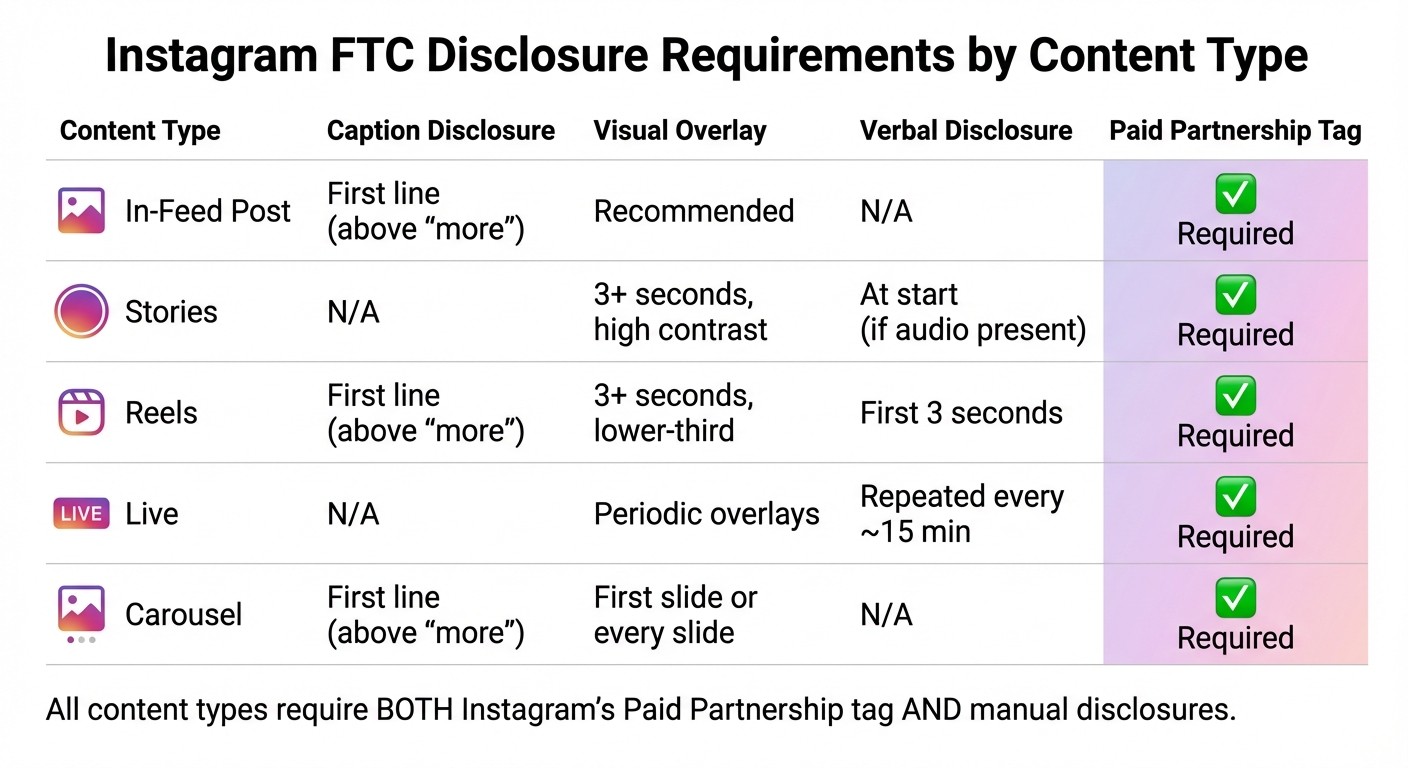
FTC-Compliant Instagram Disclosure Requirements by Content Type
How to Use Instagram's Branded Content Tag
Instagram makes it easy to disclose partnerships with its "Paid Partnership" label, which appears at the top of your post when you tag a brand partner. To activate this feature, turn on the "Branded Content" option while creating your post and select the brand you're collaborating with, or use an AI Media Buyer to manage your partnership campaigns. Once set, a gray banner will display the label as "Paid Partnership with [Brand Name]" above your content.
However, simply using this built-in tool isn't enough to meet FTC guidelines. While Instagram requires the label for branded content, you also need to include a clear manual disclosure. To stay compliant, add a disclosure like #ad or #sponsored at the very beginning of your caption - before any emojis, hashtags, or other text. Combining Instagram's tool with a manual disclosure ensures you're fully transparent with your audience.
It's also important to tailor your disclosures based on the type of content you're posting to align with Meta ads FTC endorsement rules.
Disclosure Requirements by Content Type
Each Instagram content format has specific guidelines for disclosures, in addition to the built-in "Paid Partnership" tag. Here's how to handle disclosures across different types of posts:
In-feed posts: Place your disclosure in the first line of the caption - above the "more" button that truncates text on mobile. Use the Paid Partnership tag as well.
Stories: Add a clear text overlay using high-contrast colors (balancing ad copy vs. visuals) that stays visible for at least three seconds. If your Story includes audio, include a verbal disclosure at the beginning.
Reels: Use a layered approach. Add a written disclosure in the first line of the caption, include an on-screen text overlay (like a lower-third banner) visible for at least three seconds, and verbally disclose the partnership within the first three seconds of audio.
Live streams: Repeat your disclosure every 15 minutes so viewers who join later are informed. Visual overlays can also help reinforce transparency.
Carousel posts: Include a disclosure on the first slide or on every slide featuring the sponsored product.
Here's a quick breakdown of these requirements:
Content Type | Caption Disclosure | Visual Overlay | Verbal Disclosure | Paid Partnership Tag |
|---|---|---|---|---|
In-Feed Post | First line (above "more") | Recommended | N/A | Required |
Stories | N/A | 3+ seconds, high contrast | At start (if audio present) | Required |
Reels | First line (above "more") | 3+ seconds, lower-third | First 3 seconds | Required |
Live | N/A | Periodic overlays | Repeated every ~15 min | Required |
Carousel | First line (above "more") | First slide or every slide | N/A | Required |
Common FTC Violations and How to Avoid Them
Typical Disclosure Mistakes
Even brands and influencers with good intentions can stumble when it comes to FTC compliance. One frequent misstep is using unclear language that leaves the audience unsure about a paid partnership. For example, hashtags like #sp, #spon, #collab, #partner, or #ambassador don't make the relationship obvious. The FTC requires straightforward terms such as #ad or #sponsored to clearly indicate sponsorship.
Another common issue is where disclosures are placed. If they're tucked away at the end of a caption, buried in a sea of hashtags, or hidden behind the "more" button, mobile users might miss them entirely. Some influencers mistakenly think a disclosure in their profile or bio covers them, but the FTC expects each sponsored post to include its own clear disclosure. Additionally, relying solely on Instagram's "Paid Partnership" tag without adding a manual disclosure can leave you out of compliance.
Video content adds another layer of complexity. Simply tagging a brand in a photo or video isn't enough without a visible #ad. For Reels and Stories, disclosures must be both audible and visible. Live streams require periodic reminders so viewers who join later are informed. Failing to meet these standards means crucial information might not reach the audience.
The consequences of non-compliance are steep. In 2023, the FTC sent over 700 warning letters to influencers and brands for failing to meet disclosure requirements. Civil penalties can climb to $50,000 per violation.
Disclosure Type | FTC-Compliant Examples | Non-Compliant Examples |
|---|---|---|
Hashtags | #ad, #sponsored, #BrandPartner | #sp, #spon, #collab, #partner |
Phrasing | "Thanks [Brand] for the free product" | "Thanks [Brand]", "Ambassador" |
Placement | Above the "more" button; start of caption | End of post; buried in a hashtag cloud |
Video | Audible mention + on-screen text | Description box only |
Fixing these mistakes is crucial, but it’s just the beginning. Regular audits and third-party compliance tools can help ensure your practices stay in line with FTC endorsement rules for Meta ads.
How to Audit Your Disclosure Practices
Once you understand the common mistakes, it’s time to evaluate your content for compliance. Here’s how to get started.
First, check each post on a smartphone to confirm disclosures are visible above the "more" button. If they’re hidden, move them to the start of your caption where they’re immediately noticeable.
Next, review the language you’re using. Replace any vague terms with FTC-approved options like #ad or phrases such as "Paid partnership with [Brand]."
For video content, ensure Reels and Stories feature a spoken disclosure within the first three seconds, along with an on-screen text overlay that’s easy to read (use high-contrast colors). During live streams, repeat disclosures periodically so latecomers aren’t left in the dark.
Also, take inventory of all relationships that require disclosure. The FTC mandates transparency for any connection involving financial compensation, free products, discounts, employment, or even family ties. As the FTC emphasizes:
"As an influencer, it's your responsibility to make these disclosures, to be familiar with the Endorsement Guides, and to comply with laws against deceptive ads. Don't rely on others to do it for you."
Brands should also establish a system to catch potential issues before they happen. Require influencers to submit drafts for approval before posting, and conduct regular reviews to spot gaps in compliance. A simple scorecard system - ✅ for compliant, ⚠️ for needs revision, and ❌ for non-compliant - can help you evaluate past posts and pinpoint recurring problems. Update contracts with influencers to explicitly require #ad tags and specify where disclosures must appear.
Tools That Help Maintain FTC Compliance
How AdAmigo.ai Supports Instagram Compliance
Keeping up with FTC compliance on a large scale requires automated systems that can quickly identify mistakes. AI platforms are now capable of detecting compliance issues within 30 seconds of posting. The FTC has made it clear that monitoring, documentation, and pre-approval workflows are no longer optional - they are now considered essential practices.
AI-powered tools can monitor influencer posts, Stories, and Reels in real time, flagging missing #ad disclosures or unclear terms like #sp or #collab. They even keep an eye on temporary content like Instagram Stories, capturing original versions and tracking any edits or deletions. This creates a detailed audit trail with metadata and timestamps, which is critical when penalties can climb as high as $50,120 per violation.
AdAmigo.ai takes these capabilities a step further by using AI to help brands maintain compliance seamlessly. The platform generates FTC-compliant ad creatives, optimizes targeting, and ensures consistent disclosure language across campaigns. Its AI Ads Agent studies your brand's identity and can be programmed to include proper FTC disclosures in both ad copy and creative templates, minimizing the risk of launching campaigns with unclear sponsorship messaging.
Pre-approval workflows are another key feature. These tools let brands review influencer content before it goes live, ensuring disclosures are placed "above the fold" (visible without clicking "more") and that video content includes both audible and visible disclosures. For example, in November 2023, the FTC issued warning letters to health influencers promoting aspartame and sugar products without clear disclosures. Many had hidden #ad tags in collapsed captions or used vague hashtags. Automated tools can flag such issues during the review process, helping brands address them before publication. These workflows integrate smoothly into a broader compliance strategy.
But compliance isn't just about avoiding penalties - it’s also about fostering trust. A survey revealed that 57% of consumers want clear transparency in brand-influencer relationships. Platforms like AdAmigo.ai not only help reduce risks but also strengthen audience trust by ensuring consistent and clear disclosures. As Enrico Schaefer, Founding Partner at Traverse Legal, emphasizes:
"Monitoring, documentation, and pre-approval workflows are no longer optional. They're baseline controls".
Conclusion: Staying FTC-Compliant on Instagram
Following FTC guidelines isn’t optional - it’s a legal obligation. The rules are clear: every material connection must be disclosed in a way that’s easy to spot and understand. This means using labels like #ad or #sponsored at the very beginning of captions, above the "more" button, and making sure disclosures are superimposed on Stories and Reels for maximum visibility. While Instagram’s Branded Content tag is a helpful feature, it doesn’t replace the need for clear, manual disclosures. This responsibility applies to everyone involved - brands, influencers, and agencies alike.
Failing to comply can lead to serious consequences. For example, in March 2020, Teami, LLC had to pay $1 million after failing to meet disclosure requirements. But beyond avoiding fines, compliance is about building trust. Research shows that 33% of Gen Z trust influencers more when they clearly disclose paid partnerships, proving that transparency strengthens audience relationships.
As the FTC itself states:
"The Guides, at their core, reflect the basic truth-in-advertising principle that endorsements must be honest and not misleading."
Using automation tools can simplify compliance. Platforms like AdAmigo.ai can embed FTC-compliant disclosures directly into ad copy and creative templates, making transparency part of the process from the start. Features like pre-approval workflows, real-time monitoring, and audit trails ensure campaigns are both compliant and efficient. These tools not only reduce manual errors but also help reinforce trust with your audience.
To stay compliant, take steps like auditing your current practices, training your team on disclosure rules, and implementing systems to catch mistakes before they go live. Being proactive about compliance protects your brand, keeps you within legal boundaries, and strengthens the loyalty and trust of your audience.
FAQs
What counts as a “material connection” on Instagram?
A “material connection” on Instagram refers to any financial, employment, personal, or family relationship with a brand. This includes situations where you receive free or discounted products, payments, or other perks from the brand. To stay transparent and align with FTC guidelines, such connections must be clearly disclosed.
Where should I put #ad so it’s FTC-compliant?
When including #ad in your content, make sure it’s placed in a clear and visible location, like on the same screen as the post or video. It should stand out enough for viewers to notice, ensuring transparency about your relationship with the brand. Following FTC guidelines, avoid hiding or making the disclosure hard to find.
Do I still need #ad if I use the Paid Partnership tag?
Yes, it’s still necessary to include #ad or a similar disclosure, even if you’re using the Paid Partnership tag. The FTC requires that any material connection between you and a brand is clearly and prominently disclosed. Using hashtags like #ad helps meet this requirement, ensuring transparency and compliance with FTC guidelines for sponsored content.