
Interest Layering: Best Practices for Meta Ads
Refine Meta ad targeting with interest layering - combine interests, behaviors, and demographics with AND logic to cut CPA and boost ROAS.
Interest layering is a powerful way to refine your Meta ads targeting in 2026. With Facebook CPMs up 23% year-over-year and 70% of campaign underperformance linked to vague targeting, this method helps you focus on high-intent users. By combining interests, behaviors, and demographics with "AND" logic, you can lower CPAs by up to 45% and boost ROAS by 2–3x.
Key Takeaways:
What it is: Combines specific interests (e.g., "Fitness") with behaviors (e.g., "Frequent Online Shoppers") for precise audience targeting.
Why it works: Filters out irrelevant users, improving ad relevance, lowering costs, and increasing click-through rates (CTR).
How to do it:
Start with broad interests (5–20M reach).
Add behaviors (e.g., "Recently moved") and demographic filters (e.g., "Income top 25%").
Use Meta's Narrow Audience feature for "AND" logic.
Avoid overly small audiences (<10,000 users).
Results You Can Expect:
CPA Reduction: Up to 38% lower costs.
Higher Engagement: 1.64% increase in CTR.
Improved Ad Quality: Up to 72% better scores.
Layering interests with behaviors and custom audiences can further refine targeting. AI tools like AdAmigo.ai automate this process, saving time and optimizing for better performance. Test, refine, and adjust your strategies regularly to keep costs low and conversions high.
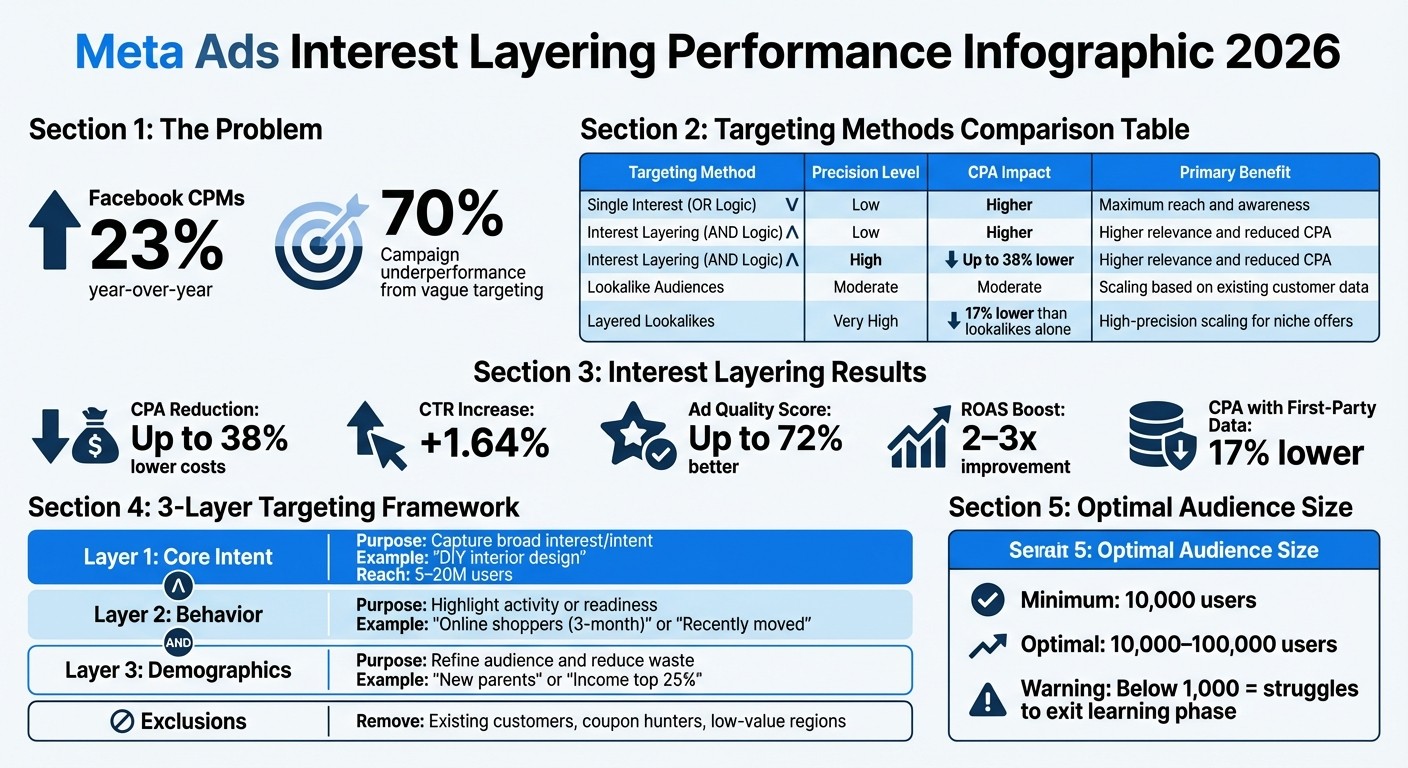
Meta Ads Interest Layering Performance Comparison: Targeting Methods and Results
How To Set Up Meta Ads Layered Targeting
What Is Interest Layering and Why It Works
Interest layering - also known as interest stacking - is a method of combining specific interests, behaviors, and demographics using layered AND/OR statements to create highly targeted audiences. For example, instead of relying on broad categories, you can refine your audience by merging product interests with specific shopping behaviors. This approach ensures you're reaching people more likely to engage with your ad.
The magic lies in the logic. Traditional "OR" targeting casts a wider net, which can dilute precision. Layering, on the other hand, uses "AND" logic, meaning users must meet all the conditions of each layer to see your ad. LeadEnforce sums it up perfectly:
"Each layer removes the noise, letting you zero in on the people who are actually likely to click, engage, and buy".
This filtering process screens out those with only a passing interest, focusing instead on individuals with genuine intent. The results? Interest layering can lead to a 1.64% increase in click-through rates (CTR) and up to a 38% reduction in cost per acquisition (CPA). When combined with first-party data, this method can even outperform lookalike audiences, delivering 17% lower CPA.
How Meta Categorizes Interests
Meta organizes user interests into three main categories: Interests (e.g., "email marketing"), Behaviors (e.g., "engaged shoppers" or "business page admins"), and Demographics (e.g., job titles, age, or relationship status). These profiles are built using a mix of declared preferences, observed behaviors, and engagement patterns - such as video views, page likes, comments, and Instagram activity - across its platforms.
By default, Meta applies "OR" logic when you add multiple interests to a single targeting field. While this expands your audience, it can also dilute targeting precision. Understanding why advertise on Meta and how these categories work is crucial for leveraging interest-based targeting strategies to improve ad performance. Advanced advertisers often use AI audience profiling to further refine these segments.
Why Interest Layering Improves Performance
By combining a core interest with a specific behavior or life stage, layering creates more refined audiences. For instance, targeting "trail runners" and "data enthusiasts" ensures you're reaching individuals who not only enjoy running but are also likely tracking their performance metrics. This specificity boosts ad relevance, which helps reduce costs and improve engagement.
The numbers speak for themselves. Layered targeting can improve ad quality rankings by as much as 72% compared to broad targeting. And with Facebook's global CPM averages rising by 23% year-over-year, using precise targeting methods like layering is becoming essential to manage costs effectively. However, it's important not to overdo it - if your audience size falls below 1,000, your campaign may struggle to exit the learning phase. For best results, aim for an audience size between 10,000 and 100,000 users.
Targeting Method | Precision | CPA Impact | Primary Benefit |
|---|---|---|---|
Single Interest (OR Logic) | Low | Higher | Maximum reach and awareness |
Interest Layering (AND Logic) | High | Up to 38% lower | Higher relevance and reduced CPA |
Lookalike Audiences | Moderate | Moderate | Scaling based on existing customer data |
Layered Lookalikes | Very High | 17% lower than lookalikes alone | High-precision scaling for niche offers |
In the next section, we’ll dive into actionable steps for building interest layers that drive results. Stay tuned!
How to Build Interest Layers That Work
Building interest-based audiences involves starting with broad categories and progressively narrowing them down. This approach helps eliminate irrelevant users while keeping those with high intent.
Combining Broad and Narrow Interests
Begin with a core interest that signals purchase intent. Ideally, this should have a reach of 5 to 20 million users. For example, instead of targeting the generic category "Home", try something more specific like "DIY interior design" to capture intent. Then, integrate behavioral signals such as "Online shoppers (3-month)" or "Recently moved" to highlight readiness to buy. Add demographic filters like "New parents" or "Income top 25%" to further refine your audience.
The trick is to combine interests that complement each other rather than overlap. For instance, pairing "Running" with "Wearable technology" creates a more precise audience, while combining "Running" with "Jogging" only reduces your reach without adding new insights.
Finding Related Interests with Meta's Suggestions
AI tools for interest-based Meta ads and Meta's Suggestions tool are handy resources for uncovering related interest groups you might not have considered. As you type an interest into the targeting field, Meta suggests categories based on user engagement metrics like page likes, group memberships, and video views. Use these suggestions to find complementary interests rather than synonyms. For example, if your core interest is "Strength training", Meta might recommend "Home gym equipment" or "Protein supplements", which help refine your targeting.
Avoid layering synonymous interests like "Fitness" and "Physical exercise", as this creates redundancy. Instead, focus on interests that highlight different aspects of your audience’s behavior or intent. Once identified, apply manual vs AI-powered targeting logic settings to fine-tune your reach.
Using AND/OR Logic to Control Reach
By default, Meta applies OR logic when you add multiple interests, which broadens your audience. To increase precision, use the "Narrow Audience" option to enforce AND logic. While OR logic can expand your reach, it risks reducing relevance. AND logic ensures users meet all the criteria you set, creating a more focused audience.
For instance, you could group related interests in Layer 1 using OR logic (e.g., "Email marketing" OR "Mailchimp"). Then, apply AND logic to require users to also match Layer 2 ("Small business owners") and Layer 3 ("Online shoppers"). Additionally, exclude segments like existing customers, discount seekers, or low-value regions to keep acquisition data clean and control costs.
Layer Type | Purpose | Example |
|---|---|---|
Layer 1: Core Intent | Capture broad interest/intent | "DIY interior design" |
Layer 2: Behavior | Highlight activity or readiness | "Online shoppers (3-month)" |
Layer 3: Demographics | Refine audience and reduce waste | "New parents" or "Income top 25%" |
Exclusions | Remove low-value users | Existing customers, coupon hunters |
Layering Interests with Behaviors and Custom Audiences
Interest targeting on its own can sometimes miss the mark. To refine your approach, combine interests with behavioral signals and custom audience segmentation. This method enhances earlier techniques of blending broad and specific interests by adding deeper layers of user actions and your own audience data.
Adding Behavioral Signals to Interest Layers
Behavioral signals give you insights into user engagement. Start with a core interest such as "Clean beauty" (5–20M reach), then add behaviors like "Online shoppers (3-month)" or "Recently moved" to zero in on users who are actively making decisions. For example, stacking first-party behavioral data with interest targeting has been shown to reduce CPA by 17%. You can also include device or app usage data - for instance, targeting "Fitness enthusiasts" who also use "Health and fitness apps" creates a more engaged audience rather than one that's merely aspirational.
To take it further, integrate custom audiences built from your own data for even greater targeting precision.
Layering Interests with Custom Audiences
Custom audiences - like those made up of website visitors, video viewers, or email subscribers - are incredibly powerful when combined with interest targeting. For example, you could target users who watched at least 50% of your product demo video and also show interest in "Sustainable living". This approach connects you with prospects who are already familiar with your brand and ready for the next step.
Here’s what the experts say:
"My findings indicate greater success when I leveraged Meta's data-rich, in-platform audiences over my client's email lists and pixel data. Facebook and Instagram engagers over the last 90 days were the top-performing audiences."
– Akvile DeFazio, President, AKvertise
Use the Narrow Audience feature to enforce an AND logic between interests and custom audiences. Additionally, exclude recent converters (7–30 days) to ensure you're not wasting budget on users who have already completed a purchase. For more advanced budget protection, consider automated campaign pausing to stop underperforming sets instantly.
Example: Multi-Layer Targeting Setup
Let’s say you’re a skincare brand looking to create a high-conversion retargeting campaign. First, choose the interest "Clean beauty" to define your niche. Then, add the behavior "Cart abandoners (1–7 days)" to focus on users with the strongest purchase intent. Next, layer in the demographic "Income top 25%" to target customers who are more likely to afford premium products. You can also use a target audience finder to identify these high-value segments automatically. Finally, exclude users who purchased in the last 30 days.
This setup creates a highly targeted group of eco-conscious, affluent shoppers who were close to buying but didn’t complete their purchase. Use compelling messages with urgency, such as limited stock alerts, expiring discounts, or social proof. Since this audience is smaller, refresh your creative every 7–10 days to keep it engaging and avoid ad fatigue.
Layer Type | Example Segment | Purpose |
|---|---|---|
Core Interest | "Clean beauty" | Identifies niche preference |
Behavior | "Cart abandoners (1–7 days)" | Targets users with purchase intent |
Demographic | "Income top 25%" | Filters for higher purchasing power |
Exclusion | "Past 30-day purchasers" | Prevents wasted ad spend |
When working with custom audiences, aim for a balance between precision and reach. If your audience size drops below 10,000, it may struggle to exit the learning phase. Also, watch for overlap between ad sets - if it exceeds 30%, consolidate them to avoid competing against yourself in the ad auction.
Using AI Tools to Automate Interest Layering
Manually testing interest layers can eat up a lot of time. AI tools, however, take over this task by running tests 24/7 and adjusting strategies based on real-time data. According to a study by Meta, using AI for campaign management can lower cost per action (CPA) by as much as 28%. This makes AI a game-changer for simplifying and improving your interest layering approach.
How AdAmigo.ai Optimizes Interest Layers
While manual layering can yield results, using AI simplifies and accelerates the process. AdAmigo.ai's AI Autopilot continuously reviews your account to pinpoint the best-performing interest combinations. You can even give it specific instructions, like: "Test Clean beauty layered with Cart abandoners and Sustainable living enthusiasts." The AI will then create, launch, and monitor campaigns based on your input.
The platform predicts which interest layers are likely to deliver the strongest results before allocating your budget. It also runs automated A/B tests on audience setups and uses predictive bidding strategies to speed up learning by as much as 32%.
One standout feature is real-time optimization. If an interest layer suddenly becomes more expensive or engagement drops, the system detects anomalies and can pause spending automatically. This dynamic adjustment reduces the need for manual bid tweaking and budget reallocation by around 85%.
Scaling with AI-Powered Audience Optimization
AI doesn’t just stop at initial optimizations - it keeps refining and expanding your audience for long-term success. AdAmigo.ai uses your customer data to create detailed lookalike audiences and uncovers new micro-segments based on buyer intent signals. For example, if your "Fitness enthusiasts" + "Health app users" layer performs well among women aged 25–34, the AI might test similar combinations, such as adding "Yoga" or "Meditation" interests.
The platform systematically tests variations and identifies top-performing combinations based on statistically significant results. This process alone can increase your return on ad spend (ROAS) by 15–30%. You can also set specific parameters, like capping daily budget increases at 20–30% or ensuring minimum ROAS thresholds, to keep the AI operating within your comfort zone.
Chris Penn, Co-founder of Trust Insights, sums it up well:
"AI doesn't replace the marketer - it augments your decisions, turning your reactions into proactive strategies".
To maximize results, pair your Meta Pixel with the Conversions API and aim for an Event Match Quality score of 7 or higher. This ensures the AI works with cleaner, more accurate data. Additionally, reserve about 10% of your budget for ongoing experiments with new interest layers. Think of your account as a dynamic testing ground where the AI can constantly discover and refine winning combinations.
Testing and Refining Your Interest Layers
Once you've set up your interest layers, the real work begins: testing and adjusting them to keep performance on track.
A/B Testing Different Interest Combinations
A/B testing is your go-to method for figuring out which combinations of interest layers deliver the best results. To get accurate insights, make sure to avoid audience overlap between your test groups. For example, if you’re testing a 1% Lookalike audience, exclude it from the 3% test group. Meta’s "Show Audience Overlap" tool can help you keep overlap under 30%, which minimizes internal competition during auctions. If you notice overlap between two audiences in the 30–50% range, consider merging those groups into a single ad set. This gives Meta’s algorithm more data to work with, improving efficiency.
In 2026, a key test to run is comparing your manually layered interest audiences against Broad targeting (where restrictions are minimal). This will reveal whether your layering strategy genuinely boosts performance or if Meta’s AI can pinpoint converters more effectively on its own. For accurate results, run these tests for at least 14 days. This timeframe allows the algorithm to exit its learning phase and deliver more stable outcomes. Be sure to track CPA and ROAS closely, and exclude recent converters (from the last 7–30 days) to focus on acquiring new customers.
Once your testing phase wraps up, use the data to tweak your audiences for better results.
Adjusting Audiences Based on Performance Data
Performance metrics like CTR, CPC, and lead quality are your compass for refining or eliminating audience segments. A CTR above 1% for feed placements indicates that your message is resonating with that audience. But don’t stop there - evaluate the quality of the leads you’re generating. A high volume of cheap leads from a specific interest layer might point to a flaw in the algorithm that needs addressing.
Pay attention to "Ad Set May Get Zero" alerts, which usually signal that your audience is either too narrow or overlapping with other ad sets. To avoid these pitfalls, review audience overlap and fragmentation every 30 days. Signs like rising costs or creative fatigue mean it’s time to make adjustments. If you notice that Meta is delivering ads beyond your specified interest layers and still achieving results, it might be worth loosening or removing those constraints.
As Jon Loomer aptly explains:
"The algorithm only cares about getting you the result you asked for. It's literal that way."
How AI Improves Optimization Over Time
As you refine your strategy, Meta’s AI takes your interest layers and treats them as flexible suggestions rather than rigid rules. Unlike manual tweaks, AI uses every click and conversion to improve targeting, consolidating data instead of scattering it across multiple ad sets. This process helps the algorithm exit the learning phase faster and work more effectively.
Meta’s algorithm often surprises marketers with its ability to optimize independently. For instance, in one case, it allocated 99% of the budget to women for a female-focused product, even though no gender restrictions were applied. The takeaway? Trust the AI to prioritize based on real-time signals like pixel activity and conversion data. Still, it’s a good idea to review your top-performing audiences monthly to catch any cost spikes early. Avoid rigid age or gender constraints unless absolutely necessary, as they can increase costs and limit the AI’s ability to find unexpected opportunities.
Key Takeaways for Interest Layering
Interest layering helps boost relevance without sacrificing scale. By combining complementary interests - like pairing "Strength training" with "Home gym equipment buyers" - you provide Meta's algorithm with clearer signals about your ideal audience, increasing the likelihood of conversions.
The trick is finding the right balance. Avoid stacking interests that mean the same thing, like "Running" and "Jogging", as this creates redundancy without improving targeting. Instead, use a mix of core intent interests (with a reach of 5–20 million), behavioral signals (like "Online shoppers"), and demographic or life-stage filters to refine your audience further. These combinations create a strong foundation for testing and creative updates.
A/B testing various campaign elements is key to identifying what works. Adjust one layer at a time to isolate performance drivers, and review your top-performing audiences every 30 days to spot potential issues like rising costs or creative fatigue. To keep engagement high, rotate ad creatives every 7–10 days within these tightly defined audience segments.
As Meta’s algorithm evolves, it’s expected to treat interest layers more as suggestions than strict rules, especially for conversion-driven campaigns. This is where advanced AI tools for Meta ad management like AdAmigo.ai shine. AdAmigo’s AI Autopilot audits your ad account, tests interest combinations, shifts budgets to high-performing layers, and generates fresh creatives - all while staying aligned with your KPIs. Many users have seen up to a 30% improvement in performance within the first month.
When done thoughtfully, interest layering can significantly improve ad performance. Pair this strategy with regular testing and AI-driven tools to navigate rising CPMs and get the most out of your Meta ad campaigns.
FAQs
When should I use interest layering vs broad targeting?
Interest layering is a powerful method for reaching specific, niche audiences. By combining multiple interest categories, you can create highly targeted audience segments. This approach is especially useful in a post-iOS 14 landscape, where precise targeting can help combat challenges like limited data availability or creative fatigue. The result? More relevant ads and potentially lower costs.
On the other hand, broad targeting is ideal for scaling campaigns or taking advantage of Meta's AI-driven tools, such as Advantage+ campaigns. Broad targeting simplifies the setup process by reducing the need for detailed audience segmentation. Instead, it relies on Meta's algorithms to optimize delivery, making it a great choice when you're aiming for larger reach with minimal manual effort.
How many layers are too many before performance drops?
Excessive layering in audience targeting doesn’t come with a set limit, but it can lead to problems like overlapping audiences and reduced relevance. These issues can negatively impact performance. The key is finding a balance between broad and specific interests to prevent over-segmentation.
How do I stop layered ad sets from competing with each other?
To keep your ad sets from competing with each other, focus on reducing audience overlap by consolidating campaigns and targeting larger, distinct audiences. Creating multiple ad sets with similar or overlapping audiences can lead to higher auction competition and drive up costs.
Instead, try techniques like interest stacking and detailed targeting to craft precise, non-overlapping audience groups. This approach boosts efficiency and helps minimize internal competition, ensuring your campaigns perform better overall.