
AI Tools for Meta Ads: Multi-Channel Segmentation Guide
AI-driven audience segmentation and budget optimization for Meta platforms using native tools and third-party automation.
AI tools are changing how advertisers manage Meta campaigns. They analyze user behavior in real time, improving audience segmentation across platforms like Facebook, Instagram, and Messenger. These tools also excel at AI-powered retargeting to re-engage past visitors. Instead of relying on manual targeting, AI dynamically adjusts budgets and fine-tunes strategies based on live performance data.
Key takeaways:
Meta's Advantage+: Uses real-time signals to optimize targeting and budgets. It simplifies campaign management by consolidating ad sets and focusing on behavior-based audiences.
Third-party AI tools for Facebook and Instagram ads like AdAmigo.ai: Offer features like predictive analytics, cross-platform management, and automated creative generation. These tools integrate with CRMs and e-commerce platforms for deeper insights.
Advanced segmentation and predictive targeting: Platforms like Pixis and Klaviyo focus on micro-segments and predictive targeting, helping reduce customer acquisition costs by up to 50%.
AI-driven segmentation helps target users more precisely, saving time and improving campaign performance. Whether using Meta's built-in tools or external platforms, these solutions simplify management and boost results.
How to Create the Best Facebook Ads with AI
AI Tools for Multi-Channel Segmentation in Meta Ads
When it comes to audience segmentation on Meta platforms, it's crucial to use tools that go beyond basic targeting. While Meta's built-in features provide a solid starting point, third-party platforms bring advanced predictive intelligence and cross-channel capabilities into play. Here's a closer look at Meta's native features, the capabilities of AdAmigo.ai, and other external tools that help refine audience targeting.
Meta's Native AI Features
Meta's Advantage+ Audiences is a key tool that uses real-time signals - like clicks, scrolls, video views, and time spent on a page - to adjust targeting dynamically. Instead of sticking to rigid demographic profiles, this system reallocates ad budgets toward users with a higher likelihood of converting, even if they don't fit the original audience mold. Additionally, the Conversions API allows advertisers to send server-side data directly to Meta, bypassing browser limitations. When paired with the pixel, this setup can lead to an average 13% improvement in cost per action.
Another standout feature is predictive interest targeting, which identifies users likely to engage with your ads before they even show intent. Meta's algorithm can pinpoint potential buyers up to 48 hours before they hit peak interest. This allows advertisers to deliver messages at the perfect time. As Metaphase Marketing puts it:
The shift is from trying to control every tiny audience detail to providing the algorithm with the best possible data inputs.
This strategy works best when advertisers consolidate their ad sets into 1–2 broad groups instead of splitting them into 10–15 smaller ones. This approach gives Meta's AI the data it needs to learn and optimize effectively.
While Meta's tools excel at real-time optimization, third-party platforms like AdAmigo.ai take things further with automated, comprehensive campaign management.
AdAmigo.ai for Automated Multi-Channel Optimization
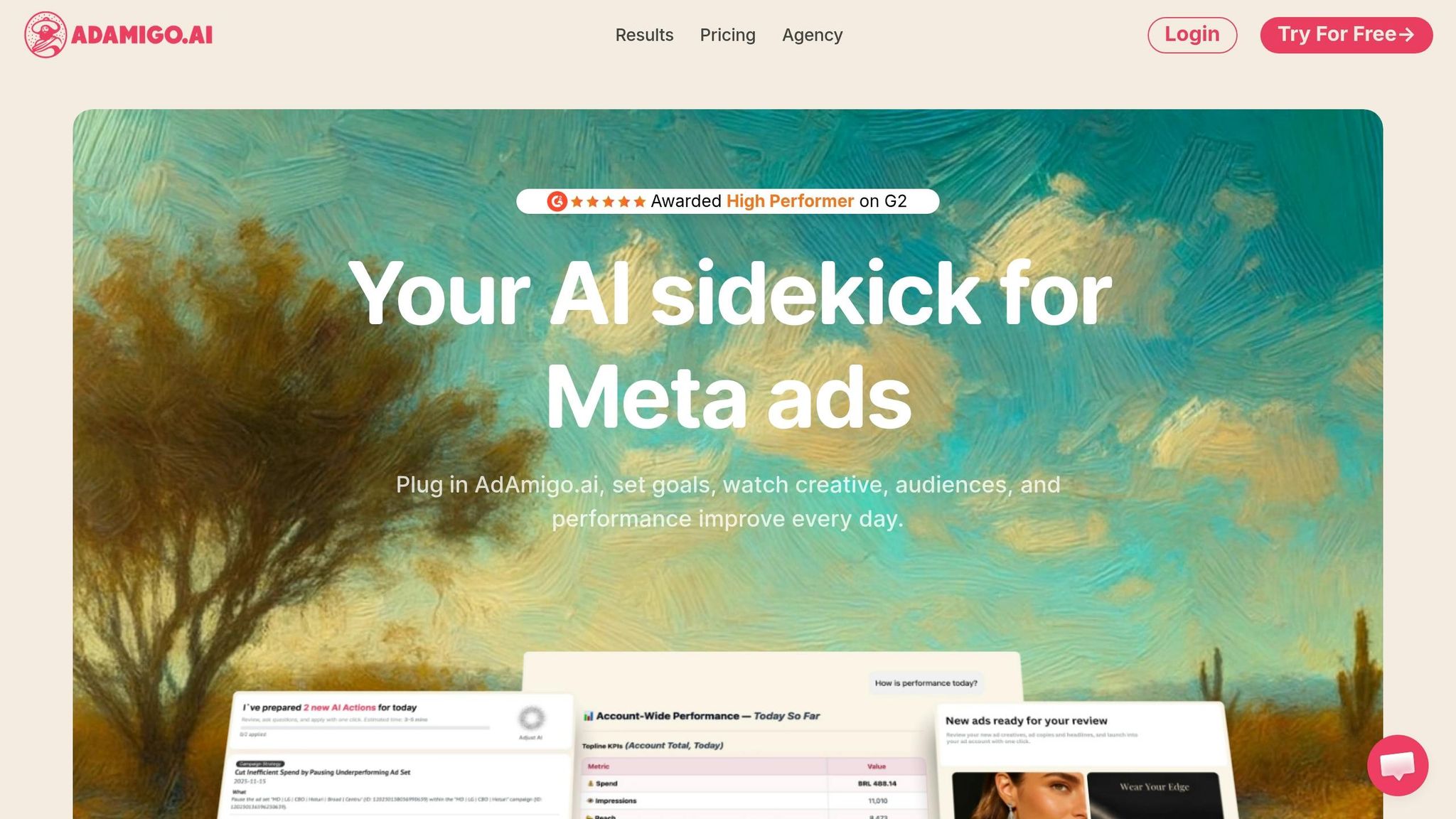
AdAmigo.ai acts as a fully autonomous media buyer. By connecting your Meta ad account and setting goals - such as "Increase spend by 30% while maintaining a 3× ROAS" - you can let the platform handle the rest. Its AI Ads Agent generates complete ad creatives, including design, copy, and targeting, by analyzing your brand and competitors. Additionally, AI Actions and a Chat Agent offer daily optimization insights, which you can either approve manually or leave on autopilot.
One standout feature is the Bulk Ad Launcher, which can deploy dozens (or even hundreds) of ads in minutes by pulling assets from your Google Drive and applying the right copy, creative, and targeting. Unlike Meta's native tools, which focus solely on its ecosystem, AdAmigo.ai integrates with CRMs, e-commerce platforms, and email tools, making it a great fit for agencies managing multiple clients and brands.
For those seeking even more advanced segmentation, external AI platforms can deliver deeper behavioral insights.
External AI Tools for Advanced Segmentation
Several external tools provide next-level audience targeting by focusing on user behavior rather than just demographics:
Pixis Advance uses neural networks and over 200 attributes to identify niche micro-segments and high-intent audiences across multiple platforms.
Klaviyo specializes in e-commerce, grouping customers based on predictive lifetime value and purchase history.
Segment acts as a Customer Data Platform (CDP), consolidating user data across different channels to maintain consistent audience segments throughout your marketing stack.
Optimove focuses on predictive segmentation, modeling churn risks and forecasting customer behaviors before they happen.
These tools shift the focus from demographic profiles to behavioral patterns, analyzing micro-signals like browsing habits, engagement trends, and purchase timing. For example, e-commerce brands using AI-driven audience targeting often see customer acquisition costs drop by 35–50% within 90 days. Marketing teams also report spending 60–70% less time on audience research and testing. The real strength of these tools lies in their ability to predict behavior, offering a more precise and effective alternative to traditional demographic-based targeting.
Multi-Channel Segmentation Strategies Using AI
These strategies are designed to structure campaigns in a way that accelerates AI learning and boosts performance across multiple channels.
Broad-to-Narrow Audience Expansion
Start by consolidating campaigns into 1–2 broad ad sets to give AI enough data to identify patterns. Begin with a wide audience, such as all U.S. adults aged 25–65, and enhance this with first-party data from your CRM, email lists, and Meta Pixel. Over time, the algorithm will refine its focus, identifying high-intent users without requiring constant manual adjustments.
Use 90 days of post-purchase data to define your Ideal Customer Profile (ICP) and inform Advantage+ targeting. This approach gives the AI a trustworthy foundation to work from. If your click-through rate (CTR) or conversion rate drops 15% below the rolling median for two consecutive days, introduce fresh creative options instead of modifying audience settings. This method naturally transitions into more behavior-based targeting as the system learns.
Lifecycle Stage-Based Targeting
Once broad audience strategies are in place, segment users further based on their lifecycle stage. Group them by behaviors like how quickly they purchase, their likelihood of retention, or their potential for upsells. Use your CRM and Conversions API to define these stages - such as prospects, trial users, and repeat buyers - and assign tailored creative assets to each group. For example, new prospects might see ads featuring value-focused headlines, while loyal customers could receive offers for exclusive rewards.
Switching from demographic targeting to behavior-based cohorts has been shown to increase incremental ROAS by 21% over two quarters. Additionally, ad accounts running more than 20 creative variations weekly achieved a 17% higher average CTR. Dynamic Creative Optimization (DCO) best practices can streamline testing combinations of headlines and visuals. Safeguard margins by setting cost caps or bid caps for acquisition and minimum ROAS thresholds for remarketing. Tools like AdAmigo.ai can automate the process of aligning lifecycle stages with creative assets.
Geographic and International Adaptation
Segmentation can also extend to geographical differences, tailoring campaigns to regional preferences. AI tools make this possible by replacing static ads with versions optimized for specific regional engagement patterns - a strategy that can improve CTR by up to 37%. Combining high-quality audience inputs, such as Meta Pixel and Conversions API data, enhances conversion modeling accuracy by more than 25% and lowers cost per action (CPA) by up to 28%.
For example, EY’s platform automates global tax compliance, showcasing how AI can adapt campaigns to local contexts. These localization capabilities complement broader segmentation strategies, creating a unified approach across channels. Personalized ads informed by AI insights are particularly effective, earning six times more clicks compared to generic, non-targeted offers.
Optimizing and Scaling Multi-Channel Campaigns
Unified Budget and Performance Optimization
AI makes managing budgets across various segments much simpler. By reallocating funds dynamically across creatives, audiences, and placements, it ensures you're getting the best possible returns. In fact, advertisers leveraging automated budget allocation and predictive bidding can leave the "learning phase" up to 32% faster. This means campaigns begin delivering effective results more quickly.
To maintain control while letting AI handle optimization, set clear boundaries like minimum ROAS thresholds and maximum CPA limits. For instance, if you're running acquisition and retention campaigns simultaneously, you could establish a specific CPA cap for acquiring new customers while requiring a minimum ROAS for remarketing efforts. A practical strategy is to reallocate 10–20% of your budget each week toward the top-performing ad sets, based on expected marginal ROAS rather than past performance. Tools like AdAmigo.ai take this a step further by optimizing budgets, bids, audiences, and creatives as interconnected elements instead of treating them as separate levers.
"AI doesn't replace the marketer - it augments your decisions, turning your reactions into proactive strategies." - Chris Penn, Co-founder, Trust Insights
This unified approach naturally leads into ongoing AI-driven monitoring of campaign performance.
AI-Driven Performance Monitoring
Consistent monitoring is essential to catch small issues before they escalate into costly problems. AI-powered tools excel at identifying performance trends and spotting anomalies - such as delivery hiccups or rising costs - before they disrupt your results. Marketers using AI-driven pre-launch prediction tools have reported a 28% improvement in campaign effectiveness and a 22% reduction in wasted ad spend. For example, AdAmigo Protect continuously monitors account health, flagging unusual activity early so you can maintain stable performance without constant manual intervention.
Key metrics to keep an eye on include CTR trends, conversion rate stability, CPA changes, and ROAS consistency. Campaigns that avoid frequent manual adjustments and maintain uninterrupted learning phases achieve up to 32% better cost efficiency.
This robust monitoring process sets the stage for testing and scaling successful segments effectively.
Testing and Scaling Winning Segments
Once you've identified promising segments, structured testing helps refine them further. Broad targeting combined with high-quality first-party data gives AI the signals it needs to optimize performance. Testing multiple creative variations each week ensures continuous improvement without causing CPM volatility. For example, Shopify Plus brands that transitioned from demographic targeting to behavior-driven cohorts - like grouping users by post-purchase behavior or retention likelihood - achieved a 21% increase in incremental ROAS over two quarters.
When scaling a successful segment, take a measured approach by gradually increasing budgets instead of making abrupt changes. Select the right AI bid strategy based on your goals: Highest Volume focuses on maximizing conversions during testing, Cost Cap enforces strict CPA targets, and ROAS Goal prioritizes profitability. Each strategy comes with trade-offs - Cost Cap may slow spending, while ROAS Goal could stop delivery if targets aren't met - so align your choice with your campaign objectives and risk tolerance.
AI Tool Comparison for Multi-Channel Segmentation
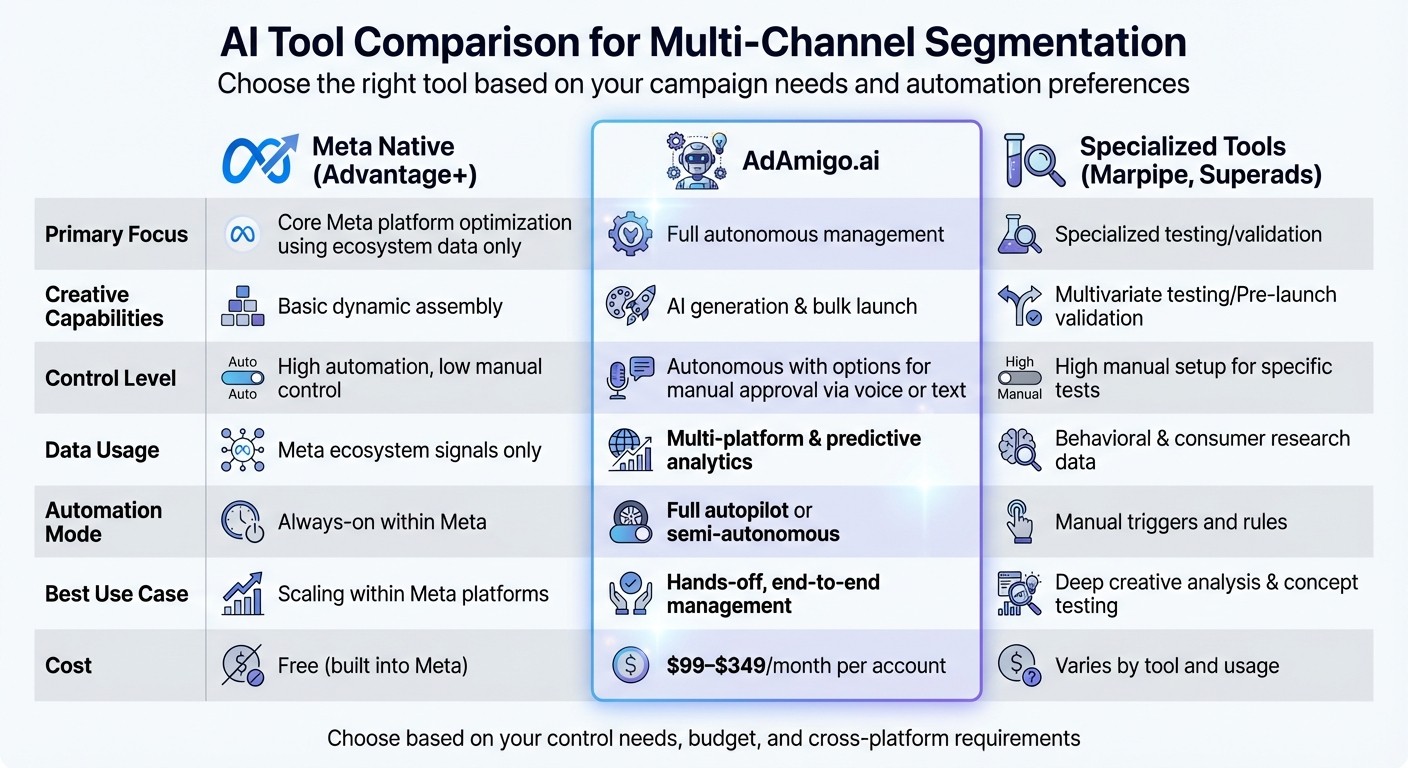
AI Tools Comparison for Meta Ads Multi-Channel Segmentation
When it comes to managing multi-channel campaigns, picking the right AI tool can make all the difference. Here's a breakdown of some popular tools based on their features, automation levels, and ideal use cases.
Tool Comparison Table
Your choice of AI tool will depend on how much control you need, your campaign goals, and whether cross-platform optimization is a priority. For simpler campaigns, Meta's native Advantage+ tools are a solid, cost-effective option. They rely on first-party data and are built for basic automation, though they lack in-depth transparency.
On the other hand, AdAmigo.ai shines as a fully autonomous AI media buyer. It handles everything from launching campaigns to tweaking budgets, testing creatives, and optimizing performance - all day, every day. Users can choose between full autopilot mode or manually approving actions. The platform also integrates with CRMs and e-commerce systems, offering predictive analytics and cross-platform optimization. Its standout feature, AI Actions, provides a prioritized daily to-do list for high-impact adjustments, which can be approved manually or automated entirely.
For niche needs, specialized tools like Marpipe and Superads are worth considering. Marpipe excels at multivariate creative testing, while Superads focuses on bulk creative production with customizable automation rules. These tools require more manual input but offer deep insights for specific testing needs.
Feature | Meta Native (Advantage+) | AdAmigo.ai | Specialized Tools (Marpipe, Superads) |
|---|---|---|---|
Primary Focus | Core Meta platform optimization using ecosystem data only | Full autonomous management | Specialized testing/validation |
Creative Capabilities | Basic dynamic assembly | AI generation & bulk launch | Multivariate testing/Pre-launch validation |
Control Level | High automation, low manual control | Autonomous with options for manual approval via voice or text | High manual setup for specific tests |
Data Usage | Meta ecosystem signals only | Multi-platform & predictive analytics | Behavioral & consumer research data |
Automation Mode | Always-on within Meta | Full autopilot or semi-autonomous | Manual triggers and rules |
Best Use Case | Scaling within Meta platforms | Hands-off, end-to-end management | Deep creative analysis & concept testing |
Cost | Free (built into Meta) | $99–$349/month per account | Varies by tool and usage |
This comparison highlights how different tools cater to varying levels of control and optimization needs. For brands aiming to streamline cross-platform campaigns with more precision, third-party tools like AdAmigo.ai provide a connected system that unifies creatives, targeting, bids, and budgets. Meanwhile, specialized tools are perfect for brands seeking advanced creative testing and validation.
Conclusion
Meta ads' multi-channel segmentation can save advertisers hours of manual effort. AI tools have reshaped how campaigns are managed, from audience targeting to creative testing and optimization. Imagine launching 100 ads in just 13 minutes - a staggering 88.2% reduction in time - while testing 2.7× more variations. This kind of automation doesn’t just save time; it supercharges your workflow. Tools like AdAmigo.ai streamline campaign management, making these efficiencies accessible to advertisers at any scale.
The trick lies in picking the right tool for your goals. While Meta's Advantage+ provides baseline automation, third-party platforms go a step further with cross-platform insights. Take AdAmigo.ai, for example - it’s a comprehensive AI media buyer that handles everything from generating creatives to optimizing budgets. You can let it work autonomously or maintain manual oversight, depending on your comfort level. For agencies, this means a single media buyer could manage 3–5× more client accounts without compromising performance. It’s a game-changer for scaling campaigns strategically.
AI-driven segmentation takes targeting to a level manual methods simply can’t achieve. By creating granular, real-time micro-segments, these tools enable campaigns to adapt and evolve continuously, leaving you free to focus on strategy instead of repetitive tasks.
Start cautiously by comparing manual vs. autopilot AI recommendations to validate performance. Once you’re confident, let automation handle routine tasks. A smart budget allocation - 70% for proven performers and 30% for testing - combined with a 7–14 day learning phase can set the stage for success.
In today’s fast-moving advertising world, AI tools provide the speed, precision, and adaptability needed to stay competitive. Whether you’re managing a single account or dozens, leveraging automation and predictive analytics creates a ripple effect of efficiency and results that manual management just can’t match.
FAQs
What data do I need to feed Meta AI for better segmentation?
To get better segmentation with Meta AI, share detailed first-party data such as website visits, customer lists, or social media activity. Meta also factors in demographics, interests, and behaviors, along with creating lookalike audiences based on your current customers. On top of that, its AI dives into behavioral signals like engagement trends and purchase history. By combining broad targeting with high-quality data, you can fine-tune audience segmentation in real-time for improved outcomes.
When should I use Meta Advantage+ vs a tool like AdAmigo.ai?
Meta Advantage+ is Meta's built-in AI tool designed to handle tasks like targeting, bidding, and optimization. It's perfect for those who want a quick setup with minimal manual effort.
On the other hand, AdAmigo.ai takes automation to the next level. It not only manages creatives and scales campaigns but also delivers strategic insights. This makes it a stronger choice for businesses or agencies looking for more control, advanced automation, and improved ROAS compared to Meta's native tools.
How do I scale with AI without wrecking the learning phase?
Scaling with AI can be a game-changer, but maintaining stability during the learning phase is key. Tools like AdAmigo.ai make this process easier by automating gradual scaling. Here's how to approach it:
Set Clear Goals and KPIs: Define what success looks like before diving into scaling. This provides a clear direction for AI-driven adjustments.
Leverage AI for Testing and Optimization: Use AI to experiment with ad variations, refine targeting, and tweak budgets step by step. This ensures small, calculated changes that won't disrupt performance.
Utilize Real-Time Recommendations: Platforms like AdAmigo.ai provide instant recommendations and optimizations, helping you make informed decisions and avoid hiccups during scaling.
By following these steps, you can scale efficiently while keeping your campaigns steady and effective.