
AI in Behavioral Sequence Prediction for Ads
AI analyzes action sequences to time and personalize ads, boosting ROAS and cutting acquisition costs.
Behavioral sequence prediction is reshaping digital advertising by analyzing the order and timing of user actions - like clicks, views, or purchases - to predict what users will do next. Unlike traditional demographic-based targeting, this AI-driven approach focuses on real-time behaviors to deliver highly relevant ads, improving campaign performance metrics.
Key Takeaways:
How It Works: AI models, like transformers, process user actions as sequences, preserving order and context for precise predictions.
Impact on Ads: Platforms like Meta and Pinterest have reported significant improvements, such as a 2–4% boost in conversions and a 45% increase in checkout performance.
Benefits: Advertisers see 40–60% higher ROAS and a 35–50% reduction in customer acquisition costs within 90 days.
Tools: Platforms like AdAmigo.ai automate campaign optimization, saving time and improving results through real-time adjustments and creative testing.
AI is transforming ad targeting by focusing on behaviors, not assumptions, leading to better engagement and higher returns.
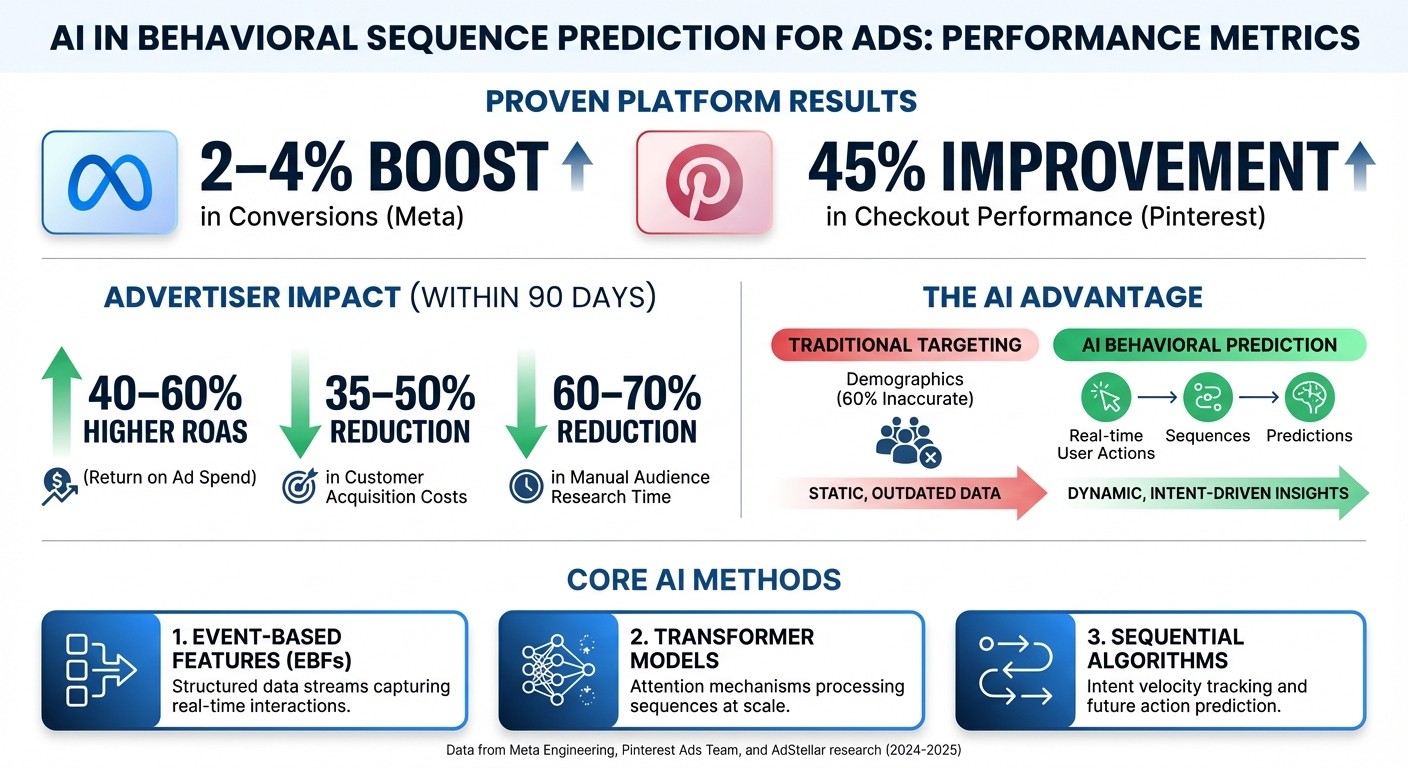
AI Behavioral Sequence Prediction Impact on Ad Performance: Key Metrics and Results
AI Methods for Behavioral Sequence Prediction
Event-Based Features (EBFs)
Event-Based Features (EBFs) act as the foundation for organizing raw user actions - such as clicks, views, or purchases - into structured data streams that AI models can analyze effectively. Unlike earlier methods that relied on sparse features and averaged user actions, EBFs preserve crucial details like the sequence, timestamps, and context (e.g., ad categories). This is important because averaging eliminates key insights about when and how users interact with content.
In November 2024, Meta's engineering team, led by Sri Reddy and Arnold Overwijk, transitioned from traditional Deep Learning Recommendation Models to a sequence learning framework powered by EBFs. This change resulted in a 2–4% boost in conversions for certain advertiser segments. EBFs create event embeddings by compressing attributes linearly, forming a detailed "vocabulary" that sequence models can interpret. With this structured data, attention-based models can better understand and predict user behavior patterns.
Sequence Models and Attention Mechanisms
Transformer-based models equipped with attention mechanisms excel at analyzing the order of user actions. Attention mechanisms allow these models to process vast amounts of data efficiently. Traditional self-attention, however, has a computational complexity of O(N²), which becomes unwieldy when processing thousands of ads in real-time. To address this, Meta's multi-headed attention pooling reduces the complexity to O(M × N), where M is a tunable parameter, enabling predictions at scale. Meta Engineering explains:
"The event sequence model... utilizes state-of-the-art attention mechanisms to synthesize the event embeddings to a predefined number of embeddings that are keyed by the ad to be ranked".
In Spring 2025, Pinterest's Ads Vertical Modeling team, including Lakshmi Manoharan and Ziwei Guo, introduced an item-level sequence model using this approach. Their bidirectional transformer analyzed user behavior across a catalog of over 1 billion items, achieving a 45% improvement in checkout performance compared to models relying on averaged user actions.
Sequential Recommendation Algorithms
Sequential recommendation algorithms are designed to predict a user's next action - whether that's making a purchase, clicking an ad, or leaving a cart behind. These algorithms build on advanced sequence modeling techniques to drive highly targeted ad outcomes.
Meta's GEM (Generative Ads Recommendation Model) leverages GPT-scale modeling to track "intent velocity" across user touchpoints. Rather than optimizing individual ads, GEM orchestrates entire user journeys. It works alongside the Wukong model, which focuses on "combination intelligence" to analyze how user traits, creative formats, and engagement patterns interact to predict outcomes.
Pinterest's team discovered that while longer sequences provide more context, the benefits tend to plateau after 100 events due to stale or noisy data. To address this, they implemented log-Q bias correction in the sampled softmax loss function, which helps balance the trade-off between popularity and personalization.
How to Use Behavioral Predictions in Ad Campaigns
Timing Ads for Better Conversions
AI can pinpoint the best times to deliver ads by analyzing historical engagement data, like when users typically click or make purchases. For instance, using EBF-captured timestamps, AI can identify the most effective times to show ads, boosting conversions by 2–4%.
A similar concept applies to email-triggered ads through send-time optimization (STO). Here, machine learning (ML) models analyze a user's unique engagement habits to deliver ads when they're most likely to interact. This approach has shown to improve email open rates by 26% and click-through rates by 41% compared to fixed schedules. For consumable goods, AI predicts when users might need to restock - for example, triggering ads 10 days before a 45-day supply runs out. However, for these timing strategies to work effectively, campaigns need a solid base of data, typically requiring 30–50 monthly conversions to train the AI.
Once ad timing is optimized, the next step is to focus on retargeting strategies using sequential user behavior data.
Improving Retargeting Strategies
Behavioral prediction moves beyond generic demographic targeting by analyzing the sequence of user actions. It looks at the order and context of behaviors - like viewing products or adding items to a cart - rather than relying solely on broad audience traits.
In Spring 2024, Pinterest introduced a transformer-based model called "Next Advertiser Prediction", developed by Lakshmi Manoharan and Karthik Jayasurya. This model analyzed user actions (e.g., product views, add-to-cart events, and checkouts) to predict which advertisers a user would engage with next. The result? Higher conversion rates and lower Cost Per Action (CPA) for Standard ads.
Performance marketer Umesh Bhat N B highlighted how Meta's Generative Ads Recommendation Model (GEM) takes this further by managing entire user journeys rather than focusing on individual ads. GEM tracks "intent velocity", or subtle browsing signals, to predict purchase intent up to 72 hours before a conversion. To maximize retargeting performance, brands can upload deep-funnel events - like "Start Trial" or "Paid Call" - via Conversion API. The more stages of the customer journey AI can observe, the better it performs. Maintaining consistent campaign data without frequent resets is also critical. Brands that adopt AI-driven behavioral targeting have reported customer acquisition cost (CAC) reductions of 35–50% within 90 days.
With retargeting fine-tuned, AI can also enhance campaign success by optimizing creative assets with AI.
Creative Optimization and Testing
AI doesn't just decide when to show ads; it also determines what to show. By analyzing where a user is in their journey, AI tailors creative content to maximize impact. This "ads orchestration" approach delivers creative assets in a sequence - hook, education, and social proof - designed to nudge users toward conversion.
Take Meta's Wukong model, for example. It evaluates creative elements like format, style, and engagement trends, matching them to individual user profiles. Similarly, in Spring 2025, Pinterest’s item-level behavioral model processed over 1 billion products, improving user checkout performance by 45% by predicting which products and creative styles would resonate best. The system even updates user profiles in real-time as new interactions occur, allowing for instant creative adjustments.
Instead of relying on manual A/B testing, AI can analyze thousands of creative-audience combinations in just days, achieving a 40–60% improvement in campaign ROAS. To make this work, brands should build a diverse library of creative assets categorized by intent stage - Hook, Education, Proof, Offer. Including formats like user-generated content (UGC), Reels, Carousels, and Explainers provides the AI with plenty of options to match varying user behaviors. Optimizing for deep-funnel events, such as "Add to Cart" or "Start Trial", helps the AI learn which creatives drive high-value actions.
Meta Just Bought This AI Tool That Predicts Winning Ads Before Your Competitors
How AdAmigo.ai Uses Behavioral Sequence Prediction
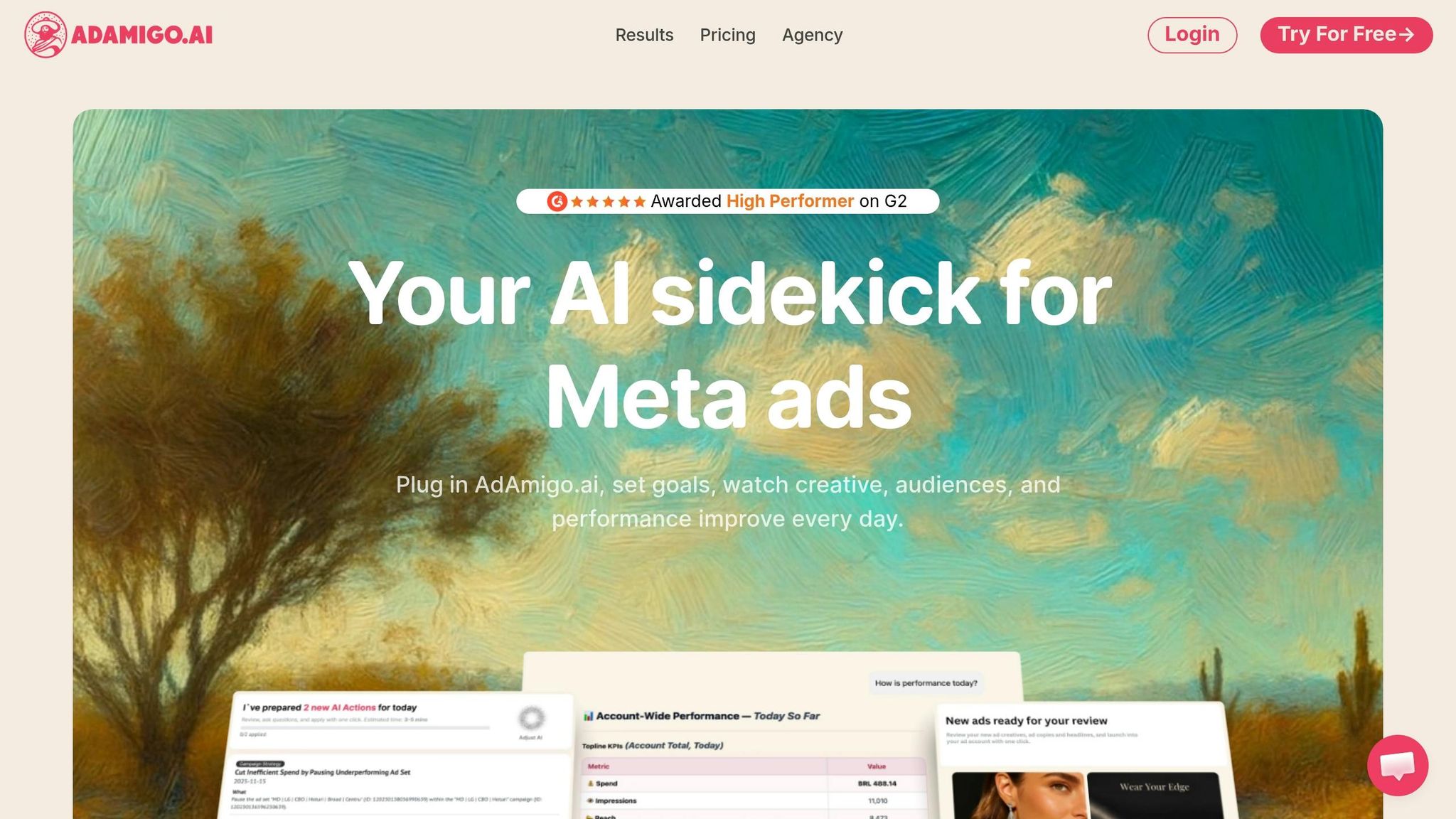
AdAmigo.ai takes the principles of behavioral prediction and puts them into action, offering full-funnel AI optimization for Meta ads to manage campaigns automatically.
AI Autopilot for Campaign Optimization
AdAmigo.ai uses real-time behavioral prediction to analyze user actions - like views, clicks, and purchases - and predict which users are most likely to convert when an ad enters an auction. Unlike static demographic targeting, which fails around 60% of the time, the platform focuses on intent velocity to gauge how close users are to making a purchase.
The AI Autopilot keeps a constant eye on your Meta ad account, spotting opportunities and making adjustments automatically or with your approval. It reallocates budgets to high-performing behavioral segments, pauses ads that underperform, and runs new tests based on micro-signals - those hard-to-detect user interactions that manual targeting often misses. By prioritizing strong segments and dialing down weaker ones, the system creates a dynamic feedback loop that improves campaign performance and sets the foundation for better creative strategies.
Creative Generation and Bulk Ad Launch
Using insights from behavioral data, AdAmigo.ai predicts the best times to show ads and designs creatives tailored to where users are in their buying journey. The Creative Generation tool, called Ad Factory, analyzes top-performing ads and competitor content to generate new assets using AI tools for different stages of intent: Hook, Education, Proof, and Offer. This method, inspired by Meta's GEM model, ensures that the right creative reaches users at just the right moment.
To streamline the process further, the Bulk Ad Launcher can deploy dozens - or even hundreds - of ads in just minutes. By uploading creatives and a brief via Google Drive, the system automatically generates ad copy, structures campaigns, and publishes ads directly to your Meta account. It then tests thousands of creative-audience combinations simultaneously, identifying top-performing segments within days. This approach often leads to a 40–60% boost in ROAS (Return on Ad Spend).
Customizable and Autonomous Ad Management
AdAmigo.ai gives you the flexibility to let the AI work independently or with your input. You set the KPIs, budget limits, and targeting preferences, and the system adjusts campaigns accordingly.
As an always-on AI media buyer, AdAmigo continuously learns from performance data, fine-tuning its strategies over time. This allows agencies to handle 3–5× more clients while freeing senior strategists to focus on big-picture growth and creative planning.
How to Implement AI for Behavioral Sequence Prediction
Collecting and Preparing User Event Data
To get accurate predictions from AI, you need clean, well-organized data. Poor-quality data leads to unreliable results. Start by reviewing your historical performance data. Check your tracking setup for any gaps or inconsistencies and fix them.
Next, standardize your data into Event-Based Features (EBFs). These EBFs should include raw event streams with timestamps and context, like categories. Keeping the sequence order intact is essential because it highlights the progression of user intent - something we've already emphasized as a key factor in behavioral prediction.
Use tools like Meta Pixel, Conversions API (CAPI), and Advanced Matching to ensure robust tracking. These tools help capture high-quality identifiers, such as email addresses, phone numbers, and external IDs. When using CAPI, aim for an Event Match Quality score between 8.5 and 9.5. For technical details, follow a Meta Conversions API setup guide to ensure your integration is optimized for these high scores. Track deeper funnel events, like registrations, trials, and purchases, because these events create a "sequential fingerprint" that helps AI identify patterns linked to high-value conversions.
Also, pay attention to the length of your sequences. Research shows that recall improvements level off after about 100 events. Make sure your events are timestamped to reflect their recency and temporal order.
Training and Deploying AI Models
Once your data is clean and structured, the next step is training AI models to turn behavioral sequences into actionable insights. A popular approach involves two-tower models, where one transformer processes user behavior and the other focuses on products or brands. This setup pairs users with the most relevant ads based on their activity history, aligning with the campaign optimization strategies we've discussed earlier.
To handle large audiences and numerous ad variations, attention mechanisms are crucial. They improve efficiency by processing sequences of varying lengths at scale.
A great example comes from Pinterest Engineering. In Spring 2025, they launched a behavioral sequence model using a two-tower transformer architecture. By analyzing offsite actions like checkouts, add-to-carts, and signups - alongside internal Pin embeddings and catalog metadata - they improved user checkout performance by up to 45%. To balance accuracy and coverage, the model incorporates log-Q bias correction within the sampled softmax loss function.
Using Tools Like AdAmigo.ai
Building AI models in-house can be resource-intensive and requires technical expertise. Platforms like AdAmigo.ai simplify this process by automating data collection, model training, and optimization - reducing manual effort by 60–70%.
AdAmigo.ai continuously audits your Meta ad account, reallocates budgets to high-performing segments, and runs tests based on real-time behavioral signals. Its AI Autopilot identifies which users are most likely to convert when an ad enters an auction.
The setup is straightforward: link your Meta ad account, define your KPIs, and share your goals with AdAmigo (e.g., "Increase spend by 30% while maintaining ≥3× ROAS"). From there, you'll receive daily AI-driven recommendations for campaigns, audiences, budgets, and creatives. Many e-commerce brands see CAC reductions of 35–50% within the first 90 days.
"The question isn't whether AI targeting will become standard practice in Meta advertising. It already is among top-performing advertisers." – AdStellar
Whether you're building your own AI models or using platforms like AdAmigo.ai, maintaining consistency is critical for long-term success. Avoid resetting campaigns too often - AI systems like Meta's GEM need stable data to learn user behavior effectively. Frequent manual changes can disrupt this learning process. Give your system the time it needs to gather data and improve; the longer it runs, the better it gets at predicting which behavioral sequences drive conversions.
Conclusion and Key Takeaways
Main Benefits of AI-Based Predictions
AI-powered behavioral sequence prediction is reshaping how Meta ad targeting works. Instead of leaning on demographics - which can be inaccurate about 60% of the time - AI focuses on user behavior to identify high-value micro-segments. This shift can lead to some impressive results: campaigns see a 40–60% boost in ROAS, customer acquisition costs drop by 35–50% within the first 90 days, and manual vs AI audience creation reduces research time by 60–70%.
Advanced systems like Meta's GEM take this further by tailoring ad sequences to match users' evolving intentions. This strategy taps into intent velocity - essentially tracking how quickly a user's interest changes - to ensure ads are delivered at the most impactful moment. The result? A noticeable improvement in campaign performance across all key metrics.
Why Tools Like AdAmigo.ai Make a Difference
Capitalizing on these AI-driven benefits can be daunting without the right tools. Building AI models in-house requires substantial resources, but platforms like AdAmigo.ai simplify the process. By automating data collection, model training, and real-time optimization, AdAmigo.ai reduces manual effort by as much as 60–70%.
AdAmigo.ai’s AI Autopilot takes it a step further by continuously auditing your Meta ad account. It identifies high-impact opportunities and makes improvements - either automatically or with your approval. The tool reallocates budgets to high-performing segments, launches tests based on real-time behavioral insights, and creates new ad creatives inspired by top-performing content and competitor trends. The setup is straightforward: connect your Meta account, set your KPIs, and define goals like “Scale spend 30% while maintaining ≥3× ROAS.” From there, you’ll receive daily, AI-driven recommendations to optimize campaigns, audiences, budgets, and creatives in a unified system.
This combination of automation, precision, and actionable insights not only boosts performance but also removes much of the complexity associated with scaling advanced behavioral prediction strategies.
FAQs
What data is needed for behavioral sequence prediction?
To effectively apply behavioral sequence prediction, you’ll need detailed data about users' online actions. This might include website visits, product views, search queries, purchase history, ad clicks, and even abandoned shopping carts. By analyzing these patterns, AI can anticipate future behaviors, enabling more precise and tailored ad targeting.
How is sequence-based targeting different from demographic targeting?
Sequence-based targeting focuses on users' behavioral patterns - like the products they've browsed or purchased - to predict what they might do next. This approach allows AI to pinpoint purchase intent or interests with more precision, leading to ads that feel more tailored and relevant.
On the other hand, demographic targeting relies on fixed attributes like age, gender, or location. While useful, it doesn't adapt to changes in user behavior and might miss the mark when it comes to reflecting someone's current interests or needs.
How long does it take to see results from this approach?
Users often notice results from AI-powered behavioral sequence prediction and ad targeting in a relatively short time. Depending on how the campaign is configured and fine-tuned, early outcomes can show up in as little as 5 minutes to a few days, with broader improvements becoming evident over the course of a few days to a few weeks.