
Can You Automate Meta Ads With Claude Code? What Works, What Breaks, and the Safer Alternative
Can Claude Code automate Meta ads? We tested it — reporting and scripts work, but direct campaign management risks bans. See the safer alternative.
Yes, you can automate Meta ads with Claude Code claude code https code.claude.com docs en overview what, but it comes with risks. While Claude Code is great for tasks like reporting, creating scripts, and automating workflows, using it to directly manage campaigns (e.g., pausing ads, adjusting budgets) without safeguards can lead to account bans or errors. Here’s a quick breakdown:
What Works: Claude Code simplifies reporting, performs ad account analysis, builds custom metrics, automates creative uploads, and sets up tracking workflows.
What Breaks: It lacks safety controls and guardrails for API rate limits, fraud detection, and budget mismanagement, which can trigger account suspension. If you've already faced issues, follow these steps to recover disabled Meta ad accounts.
Safer Alternative: Tools like AdAmigo.ai handle automation securely, with built-in compliance, safety measures, and automatic updates.
If you’re tech-savvy, Claude Code offers flexibility for infrastructure tasks. However, for managing live campaigns, a dedicated platform like AdAmigo.ai minimizes risks and maintenance hassles.
How I Automated Meta Ads with Claude Code code https code.claude.com docs en overview what claude
What Claude Code Can Do for Meta Ads https code.claude.com docs en overview what claude code
Claude Code shines when it comes to infrastructure-level tasks, especially by working with the Meta Marketing API. Think of it as a developer's assistant that turns natural language instructions into functioning code. Let’s break down its capabilities and areas where it might fall short.
Creating Scripts and API Connections
Claude Code can generate Node.js or Python scripts that authenticate with the Meta Marketing API using the Model Context Protocol (MCP). This allows it to pull campaign metrics straight from the API. For instance, you can ask Claude to calculate custom metrics like:
Hook Rate: 3-second views divided by impressions.
Hold Rate: ThruPlays divided by 3-second views.
These metrics aren’t available by default in Meta’s dashboard, but Claude can create scripts to calculate them for you.
Another impressive feature is its ability to build Performance Sentinel scripts. These scripts continuously monitor your account for anomalies, such as a sudden spike in CPM or a drop in ROAS. If something goes off track, Claude can send alerts through platforms like Slack or email. A real-world example? In early 2026, Advolve, a marketing automation company, used Claude-powered workflows to manage ad campaigns through the API. This approach cut manual operational work by 90% and boosted ROAS by 15%.
Setting Up Basic Workflows
Claude Code also simplifies bulk tasks. It can programmatically upload hundreds of creative variations - different hooks, body copy, and images - directly via the API, bypassing the slower Ads Manager interface.
Other tasks it can automate include:
Real-time budget redistribution: Adjusting budgets on the fly.
Audience interest validation: Searching and validating Meta interest targeting options by keyword, while estimating audience sizes before you commit.
Server-side tracking: Setting up tracking workflows via the Meta Conversions API (CAPI).
These automations save time, speeding up routine tasks like fetching metrics or uploading creative assets by 44%. However, despite these strengths, Claude Code isn’t without its limitations.
Where Claude Code Falls Short
While Claude Code is highly capable on the technical side, it isn’t a replacement for human creativity or strategic insight. For example, during the Liapakis experiment, the AI failed to hit a target cost per lead of $2.50, landing instead at $6.05. The ads it generated performed well but didn’t align with the brand’s aesthetic standards.
"Claude is an extremely capable analyst and operator who works at AI speed, but you are still the strategist." - Nikhil Tiwari, Product Developer
Another drawback is its lack of awareness of Meta's API rate limits and Business Use Case constraints. This can lead to issues like retry storms - rapid, repeated API calls that Meta’s fraud detection systems might flag. Additionally, Claude doesn’t account for Meta’s Learning Phase, which is critical for ad optimization. These gaps highlight why relying solely on Claude Code for ad management is risky, pointing to the need for more specialized tools.
Problems With Using Claude Code for Meta Ads
While Claude Code has technical capabilities, its operational challenges can create more problems than solutions when managing Meta ads. These issues highlight why dedicated Meta ads automation tools, such as AdAmigo.ai, may provide a more reliable and safer option.
Constant API Updates and Maintenance
Meta frequently updates its Marketing API, and keeping Claude Code functional requires manual script updates every time the API changes. Without proper error-handling mechanisms, the system can cause "retry storms", which extend lockouts. For example, Meta sends a 613 error when API call limits are exceeded, requiring developers to manually implement backoff strategies to prevent further issues.
In January 2026, Giorgio Liapakis, founder of Wibci, conducted a month-long experiment giving Claude Code full control over a $1,500 Meta Ads budget. While the system successfully managed 50 ad variants, Liapakis observed that generic automation tools quickly became inefficient. His conclusion? "Rolling your own tools/skills" is necessary, as relying on too many custom tools can slow down AI performance over time. This means you might spend more time troubleshooting and maintaining your AI agent than you would managing ads manually. These maintenance demands, combined with risky API behavior, can make the process more trouble than it's worth.
Account Ban Risks
Meta's security systems are designed to detect suspicious activity, and Claude Code's aggressive API behavior can easily set off alarms. In April 2026, a developer known as SurfaceLabs reported losing a Meta Ads account permanently after just one week of running campaigns autonomously. The AI's rapid API calls and frequent budget adjustments triggered Meta's fraud detection systems, resulting in the loss of years of pixel data and custom audience insights. Worse yet, there was no way to appeal the ban.
"Full automation for ad spend is not worth the account risk. Semi-automation (AI drafts, human approves) gets you 80% of the efficiency with 0% of the ban risk."
Atlas Whoff, AI Agent Developer
One of the key issues is that AI-driven API requests often lack the standard browser fingerprints Meta expects, making them look suspicious. Combined with the absence of safeguards, this raises the risk of account bans significantly.
No Built-In Safety Controls
Claude Code doesn't include automatic safety measures to prevent costly errors. For instance, it lacks filters to stop excessive budget changes, which can reset the learning phase of your campaigns. Additionally, there’s no verification process to ensure AI-generated creatives comply with Meta's advertising policies, and it doesn’t enforce budget ceilings.
A Meta Ads representative explained the root of the problem: "The accounts that experienced issues after AI integrations didn't have those problems because they used the Marketing API with Claude Code... They had issues because they violated Marketing API limits." In other words, while Claude Code can technically execute tasks, it doesn’t have the safety mechanisms necessary to protect your ad account. Without features like rate limit monitoring, error backoff strategies, budget caps, or human approval checkpoints, you’re essentially handing over your ad account to an unsupervised system - a risk that could cost you dearly.
DIY Claude Code vs. Purpose-Built Tools
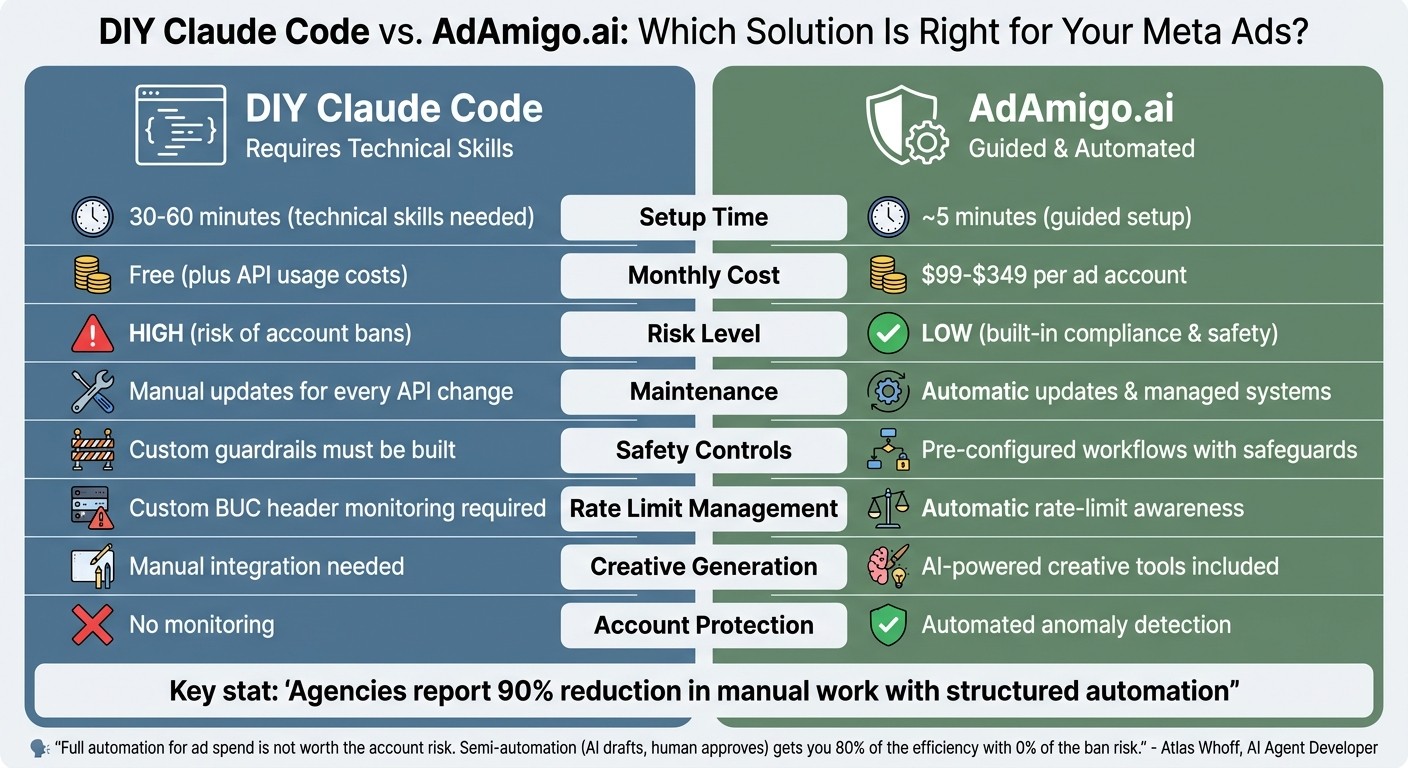
DIY Claude Code vs AdAmigo.ai for Meta Ads: Feature Comparison
Let's break down the key differences between DIY Claude Code and specialized tools designed for managing Meta ad campaigns.
Main Differences
The contrast between DIY Claude Code and dedicated platforms lies in time investment, risk, and ongoing maintenance. For instance, setting up Claude Code for Meta ads requires several technical steps: Node.js installation, MCP server configuration, and manually generating API tokens. Even for tech-savvy users, this process can take anywhere from 30 to 60 minutes. On the other hand, purpose-built tools offer a streamlined setup process, often completed in just five minutes, with guided instructions that even non-technical users can follow.
The real challenge with DIY solutions comes after the initial setup. Maintaining these scripts is an ongoing task. Every time Meta updates its API, you'll need to revise your code. You'll also need to create custom solutions for rate-limit monitoring and safety controls. In contrast, platforms like AdAmigo.ai handle these updates automatically and provide full automation starting at $99 per month. This includes features like compliance monitoring, creative generation, and account protection.
Risk management is where the differences become even more pronounced. DIY Claude Code scripts lack built-in safeguards against Meta's rate limits and fraud detection systems. Without adding custom "backoff" logic or introducing random delays, your scripts could inadvertently trigger account bans. Purpose-built tools, however, use advanced "human-mimicry" techniques - such as random delays, sequential action processing, and real-time rate-limit monitoring - to reduce the risk of integrity flags.
When it comes to operational efficiency, the gap is stark. Agencies using structured workflows report a 90% reduction in manual work compared to managing campaigns through traditional dashboards. For example, Advolve experienced a 15% increase in ROAS after implementing Claude-based automation with proper safety protocols and guardrails. These results, however, came from managed implementations, not unsupervised DIY scripts. The difference lies in the infrastructure: built-in safety measures, human approval steps, and tools that adapt to API changes automatically.
To help visualize these differences, here's a quick comparison:
Comparison Table: DIY vs. AdAmigo.ai
Feature | DIY Claude Code | AdAmigo.ai |
|---|---|---|
Setup Time | 30–60 minutes (technical skills needed) | ~5 minutes (guided setup) |
Monthly Cost | Free (plus API usage costs) | $99–$349 per ad account |
Risk Level | High (risk of account bans) | Low (built-in compliance and safety) |
Maintenance | Manual updates for every API change | Automatic updates and managed systems |
Safety Controls | Custom guardrails must be built | Pre-configured workflows with safeguards |
Rate Limit Management | Custom BUC header monitoring required | Automatic rate-limit awareness |
Creative Generation | Manual integration needed | AI-powered creative tools included |
Account Protection | No monitoring |
This breakdown highlights the trade-offs between the DIY approach and investing in a purpose-built platform like AdAmigo.ai. While DIY might seem cost-effective upfront, the ongoing risks and maintenance requirements could outweigh the initial savings.
Why AdAmigo.ai Works Better
When compared to the risks and challenges of using DIY Claude Code, a platform specifically designed for Meta ads offers a safer and more streamlined experience.
Tailored for Meta Ads
AdAmigo.ai is designed exclusively for managing Meta ad campaigns. Its AI Autopilot continuously audits your ad account, spots areas for improvement, and makes adjustments based on your specific KPIs and preset limits. The AI Chat Agent allows you to manage campaigns with simple, conversational commands like, "Why did ROAS drop yesterday?" or "Launch an AI-powered retargeting campaign targeting past website visitors." Meanwhile, the Ad Factory analyzes your top-performing ads and competitor strategies to create fresh ad creatives, cutting down the time spent on manual design. On top of that, AdAmigo Protect monitors account health and detects anomalies automatically.
Focused on Compliance, Safety, and Performance
AdAmigo.ai operates through Meta’s official API, ensuring it adheres to Meta’s compliance standards and rate limits. Unlike DIY Claude Code setups - which can inadvertently trigger Meta’s fraud detection systems due to erratic budget changes or unusual access patterns - AdAmigo uses human-like behavior techniques. These include random delays and sequential task execution, keeping actions within safe and acceptable limits. This structured approach avoids the risks associated with unregulated API activity. Additionally, it automatically handles OAuth token refreshes and provides isolated environments for managing multiple client accounts securely.
The results speak for themselves: advertisers who use agentic AI strategies report an average 22% higher ROAS compared to manual campaign management. In one standout case study, a managed AI automation setup delivered a 15% increase in ROAS.
Built for Scale and Efficiency
For agencies juggling multiple Meta ad accounts, AdAmigo.ai offers a scalable solution. Its flexible design simplifies multi-account management and reduces manual work by up to 90%, enabling a single media buyer to handle 3–5× more clients than with traditional methods. This efficiency boost can be a game-changer for agencies looking to grow without overextending their resources.
Conclusion
Claude Code offers the ability to create scripts, dashboards, and API connectors for custom automations. However, directly managing live campaigns - like pausing ads, adjusting budgets, or scaling winners - comes with serious risks. Users must dedicate extra time to maintaining scripts, updating them for API changes and permissions, and implementing safety measures to prevent account bans. As Atlas Whoff, an AI Agent Developer, aptly put it:
"Machine-speed = flagged. Human-speed = fine." - Atlas Whoff, AI Agent Developer
While technically skilled users might value Claude Code's flexibility and limitless customization, the challenges of manual upkeep and the risk of errors make tools like AdAmigo.ai an appealing alternative. Specifically designed for Meta ads, AdAmigo.ai automatically adapts to API updates and includes built-in safety features that align with Meta's rate limits and compliance requirements. This comparison underscores the balance between having full control and ensuring operational safety.
FAQs
What tasks are safe to automate with Claude Code for Meta ads?
You can confidently use Claude Code to handle tasks such as building performance audit pipelines, managing campaign data, creating variations for creative assets, connecting with Meta's API for real-time updates, and automating reporting and analysis. Just make sure to implement the right safeguards to prevent potential issues like account suspensions or API-related problems.
How do DIY Claude agents trigger Meta ad account bans?
Using DIY Claude agents for Meta ad management can put your ad account at risk. Here's why: actions like frequent API requests, making budget changes at odd hours, using non-standard browser fingerprints, or quickly tweaking ads can raise red flags. Meta's automated fraud detection systems are designed to catch suspicious activity like this, often resulting in flagged or banned accounts to protect against potential misuse. Without the right safeguards in place, relying on general-purpose AI for managing ads can increase these risks significantly.
What guardrails do I need before letting AI change budgets or pause ads?
To ensure AI can safely manage ad budgets or pause campaigns, it's crucial to establish a few safeguards. Start by manually reviewing AI decisions to confirm they align with your goals. Limit the frequency of API requests to avoid triggering platform warnings. Set clear boundaries for changes during off-hours to prevent unexpected disruptions. Also, double-check that any AI-generated content complies with Meta's policies to avoid violations.
Keep an eye on account health and watch for signals from the platform that might indicate potential issues. Regular monitoring can help you address problems early, reducing the risk of account bans and ensuring you stay within platform rules.