
5 Ways AI Predicts Conversions in Meta Ads
Breaks down five Meta AI systems that predict conversions and how clean data, volume, and creative variety improve results.
Meta predicts conversions by scoring estimated action rates, when they are most likely to act, and how much that action may be worth. In this article, I’d boil it down to five systems: GEM ranks ads, Lattice reads behavior across Meta surfaces, Andromeda builds the ad shortlist, sequence learning reads timing and action order, and value optimization pushes spend toward higher-order purchases.
Here’s the short version:
GEM helped drive a 3.5% click lift and more than 1% conversion lift
Lattice improved cross-placement performance by 5% to 10%
Andromeda filters millions of ads into a small auction set
Sequence learning uses recent behavior to spot near-term buying intent
Value optimization was tied to a 22% median CPA drop within 30 days when advertisers switched to deeper purchase signals
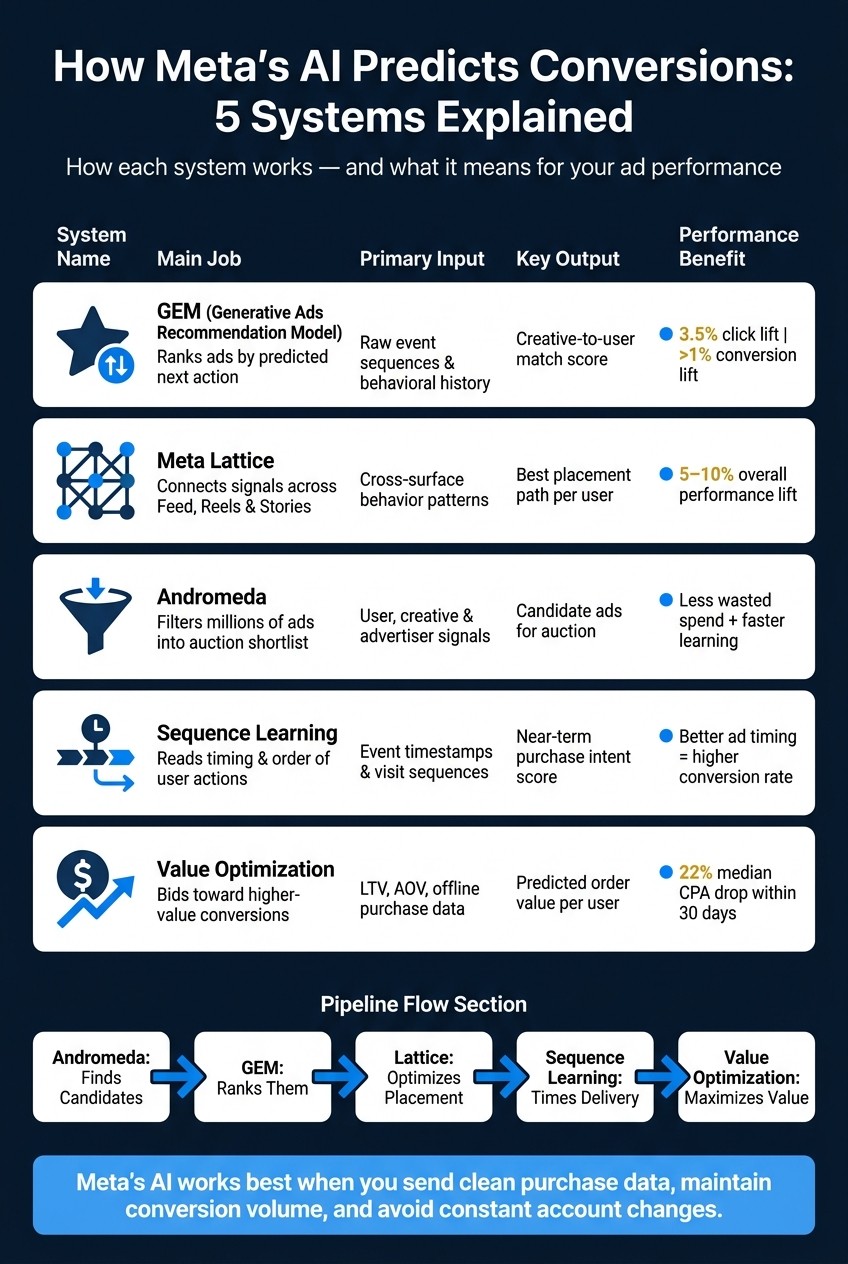
Meta AI Conversion Prediction: 5 Systems Compared
Quick Comparison
Method | Main job | Main input | Main output |
|---|---|---|---|
GEM | Ranks ads | Event sequences | Predicted next action |
Lattice | Connects signals across Feed, Reels, Stories, and more | Cross-surface behavior | Best placement path |
Andromeda | Chooses ads for the shortlist | User, ad, and advertiser signals | Candidate ads for auction |
Sequence learning | Reads timing and order of actions | Visit and event patterns | Near-term purchase intent |
Value optimization | Bids toward higher-order buyers | Purchase value, LTV, and deeper-funnel events | Predicted order value |
If I had to sum up the full article in one line, it’s this: Meta’s AI does better when you send standardized conversion data, keep enough conversion volume, and avoid constant account changes.
How AI Predicts Conversions in Meta Ads
Meta predicts conversions by estimating two things: the chance that someone will take a desired action and what that action may be worth.
Those are not the same.
Conversion value prediction looks at the revenue or profit a conversion may bring in. That’s usually shown as expected revenue or order value. So one prediction asks, “Will this person convert?” The other asks, “If they do, how much is it worth?”
Here’s the side-by-side view:
Prediction Type | What It Answers | Key Signals Used |
|---|---|---|
Likelihood to convert | Will this person take the desired action? | Click and engagement signals, on-site behavior, add-to-cart events, checkout starts |
Conversion value | How much is that action worth? | Average order value (AOV), product margins, repeat customer rate |
These two prediction types guide different optimization choices, including bidding and value-based delivery.
Meta pulls from past behavior across its ecosystem and blends that with Pixel and CAPI event signals. It also looks at ad response, audience patterns, placement, and device type to tighten the estimate. On top of that, Meta uses event-sequence learning to model how early actions can lead to later conversions.
The five methods below use these signals in different ways to improve bidding and delivery. Next, the comparison table shows how the five methods stack up side by side.
Quick Comparison: 5 AI Conversion Prediction Methods
The table below shows where each system sits in Meta's conversion-prediction pipeline. It takes the likelihood vs. value split and turns it into five concrete systems.
Method | Primary Signal Used | What it predicts | What it improves | Expected Performance Benefit |
|---|---|---|---|---|
Meta GEM (Generative Ads Recommendation Model) | Raw event sequences (behavioral history) | Next commercial action (click or purchase) | Ranking: Creative-user match | 3.5% click increase; >1% conversion lift |
Meta Lattice | Behavior across Reels, Feed, and Stories | Multi-objective performance across placements | Placements: Cross-surface delivery | 5–10% overall performance lift |
Meta Andromeda | User, creative, and advertiser signals | Best candidates for ranking | Retrieval: Ad shortlist | Less wasted spend and faster learning |
Sequence Learning | Event timestamps and visit sequences | Immediate purchase intent | Retargeting & Frequency: Timing ads to intent signals | Higher conversion rate through better timing |
Value Optimization | Downstream events (LTV, offline purchase data) | Predicted high-value conversions | Bidding: Value-based allocation | 22% median CPA reduction within 30 days |
Here’s the simple way to think about it: Andromeda finds the candidates, and GEM sorts them. Then Lattice, Sequence Learning, and Value Optimization shape where ads run, when they show up, and how much value Meta tries to drive from each impression.
First up: Meta GEM, which ranks ads based on predicted commercial action.
1. Meta GEM and Generalized Conversion Modeling
GEM handles ranking by scoring the shortlist and predicting which ad is most likely to drive the next action. At the ranking stage, it scores raw event sequences to predict which ad is most likely to lead to the next click, signup, or purchase. Because it reads behavior as a sequence, it can pick up intent even when recent signals are patchy.
Meta describes GEM as a model that learns conversion journeys instead of isolated actions.
Meta reported a 3.5% lift in Facebook clicks and more than a 1% lift in Instagram conversions after deploying GEM. Meta's CFO also said that GEM is twice as efficient at turning compute into ad performance compared with earlier ranking models.
For advertisers, GEM tends to work best when campaigns use broad targeting, leveraging AI tools for behavioral targeting to refine audience signals, enough ad variety for the model to learn from, and attribution windows that are long enough to catch delayed conversions. If the attribution window is too short, those delayed conversions may not show up.
Once GEM spots the likely converter, Meta can use that same signal across placements to decide where the conversion is most likely to happen.
2. Meta Lattice and Cross-Surface Learning
Meta Lattice learns from activity across Facebook, Instagram, Reels, and Stories to predict where a conversion is most likely to happen. Instead of treating each surface like its own silo, it pulls user events into one sequence and reads the order and mix of actions to predict the next conversion, much like a language model predicts the next word in a sentence. That gives Meta more signal when it tries to figure out where a conversion is most likely to happen.
Meta says the model looks at conversion journeys, not one-off actions. Older models leaned on fixed, hand-built features. Lattice works differently: it takes in raw event sequences and keeps the context and order intact, which helps improve prediction accuracy.
To process all of that at auction speed, Lattice uses a two-stage setup. A batch model builds user embeddings from large event histories. Then a lightweight online model scores ads in real time.
For advertisers, the takeaway is pretty direct: use broad targeting, cut down on ad-set splits, and test more creative variants using an AI framework. That gives Lattice enough cross-surface signal to learn from and a clearer view of how people move toward a conversion across Meta's surfaces. Those same signals also feed the retrieval layer, which decides which ads make it into the ranking pool.
3. Meta Andromeda and Ad Retrieval Prediction
After Lattice reads behavior across surfaces, Andromeda decides which ads even make it onto the auction shortlist.
Andromeda is Meta's retrieval layer. Its job is to cut millions of possible ads down to a small candidate set before ranking starts. Meta first introduced it publicly in December 2024, noting that it can filter millions of ads into a small candidate set in milliseconds.
It scores each candidate with three main signal groups: user-history signals, creative-response signals, and account signals. User-history signals include behavioral history on Facebook and Instagram, off-platform events from Pixel and CAPI, and device type. Creative-response signals include early impression responses, performance from similar creatives, and format-level engagement such as Reels completion rates. Account signals include Pixel conversion history, landing page quality, and conversions per dollar spent. These inputs feed Meta's auction score.
For advertisers, that means a better shortlist and less wasted spend. If you want Andromeda to retrieve the right users for your ad, a few basics matter:
Keep your Conversions API (CAPI) Event Match Quality score above 7.0
Optimize for purchases instead of clicks
Keep enough conversion volume in each ad set so Andromeda can tell which users are worth shortlisting for your ad
That shortlist then moves into the ranking models that predict the next action.
4. Sequence Learning for Purchase Intent Prediction
After Andromeda narrows the field, sequence learning sorts those candidates based on how a user's recent actions point to buying intent. These models look at the order and timing of behavior as one path toward conversion. If someone moves through the funnel fast, that usually shows stronger intent than if they take the same steps over a much longer stretch.
Meta handles this with a two-stage setup. An upstream model takes a user's longer event history - sometimes thousands of events - and compresses it into a stored user embedding. Then a downstream model uses that embedding during a live auction to rank ad candidates in milliseconds. That split lets Meta score sequences fast enough for live bidding.
In plain terms, Meta can shift delivery and bidding toward people whose behavior shows high purchase intent right now - not just people who fit a demographic group or happened to click once.
For advertisers, two things have a direct impact on how well these models perform.
Avoid budget changes above 20% in a short period, or use automated bid rules to scale safely. Big edits can reset the learning phase and throw off the model's calibration.
Give the system enough ad variety by following creative testing benchmarks. With at least 8–10 creative variations per campaign, the ranking model has more options to match specific ads to users at different points in their behavior.
Those intent scores also feed value-based optimization.
5. Value Optimization and Incremental Attribution
Once Meta figures out who’s likely to convert, the next step is deciding which conversions matter most.
That’s where value optimization comes in. It estimates how much revenue a conversion may bring in, then bids more toward users with higher AOV and higher LTV.
It can also improve incremental attribution because you’re training Meta on actual purchase value, not softer signals like link clicks. Advertisers that switched from proxy events to downstream purchase events saw a 22% median CPA drop within 30 days.
For this to work, send value and currency with every purchase event. It also helps to map deeper-funnel events like "Subscription Upgrade" and "Trial Completed" so the model gets earlier signals tied to higher-value customers.
Those higher-value predictions are based on a mix of signals:
Signal Type | Data Points Used |
|---|---|
Behavioral | Page visit sequences, time on high-ticket categories, scroll depth, saves |
Business | Historical AOV, product margins, repeat customer rates |
Meta ecosystem | Cross-device activity, app usage, and Meta-side purchase history |
Measurement | Event Match Quality (EMQ) scores, server-side CAPI data |
In plain English, Meta is looking at what people do, what your business data says, what it can see across its own platforms, and how clean your measurement setup is.
One more thing: keep enough purchase volume in each ad set, and don’t make constant edits. If the setup keeps changing, the value signals can get noisy.
Those value predictions then guide budget allocation, bidding, and ROAS.
What These Predictions Mean for Advertisers Running Meta Campaigns
These models handle different tasks, but they push toward the same goal: better conversion prediction. Put them together, and Meta gets better at spending budget on people who are more likely to convert, take higher-value actions, and see ads at the right time.
At the core, it comes down to fit. The right ad. The right person. The right moment.
That’s also why moving from proxy events like link clicks to deeper conversion events like purchases can cut CPA. When advertisers made that shift, they saw a median 22% drop within 30 days.
Broad targeting also gets stronger when Meta has enough signal to work with. Advertisers that moved away from stacked manual audiences and leaned into AI-driven broad targeting saw CPMs fall by 18–24%.
Sequence learning adds another edge. It looks at recent behavior and helps Meta spot purchase intent earlier than manual retargeting usually can. In plain English: Meta can react before a person hits the old retargeting bucket.
For advertisers, the message is pretty clear:
Keep budgets steady
Give the system enough volume to learn well
When those pieces are in place, Meta’s prediction stack tends to make better delivery decisions.
Conclusion
These five systems make up Meta's conversion-prediction stack.
Here's the simple version: Andromeda pulls in ads that are likely to matter, GEM sorts and ranks them, Lattice passes signals across surfaces, and value optimization puts more weight on higher-value outcomes. Put it all together, and the system works best when it has clean conversion signals, enough event volume, and enough ad variation to learn what works.
For advertisers, the main takeaway is pretty straightforward: AI can improve delivery, but signal quality, conversion volume, and multi-format creative variety still shape how well Meta can predict conversions.
FAQs
Which Meta AI system matters most for my campaigns?
The most important system here is Meta’s internal prediction and ranking engine. Today, that engine is driven by the Generative Ads Recommendation Model (GEM), which estimates how likely each impression is to lead to a conversion during auction ranking.
If you want better results, give that system better data. Meta’s Conversions API helps by sending more complete server-side signals, which can fill gaps that browser-only tracking often misses. Tools like AdAmigo.ai can also help keep campaigns tuned up and give the system stronger inputs.
What data does Meta need to predict conversions well?
Meta’s AI works best when it has strong historical data and live behavior signals to predict conversions with confidence.
That usually means feeding it data from the Meta Pixel, Conversions API (CAPI), and rich event details such as purchase value, product category, and actions like trial sign-ups.
It can also use:
Offline CRM data
Point-of-sale data
Signals like click-through rate, time on site, and cross-platform engagement
As a rule of thumb, it tends to perform best when it gets at least 50 conversions per week.
How can I help Meta’s AI improve conversion results?
Use strong data and a good mix of ad assets. Set up both the Meta Pixel and Conversions API so Meta can see the full customer journey across browser and server-side events.
On the ad side, give the system at least eight clearly different creative variations. And during the learning phase, avoid big changes that could reset progress. That phase usually takes about 50 optimization events.
If you want help managing this, AdAmigo.ai can handle much of the work by auditing your account on a continuous basis and making performance improvements.