
How AI Segments Audiences by Intent
AI groups users by purchase intent, updating segments in real time to improve Meta ad targeting and ROAS.
AI audience segmentation helps advertisers go beyond basic demographics by analyzing machine learning metrics to group users based on purchase intent. Instead of guessing who’s interested, AI uses predictive analytics to track actions like product page visits, cart additions, and ad engagement to predict conversion likelihood. This approach creates dynamic audience segments - like “high-intent” buyers or “cart abandoners” - that update in real time, ensuring your Meta ad targeting stays accurate and cost-effective.
Key takeaways:
High ROI: AI-driven audience targeting can deliver up to 3x higher ROAS compared to demographic-based methods.
Dynamic Updates: Tools like Meta Pixel and Conversions API allow AI to continuously refresh audience segments based on live behavior.
Automation: Platforms such as AdAmigo.ai automate segmentation, budget allocation, and campaign adjustments, saving time while improving performance.
The Next Era of AI Audience Targeting
How AI Analyzes Data to Identify Purchase Intent
AI dives deep into explicit data signals to create accurate user intent profiles. By examining interactions like website activity (e.g., page views, session duration), CRM inputs (customer details, purchase history), ad engagement metrics (clicks, video views on Meta ads), and transactional behavior (cart abandonment, order values), AI goes beyond surface-level demographics to uncover meaningful patterns. Here's a closer look at the data sources, behavioral cues, and predictive models for behavioral targeting that fuel these insights.
Data Sources AI Uses for Analysis
AI pulls from a variety of data sources to build intent profiles.
First-party data: Tracks user activity on websites, such as product views, time spent on pages, and abandoned carts.
CRM systems: Add depth with email engagement stats and past purchase behavior.
Meta Pixel and Conversions API: Capture signals like "ViewContent" and "AddToCart" events while ensuring accurate tracking as cookies become less reliable.
Take Adidas as an example. In Q1 2023, the brand used GA4 and BigQuery ML to analyze cart abandonment and session depth. The result? A 28% boost in conversions and an increase in ROAS from 4.2× to 5.8×.
Behavioral Signals That Show Purchase Intent
Certain user actions directly hint at their likelihood to purchase.
Frequent page visits or spending over two minutes on a product page suggest strong interest.
Cart abandonment often signals a user is close to buying but hesitates for some reason.
Ad engagement combined with these behaviors can increase conversion likelihood by 30–50%.
For instance, Shopify merchant Allbirds used AI to score repeat visitors - those returning more than five times per month. This strategy cut customer acquisition costs by 35% and drove a 22% revenue increase in 2022.
Machine Learning Models for Predictive Scoring
AI assigns intent scores on a 0–100 scale using machine learning techniques like logistic regression, random forests, and gradient boosting (e.g., XGBoost). These models weigh different signals:
Cart abandonment: 40%
Time spent on pages: 25%
Ad engagement: 20%
The models retrain daily with fresh data. For example, if a user shifts from casual browsing to adding items to their cart, their score might jump from 30 to 80 in real-time. This allows platforms to refresh audience targeting every 24 hours for Meta campaigns. Studies show these models can achieve up to 85% accuracy in predicting purchases, enabling marketers to focus on high-intent users for retargeting and retention. This dynamic scoring is a game-changer for optimizing ad performance.
Building Audience Segments with AI
AI takes intent scores and clusters users into actionable segments using algorithms like k-means or DBSCAN. These algorithms analyze user behaviors - such as cart additions, page views, and search queries - to create dynamic segments that reflect the likelihood of a purchase. Here’s how the process works:
Collect data from various sources (e.g., Meta Pixel, CRM systems).
Use machine learning to analyze behavioral signals.
Apply clustering algorithms like k-means or DBSCAN to group similar users.
Assign predictive scores that are normalized for consistency.
Generate segments, such as "high-intent" for predictive scores above 0.8.
This AI-driven audience segmentation can increase conversion rates by 30–50% compared to manual segmentation. Why? It processes over 100 behavioral signals instead of relying on simple rules like "last purchase >30 days." Plus, segments are updated automatically. For example, if a user moves from browsing to adding items to their cart, they can shift from a mid-intent to a high-intent segment within 15–60 minutes. This adaptability ensures campaigns remain relevant and aligned with real-time user behavior.
Common Segment Types and How to Use Them
High-intent buyers are users who exhibit strong purchase signals, such as viewing a product page five or more times within a week or adding items to their cart. These users are ideal for bottom-funnel retargeting ads that feature discounts or urgency-driven messaging. Allocate about 60% of your ad budget to this group for the highest return on ad spend (ROAS).
Cart abandoners are those who add products to their cart but fail to check out within 24–48 hours. Retarget these users with dynamic product ads that encourage them to "Complete your purchase" or highlight limited-time offers. Prompt retargeting can recover 15–25% of these users.
Churn risks are past customers who haven’t engaged for 30 days or more. Reconnect with them using loyalty offers or win-back campaigns. Aiming for a 10% reactivation rate is reasonable. For example, during Black Friday 2023, Adidas used AI-driven churn risk segments to recover 12% of lapsed customers. This approach delivered a 3× ROAS (a $4.50 return for every $1 spent), compared to a baseline of 1.8×, and generated $15 million in additional sales. Similarly, in the second half of 2023, Glossier used Meta's AI lookalikes, based on purchase intent signals, to increase ROAS by 42% (up to 4.1×) and attract 250,000 new customers.
These segments are continuously refined, adapting to changes in user behavior and ensuring campaigns remain highly responsive.
Real-Time Updates Based on Changing Behavior
AI monitors streaming data through tools like the Meta Conversions API, recalculating intent scores every 15–60 minutes. When user behavior shifts - such as moving from casual browsing to requesting a product demo - online learning models (e.g., incremental SVM) automatically reassign users to higher-intent segments. This real-time adaptability can improve campaign performance by 25% in fast-changing eCommerce environments.
Additionally, these models retrain daily or weekly using updated performance data. For example, if cart abandoners start converting at higher rates after seeing video ads, the AI adjusts scoring weights to reflect what’s driving conversions. This ensures segmentation remains accurate as market trends evolve.
These constantly updated segments feed directly into your Meta ad campaigns, enabling precise and timely optimizations.
Using AI-Generated Segments in Meta Ad Campaigns
Meta Ads Manager makes it easy to use AI-generated segments for targeted advertising. AI platforms integrate directly with Meta, syncing identity data from tools like CDPs and CRMs, often outperforming AI vs manual audience creation in speed and scale. This means segments - like users who frequently visit a product page - can be automatically updated and ready for targeting without the need for manual CSV uploads or complicated integrations. This setup streamlines the process, paving the way for highly focused and automated targeting strategies.
To improve the accuracy of these segments, pair the Meta Pixel with the Conversions API (CAPI). This combination reduces data loss due to privacy restrictions, ensuring cleaner and more reliable data for AI-driven optimization. In fact, using CAPI alongside the Pixel has been shown to improve cost per action by 13%. This approach ensures your AI-generated segments are built on precise behavioral signals rather than incomplete browser data.
Custom Audiences and Lookalike Audiences
Start by uploading your AI-generated segments into Meta Ads Manager as Custom Audiences. This allows you to target specific groups, like high-intent buyers, with tailored messaging. Once these Custom Audiences show strong performance, expand your reach by creating Lookalike Audiences. Meta’s AI identifies users with similar traits to your best customers, helping you target new potential buyers. For the best results, use a source audience of 1,000–5,000 high-value customers.
For example, the streaming service NOW saw a 6% incremental lift in purchases by running an automated Advantage+ shopping campaign alongside its traditional setup. To enhance your campaign’s effectiveness, enable Advantage+ Placements vs Manual Placements. This feature lets Meta’s AI allocate budgets across platforms based on where each intent segment is most active. For instance, browsing audiences might engage more with Instagram Stories, while high-intent buyers could respond better on the Facebook Feed.
Once your audience pools are in place, focus on strategically allocating your budget to maximize performance.
Budget Allocation by Intent Level
Divide your budget based on purchase intent. High-intent segments, such as your most engaged customers, should receive the largest portion of your conversion budget. Meanwhile, mid-intent and colder audiences can receive smaller allocations to support awareness and prospecting efforts. Tools like AdAmigo.ai can simplify this process by automatically reallocating funds toward the best-performing segments in real time, based on your KPIs and budget parameters. These tools continuously adjust budgets as performance shifts, ensuring your spending stays aligned with campaign results.
For even more precision, combine Meta's Conversions API with pixel data. This pairing provides the granularity needed to make real-time budgeting adjustments as user behavior evolves, keeping your campaigns efficient and effective.
Automating Campaign Optimization with AdAmigo.ai
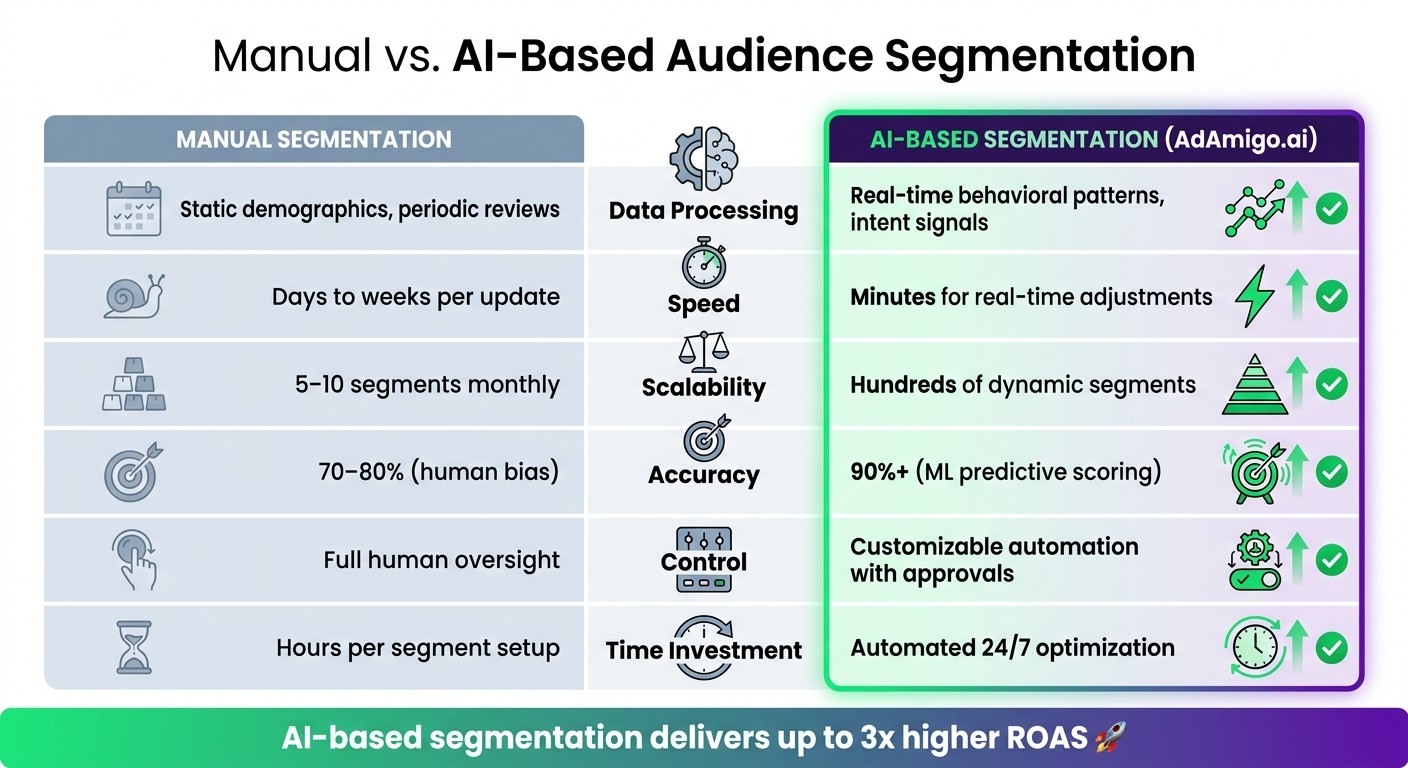
Manual vs AI-Based Audience Segmentation Comparison
Managing manual segmentation can overwhelm even the most experienced media buyers. That’s where AdAmigo.ai (https://adamigo.ai) steps in. This platform automates audience identification and AI budget testing in real time, running continuous audits and optimizations 24/7. This means you can focus on strategy while the AI takes care of execution.
Building on the principles of dynamic audience segmentation, AdAmigo.ai goes a step further by automating ongoing optimizations. Let’s dive into how this tool transforms campaign management.
How AdAmigo.ai Optimizes Audiences
At the heart of AdAmigo.ai is AI Autopilot, a system that continuously audits your Meta ad account. It analyzes behavioral signals like website visits, cart additions, and purchase intent scores to identify high-intent audience segments. From there, it refines targeting, tests intent-based ad sets, scales successful campaigns, and pauses underperformers - all while aligning with your KPIs, such as a target ROAS.
Here’s how it works: Autopilot performs real-time analysis, identifies high-intent opportunities, and executes optimizations like budget reallocations. For instance, if mobile purchase intent surges, Autopilot might shift 20–30% of the budget to capitalize on that trend. This method has shown ROAS improvements of 15–25% based on historical performance data.
Agencies that use AdAmigo.ai can manage three to five times more clients while achieving ROAS increases of 20–50%. For eCommerce teams, the AI’s iterative testing capabilities deliver consistent improvements that manual methods simply can’t match at scale.
AdAmigo.ai Features for Meta Campaigns
AdAmigo.ai offers several tools to simplify and enhance Meta campaign management:
AI Chat Agent: This feature allows you to make campaign adjustments using conversational commands. Instead of navigating complex menus, you can type requests like “Launch retargeting for high purchase intent audiences” or “Why did ROAS drop in low-intent segments?” The agent analyzes your Meta data, explains issues (e.g., “Intent scores fell due to seasonal behavior”), and implements fixes directly through the API.
Ad Factory: This tool studies your best-performing ads and competitor creatives to generate new ads tailored to specific intent segments. It helps keep campaigns fresh and prevents creative fatigue.
Bulk Ad Launcher: With this feature, you can upload creatives to Google Drive, provide a brief, and deploy dozens or even hundreds of ads in minutes. AdAmigo handles everything from generating ad copy to structuring campaigns and publishing them directly into your Meta account.
AdAmigo Protect: Acting as a safety net, this feature monitors account health and flags issues like traffic drops or delivery problems caused by Meta restrictions. It alerts you early and suggests automated fixes to protect your campaigns from costly mistakes.
These features highlight the efficiency and scalability of AdAmigo.ai, especially when compared to manual methods.
Manual vs. AI-Based Segmentation
The gap between manual and AI-driven segmentation is stark when you consider speed, scalability, and accuracy. Manual segmentation relies on static data and is slow to update, typically creating 5–10 segments per month with 70–80% accuracy. In contrast, AI-based tools like AdAmigo.ai process real-time data, scale to hundreds of dynamic segments, and reach over 90% accuracy thanks to machine learning.
Aspect | Manual Segmentation | AI-Based Segmentation (AdAmigo.ai) |
|---|---|---|
Data Processing | Static demographics, periodic reviews | Real-time behavioral patterns, intent signals |
Speed | Days to weeks per update | Minutes for real-time adjustments |
Scalability | 5–10 segments monthly | Hundreds of dynamic segments |
Accuracy | 70–80% (human bias) | 90%+ (ML predictive scoring) |
Control | Full human oversight | Customizable automation with approvals |
Time Investment | Hours per segment setup | Automated 24/7 optimization |
To get started with AdAmigo.ai, connect your account through Meta’s API, set KPIs like a target ROAS of $4.00+, and define preferences such as focusing on high-intent segments. You can enable Autopilot for automatic adjustments or opt for user-loop approvals to review changes before they’re implemented. Use chat queries for quick tests, monitor progress through daily action plans, and scale campaigns with the Bulk Ad Launcher for intent-based targeting.
Conclusion
AI-powered intent segmentation is reshaping how advertisers approach Meta campaigns, offering precision and efficiency that manual methods simply can't match.
By analyzing real-time behavioral signals, AI identifies users most likely to convert, moving beyond static demographics and outdated manual updates. According to Meta's internal benchmarks, this approach can deliver up to 3x higher ROAS - a game-changer for advertisers seeking better results from their budgets. This shift from guesswork to data-driven predictions ensures every dollar works harder.
The efficiency benefits are equally striking. Traditional segmentation requires time-intensive updates and relies on static audience data. In contrast, AI tools continuously refine audience segments in real time. This not only improves targeting but also allows media buyers to focus on higher-level strategies rather than tedious manual tasks.
In Q1 2024, Gymshark leveraged AI-driven intent segmentation for its Meta ads, increasing ROAS from 4.2x to 7.8x within 90 days. By targeting high-intent users based on behavioral signals, the brand generated an additional $15M in revenue.
Platforms like AdAmigo.ai take this a step further by automating the entire campaign optimization process. From audience analysis to budget adjustments and creative testing, these tools streamline execution. Users can either guide the AI manually or activate Autopilot to let it handle improvements independently.
The competitive edge is undeniable. AI-enhanced strategies have been proven to drive substantial performance gains. For instance:
During the 2023 Black Friday period, ASOS used AI predictive scoring in its Meta campaigns, increasing conversion rates by 42% (from 3.1% to 4.4%). Machine learning models analyzed purchase signals across 10 million users, resulting in $28M in incremental sales.
These kinds of results highlight the limitations of manual methods. Agencies adopting platforms like AdAmigo.ai can manage 3–5× more clients while maintaining performance levels that manual workflows struggle to achieve.
The question for businesses now is how quickly they can adopt AI-powered segmentation for their Meta campaigns. The potential is clear: higher ROAS, greater efficiency, and continually improving performance as AI refines its insights. With tools like AdAmigo.ai, even companies without large internal teams can unlock these benefits, turning data into actionable, profitable campaigns. The time to act is now.
FAQs
What tracking setup do I need for intent-based segments?
To track intent-based audience segments, start by using Meta’s tools, such as the Meta Pixel and SDK, to gather first-party data from user interactions on your website and app. Make sure your campaigns in Meta Ads Manager are set up to monitor essential actions like product views, add-to-cart events, and purchases. These data points give platforms like AdAmigo.ai the ability to analyze user behavior, segment audiences based on intent, and fine-tune targeting dynamically.
How quickly do AI intent segments update in Meta ads?
Meta ads use AI intent segments to keep audience targeting sharp and up-to-date. These segments work in real-time, analyzing user behavior and adjusting targeting dynamically. This means your ads can align with the latest data and trends, ensuring they stay relevant to your audience.
How do I split budget between high-, mid-, and low-intent audiences?
Using AI tools to segment your audience by intent is a smart way to allocate your marketing budget. Here's how it works:
High-intent audiences: These are the people most likely to convert. They should receive the largest portion of your budget to maximize your ROI.
Mid-intent groups: These individuals are interested but not ready to commit yet. Assign them a moderate budget to nurture their interest.
Low-intent audiences: These are the least likely to convert right now. Allocate a smaller budget to them or consider retargeting them later.
AI platforms like AdAmigo.ai make this process seamless by dynamically adjusting budget allocations in real-time. This means you can optimize your spending without the hassle of constant manual monitoring.