
Schema Versioning for Meta Ads
How to version event, field, and naming schemas for reliable Meta Ads reporting and smooth migrations.
Schema versioning is the process of managing changes to data structures, ensuring consistency and accuracy in Meta Ads campaigns. Without it, even small changes can disrupt reporting, optimization, and attribution. This guide covers why schema versioning matters, its risks, strategies, and practical implementation for Meta Ads.
Key Takeaways:
Why It Matters: Meta’s frequent API updates (every ~4 months) can break setups, leading to errors and inaccurate attribution. Consistent schemas prevent issues like duplicate rows in analytics or misaligned data.
Risks of Skipping: Unversioned changes can cause silent mutations, delivery instability, and debugging challenges with over 800 Meta API error codes.
Core Components:
Event Schemas: Standardize events like
PurchaseorLeadand map custom ones (e.g.,TrialStarted) to Meta’s standard events for better optimization.Field Mapping: Align internal fields (e.g.,
contact_email) with Meta’s formats to avoid double-counting or data loss.Naming Conventions: Use structured naming schemas (e.g.,
SALES_PROS_US_2026Q2) for campaigns, ad sets, and ads to streamline reporting and avoid confusion.
Implementation Tips:
Versioning Methods: Use semantic (e.g., v1.0 → v1.1) or rule-based versioning triggered by changes like new creative hooks or optimization events.
Version Markers: Add identifiers (e.g.,
|nc1) to campaigns or use fields likeschema_version: "v2"in event payloads to track updates.Dual-Writing Approach: Run old and new schema campaigns simultaneously during transitions to avoid disrupting performance.
Governance: Assign ownership, enforce controlled vocabularies, and document changes to maintain consistency.
Schema versioning ensures accurate reporting, reduces errors, and supports smooth transitions during updates. With Meta’s evolving platform, adopting structured versioning is essential for reliable campaign performance and effective data management.
Core Components of Meta Ads Schema Design
Understanding and defining the schemas you use is a crucial first step for effective version control and seamless integration with Meta Ads. In the Meta Ads ecosystem, schemas are present in three key areas: the events you use to track user behavior, the internal data structures you align with Meta's format, and the naming conventions you apply to campaigns and ads. Let’s break down these schema types and their importance.
Meta's Event Schemas
Meta's event schema revolves around a set of standard events like Purchase, Lead, AddToCart, and ViewContent. These events are pre-configured to work seamlessly with Meta's algorithm, optimizing ad delivery based on their signals.
When you create custom events, such as TrialStarted, they need to be mapped to these standard events using conversion rules. Without this mapping, Meta's algorithm may not fully understand the signal, which can reduce its ability to optimize campaigns effectively.
Meta's algorithm also requires approximately 50 conversions per ad set each week to exit the learning phase. If your event schema is fragmented - spreading the same conversion signal across multiple custom events - it becomes harder to hit that threshold consistently, which can hinder performance.
Internal vs. Meta Schemas
Your internal data fields often won't match Meta's standard field names directly, so mapping them explicitly is necessary to ensure smooth integration.
Source System Field | Meta Standard Field | Hashing Required? |
|---|---|---|
|
| Yes (SHA256) |
|
| No |
|
| No (ISO 4217) |
|
| Yes (SHA256) |
|
| No |
One critical field is event_id, which links server-side Conversions API data with browser-based Pixel data. When both sources use the same event_id, Meta can automatically deduplicate events within a 48-hour window. Without this, you risk double-counting conversions, which can distort your attribution data.
Accurate field mapping is essential for maintaining data integrity and sets the stage for implementing effective naming conventions.
Naming Convention Schemas
Campaign names act as compact data schemas, encoding key information that helps you group and filter data across reporting tools, spreadsheets, and data warehouses. A well-structured naming schema ensures data is easy to retrieve, while a poorly structured one creates unnecessary confusion.
A typical naming schema mirrors Meta's three-tier campaign structure:
Level | Recommended Tokens | Example |
|---|---|---|
Campaign | Objective, Funnel Stage, Market, Date |
|
Ad Set | Audience Type, Detail, Placement, Optimization |
|
Ad | Format, Angle/Hook, Variant, Asset ID |
|
To keep naming schemas functional over time, follow these practical rules:
Use underscores (
_) to separate tokens and hyphens (-) for compound values within a token.Stick to lowercase for tokens that feed into UTM parameters - Google Analytics 4 treats
Spring_Saleandspring_saleas different campaigns.Use ISO date formats like
2026Q2or2026-05to ensure proper sorting in exports.
For Advantage+ Shopping Campaigns (ASC), which lack the ad set layer, include audience details in the campaign-level name. If your naming schema doesn’t account for this, you’ll miss critical data points in your reporting.
Schema Versioning Strategies for Meta Ads
To keep data flowing smoothly and ensure its accuracy, it's crucial to establish a versioning strategy for your schemas. Once your schemas are in place, a structured approach to versioning will help manage changes over time without compromising data integrity.
Versioning Approaches
When it comes to versioning Meta Ads schemas, two common methods stand out: semantic versioning and rule-based versioning.
Semantic versioning: This approach follows software versioning conventions. Major updates, such as significant schema changes, warrant a new major version (e.g., v1 → v2). Smaller updates, like adding fields or minor adjustments, result in a minor version bump (e.g., v1.0 → v1.1). For minimal fixes, patches are used. This method is ideal for scenarios requiring precise tracking, such as Conversions API event schemas or data warehouse tables.
Rule-based versioning: This method is more practical for creative and naming schemas. Instead of arbitrary increments, specific triggers dictate when a new version is necessary. Cedric Yarish of AdManage sums it up well:
"Versioning is basically vibes... 'v2' means nothing unless your team agrees on what triggers a version increment."
Examples of triggers include introducing a new creative hook, adjusting an aspect ratio, changing an offer, or adding a new optimization event. Without clear rules, version labels can lose their meaning, creating confusion in your data.
Next, we’ll look at how to include these version details directly in your schema elements.
Embedding Version Identifiers
Where you place version markers is just as important as the system you use. For creative iterations, you can append the version identifier to the ad name. For example, VID_SOCIAL-PROOF_v01_CR042 becomes VID_SOCIAL-PROOF_v02_CR042 when the creative hook changes. The Creative ID (CR042) remains constant across updates, even though platform-generated IDs reset whenever an ad is duplicated.
For naming convention updates, where the schema structure itself changes, you can append a version marker at the campaign level. For instance, use |nc1 or |nc2 to differentiate between old and new naming conventions. This allows reporting tools to separate historical data from updated schema versions without causing silent data corruption.
"Eventually you'll need to change something. Don't silently mutate token meanings. Add a convention version at the end if needed." - Cedric Yarish, AdManage
Version markers are essential, but ensuring a smooth transition between versions is just as critical.
Maintaining Compatibility During Updates
One of the biggest challenges in schema versioning is avoiding disruptions during transitions. The golden rule: never rename an active ad set mid-flight. Renaming can reset the learning phase, which disrupts delivery and wastes budget. Once an ad set moves past the learning phase, treat its name as permanent.
When migrating to a new schema, consider using a dual-writing approach. This means launching new campaigns under the updated schema while allowing existing campaigns to finish running under the old one. To keep things organized, prefix legacy campaigns with LEGACY_, making it easy to filter them out in reporting while preserving historical data.
Meta also phases out API versions on a rolling basis, typically offering a 90-day migration window before deprecating older versions. Teams working directly with the API often report that even minor updates can take 2–4 weeks to implement. Using a middleware layer can help absorb these API changes, keeping your internal schemas stable even as Meta’s platform evolves.
Applying Schema Versioning Across the Meta Stack
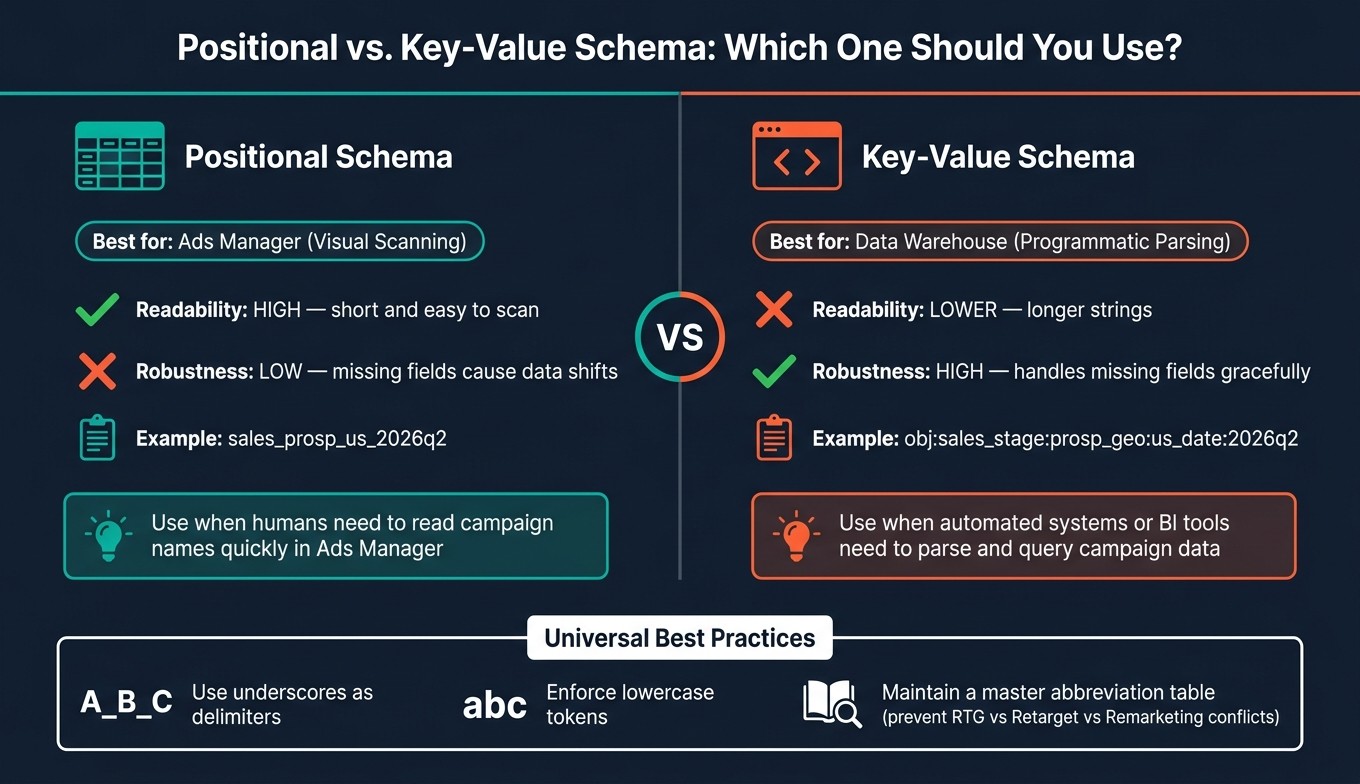
Meta Ads Schema Versioning: Positional vs. Key-Value Schemas Explained
This section explains how to implement schema versioning across the Meta stack, ensuring consistency in Pixel events, Conversions API payloads, campaign names, and data warehouse schemas.
Versioning Meta Pixel and Conversions API Events
Add a schema_version field to every event payload, such as schema_version: "v2", whether it’s sent via the Pixel or Conversions API. This makes it easier for your analytics pipeline to filter and segment data based on the schema version.
For creative tracking, use a stable internal Creative ID (e.g., cr000123) that stays consistent across your digital asset manager, ad names, and UTM parameters.
Positional schemas (e.g.,
brand|geo|concept|v01) are ideal for quick visual scanning in Ads Manager.Key-value schemas (e.g.,
cr:cr00142_v:03) work better for UTMs and programmatic parsing, offering reliability.
This strategy minimizes the risk of silent data corruption and ensures historical data remains intact as schemas evolve. Next, extend these practices to campaign naming conventions.
Versioning Campaign Naming Conventions
When updating naming rules, include a version marker in new campaigns. For example, use |nc1 for the original naming convention and |nc2 for the revised one. This allows analysts to filter data by schema version while preserving historical records.
Murat Bock, Founder of adlibrary.com, emphasizes:
"Renaming a campaign itself does not reset the learning phase - campaign names are metadata. Renaming an active ad set is riskier because ad sets are the optimization unit."
To avoid disrupting performance, apply new naming schemas only to new campaigns. Avoid renaming existing campaigns. Using ISO date formats like YYYY-MM-DD or YYYY-QQ in campaign names ensures correct sorting in exports and dashboards, maintaining data integrity across updates.
Finally, adopt similar principles for your data warehouse schemas to support programmatic parsing.
Managing Data Warehouse Schemas
In the data warehouse, key-value schemas provide a reliable default for programmatic parsing. While longer than positional schemas, they are more resilient to missing fields. For instance, obj:sales_stage:prosp_geo:us_date:2026q2 remains functional even if a field is omitted.
Feature | Positional Schema | Key-Value Schema |
|---|---|---|
Primary Use | Ads Manager (visual scanning) | Data warehouse (programmatic parsing) |
Readability | High - short and easy to scan | Lower - longer strings |
Robustness | Low - missing fields cause shifts | High - handles missing fields well |
Example |
|
|
To maintain consistency, use underscores as delimiters and enforce lowercase tokens in CSV exports and BI tools. A master abbreviation table can prevent inconsistencies, such as RTG, Retarget, and Remarketing showing up in the same pivot table. This ensures clean, reliable data across your reporting stack.
Governance and Maintenance Best Practices
Maintaining schema consistency isn't just about versioning - it demands thorough governance and well-structured documentation.
Governance and Change Management
To manage schemas effectively, you need clear ownership and a streamlined review process before any updates go live. Assign a dedicated individual or a small team to oversee updates to naming conventions, event schemas, and field definitions. Without this oversight, inconsistencies like using RTG, Retarget, and Remarketing interchangeably can creep in, causing fragmented reporting data.
One way to avoid such issues is by using a controlled vocabulary - a predefined list of acceptable values for each schema field. For example, you could limit the stage field to values like pros, rtg, lapsed, and upsell, and the format field to options such as vid, img, and car. This approach helps prevent schema drift.
Field | Allowed Values | Level |
|---|---|---|
Stage |
| Campaign |
Audience Type |
| Ad Set |
Format |
| Ad |
Objective |
| Campaign |
Geo | ISO codes (e.g., | Campaign/Ad Set |
This table acts as a single source of truth for your team and automated systems. By automating enforcement - such as embedding naming rules into bulk workflows or leveraging Meta's naming templates - you can minimize reliance on manual checks and human memory.
Strong governance naturally feeds into better documentation, which is essential for maintaining long-term consistency.
Documentation Standards
Good documentation ensures every schema change is easy to track. Instead of relying on sprawling internal wikis, aim for a concise, one-page naming spec. This document should include campaign-level templates, a glossary of your controlled vocabulary, and at least 10 practical examples.
"A well-groomed ad account is a thing of beauty, and it almost always correlates with strong performance." - Chris Pollard, Founder, Ads Uploader
Beyond naming conventions, it's crucial to maintain a versioned mapping document for custom conversions. This document should map UI-layer event names in Events Manager to their corresponding API action keys. Keeping this updated prevents blank reporting columns when events are renamed. For every schema change, provide three key artifacts: a release note summarizing the update, a technical changelog, and a migration guide for downstream users. Publish these alongside deprecation notices at least 6 months before retiring any feature.
Auditing and Deprecation Strategies
Regular audits are key to keeping your account clean. Export your data to a CSV file and score each campaign, ad set, and ad name based on required fields like objective, audience type, creative ID, geo, and date. Any row missing three or more fields should be flagged for cleanup.
When phasing out an old schema, use a forward-only rollout strategy. Apply the new naming conventions to all future launches while prefixing older campaigns with LEGACY_. Avoid renaming everything at once - focus only on high-spend, evergreen campaigns. Also, steer clear of mass renames during peak revenue periods or within 48 hours of budget changes.
While campaign names can be updated without major issues, renaming active ad set names can disrupt operations.
"Renaming an active ad set can trigger a learning phase reset... so treat ad set names as nearly immutable once a structure exits learning." - Murat Bock, adlibrary
For API governance, always use System User tokens instead of personal user tokens for long-term integrations. This prevents disruptions caused by password changes or team turnover. Additionally, since Meta regularly deprecates older API versions, creating an intermediate abstraction layer between your systems and the Meta API can make migrations smoother.
Conclusion: The Case for Schema Versioning in Meta Ads
Schema versioning is more than just a smart practice - it’s the backbone of reliable Meta ads performance. It ensures your data stays consistent, your reports are accurate, and your automation doesn’t turn into a constant headache.
By taking a structured approach, you can improve everything from creative attribute roll-ups to conversion tracking. For example, stable Creative IDs allow you to seamlessly combine Meta data with GA4 and backend databases. This means you can pinpoint exactly which version of a hook or angle drove a conversion, avoiding the kind of reporting errors that misattribute performance.
The financial and operational advantages of schema versioning are hard to ignore. With Meta ad prices increasing by 10% year-over-year in 2024, even small attribution mistakes can have a big impact on your budget. On top of that, developers often spend over 10 hours a week troubleshooting and face 2–4 weeks of migration work when issues arise. A well-designed schema with an abstraction layer can absorb these disruptions, keeping your workflows smooth and efficient.
Looking ahead, Meta’s 2026 Andromeda update will consolidate campaign structures and expand Advantage+ automation. As the traditional campaign-adset-ad hierarchy becomes flatter, schema-based naming conventions will be critical for tracking budget allocation across creative variations. These platform changes make robust schema versioning more important than ever.
Chris Pollard, Founder of Ads Uploader, puts it best:
"Naming conventions stop being just about organization and start becoming operational infrastructure that your tools can act on." - Chris Pollard
In today’s evolving Meta ads landscape, schema versioning isn’t just a technical detail - it’s a strategic necessity. Tools like AdAmigo.ai can help bridge the gap between strategy and execution. With its AI Autopilot, AdAmigo audits accounts, runs tests, and optimizes performance, all while leveraging Meta’s official API framework. Together, disciplined schema versioning and smart automation create a solid foundation for scalable, dependable Meta ads success.
FAQs
What’s the simplest way to add schema versioning to Meta Pixel and CAPI events?
The simplest method to implement schema versioning for Meta Pixel and Conversions API (CAPI) events is by leveraging Meta's official API versioning system. To do this, include the specific API version you want to use in your requests or SDK configurations. This approach helps you manage updates and maintain compatibility with older versions. It's a good idea to regularly check Meta's versioning guidelines for updates, so your event data stays aligned with your analytics and attribution tools.
How can I change naming conventions without affecting reporting or performance?
When transitioning naming conventions for Meta ads, it's important to avoid disrupting your reporting or performance data. A structured naming system is key - include essential details like the campaign's objective, target audience, placement, and date in the new format.
To make the process smoother, start by applying the updated naming convention to new campaigns. Then, during regular audits, update the names of existing campaigns gradually. Tools like AdAmigo.ai can simplify the renaming process while ensuring your historical data stays intact.
Finally, double-check your reporting accuracy once the changes are made to ensure there are no data inconsistencies.
What schema changes should require a new version (and which shouldn’t)?
Changes that alter the structure, naming conventions, or key elements of a schema should always prompt a new version. On the other hand, minor updates - like formatting changes or metadata adjustments - usually don’t call for versioning.