
Meta Ads Reporting After GDPR and CCPA
Why Meta Ads undercount conversions after GDPR/CCPA and how CAPI, region splits, and backend data restore measurement accuracy.
Meta Ads numbers can be off by a lot. In 2026, reported conversions can miss 20% to 60% of actual business events, and same-day ROAS may show only 40% to 60% of where results later settle.
If I had to boil this down, it’s this:
Ads Manager is now partial, not complete
Backend data should guide budget calls
CAPI can recover some lost tracking, often adding 10% to 20% more reported conversions than pixel-only setups
Retargeting pools are smaller in privacy-restricted markets
Reporting delays matter, because modeled conversions can shift for 24 to 72 hours or more
Privacy rules didn’t just change compliance. They changed how Meta counts conversions, how it attributes sales, and how much trust I can put in platform ROAS by itself.
A few numbers stand out:
In the EEA, less personalized ads use 90% less data
iOS tracking opt-in rates are around 25% to 35% globally
The move to shorter attribution windows led many brands to see a 15% to 30% drop in reported conversions
CRM or Shopify data often shows 15% to 30% more matched conversions than Meta alone
Here’s the simple way I’d read the article:
Use Meta for in-platform direction
Use CRM, Shopify, or order data as the source of truth
Check results at T+1, T+3, and T+7
Split reports by region, especially EU vs. non-EU
Test incrementality before trusting platform-reported ROAS
This article explains where the reporting gap comes from, how it affects conversions and audiences, and what I’d do to measure performance with less guesswork.
Meta Conversion API & GDPR Consent Setup
How GDPR and CCPA Changed Meta's Data Collection and Attribution
Privacy rules cut the amount of conversion data Meta can collect, match, and report. The chain reaction is pretty direct: consent limits reduce the data coming in, and that pushes Meta toward modeled attribution on the back end.
How Consent Rules Cut Trackable Meta Pixel and Conversions API Events
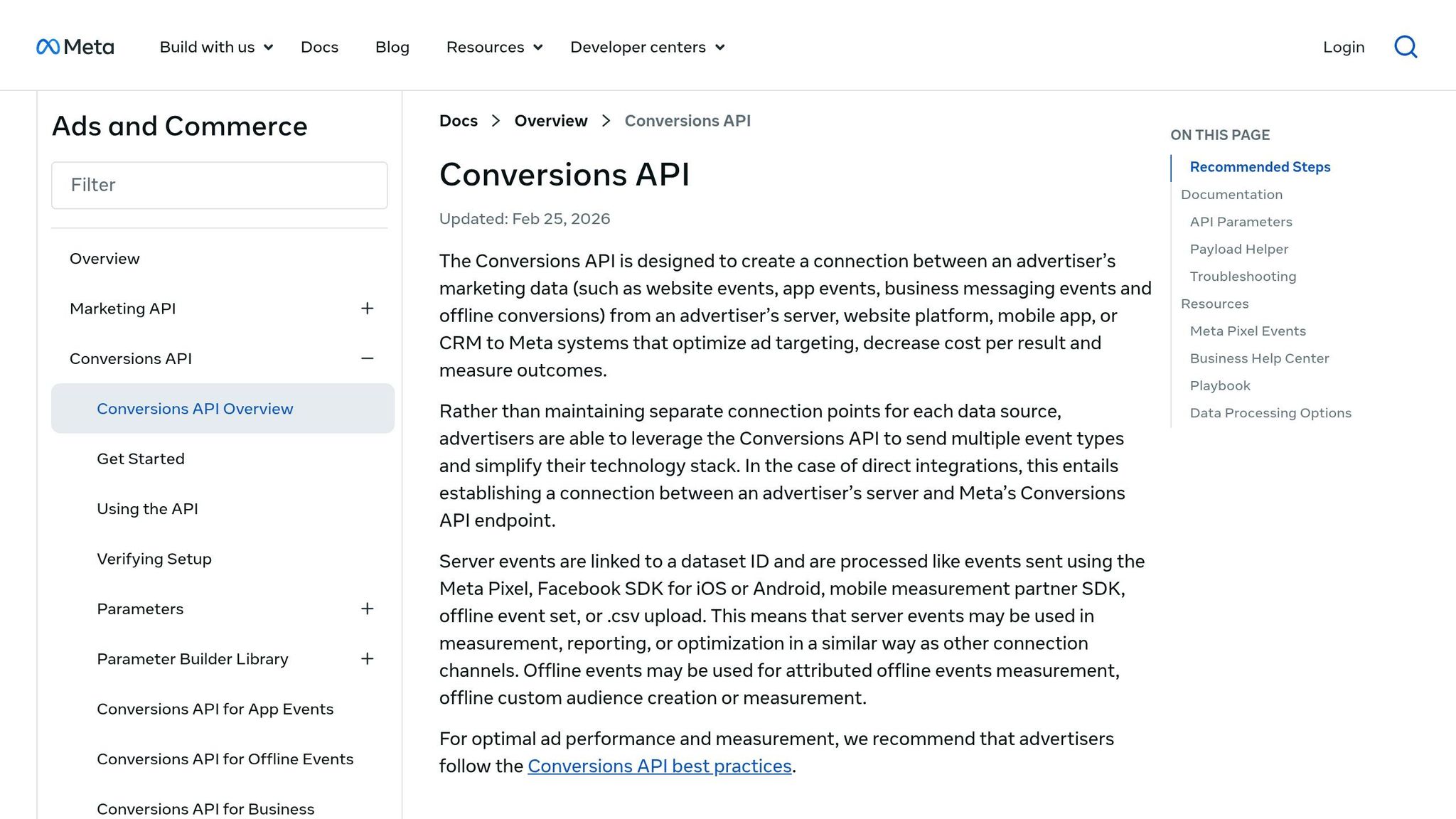
When users withhold consent under GDPR or opt out under CCPA/CPRA, Meta can't match clicks to conversions. Those events then move into Aggregated Event Measurement (AEM), which limits each domain to 8 prioritized conversion events. If an event sits lower on the list, it gets dropped.
Conversions API (CAPI) helps recover some browser-side loss by sending events from the server instead of the browser. But there’s still a hard limit here: if a user has opted out, Meta still can't attribute that person’s conversion at the individual level. In practice, a clean CAPI setup with deduplication often reports 10% to 20% more conversions than a pixel-only setup.
iOS tracking opt-in rates sit at about 25% to 35% globally, and Safari link protections make click-to-conversion matching even weaker.
So this isn’t just a tracking issue. It changes what Meta can tie back to ad clicks later, which then changes reporting.
How Meta Reporting Moved from Direct Tracking to Modeled Measurement
With fewer identifiers available, Meta now mixes observed conversions with modeled estimates when attribution signals are missing. That shift comes with tradeoffs. Reporting can lag by 24 to 72 hours, and a reported CPA can shift by double-digit percentages days after the first report, without any visible version flag. That means teams making same-day optimization calls are often working off partial numbers.
Feature | Pre-Privacy Reporting | Post-Privacy Reporting |
|---|---|---|
Signal type | Deterministic (user-level) | Aggregated and modeled (statistical estimates) |
Default window | Up to 28-day click/view | Max 7-day click / 1-day view (standard) |
Reporting lag | Near real-time | 24–72 hour lag for modeled events |
Reported conversions | Raw event counts | Blended observed and modeled totals |
That loss of signal is exactly what starts to show up in reported conversions, ROAS, and audience stability.
What Studies Show About Reporting Accuracy and Performance Metrics
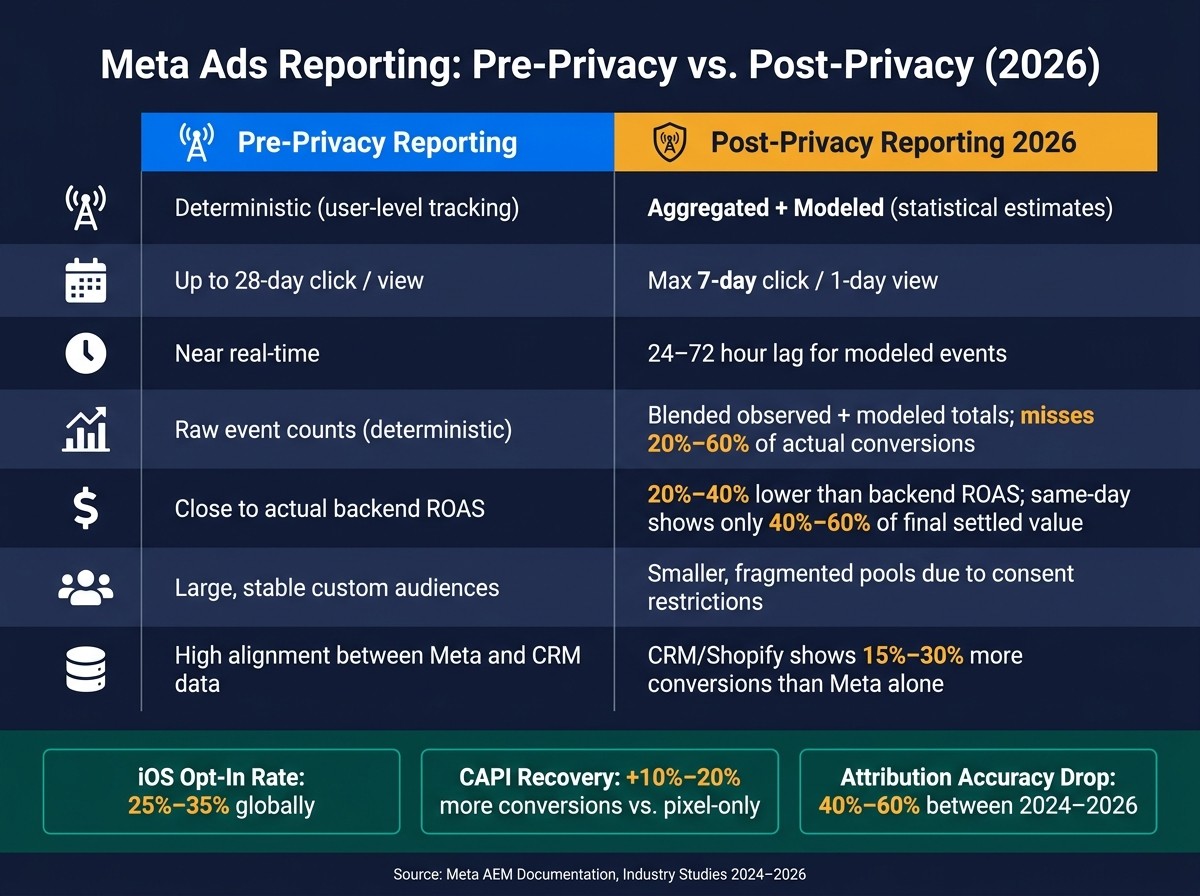
Meta Ads Reporting: Pre-Privacy vs. Post-Privacy Performance Metrics (2026)
Why Attributed Conversions and Reported ROAS Often Look Lower Than Actual Business Results
Studies estimate Meta reporting misses 20% to 60% of actual conversions because of privacy-driven signal loss. So a campaign can look weaker in Ads Manager than it is in the business itself.
Meta tries to fill those gaps with modeled estimates. That helps, but it also means reported results can change after they first appear.
There’s another catch. Meta’s modeling system needs time to process conversions affected by privacy limits, so same-day ROAS reports often show only 40% to 60% of the final settled data. If you judge performance too early, you’re often looking at an incomplete picture.
That gap shows up when teams compare Meta against real-time conversion tracking from CRM or Shopify data. In many cases, they find 15% to 30% more matched conversions than Meta-reported numbers alone.
The same signal loss doesn’t just affect reporting. It also shrinks audience pools and makes them less stable.
How Retargeting Audiences and Reach Became Less Stable in Privacy-Restricted Regions
Retargeting has gotten less stable in privacy-restricted regions. Audience matching is weaker, and reach tends to drop with it.
In plain English: fewer users can be tracked and matched the way they were before. That leaves retargeting pools smaller and more fragmented, which makes performance less steady from one campaign to the next.
Pre-Privacy vs. Post-Privacy Meta Reporting: Side-by-Side Comparison
These shifts show up most clearly in three areas: conversions, ROAS, and retargeting reach. The table below separates what Meta reports from what backend data usually shows.
Metric | Pre-Privacy | Post-Privacy (2026) | Practical Impact |
|---|---|---|---|
Attributed Conversions | Deterministic, pixel-based | Modeled via AEM; statistical estimates | Meta-reported conversions undercount actual sales; triangulate with backend data |
Reported ROAS | Closer to backend ROAS | Often lower than backend ROAS | 20%–40% lower visibility due to loss of click-level tracking; use Blended ROAS or MER instead |
Retargeting Audience Size | Large, stable custom audiences | Smaller, fragmented pools | Retargeting reach is restricted; broader audience strategies are needed |
How to Read Meta Ads Data Under Stricter Privacy Rules
When Ads Manager and your backend revenue don't match, the goal is simple: figure out what's actual signal and what's just modeling.
How to Account for Consent Bias and Gaps Between Platform Data and Backend Revenue
People who agree to tracking are only one slice of your customer base. That means Meta-reported conversions and ROAS reflect only part of the picture. Before you touch budgets, compare Meta-reported conversions against Shopify or CRM totals.
A useful check is the inflation ratio:
platform revenue ÷ backend revenue
If that ratio is above 1.5x, budget decisions are being shaped by shaky attribution. Research shows Meta over-reports conversions at a median of 134%, which equals 2.34x inflation. Put more plainly, for every $1.00 of ROAS Meta reports, only about $0.43 was actually caused by the ad.
For a cleaner read, look at Meta Pixel data, Conversions API data, and first-party CRM or Shopify events together instead of leaning on Ads Manager by itself.
You should also add a post-purchase survey question on the order confirmation page:
"Where did you first hear about us?"
That gives you self-reported attribution outside Meta's modeling. If Meta's claimed share is 30% higher than what customers report, modeling inflation is likely having a big effect.
Once you've pinned down the backend gap, the next move is to see whether it's tied to region or reporting lag.
Use Region Splits and Longer Reporting Windows
Split reporting by region, especially EU traffic versus non-EU traffic. Privacy rules don't hit every market the same way, so signal quality can vary a lot. In restricted regions, conversion volume will often be lower by design.
It's also smart to snapshot conversions at:
T+1
T+3
T+7
Treat same-day numbers as provisional. Modeled events can keep shifting for up to 7 days.
And watch year-over-year comparisons that cross January 12, 2026. That's when the 7-day and 28-day view windows were deprecated, which led to a 15% to 30% drop in reported conversions for most brands. If you ignore that change, your trend line can look worse than it is.
Measurement Methods in a Low-Signal Environment: Side-by-Side Comparison
Use the methods below as a hierarchy, not as a replacement for backend revenue.
Method | Strengths | Weaknesses | Data Requirements | Privacy Limitations |
|---|---|---|---|---|
Meta attribution | Real-time optimization signals | High inflation; includes modeled data | Meta Pixel / AEM | Heavily impacted by ATT and GDPR opt-outs |
Conversions API (CAPI) | Bypasses browser blocks; typically shows 15–25% more attributed conversions | Requires server-side setup; deduplication risks | Server-side event stream | Depends on first-party data match quality |
First-party CRM analytics | Revenue source of truth; no double-counting | Misses top-of-funnel view-through touchpoints | Backend sales data (Shopify, CRM, GA4) | Uses owned data |
Incrementality testing | Measures true causal impact; identifies budget waste | Requires high spend and holdout groups; not real-time | Geo-testing or randomized control groups | Aggregate data only |
Media mix modeling | Cross-channel view; no tracking pixels needed | Complex to build; requires historical data; slow to update | Aggregated spend and revenue data | No user-level data |
Attribution accuracy for Meta ads has declined by 40% to 60% between 2024 and 2026. That's why depending on one measurement source is risky. These checks give you a steadier base before making budget or creative calls.
What Advertisers Should Do Next
Strengthen Reporting with Privacy-Aligned Setup and Testing
After you measure the gap, fix the setup behind it.
Start with measurement hygiene. Keep EMQ above 6.0 and rank Purchase first in AEM. For budget decisions, lean on backend Blended ROAS or MER instead of platform ROAS. Then check incrementality with a geo-holdout test.
The idea is simple: if your setup is messy, your reporting will be messy too. And once that happens, every budget call gets harder than it needs to be.
Where AI Tools Can Help When Meta Reporting Signals Are Weaker
If signal quality is still weak after those setup fixes, automation can cut down on manual guesswork.
When signal quality drops, manual Meta optimization gets slower and less reliable. Tools like AdAmigo.ai can help by auditing account health, flagging anomalies, and automating tests or budget shifts through Meta's API.
That doesn't replace judgment. It just gives teams a cleaner way to spot problems and act on them without digging through every report by hand.
Key Reporting Lessons After GDPR and CCPA
Once reporting is more stable, use a simple rule for decision-making.
Treat Meta reporting as partial data and check it against first-party revenue. Use Ads Manager for within-channel optimization, and use your CRM or order management system as the source of truth.
FAQs
Why is Meta underreporting conversions now?
Meta is underreporting conversions because stricter privacy rules and signal loss limit how much data it can collect and report.
The big drivers are iOS 17 and later, shorter attribution windows, browser privacy protections, and regulatory changes. Put simply, Meta now sees less of the customer journey, so reported conversion data is often less complete and less accurate.
How much can CAPI improve Meta reporting?
CAPI can improve Meta reporting accuracy in a big way. It helps cut down on deduplication problems, improves signal quality, and gives you conversion data you can trust more.
That said, the biggest gains come when CAPI is set up properly and watched closely. A sloppy setup can muddy the data instead of cleaning it up.
Which data source should I trust most?
Rely on a data source that follows the privacy laws that apply to your business and gives you clear, audit-ready reporting.
For example, Secure Privacy's platform supports GDPR and CCPA. It also provides proof of consent and detailed compliance reports.